
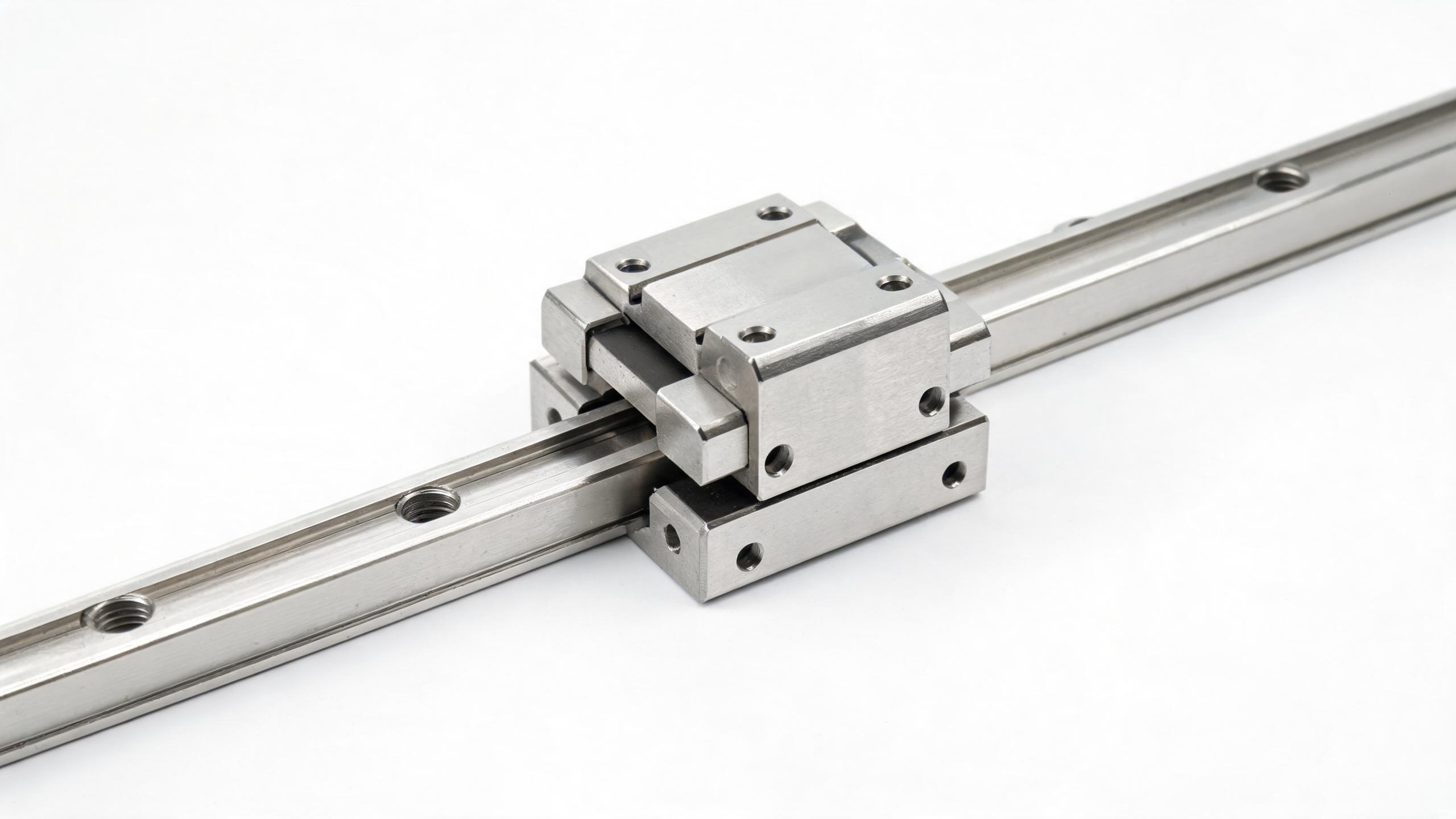
A practical, spec-first guide to MGN12 linear rails for B2B buyers. Covers dimensions, load ratings, preload classes, rail vs. carriage options, installation tolerances, and how to evaluate suppliers for precision instruments and compact automation.
BUYER GUIDE · LINEAR MOTION
MGN12 Linear Rail: Miniature Guide Selection for Precision Instruments and Compact Automation
If you are sourcing linear motion components for a small gantry, a laboratory instrument, or a compact pick-and-place axis, the MGN12 linear rail is likely on your shortlist. It is one of the most widely specified miniature profile rails in light automation. But "MGN12" is not a single part—it covers a family of rails and carriages with different widths, heights, preload classes, and accuracy grades. Ordering the wrong combination means rework, longer lead times, or a carriage that does not fit the rail.
This guide covers the dimensions, load ratings, and selection criteria that matter when buying MGN12 linear rails, linear guide sliders, and sliding linear bearings for precision equipment. It is written for engineers and purchasing teams who need to confirm specifications before placing an order.
- MGN12 refers to a 12 mm rail width family—confirm rail length, carriage type (short vs. long), and preload before ordering.
- Basic dynamic load rating for the standard MGN12 carriage is approximately 3.9 kN; the long carriage (MGN12H) is rated higher, around 5.1 kN.
- Accuracy grades (C, H, P) and preload classes (ZF, Z0, Z1) determine running accuracy and rigidity—match them to your application, not to the cheapest option.
- Mounting surface flatness and screw torque matter as much as the rail itself; a good rail on a poor surface will not run true.
- Ask suppliers for material grade, hardness (typically HRC 58–62 on the raceway), and straightness data in writing.
What Exactly Is an MGN12 Linear Rail?
The MGN12 is a miniature linear guide system. It consists of a hardened steel rail with ground raceways and a carriage (also called a block or slider) that recirculates steel balls between the rail and the carriage. The balls carry the load and allow low-friction linear motion.
The "12" refers to the nominal rail width: 12 mm. The rail itself is narrower than the carriage, which is typical for this guide series. The standard carriage is designated MGN12C (short) and the long version MGN12H (high-load, longer carriage). Both fit the same rail profile, but they have different load capacities and moment rigidity.
This guide type is commonly paired with a sliding linear bearing in applications where space is tight but accuracy is still required. It is not a heavy-duty machine tool guide—it is designed for light loads, smooth motion, and compact envelopes.
Key Dimensions and Specifications
Before comparing suppliers, you need the basic geometry. The MGN12 rail and carriage dimensions are standardized across most manufacturers, but always confirm with the supplier's datasheet—do not assume interchangeability without checking.
| Parameter | MGN12C (Standard) | MGN12H (Long) |
|---|---|---|
| Rail width (W) | 12 mm | 12 mm |
| Rail height (H1) | 8 mm | 8 mm |
| Carriage width (W1) | 27 mm | 27 mm |
| Carriage length (L) | 34.7 mm | 48.1 mm |
| Carriage height (H) | 10 mm | 10 mm |
| Basic dynamic load rating (C) | ≈ 3.9 kN | ≈ 5.1 kN |
| Basic static load rating (C0) | ≈ 5.1 kN | ≈ 6.8 kN |
| Mounting hole pitch (rail) | 25 mm (typical) | 25 mm (typical) |
These numbers are typical for standard-grade MGN12 products. Confirm exact values with your supplier, as some manufacturers optimize the internal ball count or raceway geometry slightly differently.
Accuracy Grades: What Do C, H, and P Mean?
Miniature linear guides are classified by running accuracy. The most common grades for MGN12 are:
- Normal (C): Suitable for general automation, dispensing, and light assembly. Running parallelism is typically within a few microns per 100 mm of travel.
- High (H): Tighter tolerances, used in measuring equipment, optical stages, and semiconductor handling.
- Precision (P): The tightest standard grade, for precision instruments, inspection machines, and high-end pick-and-place.
The accuracy grade affects the height and width tolerance of the carriage relative to the rail, as well as the running parallelism. For a precision instrument, do not default to grade C just because the load is light. The load is not the only consideration—the positioning repeatability and straightness of travel matter more.
Preload Classes: ZF, Z0, Z1
Preload removes internal clearance between the balls and raceways. It increases rigidity and reduces vibration, but it also increases friction and requires a more accurate mounting surface.
- ZF (clearance): Slight negative preload, lowest friction. For applications where smoothness matters more than rigidity, and where the load direction is consistent.
- Z0 (light preload): The most common choice. Balances rigidity and friction. Suitable for most general automation and light precision applications.
- Z1 (medium preload): Higher rigidity, higher friction. For applications with overturning moments or where deflection must be minimized.
For an MGN12 in a compact gantry or a small Z-axis, Z0 is usually the right starting point. If you are mounting the rail vertically or hanging the load, discuss preload with the supplier—the load direction affects the effective rigidity.
MGN12 vs. Other Miniature Guides
Buyers often compare the MGN12 with the MGN9 (9 mm rail width) and the MGN15 (15 mm). The choice is driven by load, envelope, and moment requirements.
| Criteria | MGN9 | MGN12 | MGN15 |
|---|---|---|---|
| Rail width | 9 mm | 12 mm | 15 mm |
| Typical dynamic load (short carriage) | ≈ 2.2 kN | ≈ 3.9 kN | ≈ 6.2 kN |
| Carriage width | 20 mm | 27 mm | 32 mm |
| Best for | Very tight spaces, light sensors | Compact automation, precision instruments | Heavier loads, small gantries |
If your design has significant overhang (a load cantilevered off the carriage), the moment capacity of the MGN12H long carriage is often a better fit than the short MGN12C, even if the vertical load is small. Moment loads are frequently underestimated in miniature guide selection.
Rail Length and Mounting Considerations
MGN12 rails are typically available in lengths from 100 mm to 1000 mm, with custom lengths cut to order. The rail has counterbored mounting holes at a standard pitch (often 25 mm). When specifying length, confirm:
- Total travel required (the distance the carriage must move).
- Carriage length (the long carriage needs more rail to travel the same distance).
- End clearance (you need some rail beyond the carriage at both ends of travel).
A common mistake is ordering a rail exactly equal to the required travel. The carriage overhangs the rail at the ends of its stroke, so you need additional rail length on both sides.
Mounting Surface and Installation
The MGN12 is forgiving in light-duty applications, but for precision work, the mounting surface matters. Key requirements:
- Flatness: The mounting surface should be flat within a few microns over the rail length. A warped surface will distort the rail and cause binding.
- Parallelism: If two rails are used in parallel (common for a gantry), the distance between them must be controlled. The second rail is usually the "floating" side, with one rail guiding and the other supporting.
- Screw torque: Use the recommended torque for M3 or M4 mounting screws. Over-tightening distorts the rail; under-tightening allows movement.
- Reference edge: Use the machined side of the rail as the datum. Push the rail against a straight reference edge during installation for best straightness.
How to Evaluate a Supplier for MGN12 Rails
When you are sourcing from overseas, the datasheet is only part of the story. Ask these questions before committing to a supplier:
- What is the material and hardness? The rail and carriage should be bearing steel, typically GCr15 (equivalent to 52100), hardened to HRC 58–62 on the raceway. Ask for the hardness test report.
- What is the straightness tolerance? For a 500 mm rail, a good supplier will specify straightness in microns. If they cannot state a number, that is a red flag.
- What is the surface finish? The raceway grind finish affects noise and smoothness. Ask about Ra values.
- Are the rails and carriages matched? Carriages and rails are often lapped or matched in production. Interchangeable parts are fine for general use, but for precision grades, matched sets are better.
- What is the lead time for custom lengths? Miniature rails are often cut to length. Confirm whether custom lengths require a minimum order quantity (MOQ) and how long the lead time is.
- Material grade and hardness test report (HRC 58–62 typical)
- Straightness and running parallelism data in microns
- Accuracy grade (C/H/P) and preload class (ZF/Z0/Z1) clearly stated
- Mounting hole pitch and counterbore depth for your screw size
- MOQ and lead time for custom rail lengths
- Packaging method—rails must ship flat, not coiled or bent
Common Applications for MGN12 Linear Rails
The MGN12 is a workhorse in light automation and precision equipment. Typical uses include:
- Laboratory instruments: Pipetting systems, sample handlers, and microplate readers where smooth, repeatable motion is required.
- Compact gantries: Small XYZ stages for dispensing, soldering, or inspection.
- Optical systems: Focus stages and filter wheels where straightness of travel affects image quality.
- Medical devices: Small linear actuators in diagnostic equipment.
- 3D printers and light CNC: The MGN12 is a common upgrade for motion axes in desktop machines.
In all these cases, the linear guide slider carries the load and the sliding linear bearing provides the low-friction motion. The combination of small size, reasonable load capacity, and good accuracy makes the MGN12 a default choice.
FAQ: MGN12 Linear Rail
Q: Can I mix an MGN12C carriage with an MGN12H carriage on the same rail? A: Both fit the same rail profile, but the preload and accuracy grades must match. Mixing carriages from different accuracy classes on one rail is not recommended for precision applications.
Q: What is the difference between a linear guide slider and a sliding linear bearing? A: In practice, the terms are often used interchangeably for miniature guides. A linear guide slider usually refers to the carriage/block that rides on a profile rail. A sliding linear bearing can refer to a plain bearing (no recirculating balls) or a bushing. For the MGN12, you are dealing with a recirculating ball type.
Q: How much travel can I get from an MGN12 rail? A: Rail lengths up to 1000 mm are common, but for longer travels, consider a larger guide. The MGN12 is best suited for strokes under 600–800 mm where rigidity and accuracy are maintained.
Q: Do I need lubrication? A: Yes. The rails ship with a light anti-rust oil. For running, apply a lithium-based grease or the supplier's recommended lubricant. Relubrication intervals depend on duty cycle and environment.
Q: Can the MGN12 handle vertical mounting? A: Yes, but vertical mounting changes the load distribution. Confirm the preload and consider the moment load on the carriage. Discuss this with the supplier if the load is significant.
Final Recommendations
For precision instruments and compact automation, the MGN12 linear rail is a solid, proven choice. The selection process comes down to three decisions:
- Carriage type: MGN12C for standard loads, MGN12H for higher load or moment capacity.
- Accuracy grade: C for general automation, H or P for precision instruments.
- Preload: Z0 as the default, Z1 for higher rigidity, ZF for lowest friction.
Then confirm the rail length, mounting hole pattern, and the supplier's quality documentation. If you are sourcing from a new supplier, request a sample or a small pilot order before committing to volume. Verify the straightness and running smoothness on your own fixture—datasheets are a starting point, not a guarantee.
If you need help selecting the right MGN12 configuration for your application, or if you need custom rail lengths and matched sets, contact us with your load, travel, and accuracy requirements. We will confirm the specifications and lead time before you place an order.