
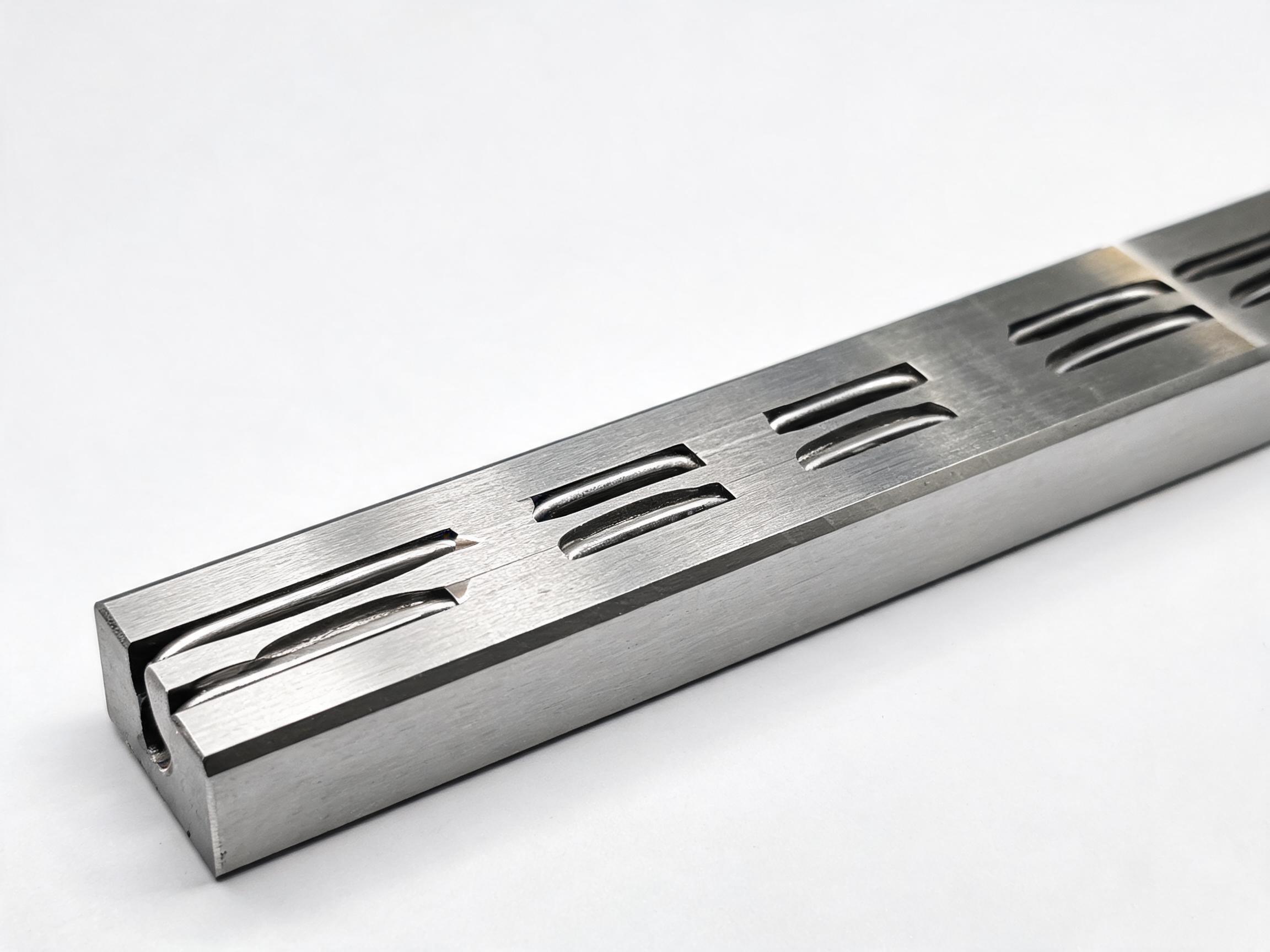
A buyer's comparison of the three linear rail families — HGR profile guideways, SBR/SBS round-shaft units and EGH/MGN miniature rails — on load capacity, envelope height, frame material, rail length limits and cost trade-offs, with a selection checklist.
Linear Motion Selection
Picking a linear rail family before you have settled the carriage load, the mounting height and the frame material is the usual reason a first design gets reworked. The three families below are not interchangeable steps on a quality ladder — they solve different envelope and load problems. What follows compares them on the numbers that actually drive the decision.
Key takeaways
- Profile rails (HGR) carry the highest load per rail and are hardened steel through the raceway; they are the default for machine tools, gantries and heavy tooling plates.
- Round-shaft units (SBR) bolt a hardened shaft onto an anodized aluminum support rail, so the frame can be lighter and the mounting is simpler than a machined pad.
- Miniature rails (EGH/MGN) exist to shrink the envelope — rail widths from 9 to 15 mm — not to match profile-rail loads.
- Rail length limits differ enough to rule a family out early: 4000 mm for HGR, 3000 mm for SBR, 1000 mm for EGH, 500 mm for the SBS16 slide unit.
What separates the three families
The physical difference is how the raceway is created. A profile guideway is a single hardened steel rail with a machined and ground track; the carriage rides that track directly. A round-shaft unit is a shaft supported along its length by an aluminum extrusion, and separate bearing blocks slide on the shaft. A miniature rail is a profile rail scaled down, with the same basic architecture but a much smaller rail cross-section.
That difference drives everything a buyer cares about: where the load goes, how tall the assembly sits above the mounting surface, what the frame has to be made of, and how far the rail can span before deflection or manufacturing length becomes the constraint.
Profile guideway rails (HGR)
The HGR series is built from 55# high-carbon steel with an induction-hardened raceway at 58–62 HRC. Sizes run from HGR15 to HGR45, and rails are supplied in two accuracy classes: ground H (P5) and rolled N (P7). Maximum standard length is 4000 mm.
Load capacity is the reason most buyers arrive here. A single HGR20 carriage is rated at 16.7 kN dynamic — that is a per-carriage rating. It is what allows a gantry to carry a spindle head or a tooling plate without adding a second rail pair purely to distribute load.
The two accuracy grades are a cost lever, not a quality hierarchy. Ground H suits applications where the carriage position must be tight against a reference — measuring axes, precision positioning. Rolled N covers the many cases where the rail simply has to guide a load smoothly along a straight line. Specifying P5 everywhere raises cost without improving the machine where the tolerance is not needed.
Because the rail is hardened steel and the carriage runs on a machined track, the mounting surface has to be flat and rigid. A profile rail does not forgive a soft or twisted frame. See the HGR heavy-duty guideway rail for the size and grade range.
Round-shaft support units (SBR and SBS)
Round-shaft units put the hardened shaft on top of an aluminum support rather than machining a track into the frame. The SBR20 unit uses a 20 mm GCr15 shaft on an anodized 6063-T5 aluminum support rail, with dual bearing blocks. Each block is rated at 11.2 kN dynamic, and with the dual-block configuration the assembly totals 22.4 kN per axis. Maximum standard length is 3000 mm.
Two consequences follow. First, the aluminum support rail is light, which matters on moving frames, cantilevered arms and machines where the structure itself travels. Second, the shaft is a standard ground bar — the support extrusion takes care of straightness and stiffness along the span. The mounting surface does not need a ground pad in the way a profile rail does.
The trade-off is height and bulk. A supported shaft assembly stands noticeably taller than a profile rail of comparable load, and the bearing blocks wrap around the shaft rather than sitting beside it. For a machine with a generous vertical envelope and a fabricated frame, that is usually acceptable. For a compact one, it is often not.
For low-profile cases there is a second round-shaft route. The SBS16 slide unit uses a 16 mm shaft and keeps the total system height to 18 mm, with 5.2 kN dynamic rating and standard lengths of 150–500 mm. That combination suits short-travel, low-clearance axes where a full SBR assembly would not fit. Both are worth reviewing together: SBR20 dual-block unit and SBS16 low-profile slide unit.
Miniature rails (EGH and MGN)
The EGH miniature guideway covers rail widths of 9–15 mm and runs a two-row Gothic-arch circuit. The EGH15CA carriage is rated 5.5 kN dynamic and 9.2 kN static. It is supplied in P5 ground only, with a maximum rail length of 1000 mm.
The Gothic-arch geometry is there to give the small carriage load capacity in more than one direction without a wide rail. It also means the miniature family is the right answer when the constraint is envelope, not force — compact pick-and-place heads, small inspection stages, desktop automation, laboratory fixtures.
The length limit is the practical boundary. At 1000 mm maximum rail length, an EGH rail is not a substitute for a long-travel axis even if the load would theoretically allow it. If the axis needs to run further, the design has to move up to a profile rail. The EGH miniature guideway rail and carriage page lists the width and accuracy options. An MGN stainless miniature series is also available where a stainless rail is preferred.
Side-by-side comparison
| Family | Load reference | Envelope / height note | Frame material fit | Max standard length |
|---|---|---|---|---|
| HGR profile guideway | 16.7 kN dynamic per carriage (HGR20) | Lowest profile of the three at a given load; needs a flat, rigid mounting pad | Cast iron, steel, or a rigid machined aluminum structure | 4000 mm |
| SBR round-shaft support unit | 11.2 kN dynamic per block; 22.4 kN per axis with dual blocks (SBR20) | Taller assembly; shaft sits on a support extrusion | Fabricated steel or aluminum frames; light support rail reduces moving mass | 3000 mm |
| SBS low-profile slide unit | 5.2 kN dynamic (SBS16) | 18 mm total system height | Compact frames with limited vertical clearance | 500 mm |
| EGH miniature guideway | 5.5 kN dynamic / 9.2 kN static (EGH15CA) | Rail widths 9–15 mm; smallest envelope | Small machined plates and compact aluminum structures | 1000 mm |
Load figures are per carriage or per block as stated and are taken from the standard product data for the named models. The families are counted differently — profile-rail ratings are per carriage, round-shaft ratings are per block — so never compare a dual-block total against a single-carriage rating directly. Compare at the same block count and check load distribution across the blocks for your mounting geometry with the supplier.
Where cost actually moves
Buyers often assume the profile rail is always the expensive option. It is not, once the whole assembly is counted. A round-shaft unit bundles the shaft, the support rail and the bearing blocks into one part number, but the aluminum extrusion adds a component and the assembly is taller. A profile rail is a single hardened part, but it demands a machined, flat mounting surface — and that machining has its own cost.
Within the profile family, the accuracy grade is the clearest cost control. Rolled N covers straight guidance; ground H is for the axes that need it. Within the round-shaft family, choose between the full SBR assembly and the low-profile SBS16 based on clearance, not on price alone — they solve different envelope problems.
Rail length is a second cost variable. Ordering a 4000 mm HGR rail for a 1200 mm travel axis buys material you will cut and scrap. Specify the length the axis needs.
Selection checklist
- Start with the load per carriage. If a single carriage needs to carry more than the miniature or low-profile range provides, the choice is already between HGR and SBR.
- Measure the vertical envelope. If the total assembly height must stay in the 18 mm class, the SBS16 slide unit is the starting point before anything else.
- Check the required travel against the length limit. Over 1000 mm rules out EGH; over 3000 mm rules out SBR; over 4000 mm means more than one rail length or a different architecture.
- Look at the frame you can actually build. A profile rail needs a flat, rigid, machinable pad. A fabricated or lighter frame points toward a supported shaft.
- Decide the accuracy requirement per axis. Ground H (P5) for positioning axes; rolled N (P7) where straight guidance is enough.
- Confirm environment. Where a stainless rail is preferred, the MGN stainless miniature series is available; for the larger families, confirm the surface treatment you need with the supplier.
If two families still fit after this list, the deciding factor is usually the frame: whichever rail the existing structure can mount without re-machining is the cheaper route in practice. Send the load per carriage, travel length, mounting height limit and frame material, and the rail family and size can be narrowed from there.