
A vertical Z axis is not a horizontal axis turned upright. Gravity turns the payload into a permanent bearing load, drains lubricant away from the rolling contact, and keeps pulling when the drive stops. This engineering checklist covers what to specify — rail lubrication, screw pre-load and rigidity, holding strategy — and what to confirm with the supplier before the order is placed.
The short version: on a vertical Z axis, the load never leaves the bearing. Gravity keeps the carriage pressed against the guides and the screw nut loaded in one direction, lubricant migrates down and out of the contact zone, and if holding is not designed in, the axis is held only by whatever the drive happens to resist. Specify all three before you compare price.
A linear motion system Z axis is often specified by taking a horizontal stage layout and rotating the drawing ninety degrees. The components may be the same family, but the load case is not. On a horizontal axis the payload rests on the carriage; on a vertical axis it hangs from it. That single change alters rail loading, lubrication behaviour, screw pre-load requirements and — most often overlooked — what happens when the motor is de-energised.
This checklist is written for machine builders who are selecting linear guides and screws for a vertical axis, and who want to know which questions to put to the supplier before committing to an order.
What this article covers
- How gravity changes the load case on guides and screws
- Why lubrication drains and what retains it
- Holding the load: a design requirement, not an accessory
- Pre-load, rigidity and screw selection for vertical drives
- A pre-order confirmation list for the supplier
Gravity turns the payload into a permanent stress
On a vertical axis the moving mass is supported in a way that keeps the rolling elements under load at all times. Three consequences follow directly.
The guide blocks see a constant radial load
With the carriage hanging from the rail, the payload acts as a radial load on the block, and its position relative to the rail matters. A centre of mass offset from the rail face adds a moment that loads the blocks unevenly — front and rear blocks in a four-block carriage carry different shares. Even at standstill, with no acceleration, that load does not relax. A horizontal axis with the same mass may see almost no radial load at rest; the vertical one sees the full weight continuously.
Duty cycle assumptions change
Static and near-static dwell periods are common on vertical axes — a lift holding a tool at height, a gantry waiting for the next part. Those dwells count toward the time the rolling contact spends loaded in the same position. When you describe the application to the supplier, include the dwell pattern, not only the number of strokes per hour.
The screw nut is loaded in one direction almost permanently
A ball screw on a vertical axis carries the payload axially whether it is moving up, moving down or stopped. The nut is not alternately loaded and unloaded the way a reversing horizontal screw can be. That makes axial rigidity and pre-load class more relevant than on a comparable horizontal application, and it makes any axial clearance in the nut assembly visible as lost motion or position droop under load — which is why the supplier should be asked to state the rated axial rigidity under the pre-load class you order, and how loaded-position accuracy should be verified on your machine.
Lubrication drains away from the contact zone
Grease applied to a horizontal guide tends to stay near where it was applied. On a vertical rail, the same grease films down the rail face under gravity, and oil separated from the grease follows it. Over a long re-greasing interval the upper portion of the rail can run drier than the lower portion, even though the same amount of lubricant was applied to both.
What retains a film between intervals
Rail geometry is the practical lever here. The HGR profile rail carries a continuous oil-groove channel along the rail body. The groove helps retain lubricant along the running length rather than letting it leave the contact zone vertically — precisely the condition a vertical-axis installation creates. How much film is actually retained still depends on the grease grade, the re-greasing interval, the load and the stroke speed, so the upper rail section should be checked at the supplier-recommended interval rather than assumed dry or wet. For a Z axis with long dwell periods or infrequent maintenance access, that channel is worth specifying rather than treating rails as interchangeable.
Re-greasing practice on a vertical axis
- Check where the lubricant port actually sits on the block and whether it is reachable with the axis installed in the machine frame.
- Confirm the grease grade recommended for the application temperature and stroke speed with the supplier; a grade chosen for a horizontal axis may not suit a vertical one with high dwell time.
- Treat the top of the stroke as the critical zone. If the upper rail section dries first, that is where wear and stick-slip will appear.
Ball screws have the same problem in a different form. Grease on a vertical screw nut tends to work downward. The SFU1605 rolled ball screw, for example, carries a lubrication port on the nut body for grease or oil maintenance — a detail worth checking against your maintenance plan, because on a vertical installation the port orientation should allow the lubricant to be introduced at the top of the nut rather than below it.
Holding the load matters as much as moving it
An axis that lifts a load must also decide what keeps the load in place when the drive is not actively positioning. This is a design decision, and it has to be made early because it changes the screw pre-load, the motor choice and the machine's safety concept.
Questions to settle before selecting components
- What happens on power loss? A load held only by the drive will move when the drive releases. If that is not acceptable, a mechanical holding element is needed. Ask the supplier what holding or brake options are available for the screw and motor configuration you are considering.
- Is the holding device part of the screw assembly or the motor? Both are used; the answer changes the envelope, the wiring and the maintenance access.
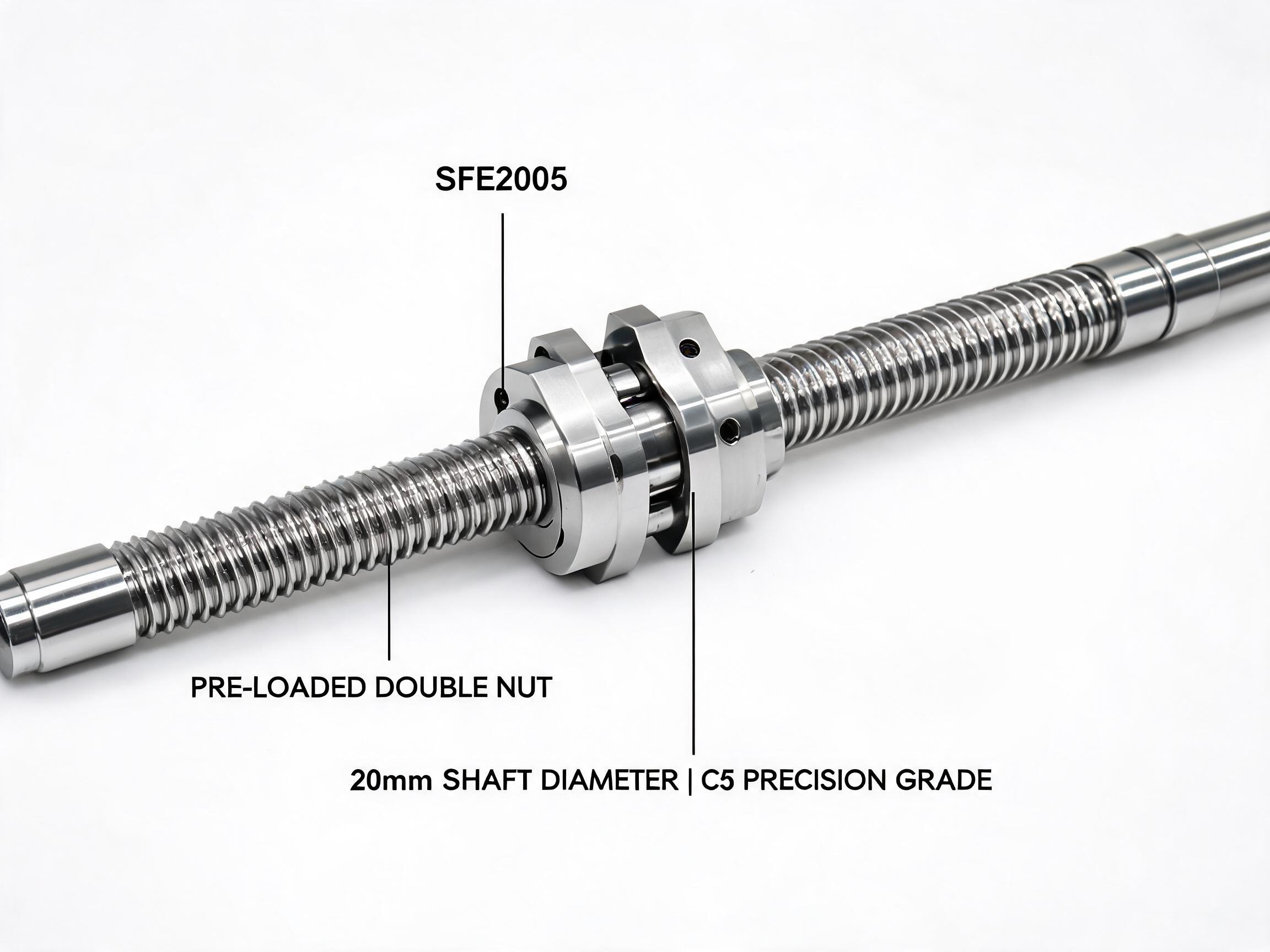
- Does the pre-load class support the holding strategy? A pre-loaded double nut reduces axial play, but it is not a substitute for a brake. Keep the two functions separate in your reasoning.
- What does the load do during a controlled stop? Deceleration on a downward move adds to the axial load; the screw and nut must be able to take that combined load, not just the static weight.
Do not specify holding torque from a catalogue guess
Brake and holding torque figures, motor sizing and cycle-life estimates depend on the specific drive, gearing and load case, and they should be confirmed against the actual supplier's data for the part you will receive — not inferred from a generic table or carried over from a different axis on the same machine.
Pre-load, rigidity and screw selection for vertical drives
Two screw families cover most vertical-axis requirements, and the choice is usually about duty and precision rather than about orientation alone.
| Consideration | SFE series (ground) | SFU series (rolled) |
|---|---|---|
| Construction | Ground screw, pre-loaded double nut | Rolled screw, lubrication port on nut body |
| Stated axial rigidity | Up to 280 N/µm under rated pre-load (SFE2005) | Not stated in the product record |
| Supplier-stated use | Vertical axis and high-duty-cycle applications | Horizontal and vertical axis use |
| Pre-load class | Light or medium, specified at order | Confirm with supplier |
| Maintenance access | Confirm grease point for your mounting | Lubrication port on the nut body |
The SFE series ground ball screw assembly is the direct answer when the vertical axis must hold position repeatably under a hanging load and run at high duty cycle. The SFE2005, with a 20 mm shaft and C5 precision grade, is rated for axial rigidity up to 280 N/µm under rated pre-load — a figure that matters on a vertical axis because the nut is loaded in one direction almost continuously, so any compliance in the nut shows up directly as position variation under load.
The SFU series rolled ball screw assembly is the practical choice for vertical axes where the duty is lighter and the priority is a cost-effective, serviceable drive. The SFU1605 is stated by the supplier as suitable for both horizontal and vertical use, and it carries its lubrication port on the nut body, which simplifies maintenance planning on a vertical installation.
Whichever family you select, pre-load class is an order-line item on the SFE series: choose between the light and medium classes to match the holding strategy and the axial load, rather than defaulting to the tighter of the two.
For the guide side, the HGR series heavy-duty linear guideway rail is worth reviewing for vertical axes specifically because of the continuous oil-groove channel along the rail body described above.
Pre-order confirmation checklist
Work through these with the supplier before the purchase order is issued. Each one changes either the part number or the machine design, and most are cheaper to resolve now than after delivery.
Load and motion
- Moving mass, plus tool or fixture mass, and the height of its centre of gravity relative to the rail face.
- Stroke length and the dwell pattern at the top and bottom of travel.
- Acceleration and deceleration on the downward move, which adds to the axial load.
- Any side or moment loads from the tool, cutting force or cable management.
Holding and safety
- Behaviour required on power loss, and whether a mechanical holding element is needed.
- Available holding or brake options for the selected screw and motor configuration.
- Whether the holding device is mounted on the screw or the motor, and how that affects the envelope and wiring.
- How the axis will be locked out during maintenance.
Lubrication and maintenance
- Rail geometry: confirm whether the rail carries an oil-groove channel.
- Lubrication port position on the nut and block, and whether it is reachable after assembly.
- Recommended grease or oil grade for the application temperature and duty.
- Re-greasing interval and how the upper section of the rail will be checked.
Specification lines to state explicitly
- Screw family, diameter, lead and precision grade.
- Pre-load class (light or medium on the SFE series) and the axial load it is intended for.
- Mounting orientation on the drawing, so the supplier reviews the same vertical configuration you will build.
- Any interface dimensions, end machining and bearing support details that affect axial rigidity at the fixed end.
Frequently asked questions
Can a horizontal-axis linear guide be used on a vertical Z axis?
The rail and block families are not inherently restricted to one orientation, but the load case differs: on a vertical axis the payload is a constant radial load and the blocks never fully unload. Review the actual radial and moment loads with the supplier against the block configuration you plan to use, and include dwell time in the duty description.
Is a pre-loaded double nut enough to hold a vertical load?
No. Pre-load removes axial play and raises rigidity; it does not hold a load against gravity when the drive is de-energised. Holding is a separate design decision, and it should be confirmed with the supplier along with whatever brake or holding options they offer.
Why does a vertical rail need different lubrication attention?
Lubricant migrates downward under gravity, so the upper running length can dry out before the lower one. A rail with a continuous oil-groove channel helps retain a film along the rail body between re-greasing intervals — the actual result still depends on grease grade, interval, load and speed, so the upper section should be checked at the supplier-recommended interval rather than treated as interchangeable with any rail.
Which screw should I start with for a vertical axis?
If the axis must hold position repeatably under a hanging load at high duty cycle, start with the ground SFE series and specify pre-load class at order. If duty is lighter and serviceability and cost are the priority, the rolled SFU series is stated as suitable for vertical use and carries its lubrication port on the nut body. Confirm the final selection against your load, holding strategy and re-greasing plan.
If you are designing a vertical Z axis and want the rail and screw selection reviewed against your load case, send the moving mass, stroke, centre-of-gravity offset, dwell pattern and power-loss requirement. Those five inputs are enough to check the guide and screw proposal against the conditions the axis will actually run in.