
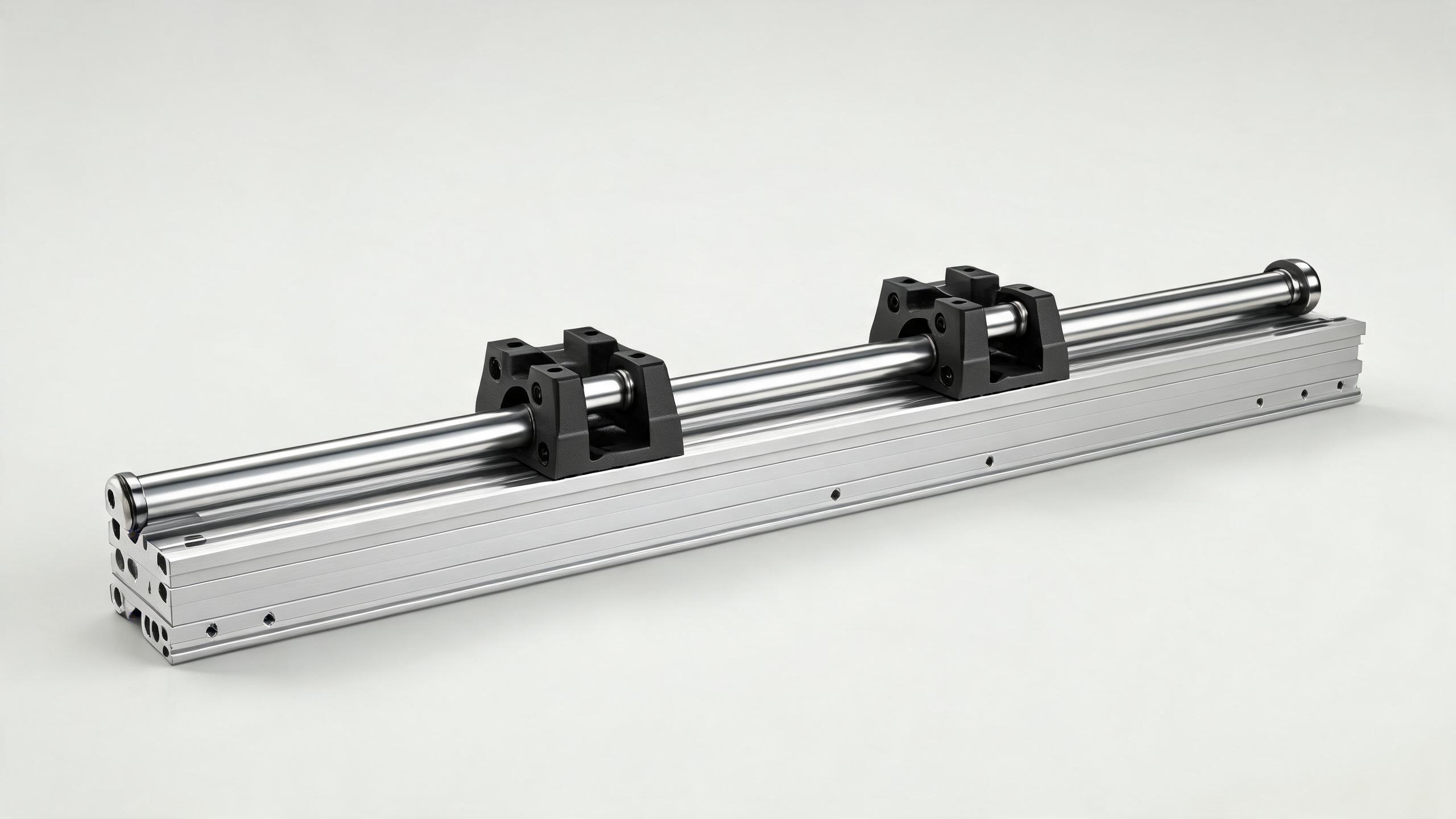
A practical buyer's guide to BSH miniature ground ball screws—covering what distinguishes a ground screw from a rolled one, how to read lead accuracy and preload specs, and how to match a compact ball and screw linear actuator to real small automation tasks like dispensing, vision inspection, and lab instrumentation.
BUYER GUIDE · MOTION CONTROL
Why miniature ground ball screws are a different category
When a design engineer specifies a ball and screw linear actuator for a compact machine, the first question is usually about size—diameter, stroke, overall length. But the second question, the one that separates a reliable motion axis from a recurring field-service problem, is about how the screw thread was manufactured.
Miniature ball screws below 16 mm diameter are typically made by one of two processes: rolling or grinding. Rolled screws are fast to produce and cost less per unit. Ground screws start from a hardened blank and the thread profile is machined with a grinding wheel to a controlled geometry. That extra step changes several engineering properties at once: lead accuracy, surface finish, dimensional consistency, and the usable life of the nut under load.
For a compact axis running at moderate speed with light loads—say 5 kg or less—a rolled screw is often acceptable. But when the application requires repeatable positioning in the micron range, smooth low-speed motion, or a long service life in a dirty environment, a ground ball screw is the more predictable choice.
- Ground screws give you lead accuracy in the ±5 µm/300 mm class; rolled screws typically land at ±50 µm/300 mm or worse.
- Miniature ground screws are available from 6 mm to 16 mm diameter—the range that covers most small automation axes.
- Preload class, lead, and nut style matter as much as diameter when selecting a ball and screw linear actuator.
- If your machine is exported or CE-marked, ask the supplier for material certificates and a lead measurement report.
What "BSH miniature" actually means in practice
The BSH series refers to miniature ground ball screws designed for compact linear motion assemblies. They are typically supplied with a precision-ground thread, a flanged or cylindrical nut, and an optional wiper. The "miniature" label is not a marketing term—it reflects a physical envelope: shaft diameters from roughly 6 mm to 16 mm, with leads from 1 mm to 10 mm.
Because the screw is ground, the supplier can hold the lead error to a tight tolerance across the full travel. That matters when the screw drives a linear screw drive used for focusing, dispensing, or metering—applications where a few microns of positional error directly affects product quality.
How to read the specifications that matter
When comparing miniature ground ball screws from different suppliers, focus on five numbers. They will tell you more than any brochure language.
| Parameter | What it controls | Typical value to look for |
|---|---|---|
| Shaft diameter (d) | Stiffness, critical speed, load capacity | 6–16 mm for miniature class |
| Lead (P) | Travel per revolution, resolution, max speed | 1–10 mm; choose by speed vs. resolution trade-off |
| Lead accuracy grade | Positioning repeatability | C5 or better for ground screws |
| Preload (N) | Axial backlash, rigidity | Light preload for general use; medium for high-stiffness axes |
| Dynamic load rating (Ca) | Service life under load | Check the supplier's table for your load and speed |
Do not assume a higher preload is always better. Over-preloading a miniature screw increases drag torque and heat, which can reduce the effective life of the nut in a compact assembly. The right preload is the one that removes backlash without creating excessive friction.
Selecting a ball and screw linear actuator for small automation
A ball and screw linear actuator is a complete assembly: screw, nut, and usually a housing or carriage. For small automation, the selection process is not about picking the cheapest screw—it is about matching the screw's characteristics to the motion profile of the machine.
Consider these application types and what they demand from the screw:
- Dispensing and metering: Requires smooth motion at low speed, often with a short stroke. A ground screw with a small lead (1–2 mm) gives fine resolution without needing a high-ratio gearbox.
- Vision inspection and focusing: Needs micron-level repeatability and minimal backlash. A preloaded ground nut is the standard choice.
- Pick-and-place and light assembly: Demands speed and moderate accuracy. A lead of 5–10 mm on a 12–16 mm screw keeps cycle times low while retaining acceptable resolution.
- Lab instrumentation and medical devices: Requires quiet operation, clean running, and long life. Ground screws with wipers and low-friction seals are preferred.
For each case, verify the critical speed of the screw at your maximum rpm. A long, thin screw can whip at high speed, which limits the usable travel. If your stroke is long relative to the diameter, consider a larger shaft or a supported design.
Ground vs. rolled: a practical comparison
If you are evaluating whether to step up to a ground screw, the table below summarizes the trade-offs in terms a procurement engineer will recognize.
| Criterion | Ground ball screw | Rolled ball screw |
|---|---|---|
| Lead accuracy | ±5 µm / 300 mm typical | ±50 µm / 300 mm typical |
| Surface finish | Better; lower friction, less wear | Adequate for general use |
| Cost per unit | Higher (more machining steps) | Lower (high-volume process) |
| Noise and vibration | Lower at equivalent speed | Acceptable, but more variation |
| Typical application | Precision dispensing, inspection, medical | General automation, positioning tables |
If your machine runs a CNC ballscrew axis for light cutting or engraving, a ground screw is often specified because the cutting forces and thermal changes demand a stable thread geometry. For pure positioning without cutting forces, a rolled screw may be sufficient—but verify the accuracy class before you commit.
Quality checks before you place an order
For a B2B buyer, the risk is not just choosing the wrong screw—it is receiving a screw that does not match the agreed specification. Here is a short checklist to include in your supplier communication:
- Ask for a lead measurement report on the specific batch, not a generic certificate. A ground screw supplier should be able to provide a plot of lead error over travel.
- Confirm the material grade for the shaft and nut. Common choices are bearing steel (e.g., GCr15 or equivalent) with induction hardening. Ask for the hardness value if it is not on the datasheet.
- Specify the preload class in writing. A verbal "light preload" is not a specification. Use the supplier's class codes.
- Check the wiper/seal option. For dusty or dirty environments, a wiper extends nut life significantly. For clean-room use, confirm the seal material is compatible.
- Request a sample or a small pilot lot before committing to volume. Measure the lead and backlash on your own test rig if possible.
A ground ball screw is not an upgrade you add at the end. It is a decision you make at the beginning of the axis design, because the nut geometry, the housing, and the motor coupling all depend on it.
Common mistakes in miniature screw selection
Even experienced engineers make these errors when specifying a compact linear screw drive:
- Over-specifying accuracy. Buying a C3 ground screw when C5 is sufficient adds cost without measurable benefit. Match the grade to the machine's real repeatability target.
- Ignoring critical speed. A 6 mm screw at 3000 rpm may whip if the unsupported length is too long. Use the supplier's critical speed chart.
- Choosing the smallest diameter to save space. A 6 mm screw is fine for light loads, but if the axis carries a camera or a dispensing head with a cantilever, a 10 mm or 12 mm screw gives much better stiffness for a small size increase.
- Forgetting thermal growth. In a compact machine, heat from the motor or the process can change the screw's effective length. For micron-level work, consider a linear encoder on the carriage rather than relying on the screw's lead accuracy alone.
Frequently asked questions
Q: What is the difference between a ball screw and a lead screw for small automation?
A ball screw uses recirculating balls between the nut and the thread, giving lower friction and higher efficiency (typically 90% vs. 30–50% for a lead screw). A lead screw is simpler and cheaper but wears faster and has more backlash. For a linear screw drive with frequent starts and stops, a ball screw is usually the better choice.
Q: Can I use a miniature ground ball screw for vertical applications?
Yes, but you must account for the weight of the carriage and any payload. A preloaded nut reduces backlash, but for a vertical axis you should also consider a brake or a counterweight to prevent the carriage from dropping when power is removed. Confirm the dynamic load rating covers the combined load.
Q: How do I know if I need a ground screw or a rolled screw?
If your positioning repeatability target is ±10 µm or better, or if you need smooth low-speed motion without stick-slip, choose ground. If your tolerance is ±50 µm or looser and speed is moderate, rolled is likely sufficient and more economical.
Q: What lead should I choose for a dispensing application?
For dispensing, a small lead (1–2 mm) gives fine resolution and smooth motion at low speeds. If you need faster traverse between dispense points, consider a dual-lead design or a motor with a higher resolution encoder rather than increasing the screw lead.
Q: Do you provide custom end machining on BSH screws?
Custom ends, thread lengths, and nut flanges are commonly available. Send your drawing or specify the mounting interface, and the supplier will confirm feasibility and lead time. Minimum order quantities apply for custom machining.
Summary: what to specify when you ask for a quote
When you contact a supplier about a BSH miniature ground ball screw, include these details in your RFQ to get an accurate response on the first pass:
- Shaft diameter and lead
- Stroke length and overall length
- Lead accuracy grade (e.g., C5)
- Preload class
- Nut type (flanged, cylindrical, with or without wiper)
- End machining requirements (shaft end, thread, keyway)
- Operating speed, load, and duty cycle
- Environmental conditions (temperature, dust, humidity)
The more precisely you define the motion profile, the better the supplier can match the screw to your machine. A miniature ground ball screw is a precision component—it deserves a specification that is equally precise.