
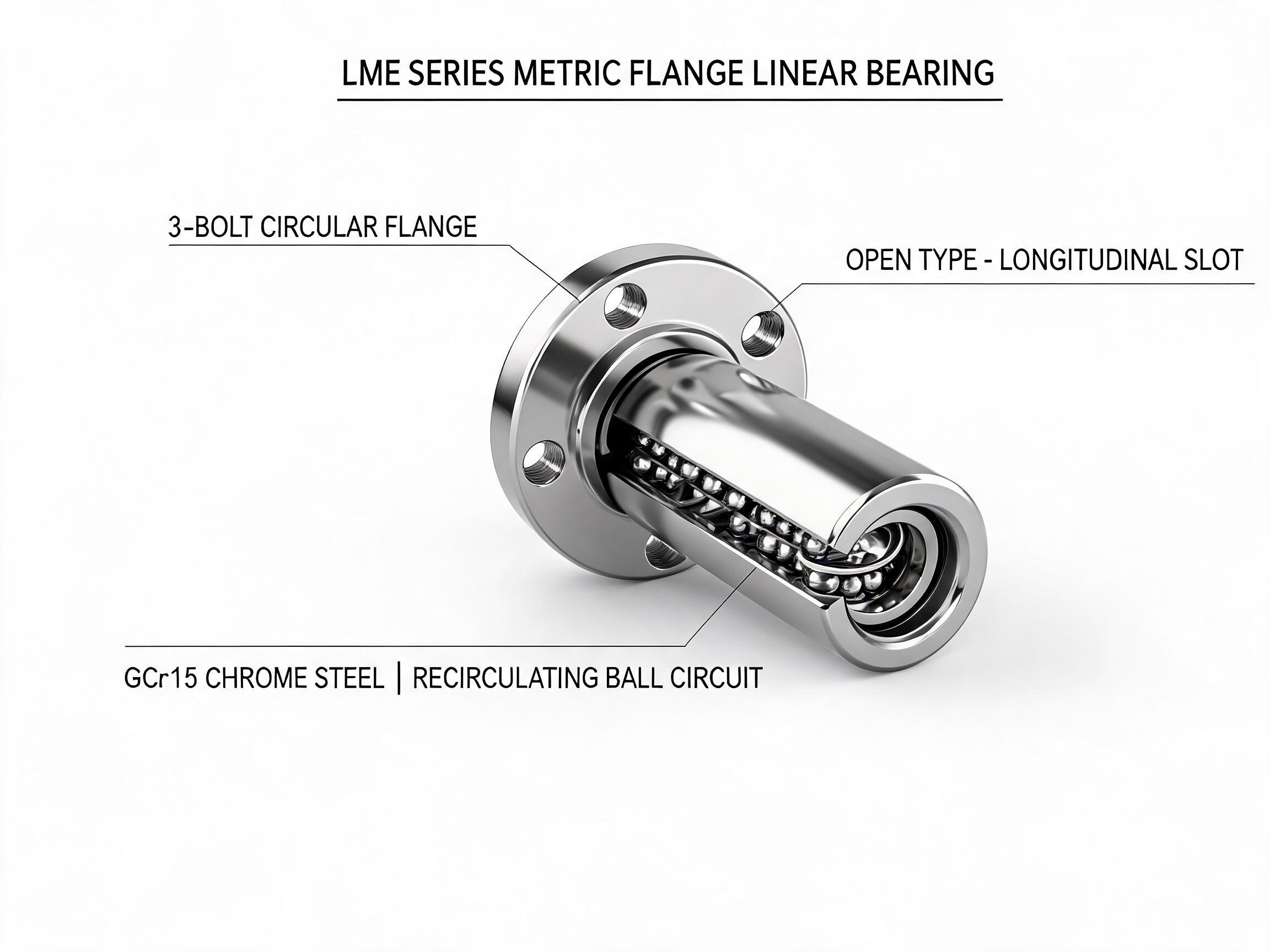
A practical sourcing playbook for buyers who want to evaluate linear bearing quality before committing to volume: what to put in a sample request, what suppliers typically ship, how to test on receipt, and how sample cost is usually handled against bulk orders.
A sample order is the cheapest test your assembly will ever run. A few pieces on a real shaft and in a real fixture tell you more about fit, smoothness and finish than any catalogue photograph. This playbook covers what to put in the request, what suppliers generally ship, what to measure on arrival, and how the sample invoice is normally treated once volume starts.
- What to specify in a sample request
- What suppliers typically provide
- What to test when the box arrives
- How sample cost is treated in volume orders
- Specify shaft diameter, UU or OP closure, quantity and the application environment in the first email.
- LM series covers 6–60 mm shaft diameters; closed UU and open OP types share identical envelope dimensions.
- Request the bore fit check on an h6 shaft and compare envelope dimensions against the datasheet before running anything.
- Sample quantities and credit terms vary by product family — confirm them with the supplier for your order.
Why a sample request is a specification exercise
A linear bearing sample request that reads “please send a sample” usually produces a reply asking three more questions. That back-and-forth is time your project does not have. A request that already states shaft diameter, closure type, quantity and operating environment can be quoted in one pass — and the pieces that arrive match the parts you intend to buy.
The point is not to test the supplier's enthusiasm. It is to check whether a catalogue part performs in your mount, on your shaft, in your environment. Anything you can specify up front narrows what you need to verify later.
What to specify in a sample request
Shaft diameter and part number
Give the nominal shaft diameter in millimetres and the corresponding model, for example LM16UU. The LM series linear ball bearing bush covers shaft diameters from 6 mm to 60 mm, so the diameter alone identifies the size but not the closure. State both to avoid a substitution.
Closed UU or open OP
Closed UU bearings carry a full ring with seals; open OP types have a slot so the housing can pass over a supported shaft. The two share identical envelope dimensions, which is convenient for design but dangerous for ordering: the outer diameter and length will match either way, so the drawing alone will not tell you which one you received. Name the type explicitly.
The LM series linear ball bearing bush page lists both closures against the same dimensional table, which is a useful reference when you write the request.
Quantity for the sample stage
Samples are not a retail pack. On the LM series, standard MOQ is 100 pieces per size, and sample quantities of 10–20 pieces per size are available for qualified buyers. If your evaluation needs fewer than 10 pieces or more than 20, state the exact number in the inquiry and let the supplier confirm feasibility rather than assuming the range applies to your case.
Application and environment
This is the section buyers skip and later regret. Two or three sentences is enough:
- What the axis does — horizontal transfer, vertical lift, short stroke, continuous reciprocation.
- Load direction and rough magnitude, so the supplier can sanity-check the dynamic rating against your duty.
- Contamination: dust, chips, coolant, washdown. Seal type should follow from this.
- Temperature and lubrication plan.
- Whether the shaft is supported (OP) or fully round (UU).
For reference, the LM16UU carries a dynamic load rating of 980 N. The outer ring is GCr15 chrome steel hardened to HRC 60–64, and the retainer is PA66-GF. Those are the material facts a supplier can put against your application; the environmental detail is what you supply.
Housing or rail, if the sample includes one
If your design uses pillow blocks rather than plain bushes, sample the assembly. KH pillow block units ship with an LM..UU bearing pre-installed, and sample units of 5–10 pieces per size are available with the buyer covering shipping. For profile rail applications, the MGN12 rail has a MOQ of 50 pieces per size, with sample sets of 5–10 pieces available for prototyping. Both are listed at KH series pillow block units and MGN12 linear rail.
What suppliers typically provide
A sample shipment is a subset of a production run, not a hand-built prototype. Expect the same bearing, retainer and seal construction as the bulk order. What varies is the quantity and the paperwork.
| Item | Typical sample provision | Confirm with supplier |
|---|---|---|
| LM series bush | 10–20 pcs per size for qualified buyers; MOQ 100 pcs per size for bulk | Qualification criteria; per-size pricing |
| KH pillow block with LM..UU | 5–10 pcs per size; buyer pays shipping; cost credited on 200+ pcs | Credit mechanics and threshold details |
| MGN12 rail | 5–10 pcs per set for prototyping; MOQ 50 pcs per size | Rail length and hole pattern options |
| Shipping | Express courier DHL/FedEx, 5–7 days for samples | Destination, duties, Incoterms |
Sample charges, payment method and any product-specific lead time beyond the above should be confirmed with the supplier in writing before you order.
Ask for the dimensional drawing or catalogue sheet with the shipment. The envelope dimensions, bore tolerance and seal designation on that sheet are what you will check the physical parts against.
What to test when the box arrives
Do the checks in this order. Each one is quick, and stopping at the first failure saves the rest of the effort.
1. Envelope dimensions against the datasheet
Measure outer diameter, length and flange or housing dimensions with a micrometer or caliper and compare to the drawing. Because UU and OP share envelope dimensions, a dimensional match does not confirm the closure type — check the seal and slot visually as well.
2. Bore fit on an h6 shaft
Slide the bearing onto a shaft ground to h6. It should go on without force and without perceptible radial play that you can feel by hand. Note that the shaft is the other half of the fit: an out-of-tolerance shaft will make a good bearing feel wrong, and vice versa. If the fit is loose or tight, measure the shaft before blaming the bearing.
3. Running smoothness
Rotate or reciprocate by hand, then run at low speed in the actual fixture. Listen and feel for binding, intermittent drag or a catch at one point in the stroke. A single rough spot on a new bearing is worth a conversation with the supplier before you accept the lot.
4. Seal and retainer type
Confirm the seal type matches your environment, and that the retainer and ball complement are what the datasheet describes. Hold a sample from each size in a batch and compare them to each other — inconsistency across a small shipment is a signal about what a large one might look like.
5. Fit in your own housing
The final check is the one no datasheet can do: install the sample in your actual housing or pillow block and cycle it through the real stroke. This is where clearance stack-up, mounting flatness and alignment show up.
Record what you measured and under what conditions. A test result is a snapshot of those parts in that fixture; it does not predict the life of the next lot, but it does tell you whether to place the order.
How sample cost is treated in volume orders
Treatment depends on the product family, and it is worth getting the arrangement in the quotation rather than agreeing it verbally.
- KH pillow block units: the buyer covers shipping on the sample, and the sample cost is credited toward bulk orders of 200+ pieces.
- LM series bushes and MGN12 rails: sample quantities are quoted per size; whether and how the sample cost is credited should be confirmed with the supplier when you request the linear bearing quotation.
Ask for the credit condition in writing as part of the quotation: the threshold quantity, whether it is per size or per order, and whether it is applied as a line-item discount or a separate credit. For a multi-size order, per-size versus per-order thresholds can change the arithmetic considerably.
Putting the request together
A workable first email contains: model and shaft diameter, UU or OP, sample quantity, the application and environment in a few lines, the shipping address and preferred courier, and a request for the dimensional drawing and the volume quotation with sample-credit terms. That is enough for a supplier to quote and ship without a second round of questions.
Test the arrival against the drawing and your own fixture, keep the measurements on file, and use them as the acceptance reference for the first bulk delivery. The sample has then done its job twice: it qualified the part and it gave you a baseline for incoming inspection.