
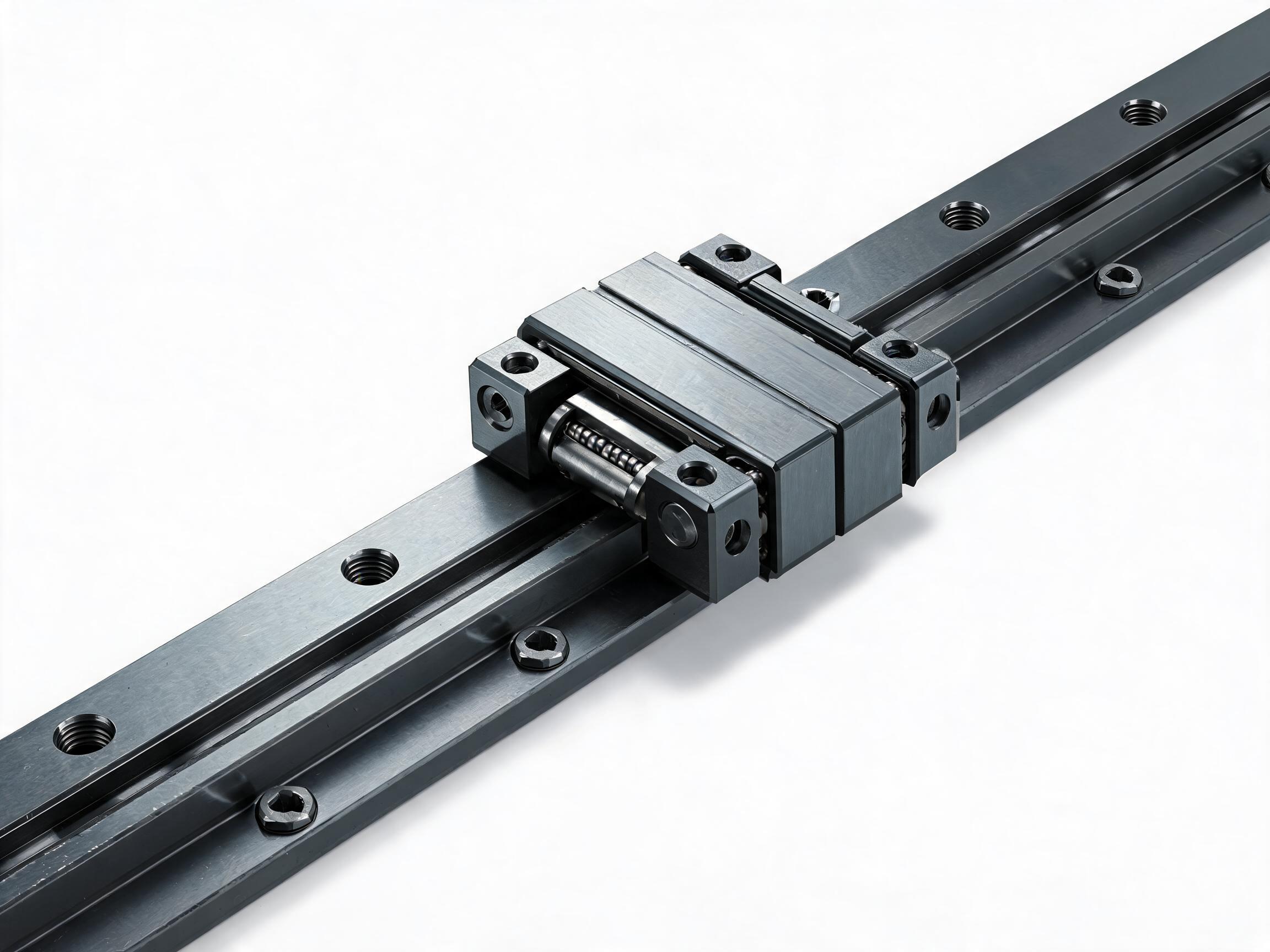
A parameter explainer on what the width number in a linear guideway size designation actually controls: per-carriage load capacity, rigidity context, mounting bolt size, and carriage family — plus how to measure an existing rail and why width and height are two separate dimensions.
Parameter explainer
The number in a linear guideway designation — 15, 20, 25, 30, 35, 45 — is the rail width in millimetres. It is a size classification for the whole rail-and-carriage assembly, not a description of the running surface alone. Changing that number changes which carriages fit, what bolt sizes the rail accepts, and what load figures appear beside the part number.
Key takeaways
- Width is the size designation. It selects a carriage family; a 25 mm rail does not accept a 30 mm carriage.
- Width is the dimension the load rating is indexed against. Dongfeng Bearing lists HGR20 at 16.7 kN dynamic / 26.7 kN static per carriage, and HGR45 at 62.8 kN dynamic / 112 kN static when paired with the HGW45CA carriage.
- Mounting bolt size tracks the width: HGR45 uses M12 bolts on a 60 mm hole pitch.
- Width and height are separate dimensions. A rail is not square, and matching one without the other does not guarantee fit.
In this article
- The width number is the size designation
- What the width correlates with
- How bolt size follows the width
- How to measure an existing rail
- Width versus height: two different dimensions
- Width across the HGR series
The width number is the size designation
When a catalogue lists a linear guide rail as HGR20 or HGR45, the trailing figure refers to the nominal rail width in millimetres. In the HGR series offered by Dongfeng Bearing, the range runs 15, 20, 25, 30, 35 and 45 mm. These are standardised nominal sizes within the series, which is why a carriage ordered for one width does not bolt onto another. The number is a designation first and a physical dimension second.
That distinction matters when you are reading a datasheet. The nominal width tells you which product family you are in. The exact cross-section — the finished height, the bolt hole spacing, the shoulder dimensions — is the value you check against a drawing. For the HGR series, the full cross-section table for each size sits in the datasheet, and only one size, HGR45, is recorded here in both dimensions: 45 mm width and 38 mm height. For the other sizes, use the datasheet figure rather than assuming the rail is square or inferring height from width.
Buyers searching for linear guide rail width usually want one of two things: to understand what the number controls when specifying a new axis, or to identify an existing rail so a replacement or an added carriage matches. Both questions are answered by the same rule — width is the selector, and everything else is checked after the selector is fixed.
What the width correlates with
The published load ratings for a linear guideway are stated per carriage, not per metre of rail. That figure is indexed to the size: within one series, a larger width carries a larger carriage, and the carriage in turn carries more load. Two catalogue values show the gap between the small and large ends of the HGR range:
| Size | Width (nominal) | Carriage referenced | Dynamic load | Static load |
|---|---|---|---|---|
| HGR20 | 20 mm | HGR20 carriage (size-level figure) | 16.7 kN | 26.7 kN |
| HGR45 | 45 mm | HGW45CA | 62.8 kN | 112 kN |
Read the table carefully as a size comparison, not as an interchangeable specification. The HGR20 figure is given at the size level; the HGR45 figure is stated for a specific carriage, the HGW45CA. The ratio is roughly 3.8 on dynamic load and about 4.2 on static load. That is what the width number buys you when you move up the range, but the comparison only holds for the carriages named. A different carriage on the same rail width will publish a different rating, which is why the carriage type belongs in the part description alongside the rail size.
Rigidity follows the same pattern in catalogue terms — a wider rail carries a larger carriage, and the larger carriage is the component listed with the higher capacity. What the numbers do not tell you is how the axis as a whole will behave. Rail stiffness, mounting surface flatness, bolt preload and the number of carriages sharing the load all sit outside a single per-carriage figure. Treat the rating as a size-selection input, then check the whole axis design against it.
How bolt size follows the width
The mounting hardware scales with the rail. HGR45 uses M12 bolts through a rail whose bolt holes repeat on a 60 mm pitch, in a rail that weighs 6.2 kg per metre. Those are catalogue values for that size, and they show why the width number cannot be treated as cosmetic: a rail too narrow for the bolt size your structure is drilled for will not mount, regardless of its load rating.
The practical point for buyers is to fix the mounting interface before comparing sizes. If the machine base is already machined with a hole pattern and bolt size, that pattern constrains the rail size. If the base is still being designed, the rail size sets the bolt size, and the bolt size sets the minimum edge distance and the thickness the base needs under the rail. Working in that order avoids the common problem of finding a rail with adequate load capacity that physically will not attach.
The HGR45 heavy-duty large linear guideway rail page lists the 45 mm × 38 mm cross-section, the M12 bolt and 60 mm pitch, and the paired HGW45CA carriage rating. Compare those values against your base drawing before ordering.
How to measure an existing rail
When the job is replacement or a carriage added to a rail already in service, the width number has to be measured rather than guessed. The measurement is straightforward, with two cautions.
- Measure the rail body width, not the carriage. A carriage is wider than the rail it rides on because it wraps the profile. Placing a caliper across the carriage gives you the carriage width, which is a different number.
- Measure a clean, unworn section. The reference width is the rail body. Burrs, dents or a worn edge on the measurement face will shift the reading.
- Measure at more than one point. Take a reading near each end and one in the middle. Consistent readings support the nominal size; scattered readings point to a damaged rail rather than a size question.
- Confirm against the nominal list. A reading that lands close to 15, 20, 25, 30, 35 or 45 mm identifies the size family. A reading well away from these values means the rail is from a different series or a non-standard profile, and the carriage must be matched to it rather than to a nominal size.
- Record the height and hole pitch as well. Width alone does not confirm interchangeability, because two rails of the same width can differ in height and hole spacing. Note all three before contacting a supplier.
- Photograph any surviving marking. A stamped or printed part number is a far stronger identifier than a caliper reading, and a supplier can check the number against its catalogue. If no marking survives, the three measurements — width, height, hole pitch — are what allows a match.
Width versus height: two different dimensions
Width and height are often conflated in conversation, but they do different jobs in an axis. Width is the size designation and the selector for the carriage family. Height sets how far the top of the carriage sits above the mounting surface, and therefore where the moving load sits relative to the structure. A wider rail is usually taller, but the two are recorded independently for a reason: they are checked independently.
For HGR45 the catalogue records both: 45 mm width and 38 mm height. That is a useful worked example of why you cannot assume a near-square section. It also illustrates the replacement rule. If the height differs from the installed rail, the carriage will sit at a different level, and every element attached to the moving block shifts with it. A rail can match on width and still change the geometry of the machine.
For sizes where only the width is quoted in a summary document, do not extrapolate the height from the width. Request the cross-section drawing for the specific size. This applies whether you are designing a new axis or matching an existing one — the height is the dimension that decides whether the assembly fits the space it was designed for.
Width across the HGR series
The HGR series heavy-duty linear guideway rail is available in six sizes — HGR 15, 20, 25, 30, 35 and 45 — with a four-row ball circuit, ground H (P5) or rolled N (P7) precision grades, and rails up to 4000 mm long. Those common features apply across the range; the width is the variable that changes the carriage family, the load rating and the mounting hardware.
A sensible way to use the range is to start from the requirement rather than from the size you last bought. Set out the per-carriage load the axis has to carry, the mounting bolt size the structure can accept, and the height available above the base. Then find the size whose catalogue figures satisfy all three. If two sizes both satisfy the load, the smaller one that still meets the bolt and height constraints is the cheaper and lighter option — but only if the height check passes, because a size change moves the carriage level.
Where a requirement sits between sizes, the open questions are worth putting to the supplier in writing: the exact cross-section for the candidate size, the carriage rating for the specific carriage type you intend to use, the bolt and pitch figures, and the standard rail lengths available. Those four items are enough to confirm whether the width number you have selected actually delivers the axis you need. Dongfeng Bearing publishes these values at the size level, and the datasheet cross-section supplies the rest.
Catalogue figures in this article are as listed by Dongfeng Bearing for the HGR series. Ratings are per carriage and depend on the carriage type used; confirm the cross-section dimensions against the datasheet for the specific size before ordering.