
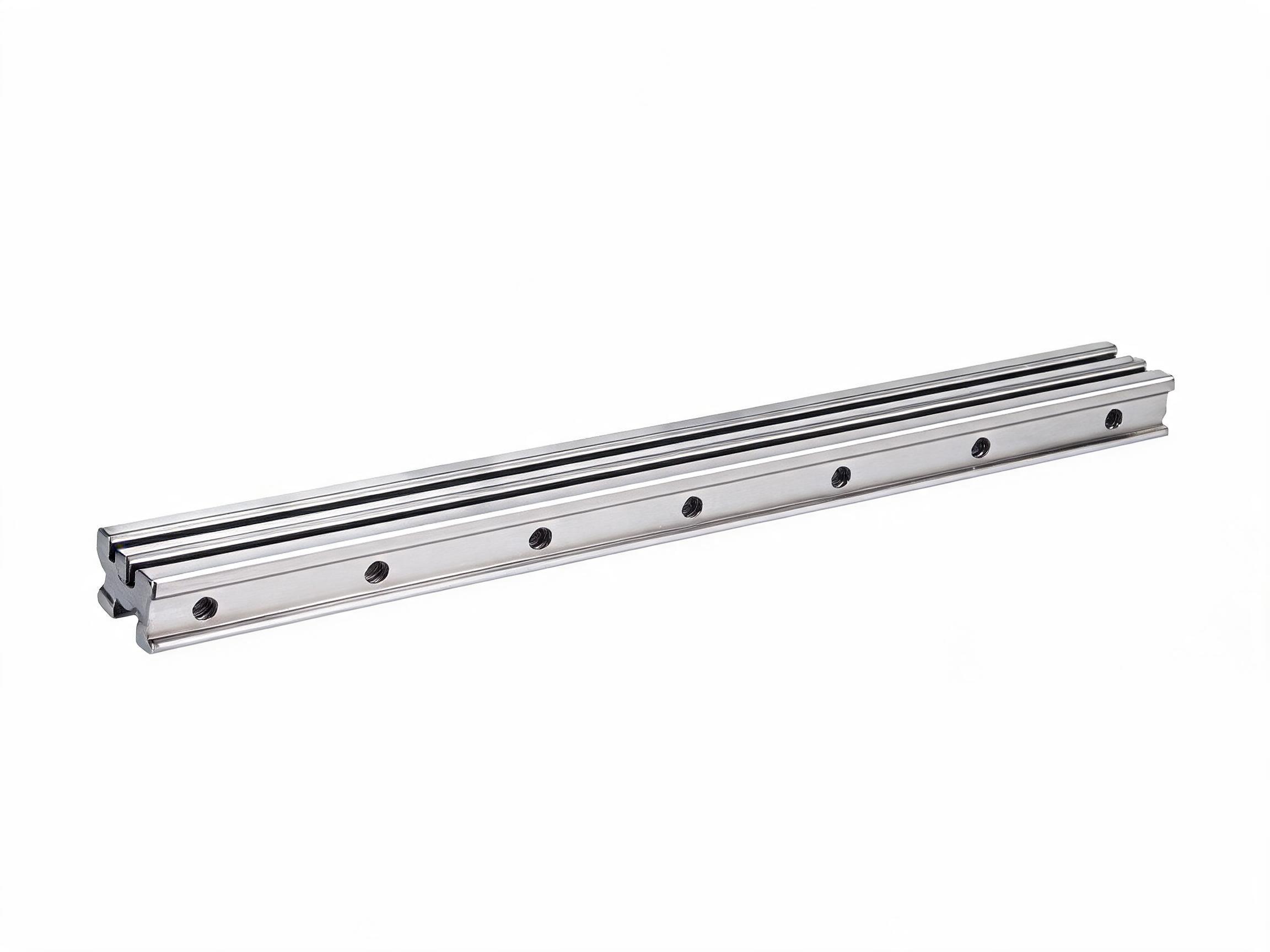
A specification-order checklist for machine builders buying linear guide rails and carriages: how to fix rail size by load and moment, choose ground versus rolled accuracy, set preload, verify raceway hardening, and specify sealing and lubrication for cutting environments.
A machine tool axis is usually designed around the rail, not the other way round. Fixing the order in which you specify rail size, accuracy grade, preload, raceway hardness and protection makes the quote and the drawing converge faster. This checklist sets out what to settle first, and which values you will need to pull from the rail and carriage datasheets before anything can be released to production.
Key takeaways
- Size the rail on dynamic and static load ratings plus the moment load at the worst overhang, and use the lower of rail and carriage rating.
- Fix the accuracy grade (ground H/P5 or rolled N/P7) before the bed is machined, because it changes the mounting-surface requirement.
- Preload C0/C1/C2 is a stiffness-and-drag choice, not a quality tier; match it to load direction.
- Raceway hardness HRC 58–62 and IP40-equivalent seals belong on the drawing as separate line items.
1. Rail size: decide on load and moment, not on space
Size selection belongs at the top of the list because the size determines what the later decisions are made against. A 15-size rail and a 45-size rail do not share carriage behaviour, mounting dimensions or stiffness, so every downstream value — preload effect, seal drag, lubrication interval — shifts once the size changes.
The HGR heavy-duty rail series is offered in HGR15, HGR20, HGR25, HGR30, HGR35 and HGR45. Each size is specified by two load ratings: a dynamic rating (the repeated load the bearing structure is rated for in service) and a static rating (the allowable stationary or shock load). Two reference figures from the records make the point:
- HGR20 rail: dynamic 16.7 kN, static 26.7 kN.
- Matching HGH20CA flange carriage: dynamic 18.0 kN, static 29.5 kN.
The guideway is rated as a system, but the rail and carriage are separate components with separate ratings, and the lower of the two governs. For sizes other than HGR20/HGH20, the per-size load tables are not reproduced here — confirm with the datasheet before fixing size.
Load alone is not enough. The moment arm matters more on a machine tool axis than on a simple transfer axis because of the offset between the cutting force and the carriage. Estimate the moment load from the working forces at the tool tip and the distance to the rail centreline, then compare it with the moment capacity the carriage datasheet states for the size under consideration. Overhang loads on a long milling head or a cantilevered tool changer are where under-sized rails show up first.
2. Accuracy grade: ground versus rolled
The HGR rail is available in two accuracy classes: ground H (P5) and rolled N (P7). This is the first decision that interacts with cost, machine assembly method and the way the axis is compensated.
| Grade | Manufacturing route | Where it fits on a machine tool |
|---|---|---|
| H (P5) | Ground | Axes where the rail straightness and running parallelism budget is tight enough that the rail is treated as a reference — precision milling, grinding, high-accuracy positioning. |
| N (P7) | Rolled | Axes where pitch or travel error can be handled in the control or by other machine components, and the rail is not carrying the accuracy budget alone. |
State the grade as a drawing call-out, not a preference. If the axis accuracy is stacked on the rail grade, the mounting surface has to be specified to a compatible flatness and the machine builder needs the grade fixed before the bed is machined. Ground H rail and rolled N rail are interchangeable mechanically in most mounting layouts, but they are not interchangeable in accuracy purpose — swapping one for the other changes what the machine can hold, so the grade should be settled before the frame drawing is released.
3. Preload class and carriage selection
The HGH flange carriage series covers HGH15, HGH20, HGH25, HGH30, HGH35 and HGH45, built on four-row ball circulation. Three preload classes are listed: C0 (clearance), C1 (light preload) and C2 (medium preload).
The preload class is not a quality level; it is a stiffness and drag choice. C0 leaves clearance and is chosen where drag must be minimal and the axis carries load in one direction. C1 and C2 remove play and raise stiffness, at the cost of running drag and heat. On a machine tool axis, the class should match the cutting force direction and the way the axis is loaded: an axis that sees alternating or reversing loads cannot use a preload that only removes clearance in one direction without the machine builder accepting the resulting lost motion.
The four-row carriage also self-aligns up to ±0.5°. That figure is a mounting tolerance, not a licence to ignore bed flatness: it lets the carriage absorb small angular mismatch between two rails or between a rail and its mounting surface during assembly. It does not correct a bed that is twisted over its length.
4. Raceway hardness
The raceway is induction hardened to HRC 58–62. Induction hardening is applied to the raceway, so the hardness sits where the balls run rather than being a through-hardness of the whole rail section. The rail is made from high-carbon steel; the exact grade is per datasheet.
Hardness belongs on the specification list because it is a durability and wear question, and it sets the limit for what the rail can be expected to tolerate over a service life. When comparing rail offers, ask for the raceway hardness value and the hardening method as separate line items — a hardness figure quoted without saying where it applies does not answer the same question.
5. Sealing and lubrication for cutting environments
A machine tool axis is usually inside a splash zone. The HGH carriage carries end seals plus side wipers, rated to IP40-equivalent. That rating describes the seal package the carriage is supplied with. It is not a statement that the whole axis is sealed against coolant, and it assumes the machine builder closes the remaining gaps — rail covers, telescopic covers or a way cover — around the guideway.
Lubrication is specified on the carriage: grease nipple M6, lithium grease NLGI 2, with a reference re-lubrication interval of every 100 km of travel or 3 months. The HGR rail accepts grease ports and oil-groove lubrication, so the same guideway can be run on grease or on oil depending on how the machine's lube system is built. Whichever route is chosen, the interval is a reference value under the carriage's design conditions — cutting dust, chips and coolant wash-down will move the practical interval, and that is for the machine builder to set against the actual duty.
Two practical points when specifying for a cutting environment:
- Confirm the lubrication route at the same time as the preload class. A C2 carriage running on an under-supplied oil groove will run hotter than the same class with the correct supply.
- Keep the wiper and seal as a wear item on the maintenance schedule, not only as a purchase-time feature.
6. Rail length and joints
HGR rail is supplied up to a maximum standard length of 4000 mm. Longer runs are made by splicing, with matched straightness at the joint. On a long machine bed, the joint position is a design decision: it should be placed where its effect on the axis is understood, and the matched straightness at the joint is a property the supplier controls and states.
Single-piece rail up to 4000 mm avoids a joint entirely. Where the axis is longer, treat the splice as part of the specification and ask how the joint is matched rather than assuming any two rail ends can be butted together.
7. Specification checklist
The order below reflects how the decisions depend on each other — a later item cannot be fixed until the earlier one is.
- Rail size from the dynamic and static load ratings plus the calculated moment load at the worst overhang. Use the lower of rail and carriage rating. For sizes outside the records quoted here, confirm with the datasheet.
- Accuracy grade: H (P5) ground or N (P7) rolled, stated on the drawing together with the mounting-surface flatness.
- Preload class: C0, C1 or C2, matched to load direction and required stiffness.
- Raceway hardness: HRC 58–62, induction hardened raceway, with the base steel grade taken from the datasheet.
- Sealing: end seals plus side wipers (IP40-equivalent), with the machine-side covers specified separately.
- Lubrication: grease via the M6 nipple with NLGI 2 lithium grease, or oil groove; reference interval every 100 km or 3 months.
- Rail length: single piece up to 4000 mm, spliced with matched straightness beyond that.
On supply terms, HGR20, HGR25 and HGR30 are usually in stock with a 7–10 working-day lead time, and the MOQ is 50. Ordering is faster once the seven items above are fixed, because they are the questions a supplier has to answer before a rail can be cut to length and a carriage assembled.