
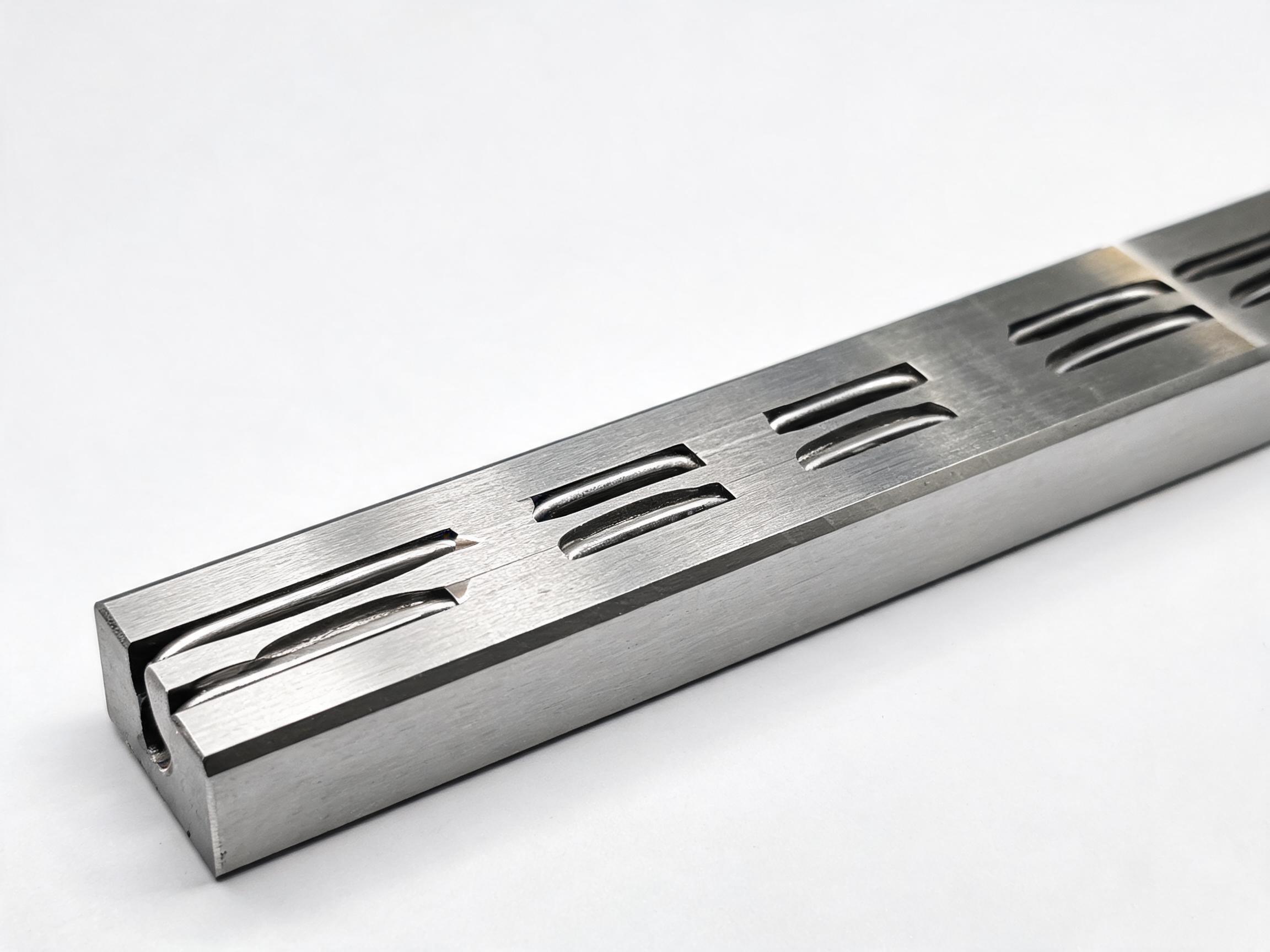
When machine travel falls outside a catalog rail length, the order changes: you move from a stock size to a custom item. This article sets out a practical ordering checklist for non-standard linear guide rails — where standard lengths end, when splicing a long run is the better route, what cutting and hole patterns mean for positioning accuracy, and how MOQ and lead time differ on custom orders.
Ordering guide
Standard catalog rails stop at defined lengths. When the machine travel needs something longer or shorter, the rail becomes a custom item, and the questions that decide a good order change with it.
Two catalogs cover most of what this article discusses. The HGR heavy-duty linear guideway rail series runs to a maximum standard length of 4000 mm and is available in accuracy grade H (P5, ground) or N (P7, rolled). The EGH miniature linear guideway rail series tops out at 1000 mm in standard length and ships in ground H (P5) as standard, with no rolled option. For both, longer runs can be spliced with straightness at the joint matched to the rail grade.
Below that, custom-length ordering breaks down into four decisions: where the standard length ends, whether to splice or use one long rail, what the cut end and hole pattern require, and how MOQ and lead time change. The SKF20 aluminum profile linear slide module is a useful reference here, because its standard strokes (100/200/300/500 mm, with custom strokes available up to 1000 mm) show the same logic on the assembly side.
Key takeaways
- Standard lengths end at 4000 mm for HGR heavy-duty rails and 1000 mm for EGH miniature rails; anything longer is a custom order.
- Splicing extends a run beyond the standard maximum, with straightness at the joint matched to the rail grade — a decision that depends on the accuracy grade your application calls for.
- Custom lengths change the order terms: MOQ is 50 for HGR and 100 for EGH, while stock HGR20/25/30 sizes typically ship in 7–10 working days.
- Per-size hole pitch, cross-section and end-machining options must be confirmed against a datasheet or dimensioned drawing before placing the order.
Where standard lengths end
A non-standard linear guide rail is simply a rail whose length is outside the catalog range. The catalog maximum is where the distinction begins, and it differs by product family.
| Product family | Maximum standard length | Accuracy options | MOQ |
|---|---|---|---|
| HGR heavy-duty rail | 4000 mm | Ground H (P5) or rolled N (P7) | 50 |
| EGH miniature rail | 1000 mm | Ground H (P5), no rolled option | 100 |
Source: product records for the HGR and EGH families. Per-size dimensions and hole pitches are not in those records; confirm them with a datasheet or dimensioned drawing.
A machine with 1,200 mm travel on an EGH rail, for example, needs a custom length because it exceeds the 1000 mm standard maximum. The same rail in a 4,100 mm run for an HGR installation falls outside the 4000 mm standard maximum. Below those ceilings, a standard size may already exist; the first step is to check the catalog before assuming the order must be custom.
For slide modules rather than bare rails, the same logic applies to stroke length. The SKF20 module lists standard strokes of 100, 200, 300 and 500 mm, with custom strokes available up to 1000 mm, so the catalog covers a range and the custom option extends it.
Splicing versus one long rail
When the required length exceeds the standard maximum, the clearest question is whether to use a single long rail or a spliced run. Both HGR and EGH rails can be spliced, with straightness at the joint matched to the rail grade. That gives you a way to go beyond the standard maximum without asking for a single piece longer than the rail can be supplied.
The decision is less about the distance and more about what the application measures across the joint.
- Ground H (P5): If your positioning or parallelism requirement is written around ground accuracy, the joint needs to hold to that grade's straightness. Specify the grade first; the splice requirement follows from it.
- Rolled N (P7): A rolled rail has a wider accuracy band, and a spliced run at that grade is a different proposition from a ground one. Confirm that the joint specification you receive matches the grade you ordered.
A single long rail avoids a joint entirely, but it still has to be manufactured to your length and carries its own handling and transport implications. A spliced run divides the length into transportable pieces, at the cost of a joint that must be controlled. Neither is automatically the better option; the grade and the accuracy requirement at the joint decide which one fits.
When you request a splice, state the length, the grade, and where the joint may fall. If the carriage must not cross the joint under load, say so in the request, because the joint position becomes a hard constraint rather than a manufacturing detail.
Cut ends and hole patterns
For non-standard lengths, the rail is cut to order. The cut end is not just a length dimension; it affects where mounting holes land and how the rail meets the machine bed.
The product records do not list, per rail size, the mounting-hole pitch, the cross-section dimensions, or the end-machining options. Those are per-size values that must be taken from a datasheet or a dimensioned drawing. In practice, this means three things should come with your request:
- The cut length and tolerance. State the finished length and what the machine bed can accept at each end.
- The hole pattern reference. Provide the hole spacing and the position of the first and last hole from the cut end, or refer to the dimensioned drawing the pattern follows.
- The end condition. If the application needs a specific end cut, a counterbore, or a feature at the end, describe it and confirm the option against the drawing before the order is released.
The reason to settle these early is accuracy. A cut changes the distance from the end to the nearest mounting hole. If that edge distance is not fixed, the rail can be correct in length and still sit wrong on the bed, or leave too little material at the end for the intended fixing. Asking for the dimensioned drawing at quotation stage turns a length request into a manufacturable one.
MOQ and lead time on custom orders
Once a rail is cut to a non-standard length, the order terms are those of the custom item, not the stock size.
MOQ is 50 for HGR heavy-duty rails and 100 for EGH miniature rails. Stock HGR20, HGR25 and HGR30 sizes are usually in stock, with a 7–10 working-day lead time for stock sizes. Custom lengths fall outside that stock flow, so the lead time for a cut rail needs to be quoted against the actual order rather than assumed from the stock figure.
Plan the order around MOQ early. A short custom run below the MOQ does not become a stock order by asking for a smaller quantity; it needs to be discussed as a separate case. If the machine program needs a mix of lengths, grouping them into one order can keep the total above the MOQ and make the custom work a single production batch.
For custom strokes on the SKF20 module, the same principle applies: the standard strokes are catalog items, while a custom stroke up to 1000 mm is a made-to-order item. State the stroke and any carriage or mounting constraints together so the quote reflects the assembly as specified.
Ordering checklist for custom-length rails
The list below is what to put in front of a supplier when the required length is outside the catalog. Each item is something the supplier needs to quote and something you need to check on the returned drawing.
| Item | What to state | Why it matters |
|---|---|---|
| Rail family and size | HGR or EGH, and the size designation | Sets the standard maximum, accuracy options and MOQ |
| Finished length | Exact cut length and tolerance | Defines whether the order is custom at all |
| Accuracy grade | Ground H (P5) or rolled N (P7) where available | Sets the straightness band, including at a splice joint |
| Splice requirement | Whether a single rail or a spliced run is required, and where the joint may fall | Joint position can be a hard constraint if a carriage crosses it |
| Hole pattern | Pitch, edge distance from each cut end, referenced to a dimensioned drawing | The cut changes edge distance; confirm per size from the datasheet |
| End machining | Any required end cut or end feature | Confirm the available options against the drawing before release |
| Quantity and MOQ | Total quantity against the 50 (HGR) or 100 (EGH) MOQ | Determines whether the custom run meets the order minimum |
| Required delivery | Date needed, checked against a quoted lead time for the custom item | Stock lead time (7–10 working days for HGR20/25/30) does not apply to a cut rail |
Two points on that list are not answerable from a catalog alone: the per-size hole pitch and cross-section, and the end-machining options. Both are confirmed with the datasheet or a dimensioned drawing. Treat those two items as the gate before the order is released, not as details to settle after placement.
For a machine that needs a non-standard rail length, the fastest route to a usable quote is a request that carries the length, the grade, the hole pattern reference and the quantity together. That package lets the supplier quote a specific item and lets you compare the returned drawing against the machine bed before anything is cut.