
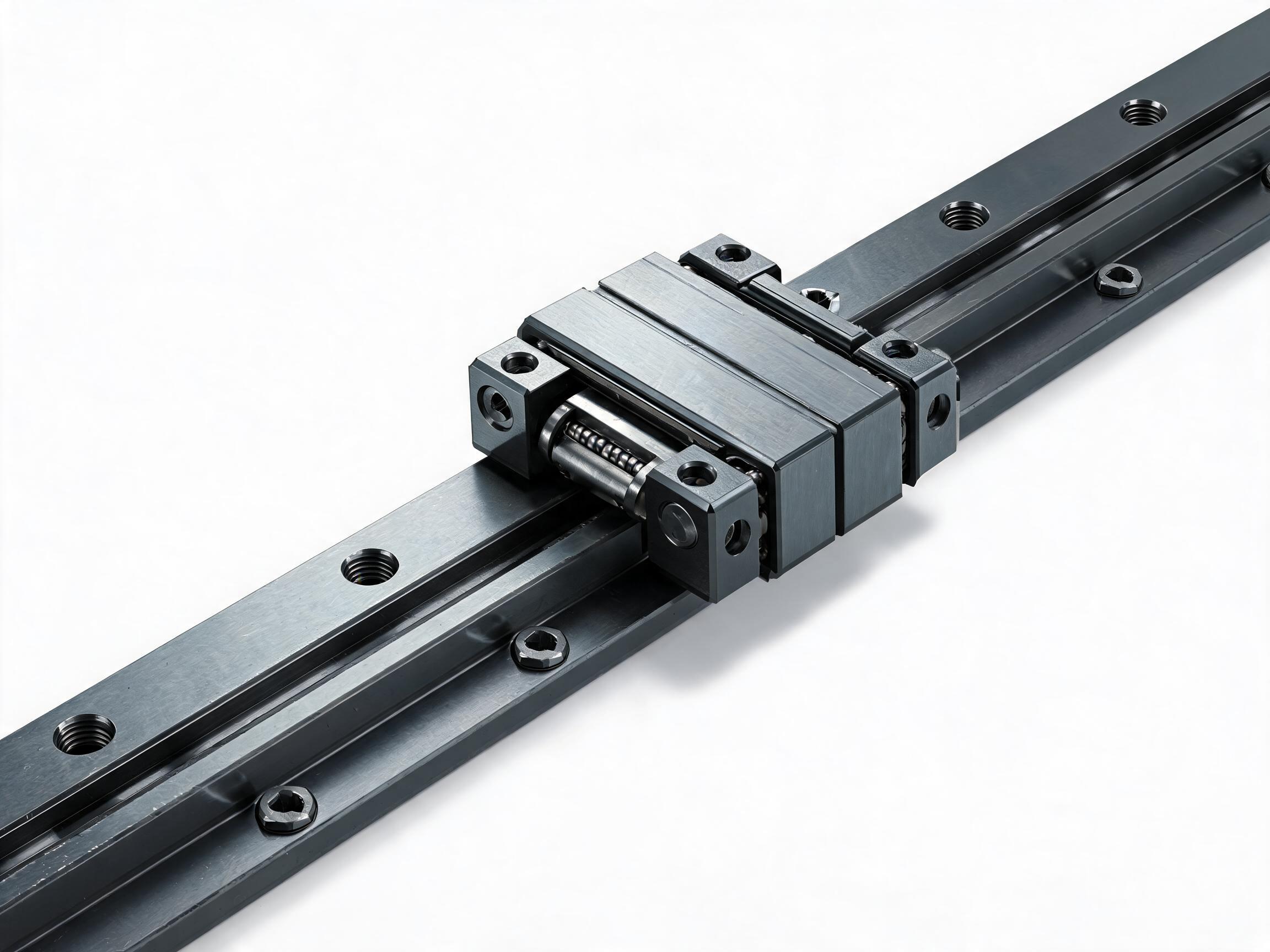
A decision guide for machine builders and automation engineers weighing the move from 20mm to 25mm profile rail on medium-duty machine tools and linear axes: which load signals justify the step, what changes at the frame and carriage level, and which items to pin down on the purchase order.
A 25mm linear rail sits in the middle of the HGR range. The series covers HGR 15, 20, 25, 30, 35 and 45, so 25 is the fourth-smallest size and one step above the 20mm rail that many medium-duty machine tools and automation axes start with. The question worth answering is not which size is “better,” but at what point the extra section depth of a 25mm rail stops being insurance and starts being the right engineering answer.
The boundary between 20mm and 25mm
To make the step-up decision concrete, it helps to anchor both ends of the HGR range. Take the HGR20 as the smaller reference point: it is rated for 16.7 kN dynamic load and 26.7 kN static load. Take the HGR45 as the large end: matched with the HGW45CA carriage, it is rated for 62.8 kN dynamic and 112 kN static. HGR25 falls between these two, and its exact dynamic and static values must be read from the datasheet — they are specific to the rail size and the carriage model you select, and they should not be interpolated from the 20 and 45 figures.
The gap between the 20mm and 45mm figures is roughly a factor of 3.8 in dynamic capacity, and the six-step ladder of HGR sizes spreads that gain across four intermediate sizes. That is why a single size change rarely doubles your safety margin. A 25mm rail buys additional section height and a bigger carriage interface, not a different order of magnitude.
| Reference point | Dynamic load | Static load | Role in this decision |
|---|---|---|---|
| HGR20 (20mm rail) | 16.7 kN | 26.7 kN | Smaller-size anchor: the duty level many medium axes are already built around |
| HGR25 (25mm rail) | Per the manufacturer datasheet | Per the manufacturer datasheet | Candidate step-up; values depend on rail size and carriage model |
| HGR45 with HGW45CA | 62.8 kN | 112 kN | Large-end anchor showing the top of the HGR range |
HGR25 figures are deliberately left open in this article. Load capacity, bolt-hole pitch, rail height and carriage width for 25mm must be confirmed against the datasheet for your chosen carriage, then verified against your frame and mounting pattern before the machine envelope is frozen.
Signals that tell you to step up
A 20mm rail works well when the load is mostly vertical, the carriage runs near the middle of the rail span, and the duty cycle is moderate. The step-up becomes worth it when one or more of the following conditions shows up in your layout rather than in a catalogue headline.
Edge loading on the carriage
When the working point sits far from the carriage center — an overhanging spindle head, a long tool arm, or a workpiece that clamps off center — the load converts into a moment on the four ball rows instead of a clean vertical push. A 25mm rail with a wider carriage spreads that moment over a larger contact zone. This is the most common reason a medium-duty machine tool moves up a size: it is not that the 20mm rail fails in the center, but that the edge case drives the rating.
Shock and reversing loads
Automation axes that hit a mechanical stop, drop a clamp, or reverse direction under load briefly exceed their static rating. The taller section of a 25mm rail and its offset ball rows give more margin against that transient peak. If the machine has a hard stop or a rapid reversal in its cycle, ask whether the 20mm margin at the worst moment is still comfortable.
Frame and cross-section stiffness
Rail height is not just a capacity number. A 25mm rail sits higher above the mounting face than a 20mm rail, which changes how the carriage mass behaves under acceleration and how much bending the machine frame sees at the rail joint. On a weldment or casting that is already stiff enough, this extra section can be used without redesigning the frame. On a light extrusion frame, the added height may need a taller mounting block or a reworked saddle — a real cost that belongs in the comparison.
Rail-to-rail spacing in the axis
Two rails in one axis share the moment according to their spacing. If your frame width lets you widen the rail centers, that often gains more stability than a single size change. If the rail gap is fixed by the machine envelope, a larger rail with a wider carriage recovers some of that stability. The right question is which of the two — wider spacing or a larger rail — your frame can actually accommodate.
Step-up checklist
- Worst-case point load, including edge and off-center conditions, is close to the 20mm rating
- The axis sees shock, hard stops or rapid reversals under load
- The frame can absorb the extra rail height without reworking the saddle
- The rail span and mounting pattern leave room for 25mm bolt-hole pitch
- HGR25 dynamic and static ratings for your carriage model are confirmed on the datasheet
What to confirm on the order
Moving to 25mm changes more than the rail itself. A few items decide whether the step-up is a drop-in change or a re-machined frame, and they should be settled against drawings before the purchase order goes out.
Width, height and bolt-hole pitch
The rail cross-section that comes with the HGR profile is matched to the Taiwanese HGR standard: bolt-hole pitch and cross-section match that profile. That matching is useful when the machine drawing was already built around HGR dimensions, because the mounting footprint follows standard geometry. It does not mean the 25mm rail drops onto a 20mm mounting pattern — a size change always moves hole positions and mounting height, and both need to be re-checked against the new drawing.
Accuracy grade
The HGR range is offered in Ground H (P5) and Rolled N (P7) grades. Ground rail suits axes where positioning accuracy and straightness matter, such as machine tool slides. Rolled rail suits automation axes where travel and repeatability, rather than tight straightness, drive the design. Choosing the grade when the size is decided keeps the two changes from being mixed up later.
Length and rail count
The rail can be supplied up to 4000 mm, with longer lengths available as a custom item. If the step-up coincides with a longer axis, check whether one rail per side is practical or whether the axis should be built from shorter rail sections. Rail joints are a layout decision, not a load decision, but they affect straightness and should be planned at the same time.
Carriage model and lubrication
The rail size and the carriage model together define the load rating. The HGR series uses a four-row ball arrangement with oil-groove lubrication. Confirm the carriage width and height for the selected model, since the saddle and drive layout are sized around that block, and confirm the lubrication path is reachable in the final assembly. HGR20, HGR25 and HGR30 sizes are normally stocked, with 7–10 working days to dispatch and a minimum order quantity of 50 pieces. Material is 55# steel with 58–62 HRC surface hardness, which applies across the series.
Common questions
Can I reuse the same carriage when I move from 20mm to 25mm?
No. The carriage is matched to the rail size, so a size change means a new carriage model and a new saddle height. Treat the move as a change of the whole bearing assembly, then confirm the new carriage dimensions on the datasheet.
Does a larger rail always give better machine accuracy?
Not by itself. Accuracy comes mostly from the rail grade and the straightness of the mounting surface. A 25mm rolled rail on a poorly prepared frame will not outperform a 20mm ground rail on a straight, flat surface. Size and grade are separate decisions and should be chosen separately.
How do I know whether 20mm is still enough?
Compare your worst-case load — not the average — with the 16.7 kN dynamic and 26.7 kN static ratings of the HGR20, and include the edge-load moment in that calculation. If the margin at that point is comfortable, the step-up is optional. If it is not, 25mm is the next size to evaluate against its datasheet values.
Next step
If your axis is at the edge of what a 20mm rail can carry, the practical move is to specify the 25mm requirement against your actual worst-case load, frame width and carriage model, then read the HGR25 ratings back from the datasheet. The HGR series heavy-duty linear guideway rail covers the full 15–45 size range with the grade, length and lubrication options above. If your frame eventually grows beyond 25mm, HGR45 heavy-duty large linear guideway rail shows the top of the range at 62.8 kN dynamic and 112 kN static with the HGW45CA carriage.
Ready to size the step-up?
Send the axis drawing with the worst-case load point, rail centers and carriage model, and specify 25mm against the datasheet values rather than by interpolation from the 20mm anchor. Stocked 25mm sizes dispatch in 7–10 working days at MOQ 50 pieces.