
A packaged rod-style electric actuator and a screw-driven linear motion module can both push a load along one axis, but they are bought on different terms. This guide compares motor interface, travel, load, and rigidity so machine builders can pick the right push axis before requesting quotes.
Linear Axis Selection
One push axis, two familiar ways to buy it. A packaged rod-style electric actuator arrives as a finished unit; a ball screw stage is a linear motion module you drive with your own motor. The choice usually comes down to how much of the axis you want to specify yourself.
Start with the verdict logic
If your machine already has a standard NEMA motor, a known stroke, and a moderate load, a screw-driven stage is often the simpler purchase. You match the motor interface, bolt the module down, and the rail, screw, and block are already aligned by the maker.
If you need the axis to arrive as a self-contained thrust device, with the screw enclosed and the mounting geometry fixed by a catalog number, a packaged actuator is the cleaner buy. Neither is automatically better. The wrong pick is the one whose motor mounting, stroke, or load path does not fit the machine you are building.
Before you compare prices, settle four things: motor interface, travel, load and rigidity, and maintenance access. The rest of this article works through each, then covers the cases where a packaged actuator wins.
What this guide covers
- Motor interface and what has to be aligned
- Travel and load reality checks
- Rigidity and maintenance
- When a packaged actuator is the better buy
- Buyer FAQs
Motor interface: the first thing that decides the purchase
The motor interface is where most projects either simplify or stall. A ball screw stage sold as a linear motion module typically exposes a motor mounting face and a coupling, and it is specified by the NEMA frame it accepts. The SKF20 aluminium profile linear motion slide module, for example, is offered with NEMA17 and NEMA23 motor interfaces. If your drive is already one of those frames, the mechanical side of the axis is largely a bolt-on decision.
A packaged actuator usually arrives with its motor and screw integrated, so the interface question becomes an electrical one: what control signal and power supply the unit expects. That can be attractive if you would rather not size and source a motor separately, and less attractive if your machine standardizes on a drive platform you already stock and support.
Whichever route you take, three alignments have to be right:
- Frame and flange match. The motor frame must match the module's mounting pattern. Confirm the interface in writing rather than relying on a photo.
- Shaft and coupling. The motor shaft diameter and the coupling bore have to line up. A mis-sized coupling is a common cause of a returned module that was otherwise fine.
- Travel direction and limit setup. Confirm which end of the axis is the home position and how overtravel is handled before the axis is bolted into the frame.
If you are still working out the drive side, the question "how to choose linear actuator" usually resolves into exactly these three points for a screw-driven axis. A supplier who can state the NEMA frame and coupling bore in the datasheet is easier to buy from than one who cannot.
Travel: what the module actually offers
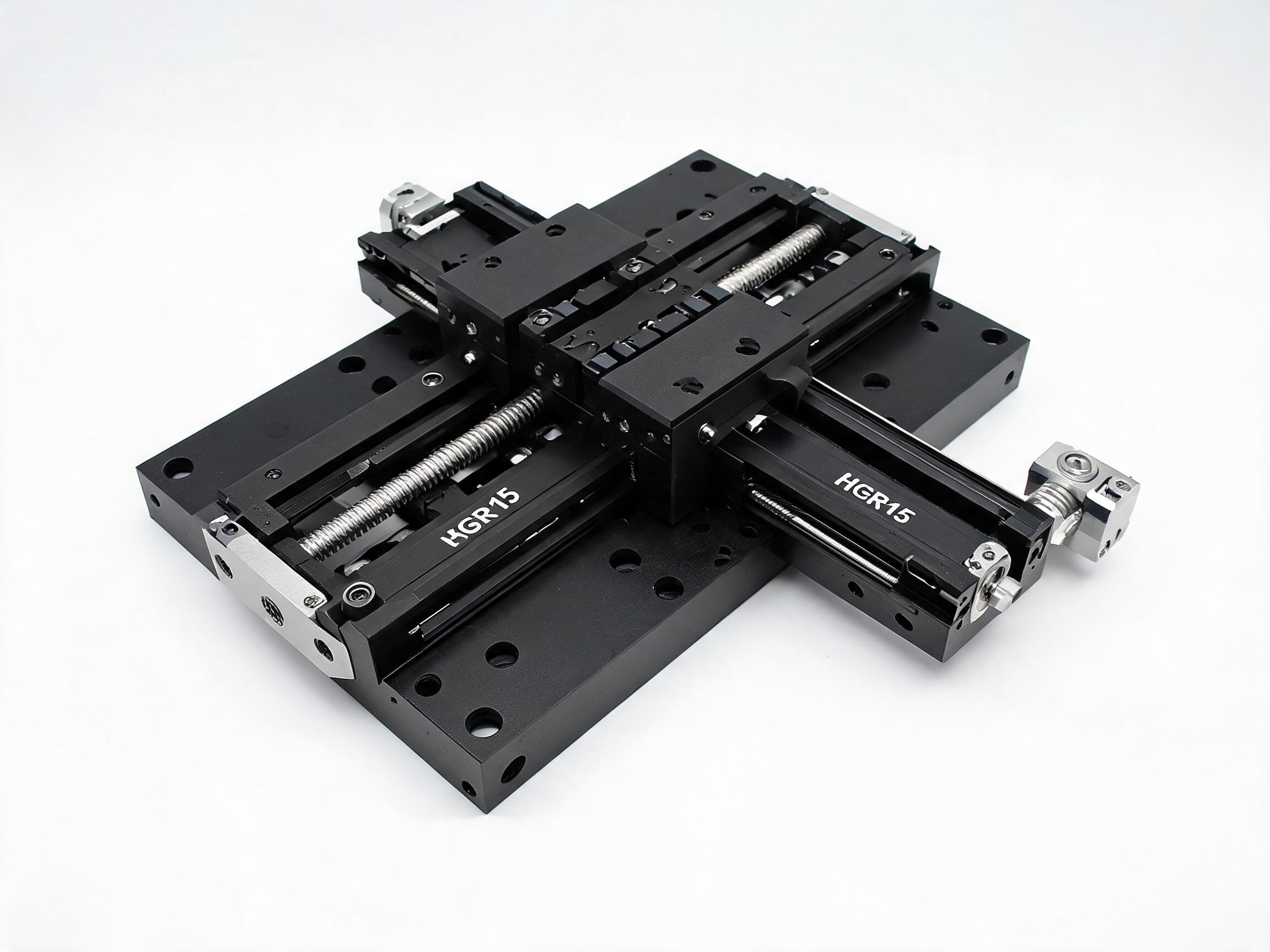
Stroke is where catalog families diverge. The SKF20 module is built on a 2020 T-slot profile base with an HGR15 rail and HGH15CA block and an SFU1605 C7 ball screw. Its standard stroke range is 100 to 500 mm, with 1000 mm available as a custom length. If your axis falls inside that band, the catalog covers you.
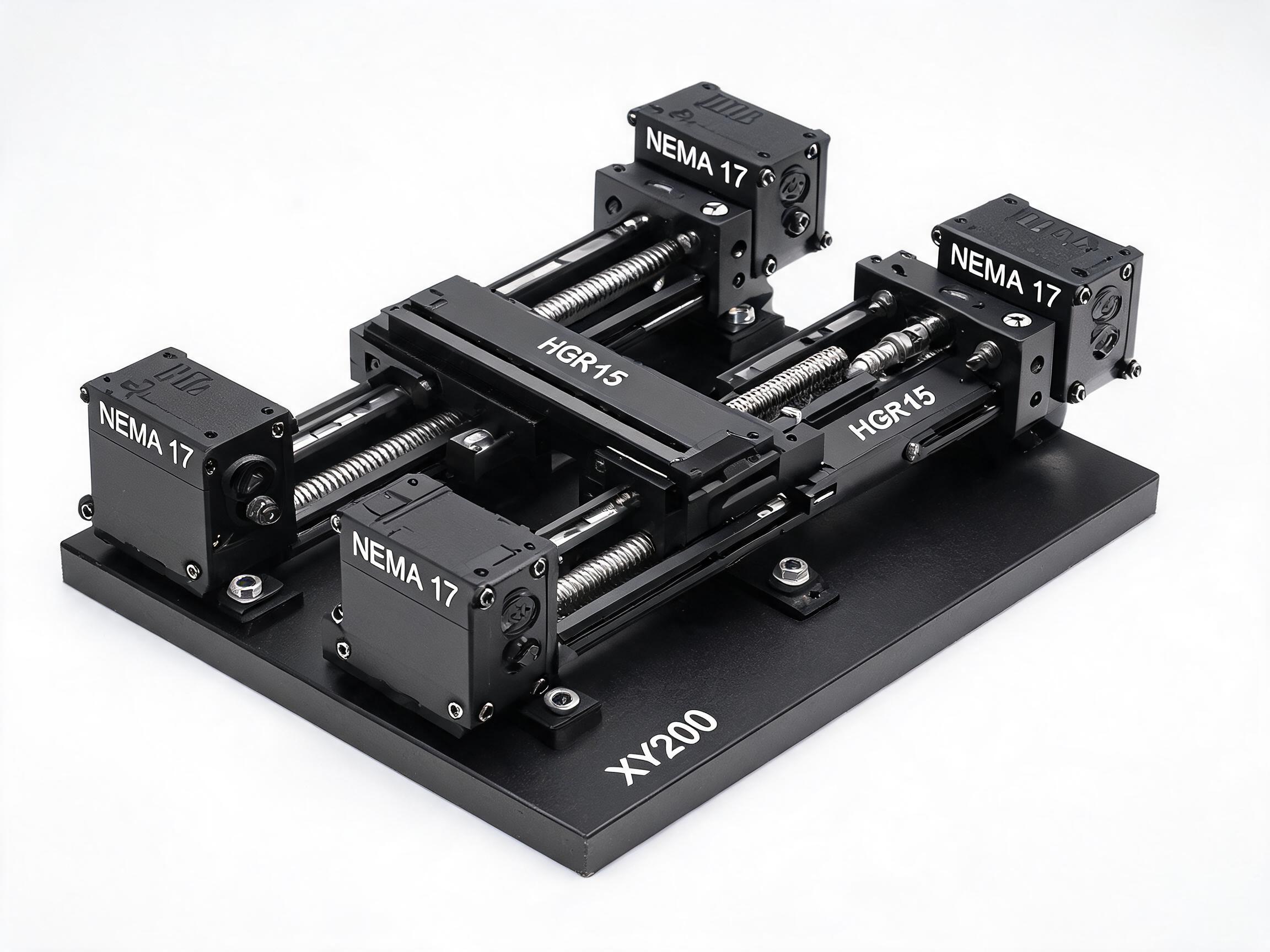
The XY200 precision cross slide table shows the same components arranged on two axes. Each axis has 200 mm of travel, with 100 to 500 mm available as custom, and each axis uses an HGR15 rail with an HGH15CA block and an SFU1605 C7 screw. Its two axes are orthogonal to 90 degrees plus or minus 0.02 degrees, verified on a CMM, and the base plate flatness is held within 0.01 mm.
Standalone screw assemblies give you a different way to think about travel. The SFU series rolled ball screw assembly is 16 mm in diameter with a 5 mm lead, and it comes in lengths from 300 to 1500 mm. Lead error is plus or minus 0.05 mm per 300 mm. That figure matters when you are positioning along a long axis and the error budget is tight.
A stroke comparison at a glance
| Item | Standard travel | Custom option | Motion elements |
|---|---|---|---|
| SKF20 aluminium profile linear motion slide module | 100-500 mm | 1000 mm | 2020 T-slot profile base, HGR15 rail with HGH15CA block, SFU1605 C7 ball screw |
| XY200 precision cross slide table | 200 mm per axis | 100-500 mm | HGR15 rail with HGH15CA block and SFU1605 C7 screw per axis |
| SFU series rolled ball screw assembly | 300-1500 mm length | not listed | SFU1605, C7, 5 mm lead |
Read the table as a fit check, not a ranking. A stage with a 500 mm standard stroke and a screw assembly that runs to 1500 mm solve different problems.
Load and rigidity: read the number with its axis
Load ratings on a linear module are stated per axis, and that distinction is easy to lose in a comparison. The SKF20 module carries a dynamic load of 11.2 kN and a static load of 17.5 kN, and it weighs 2.8 kg. The XY200 table is rated at 11.2 kN dynamic per axis, with repeatability of plus or minus 0.01 mm. The SFU series screw assembly carries a dynamic load of 6.8 kN and is made of GCr15 hardened to HRC 58-62.
Two practical points follow. First, compare dynamic ratings on the same basis: per axis, per direction, and at the travel you are actually using. Second, when you specify a screw on its own, the nut load rating is one number in a stiffness chain that also includes the rail, the block, and the mounting surface. Buying a screw rated above your load does not by itself make the axis rigid.
Repeatability is the other number worth separating from accuracy. The XY200's plus or minus 0.01 mm repeatability describes how consistently the axis returns to a commanded position; it is not the same as absolute positioning accuracy along the stroke, which also depends on screw lead error and the control system. If a drawing calls for both, ask which figure the design depends on.
Where rigidity actually comes from
Rigidity in a push axis is a system property. The profile base, rail size, block preload, screw support at each end, and the flatness of the surface the module is mounted on all contribute. A base plate held within 0.01 mm flatness, as on the XY200, gives the rail a stable foundation. Bolting the same rail to a twisted plate will undo the module's own precision.
Maintenance access is the second half of this decision. A screw-driven module exposes the screw, rail, and block, so you can inspect and lubricate them as part of normal machine service. A packaged actuator hides the screw inside its housing, which protects it from chips and dust but also means service follows the actuator maker's procedure. Choose the arrangement you can actually maintain on the floor, not the one that looks tidiest on a catalog page.
When a packaged actuator is the better buy
A stage is not automatically the right answer, and it is worth saying where a screw-driven module is the wrong one:
- The axis must arrive as a single tested unit. If your machine ships with the thrust device as a line item and you do not want to integrate motor, coupling, and screw, a packaged actuator reduces what you have to specify.
- Your motion platform is fixed. If controls, cabling, and spares are all standardized on one actuator family, introducing a NEMA-based module adds a second platform to support.
- The environment demands an enclosed screw. On dust, chip, or washdown-prone machines, an enclosed rod-style actuator can simplify guarding.
- Travel is short and the load moderate. A packaged actuator is often the efficient shape for a short push where the mounting envelope is already defined.
- You are not equipped to align an axis. A module requires a flat, stiff mounting surface and a correctly matched motor. If that work is not available, a finished unit is the lower-risk purchase.
Conversely, a screw-driven stage is the wrong answer when the buyer cannot commit to the mounting surface tolerance, when the stroke required far exceeds the catalog range, or when the machine has no room to expose the rail for service. In those cases, a packaged actuator is not a compromise; it is the correct choice.
Building the comparison before you request quotes
A short specification sheet makes supplier conversations faster and quotes more comparable. Include the stroke, the motor frame you intend to use, the orientation of the axis, the mounting surface, and the load at the point of push. If two suppliers quote different products, the sheet tells you whether the difference comes from the screw, the rail, or the drive interface.
For multi-supplier programs, confirm the commercial basics on the same page: SKF20 ships at MOQ 30, the XY200 table at MOQ 20, and the SFU series screw assembly at MOQ 50. Our standard terms include EXW, FOB, DAP, and DDP, and we ship to 50+ countries. Xiamen Dongfeng Bearing has been producing linear motion components since 2014 with more than 200 employees.
Buyer FAQs
Where to buy linear actuators for a machine build?
The fastest route is a supplier who publishes the motor interface, stroke range, and load rating for each model. For a screw-driven axis, that means a linear motion module with a stated NEMA frame. For a packaged actuator, it means a stated control interface. Ask for the datasheet before you ask for the price.
How do I choose between a linear actuator and a ball screw stage?
Answer three questions first: does your machine already standardize on a motor frame, is the required stroke inside the module's standard range, and can you provide a flat, stiff mounting surface? Three yes answers favor a screw-driven stage. Any no answer is worth discussing with the supplier before you commit.
Can I use a NEMA17 motor on a ball screw stage?
The SKF20 module and the XY200 table both accept a NEMA17 interface. Confirm the motor shaft diameter and coupling bore for your specific motor before ordering, because a frame match alone does not guarantee the coupling fits.
What does C7 mean on these ball screws?
C7 is a rolled screw accuracy class. On the SFU series assembly, 16 mm diameter and 5 mm lead, the stated lead error is plus or minus 0.05 mm per 300 mm. That figure lets you estimate position error over a given travel length before you add the control system's contribution.
Is repeatability the same as accuracy?
No. Repeatability, stated as plus or minus 0.01 mm on the XY200, describes how closely the axis returns to the same point. Accuracy along the full stroke also depends on screw lead error, mounting, and the drive. Specify the one your process actually needs.
What is the minimum order quantity for these modules?
MOQ is 30 for the SKF20 module, 20 for the XY200 cross slide table, and 50 for the SFU series ball screw assembly. Custom stroke requests should be discussed with the supplier, since longer lengths may change both the lead time and the quotation basis.
Next step: send your stroke, motor frame, mounting orientation, and load point. We will confirm which axis type fits and what it takes to quote.