
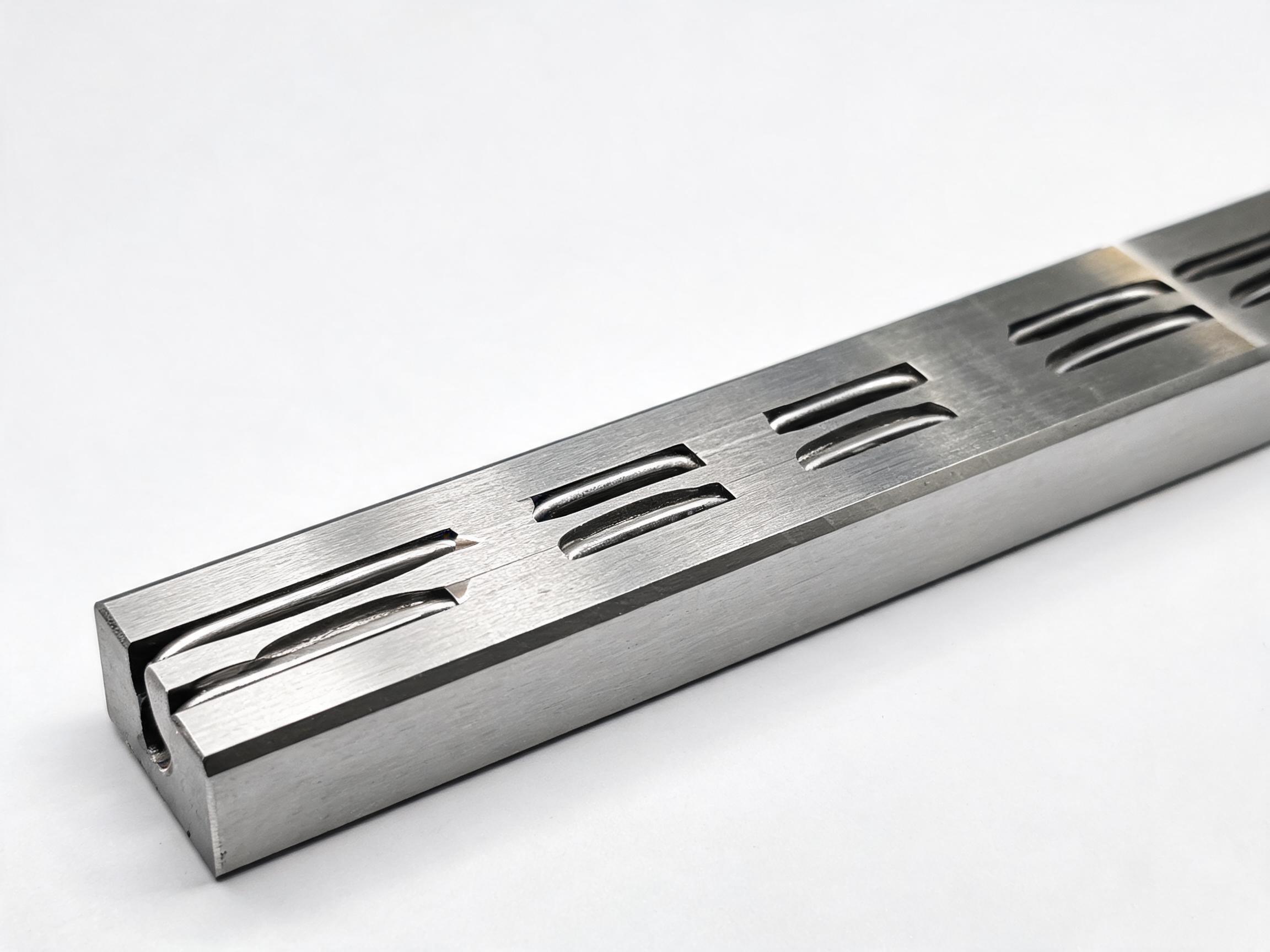
Aluminum linear rail or hardened steel guide? Compare SBR16 shaft-rail, HGR20 profile rail, and SKF20 aluminum module under the same conditions, clear up the T-slot extrusion misconception, and get a load-based selection rule.
Choose aluminum when the rail is part of a lightweight, low-load, cost-sensitive assembly and the moving parts are protected from abrasive dust. Choose hardened steel when the guideway carries high static or dynamic load, long travel, or continuous duty where surface wear decides service life. In shaft-rail systems the two materials are not competitors at all: a hardened steel shaft does the wear work and an aluminum support rail adds stiffness and length.
- Light load, low speed, short stroke, weight-sensitive frame — aluminum support rail or aluminum base module.
- Heavy load, long stroke, continuous reciprocation — hardened steel profile rail.
- Need to span distance on a light frame — hardened shaft plus aluminum support rail.
What aluminum does well — and what it does not
The case for aluminum is usually presented as weight, and weight does matter. A 6063-T5 aluminum support profile is easier to handle, easier to drill and tap on site, and easier to match to a welded or extruded machine frame without fighting corrosion. Anodized surfaces also tolerate humid or lightly corrosive workshop air better than a bare carbon steel mounting face, and fabrication cost is lower because the material machines quickly.
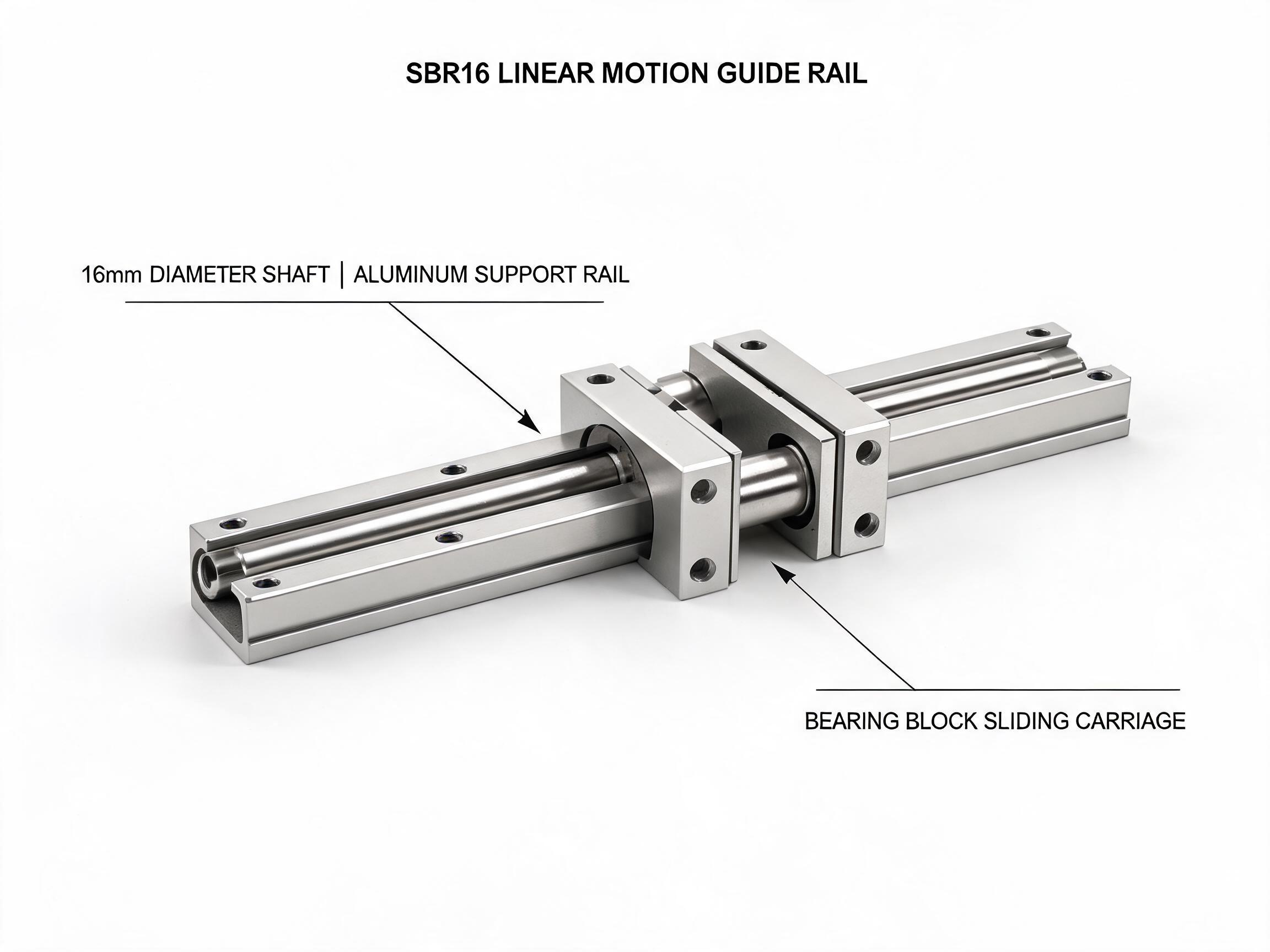
What aluminum does not do is carry rolling contact stress. Aluminum has no hardened raceway surface on its own, so it cannot be the load-carrying surface in a rolling guide. In an aluminum linear rail product that is used on a real machine, the aluminum is doing the structural job — support, length, mounting — while a hardened steel element handles the contact and wear.
The hybrid shaft-rail design, in plain terms
An SBR16 unit makes the division of labor visible. The 16 mm shaft is GCr15, hardened to HRC 58–62 — the same order of hardness used on hardened guideway surfaces. That hardened shaft is the surface the bearing block rolls on, so that is where the wear allowance lives. The support rail beneath it is 6063-T5 aluminum, which gives the shaft a continuous, stiff backbone over full length. Dual-block ratings are 7.8 kN dynamic and 12.0 kN static, with standard lengths to 2000 mm and 50 mm hole spacing for mounting.
This format answers a common machine-building problem: a light gantry or transfer axis needs a long, straight, low-deflection rail path, but the frame is aluminum and the axis is not heavily loaded. A fully hardened profile rail along the same length may be more load capacity than the axis needs, at a higher purchase and mounting weight.
Where hardened steel wins
Profile rails put the hardened surface where the rating comes from. An HGR-series rail uses 55# steel with a surface hardened to 58–62 HRC along the raceway. HGR20 is rated 16.7 kN dynamic and 26.7 kN static, and standard rails are available to 4000 mm. Compared with the SBR16 figures above, that is roughly twice the dynamic rating at a comparable nominal size, and it comes from the raceway geometry and hardened surface rather than from the support structure alone.
The steel option also suits long travel and continuous duty better. Where an aluminum-supported shaft relies on the machined shaft surface to act as the raceway, the profile rail's raceway is hardened and ground, and the block's rolling elements run in a dedicated groove. For high cycle counts, high preload, or closely controlled stiffness, hardened steel is the material doing the functional work — the choice is not a style preference.
See the HGR series heavy-duty linear guideway rail for the profile-rail format and available lengths.
T-slot extrusion is not a precision guide
One confusion is worth clearing up. A T-slot aluminum extrusion is a structural framing profile: slots accept fasteners, and the outer faces are not a rolling raceway and are not specified as a precision guide surface. A carriage that runs directly on an extrusion profile is a positioning aid or a slide, not a rated linear guideway.
That is different from an aluminum base module built specifically as a linear motion unit. The SKF20 uses a 2020 T-slot aluminum base as the module's structure, but the ratings come from the guide assembly inside it: 11.2 kN dynamic and 17.5 kN static. The aluminum profile is the frame; it is not the bearing surface. If a supplier shows an extrusion cross-section and calls it a linear guide, ask what the raceway is and what the rating applies to. A useful comparison point is the SKF20 aluminum profile linear motion slide module, where the profile and the guide function are separate parts of one assembly.
Same conditions, side by side
The table below compares the three formats on the facts that decide most applications. Ratings are per block or per carriage as stated by the product data; do not treat them as interchangeable across different block counts or mounting orientations.
| Format | Load-bearing surface | Dynamic / static rating | Standard length | Fits best when |
|---|---|---|---|---|
| SBR16 shaft + aluminum support, dual block | GCr15 shaft, HRC 58–62 | 7.8 kN / 12.0 kN | To 2000 mm, 50 mm hole spacing | Long, straight path on a light frame; moderate load |
| HGR20 profile rail | 55# steel raceway, 58–62 HRC | 16.7 kN / 26.7 kN | To 4000 mm | Heavy load, long travel, continuous duty |
| SKF20 aluminum base module | Guide assembly in 2020 T-slot base | 11.2 kN / 17.5 kN | Module format | Integrated slide module on extrusion-built machines |
Read the table by material role, not by product name. The SBR16 shaft and the HGR20 rail both use hardened steel where rolling contact occurs; they differ in how the support is built. The SKF20 sits between them in rating while using aluminum as its structural base. A strong aluminum linear rail component and a hardened steel guideway are not the same thing, and the difference shows up in the rating column.
A load-based selection rule
Work from the load case, not from the material name.
- Estimate the actual load per block. Add the moving mass, the payload, and the moment created by any overhang. Moment load often decides the size before the vertical load does.
- Match the rating to the duty, not just the weight. A light load at high cycle count still wears a surface; a heavy load at low cycle count mainly tests static capacity.
- Check the stroke against available length. If the axis needs more than the standard length offers, the rail format and jointing method change the decision.
- Then choose: aluminum support rail when load is modest and the frame is light; hardened profile rail when load, travel, or duty is demanding; an aluminum base module when the machine is already built from T-slot framing and you want an integrated slide.
The SBR16 format covers the middle ground for shaft-rail axes — see the SBR16 linear motion guide rail unit with bearing block for the shaft-and-support construction, block options, and mounting dimensions.
Before you order: confirm exact ratings for your size
Ratings scale with size, block count, and preload class, and the numbers above apply to the named sizes only. Before committing, confirm the specific dynamic and static rating for the size and block configuration you are ordering, the maximum length and how segments are joined, and the mounting hole pattern against your frame drawing. Also confirm whether the rail you are looking at is a rated guideway with a hardened raceway or a structural extrusion being used as a slide.
FAQ
Is an aluminum linear rail strong enough for a CNC axis?
It depends on the axis. An aluminum support rail with a hardened shaft can carry the loads listed for its size, but aluminum on its own is not the rolling surface. Compare the actual per-block load against the published rating for the size and block count, including moment load.
Does aluminum corrode faster than steel?
Anodized aluminum and 6063-T5 support profiles behave differently from bare carbon steel in humid air, but the deciding factor is usually the raceway surface, not the support. For any specific environment, ask the supplier which surfaces are hardened, which are coated, and how the mounting faces are protected.
Can I mount a hardened steel rail on an aluminum frame?
Yes, and this is common. The steel rail carries the rolling load; the aluminum frame carries the rail. Check the frame stiffness and the bolt torque for the rail size, because a soft frame can flex under moment load.
Why is the HGR20 rating higher than the SBR16 rating?
They are different formats at different nominal sizes. HGR20 is a hardened 55# steel profile rail with a ground raceway; SBR16 uses a 16 mm hardened shaft on an aluminum support with a dual-block carriage. Use the rating for the exact size you are specifying.