
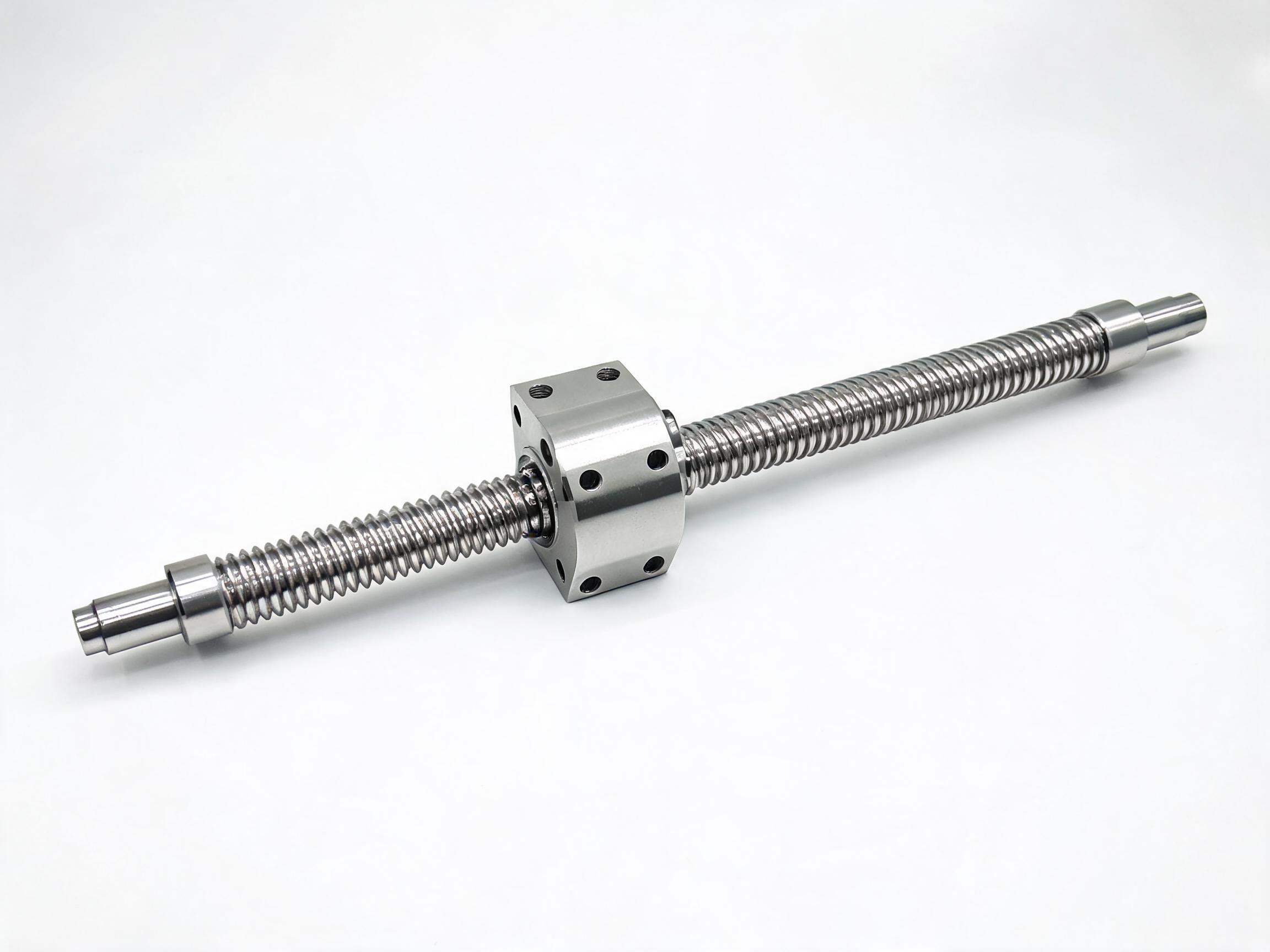
Long ball screws hit an rpm ceiling before anything else fails. Critical speed is the speed at which a rotating screw starts to whip, and it depends on diameter, unsupported length, and end support stiffness. Here's how to choose diameter and support layout for the rpm you need — and when to involve your supplier.
Axis design · Technical explanation
Key takeaways
- Critical speed is the rpm at which a rotating ball screw starts to whip. It is a shaft-dynamics limit, not a lubrication or load limit.
- Three things raise it: larger screw diameter, shorter unsupported length, and stiffer (fixed) end supports.
- The penalty for length is severe — roughly with the square of the unsupported length — so doubling the span can cut the allowable rpm to about a quarter.
- When you order, specify the rpm you need and let diameter and support layout follow from it; confirm exact limits on the datasheet or with the supplier.
- If your required rpm sits near the limit for a long, thin screw, involve the supplier before the drawing is fixed rather than after.
If you are sizing a ball screw axis and the numbers keep telling you a long screw "can't run that fast," the constraint you are hitting is usually critical speed. It is not the nut, not the lubrication, and not the motor — it is the screw shaft itself starting to bow and whirl as it turns. Understanding this limit changes what you specify when you order.
What critical speed actually is
A ball screw is a long, slender rotating shaft. Every rotating shaft has a speed at which its own mass and elasticity produce a self-excited bending vibration — the shaft bows into a whirling shape and the deflection grows. That speed is the critical speed. Below it, the shaft runs true; approach it and vibration rises sharply; run at it and the screw can whip, damaging the nut, the bearings, and the drive.
The important point for axis design is that critical speed is not a fixed property of a model number. It is a property of the whole rotating assembly: the screw diameter, how far apart the supporting bearings are, and how rigidly the ends are held. Change any of these and the limit moves.
What raises the limit
Three design levers control critical speed. All three work in the same direction — they stiffen the shaft or shorten the effective span — and all three should be considered together.
Screw diameter
A larger-diameter screw is stiffer against bending, so it whips at a higher speed. This is why long-travel axes often move up a diameter step even when the load does not demand it. In the SFU series, for example, SFU1605 is a 16 mm screw with standard lengths of 300–1500 mm, while SFU3205 is a 32 mm screw available in lengths of 500–4000 mm — the larger diameter is what makes the longer lengths practical at speed.
Unsupported length
This is the dominant factor, and the one that surprises buyers most. Critical speed falls roughly with the square of the unsupported length. In practical terms: if you double the distance between supports, the allowable speed drops to about a quarter. A screw that is comfortable at high rpm over a short span becomes sluggish over a long one. This is why "the same screw, just longer" is not a safe substitution — the length changes the speed limit far more than linear intuition suggests.
End support stiffness
How the screw ends are held matters too. A fixed (angular-contact, preloaded) support is stiffer than a floating (simple radial) support, and stiffer supports raise the critical speed. In the SFU range, end supports are matched to screw size — BK25/BF25 for SFU2510 and BK32/BF32 for SFU3205 — so the support layout is part of the speed decision, not an afterthought. (We cover fixed versus floating supports in a separate article; here the point is simply that stiffer end fixing raises the limit.)
Why the length penalty grows so quickly
It helps to see why length dominates. The whipping behaviour of a shaft is a bending vibration, and bending stiffness of a slender shaft falls as its span increases. The shaft's own mass also works against it: a longer screw has more mass to accelerate into the whirl. Both effects compound, which is why the relationship is closer to squared than linear.
For the buyer, the practical consequence is that axis length is a speed decision as much as a stroke decision. A machine that needs a long stroke and a high rapid-traverse speed is asking for a large-diameter screw with well-fixed ends — or a different drive arrangement entirely. Short-stroke, high-speed axes are the easy case; long-stroke, high-speed axes are where critical speed bites.
What it means when you order
Critical speed should be specified as a requirement, not discovered as a surprise. The sequence that works:
- State the rpm you actually need at the screw — not the motor rpm, but the screw's rotational speed after the drive ratio. Include the rapid-traverse speed, since that is usually the highest.
- State the required stroke and the bearing span, because unsupported length is what sets the limit. If the span is not yet fixed, say so; it is a design variable.
- Choose diameter and support layout for that rpm, rather than choosing a screw and then checking whether it survives. If the required rpm is close to the limit for your length, move up a diameter or stiffen the ends.
- Confirm the exact limit from the datasheet for the specific screw and support configuration. The relationships above tell you which way to move; they do not replace the published figure.
For a long, heavy-duty axis, a screw like the SFU3205 heavy-duty rolled ball screw — 32 mm diameter, 500–4000 mm lengths, matched to BK32/BF32 supports — is the kind of starting point that gives a long span more speed headroom than a 16 mm screw can. For shorter axes, the SFU series rolled ball screw assembly covers C7 (per ISO 3408), GCr15 steel at HRC 58–62, with SFU1605 standard lengths from 300 to 1500 mm.
Other limits that interact with critical speed
Critical speed is not the only ceiling, and a screw that passes the critical-speed check can still be limited elsewhere. The nut's own speed rating, the DN value (diameter × rpm) that governs lubrication and heat, and the drive's torque at speed all matter. These are separate limits with separate data; do not assume that clearing critical speed clears them all. The practical approach is to check each against the datasheet for the specific screw and nut, and to treat the lowest one as your axis ceiling.
Noise is sometimes mentioned alongside speed. In one bench measurement, SFU1605 ran below 55 dB at 600 RPM — a data point for that configuration, not a general speed or noise guarantee. Use it as context, not as a rating.
When to involve the supplier
Involve the supplier before the drawing is frozen when any of these is true:
- The required rpm is close to the critical-speed limit for your stroke and diameter.
- The axis is long and the stroke is fixed by the machine envelope, leaving little room to shorten the span.
- You are considering moving up a diameter, which changes nut size, housing, and support dimensions together.
- You are unsure which limit — critical speed, DN, nut speed, or drive torque — is the binding one.
These are exactly the cases where a supplier can tell you what the specific screw and support combination will do, and where changing the design after the fact is expensive. The SFU series carries an 18-month warranty, which is a reason to get the configuration right at order stage rather than to rely on it later.
FAQ
Does a longer screw always have a lower critical speed?
For the same diameter and support layout, yes — the unsupported length is the dominant factor and the penalty grows roughly with the square of the length. Changing diameter or support stiffness can offset part of that, but the length effect is strong.
Can I just run below critical speed and ignore it?
Running below it is the normal condition. The issue is margin: if your required rpm is close to the limit, small changes in span, support stiffness, or assembly can push you into the vibration zone. Specify the required rpm and confirm the margin rather than assuming it.
Does a larger diameter always solve a speed problem?
A larger diameter raises critical speed, but it also changes nut size, inertia, housing dimensions, and cost. It is one lever among three — diameter, unsupported length, and end support stiffness — and the right combination depends on your stroke and required rpm. Confirm the specific configuration with the supplier.
Where do I find the actual critical speed for my screw?
From the datasheet for that specific screw and support configuration, or from the supplier. The relationships in this article tell you which design changes move the limit and in which direction; they do not give you the number. Do not size a long, fast axis from rules of thumb alone.