
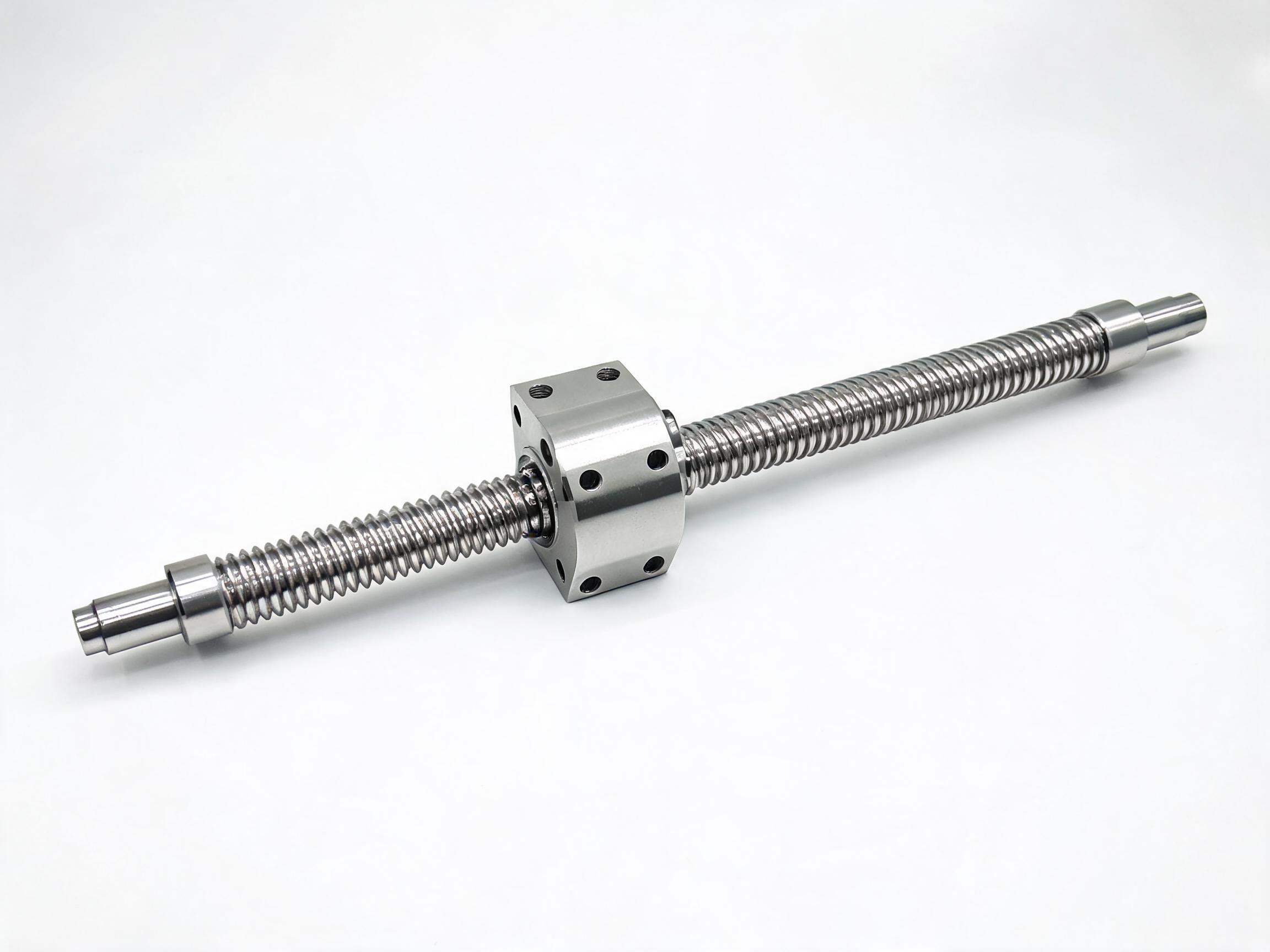
A buyer-oriented guide to selecting ball screw grease versus oil, judging re-greasing intervals from load, speed, temperature and contamination, and avoiding the two most common field mistakes: mixing incompatible thickeners and over-packing the nut.
Lubrication & Maintenance
Choosing between grease and oil for a ball screw is not a brand question. It is a question about speed, duty pattern, and how the machine is actually serviced in the field. Grease is the practical default for most medium- and low-speed, intermittent applications; oil earns its place where speed is high or where a centralized lubrication system already exists. The re-greasing interval, in turn, cannot be fixed from a table alone because it depends on load, speed, temperature and contamination.
What Grease and Oil Actually Do in a Ball Screw
A ball screw carries load through recirculating balls running between the screw shaft and the nut. Lubricant separates those rolling contacts, limits metal-to-metal wear, and helps keep the internal return path free of corrosion. Both grease and oil perform this function. They differ in how long the lubricant stays where it is needed and how easily it can be replenished.
Grease is a base oil held in a thickener structure. It stays in the nut and on the raceway for long periods with very little attention, which suits machinery that runs in cycles and is maintained on a planned service visit. Oil flows continuously and carries heat away from the contact, but it must be supplied, filtered and returned, which is why it is normally tied to a centralized lubrication system.
The two are not interchangeable in a running machine. A ball screw specified with an oil lubrication system should not be switched to grease without confirming with the screw supplier and the machine builder, because the internal geometry, seals and replenishment path were chosen for a flowing lubricant.
Grease or Oil: A Conditional Checklist
Work through the conditions below. The first column is the operating condition you can actually observe or specify; the second is the lubricant form that condition favors. Where a machine sits on the boundary, the existing lubrication infrastructure usually decides the question.
| Condition | Lubricant form that fits |
|---|---|
| Medium to low traversing speed with reversing or start-stop motion | Grease. It stays in the nut between cycles and tolerates pauses in motion. |
| Intermittent duty: the axis moves for part of the shift and rests otherwise | Grease. Replenishment is tied to a planned maintenance interval rather than to continuous flow. |
| Sustained high speed where the contact generates heat continuously | Oil. Continuous flow removes heat and refreshes the contact. |
| Machine already fitted with a centralized lubrication system feeding the axis | Oil. Use the system as designed instead of adding a second lubrication method. |
| Nut position hard to reach for manual service | Oil through a centralized system, or a grease arrangement the machine builder can actually service. |
| Vertical or lightly loaded axis with simple manual maintenance | Grease, applied per the supplier's specification. |
None of these rows is a threshold. The actual permissible speed, load and temperature for a given screw and nut are set by the manufacturer's specification; confirm the limits with the datasheet before fixing the lubrication method. A rolled screw assembly such as the SFU series rolled ball screw assembly will have its own stated lubrication and service guidance, and that document, not a general rule, governs.
Selecting a Grease That Belongs in a Ball Screw
Ball screw grease is not the same category as general-purpose bearing grease for large, slow, heavily loaded shafts. The nut has a narrow internal return path, and an excessively stiff or heavily filled grease can resist being redistributed across the raceway. When specifying, check these points against the supplier's data:
- Base oil viscosity consistent with the application. The correct grade depends on load and speed; take the value from the screw supplier's recommendation rather than selecting by habit.
- Thickener type stated explicitly. You need to know whether the product is lithium-soap, lithium-complex, polyurea, calcium sulfonate or another system, because this decides compatibility with whatever is already in the nut.
- Consistency grade suited to the replenishment method. A grease intended for manual application and one intended for an automatic lubricator are not necessarily the same consistency.
- Cleanliness and compatibility with the seals. Confirm that the grease is compatible with the nut seals and any adjacent components it may contact.
- Corrosion protection where the environment demands it. Damp or washdown-adjacent machines need a grease whose corrosion performance is stated, not assumed.
Write the grease designation into the machine's maintenance documentation at commissioning. A lubrication schedule that says "ball screw grease" without a product identification invites the next technician to use whatever is on the shelf.
When to Re-Grease: Building an Interval You Can Defend
There is no universal re-greasing period for ball screws, and quoting one in hours invites either over-servicing or a seized nut. The interval is a function of four inputs, and each one changes the answer:
- Load. Higher contact stress consumes the lubricant film faster and raises the consequences of any lapse.
- Speed. Faster motion redistributes and can throw grease out of the nut, shortening the time the lubricant stays effective.
- Temperature. Elevated temperature accelerates base oil oxidation and thickener degradation; a cold environment changes grease pumpability and redistribution.
- Contamination. Dust, chips, coolant mist and moisture all shorten service life, and a contaminated nut needs attention sooner regardless of the calendar.
The defensible method is to start from the screw supplier's lubrication specification, apply the machine builder's maintenance schedule, and then adjust based on inspection. Open the nut guard or inspection point at planned intervals and look at the grease: a dry, darkened or displaced film is a reason to shorten the period. Record what you find, because the adjustment should be based on observation rather than on a feeling that the machine has been running a while.
Re-greasing checklist
- Confirm the exact grease product and thickener type from the maintenance record before touching the nut.
- Clean the grease nipple and the surrounding area first; pushing debris into the nut is worse than a slightly late service.
- Apply the quantity specified by the screw or machine supplier, in the manner specified.
- Rotate the screw through its working stroke after application so the grease is distributed, not piled in one place.
- Observe the axis during the first running period for unusual temperature rise or change in sound.
- Record date, quantity, product and observations for the next service decision.
Two Common Field Mistakes
Mixing greases with different thickeners
Two greases can share a base oil viscosity and still be incompatible. When thickener systems differ, mixing can soften the structure, harden it, or cause the grease to drop base oil, and the result is a lubricant that performs worse than either product alone. The safe rule is one identified grease per ball screw unless the grease manufacturer and the screw supplier both confirm compatibility. If you must change products, purge the old grease as far as the nut design allows and confirm the procedure with the supplier, rather than topping up one grease with another.
Over-packing the nut
More grease is not better lubrication. An over-filled nut has nowhere for the excess to go. It can increase resistance to motion, push grease past the seals, and raise running temperature, which in turn shortens lubricant life. The visible symptom is often a warm nut or a change in drive current after a service that was supposed to improve things. Follow the specified quantity. If you are unsure how much a given nut holds, confirm the figure with the screw or machine supplier rather than filling until it looks full.
What to Confirm Before You Specify
For a purchasing decision, the lubrication question resolves into a short list of facts you should hold before releasing an order or commissioning a machine:
- The lubrication method the screw assembly is designed for, taken from its datasheet.
- The grease product designation, thickener type, base oil viscosity and consistency grade that the supplier recommends.
- The permissible speed, load and temperature envelope; confirm with the datasheet instead of assuming a general range.
- The quantity per re-greasing event and the method of application.
- Whether the nut seals and any adjacent components are compatible with the chosen grease.
Where any of these is not stated in the documentation you have, ask the supplier for it in writing. A lubrication schedule built on an identified product and a stated quantity is maintainable across staff changes; one built on "grease regularly" is not.
Reviewing lubrication and maintenance requirements for a rolled ball screw assembly? Start with the published specification and confirm the details that matter to your axis.
View the SFU series rolled ball screw assemblySpeeds, loads, temperatures, grease grades and service quantities vary by screw size, nut design and application. Confirm all values against the current datasheet or the supplier's written lubrication specification before use.