
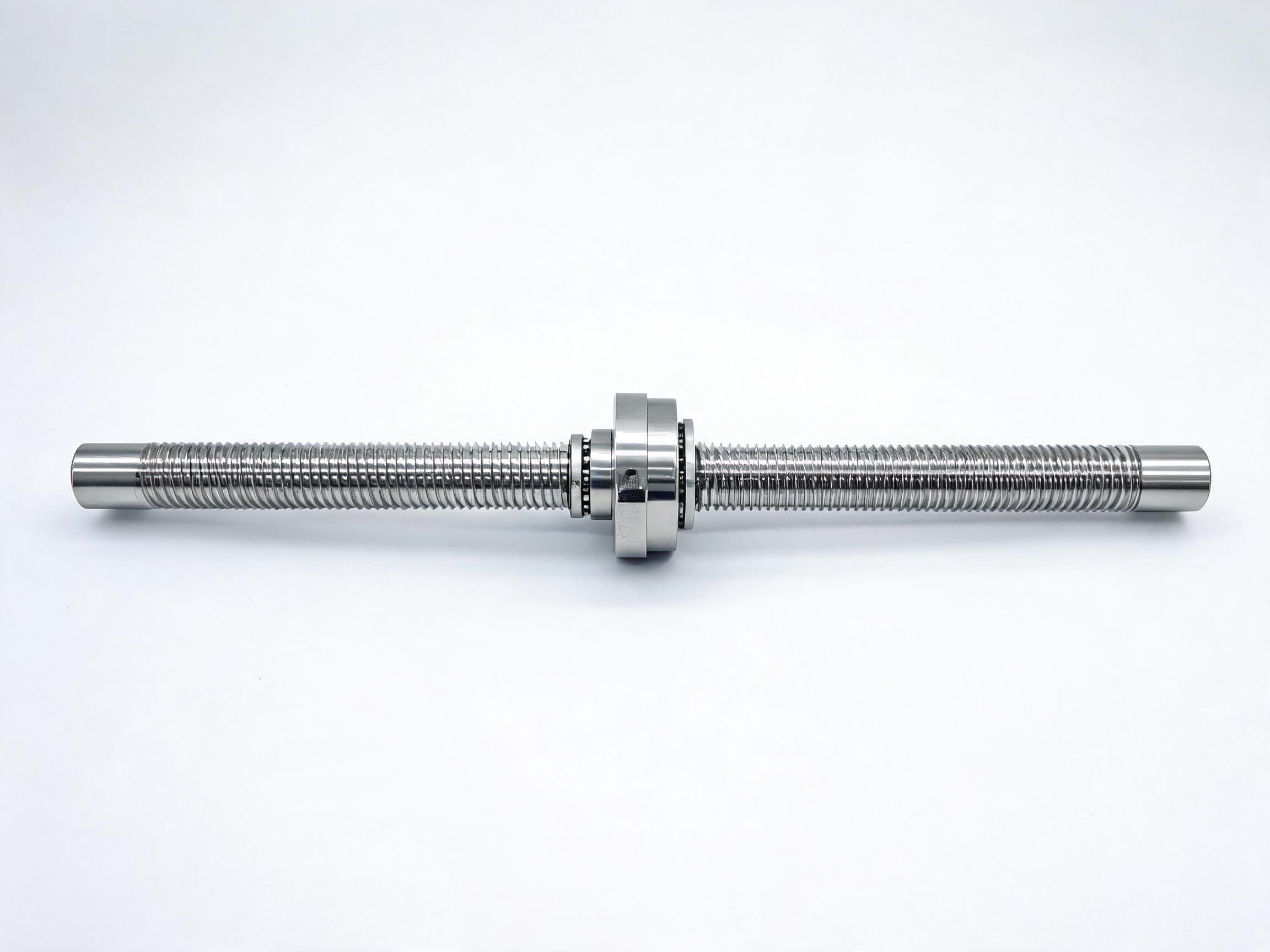
Ball screw shafts are not hardened all the way through. The ball track is induction hardened to HRC 58–62 for wear resistance, while the rest of the shaft stays softer so it can be machined and withstand bending. This explainer covers what the hardness numbers mean, how GCr15 chrome steel contributes, and why the division of hardness matters to overseas buyers.
When a buyer receives a ball screw drawing or quotation, one of the first checks is the hardness callout. It usually reads “HRC 58–62,” and that raises a natural question: is the whole shaft that hard, or only part of it? The answer is part — specifically, the ball raceway. The rest of the shaft is deliberately left softer, and the reason is not cost saving. It is a design requirement.
This article explains what a ball screw surface hardness specification actually controls, how induction hardening is applied to the raceway only, what GCr15 chrome steel contributes, and how this affects wear life and the machinability of end journals.
In this article
What the HRC 58–62 callout means
HRC is the Rockwell C hardness scale, used for hardened steels. A value of HRC 58–62 describes a surface that resists indentation and scratching. In a ball screw, that hardness is specified because the ball track is where rolling contact happens and where wear concentrates.
The number is not a blanket statement about the entire shaft. It applies to the raceway — the helical groove the balls run on. The shaft body, the end journals, and the sections that carry support bearings or couplings are not held to that value.
For buyers comparing quotations, this distinction matters. A supplier that states “hardened to HRC 58–62 at the ball track only” is describing a controlled, localized process. A quotation that lists hardness without specifying where it applies leaves the actual condition unclear and should be clarified before ordering.
Why only the raceway is hardened
The ball track needs hardness for one reason: it takes the repeated load of rolling balls. Under cyclic loading, a soft track deforms and wears, which changes the contact geometry and leads to lost preload, backlash, or noise. A hard track resists that deformation.
But hardening the full shaft body would create a different problem. A shaft hardened through its entire cross-section becomes brittle. Ball screw shafts carry bending loads between support bearings, and brittle shafts are less able to absorb those loads. Over-hardening the whole shaft works against the geometry the screw has to maintain.
Induction hardening resolves both requirements at once. The heat is applied locally to the raceway, then the shaft is quenched. The result is a hard, wear-resistant track on a shaft whose core and ends remain tougher and more workable.
The role of GCr15 chrome steel
The shaft material matters as much as the process. SFU-series shafts, including the SFU2510 and DFU variants, are produced from GCr15 chrome steel — the Chinese designation for the material known internationally as 52100 bearing steel.
GCr15 is a high-carbon chromium steel. Its alloy content allows it to respond to hardening and tempering, which is why it is used for bearing races and ball screw tracks. The material can reach the HRC 58–62 range at the raceway after induction hardening, while the untreated portions keep the base steel’s toughness.
For buyers, the material name on a drawing or quotation is a useful check. GCr15 and 52100 are equivalent designations; a supplier should be able to state which steel is used and confirm it in the datasheet for the specific shaft size ordered.
Hardness and wear life
Hardness at the raceway is a direct input to wear life. The hardened track resists the surface deformation and material loss that rolling contact produces over many cycles. A raceway held at HRC 58–62 gives the balls a stable running surface, which helps maintain preload and positioning accuracy over the screw’s service life.
This is a relationship, not a guarantee. Wear life also depends on load, speed, lubrication, contamination, and the accuracy grade of the assembly. Hardness protects the track; it does not override those other factors. When a supplier offers a raceway hardness figure, treat it as one verified condition of the assembly, not a standalone performance promise.
There is also a practical limit at the top end. Exceeding the specified range at the raceway is not an improvement; it moves toward brittleness without adding useful wear resistance. The HRC 58–62 window reflects a balance, and the supplier should be able to explain how that window is met for the shaft being supplied.
Re-machinability of end journals
The unhardened portions of the shaft are not a byproduct. They have a job. End journals are the sections that fit into bearing supports, couplings, or pulley blocks. In many applications, the buyer or the machine builder needs to modify those ends — turning down a journal, cutting a keyway, adding a thread, or adjusting a shoulder — after the screw is delivered.
A shaft hardened through its full length would make that difficult. Cutting and machining a fully hardened shaft requires different tooling and can introduce cracks. Keeping the journals and body softer preserves the option to re-machine them, which is why the hardness specification is usually tied to the raceway alone.
If a buyer intends to machine the ends, the practical step is to confirm the hardness condition of the journal area before cutting. That is a question for the supplier, answered against the specific shaft drawing and the material state at that location.
How the production sequence works
The order of operations matters because it determines what the hardness applies to and how the geometry is finished. The SFU2510 production sequence illustrates the pattern:
- GCr15 chrome steel bar stock
- CNC turning of the shaft profile
- Induction hardening at the raceway to HRC 58–62, raceway only
- Thread rolling, which forms the ball track by displacement rather than cutting
- Nut machining
- Assembly of the screw and nut
- Lead accuracy measurement
Two points in that sequence are worth noting. First, the ball track is formed by thread rolling — the material is displaced rather than cut, which produces the groove profile. Second, for higher accuracy, grinding after hardening produces the C5 geometry. Rolled screws are typically supplied in C7 grade, while C5 involves grinding after the hardening step.
This is also where buyers should ask a direct question. If a drawing calls for C5, the supplier should describe how the raceway is finished after hardening and how lead accuracy is measured. If the screw is rolled C7, the geometry comes from the rolling process rather than grinding, and the hardness remains at the raceway.
| Stage | What it establishes | Relevant condition |
|---|---|---|
| Material selection | Base steel grade | GCr15 / 52100 equivalent |
| CNC turning | Shaft profile and journals | Pre-hardening dimensions |
| Induction hardening | Raceway hardness | HRC 58–62, ball track only |
| Thread rolling | Ball track form | Rolled C7 geometry |
| Grinding (C5) | Accuracy grade | Post-hardening finishing |
| Assembly and measurement | Lead accuracy verification | Measured before shipment |
Process details above follow the SFU2510 production sequence. Conditions for other shaft sizes should be confirmed with the datasheet.
Key takeaways
- HRC 58–62 applies to the ball raceway, not the full shaft body.
- The raceway is induction hardened for wear resistance; the core and journals stay tougher.
- GCr15 (52100 equivalent) is the base steel used for these SFU/DFU shafts.
- Unhardened journals preserve the option to re-machine ends after delivery.
- Hardness supports wear life but does not replace load, lubrication, and accuracy conditions.
What to confirm with a supplier
Hardness is one line item on a ball screw specification, and it is easy to misread. Buyers can reduce that risk by asking a small set of specific questions before ordering:
- Where does the hardness apply? Ask whether HRC 58–62 refers to the raceway only or the full shaft, and get the answer in writing on the quotation or datasheet.
- Which steel is used? Confirm GCr15 / 52100 equivalence for the specific model, not just the series.
- What accuracy grade is being supplied? C7 rolled and C5 ground involve different finishing steps after hardening.
- Will the journals be machined after delivery? If so, confirm the hardness condition at the journal area and the material state there.
- How is lead accuracy verified? Ask for the measurement step in the production sequence for the ordered shaft.
These are answerable questions for a supplier that controls the hardening and finishing steps. A vague response on where the hardness applies is a signal to look closer at the specification before committing.
Summary
Ball screw hardness is a localized specification. The raceway is induction hardened to HRC 58–62 so the ball track resists wear under rolling contact, while the shaft body and end journals remain in a tougher, more machinable state. GCr15 chrome steel provides the base material that responds to this treatment, and the production sequence — turning, induction hardening, thread rolling, and for C5, grinding after hardening — determines the final geometry and accuracy grade.
For overseas buyers, the practical takeaway is to tie the hardness figure to its location and to the finishing process in the quotation. That keeps the wear surface protected and the ends workable for the installation the screw is going into.