
A selection-stage guide for machine builders who need faster axis travel without giving up positioning accuracy. It explains what lead, heat, lubrication, noise and the preload trade-off actually do to a high-speed ball screw, and compares SFU rolled screws with SFE ground screws on the numbers that matter.
Selection guide
Raising axis speed is usually a lead question before it is a motor question. A longer lead covers more distance per revolution, so the same travel rate arrives at a lower motor speed. That single change moves the heat, lubrication and noise problems downstream of the motor. This guide covers what actually constrains a ball screw high speed application at the selection stage, and where accuracy has to be traded or protected.
What this article answers
- How lead length changes motor speed, resolution and load demand at the same travel rate
- Why heat and lubrication become the limiting factors once speed rises
- How to read noise as an early warning rather than a specification headroom figure
- Where a preloaded double nut costs you heat and where it is worth it
- Concrete comparison points between SFU rolled screws and SFE ground screws
On this page
- Lead first, motor second
- Heat and lubrication: the real ceiling
- Noise as an early warning
- The preload and accuracy trade-off
- Rolled versus ground: comparison points
- Matching the screw to a travel requirement
Lead First, Motor Second
A ball screw converts motor rotation into linear travel at one rate set by the lead. Change the lead and you change the relationship between the motor and the load, without touching the motor.
Take two screws that must move an axis at the same linear speed. The short-lead screw needs more revolutions per unit of travel, so the motor spins faster and the coupling, bearing and nut all see that higher rotation. The long-lead screw reaches the same travel at a lower motor speed. That is the whole mechanical argument for going longer on lead when the application is speed-limited by what the motor and drive can deliver.
It is not free. A longer lead reduces the linear resolution per motor revolution, so for the same encoder count you get coarser positioning steps. It also reduces the mechanical advantage, so the motor needs more torque to move the same load against friction and cutting force. If your axis has a heavy table or a significant process force, the long-lead screw moves the demand onto the motor and drive. A typical layout looks like this:
- Short lead: finer resolution, higher motor speed for a given travel rate, more revolutions per minute at the nut
- Long lead: coarser resolution per revolution, lower motor speed at the same travel rate, higher torque demand from the load
The selection step is therefore to fix the required travel rate and positioning resolution first, then choose the lead that lets a sensible motor reach the travel rate, then check that the resulting torque demand is within the drive. Doing it in the other order produces an axis that either will not hit speed or cannot hold position.
Heat and Lubrication: The Real Ceiling
Speed in a ball screw generates heat where the balls recirculate and where the nut contacts the shaft. As the screw warms it expands. On a screw fixed at both ends or fixed at one end and supported at the other, that expansion has to go somewhere, and it changes the axial position of the nut relative to the commanded position. This is why a machine can be accurate cold and drift warm.
Lubrication is the second half of the same problem. Grease or oil has to reach the load zone on every pass. At low speed, film formation is forgiving. At higher speed, the recirculation rate rises and the lubricant is worked harder and displaced faster. Insufficient lubricant in a high-speed nut raises friction, which raises heat, which raises expansion and reduces clearance, which raises friction again.
What this means at the selection stage is that the choice of nut style, preload and lubrication method should be made together, not separately. A screw chosen for speed with a nut and lubrication arrangement that cannot keep the load zone supplied will not deliver the accuracy it was specified for. The specific maximum operating speed for a given diameter and lead depends on the nut, the mounting and the lubrication, so confirm with the datasheet for your diameter and lead before fixing the drive sizing.
Noise as an Early Warning
Noise is frequently treated as a comfort issue. On a high-speed axis it is better read as a diagnostic. A screw running clean and well lubricated has a repeatable sound signature at a given speed and load. A change in that signature, a rise in level or a new tonal component, usually appears before a measurable positioning error does.
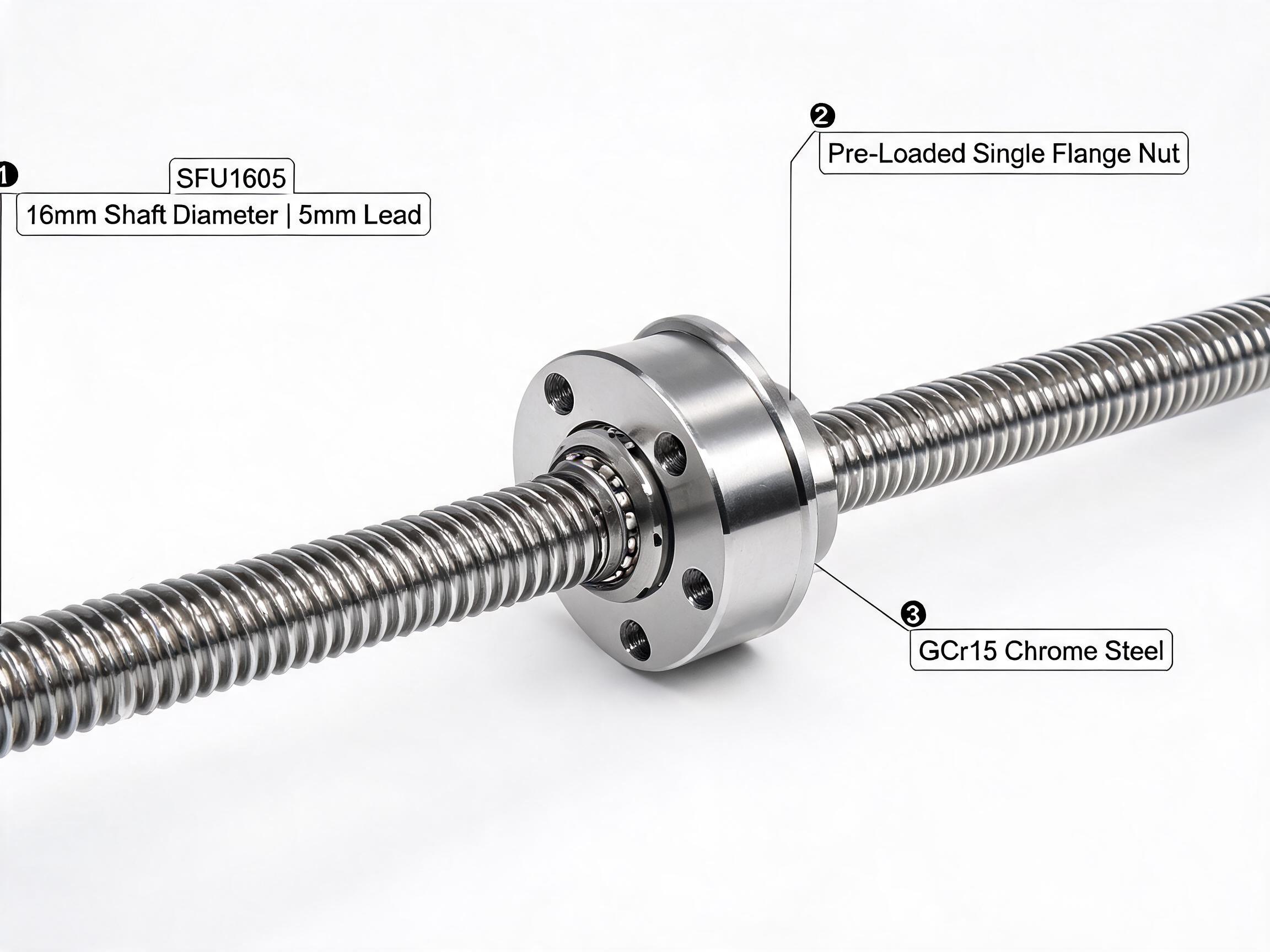
For reference on the level itself, Xiamen Dongfeng measures the SFU1605 rolled screw at below 55 dB at 600 RPM on the bench. That figure is specific to that screw, that speed and that test setup; it is useful as a basepoint for comparing a candidate screw against a known one under the same conditions, not as a promise for other diameters, leads or installations.
In practice, a noise check at commissioning gives you a baseline. Repeat it after the machine has run warm and after lubrication intervals. If the level climbs at the same speed and load, look at lubrication supply and at nut condition before looking at the drive.
The Preload and Accuracy Trade-off
Backlash is the enemy of accurate bidirectional positioning. A preloaded double nut removes it by loading the two nut halves against opposite ball tracks, so the screw is in contact under load in both directions. The cost is real: the preload adds friction at every position, not just during acceleration. More friction means more heat at a given speed, and more heat means more thermal growth.
So the trade-off is not “preload is better.” It is this:
- If the axis must hold position in both directions under reversing load, preload is usually necessary and the heat has to be managed through lubrication and thermal compensation.
- If the axis runs one direction under a consistent load, a lower preload class may run cooler and still meet the positioning requirement.
- If the axis is speed-critical and the accuracy requirement is moderate, a heavier preload may be working against the speed target.
The practical move is to specify the axial play or rigidity the application actually needs, then treat the resulting friction as a known input to the thermal calculation rather than discovering it on the machine.
Rolled Versus Ground: Comparison Points
Two families cover most machine-builder requirements, and the difference shows up directly in the numbers. Rolled screws are formed from wire, then hardened; ground screws have the raceway ground after hardening. The table below gives the figures for the two series as supplied by Xiamen Dongfeng.
| Parameter | SFU Series (rolled) | SFE Series (ground) |
|---|---|---|
| Accuracy class | C7, ±0.05 mm per 300 mm | C5, ±0.008 mm per 300 mm |
| Material and raceway | GCr15, HRC 58–62 | GCr15, ground raceway; raceway hardness per datasheet |
| Dynamic load rating | 6.8 kN | 12.7 kN |
| Axial play | Standard clearance per class | Double nut, axial play below 0.005 mm |
| Axial rigidity | — | 280 N/µm |
| Shaft diameter (journal, example) | — | 20 mm |
| Length range | 300–1500 mm | Per specification |
| Noise (bench) | Below 55 dB at 600 RPM, measured on SFU1605 | — |
Reading the table for a speed application
The accuracy gap between C7 and C5 is roughly a factor of six on lead error per 300 mm. If your positioning budget is generous and the axis is a transfer or pick-and-place motion where repeatability matters more than absolute position, the C7 tolerance is often sufficient and the lower cost per metre of travel is the practical advantage. These are the SFU Series rolled ball screw assemblies, available from 300 mm to 1500 mm.
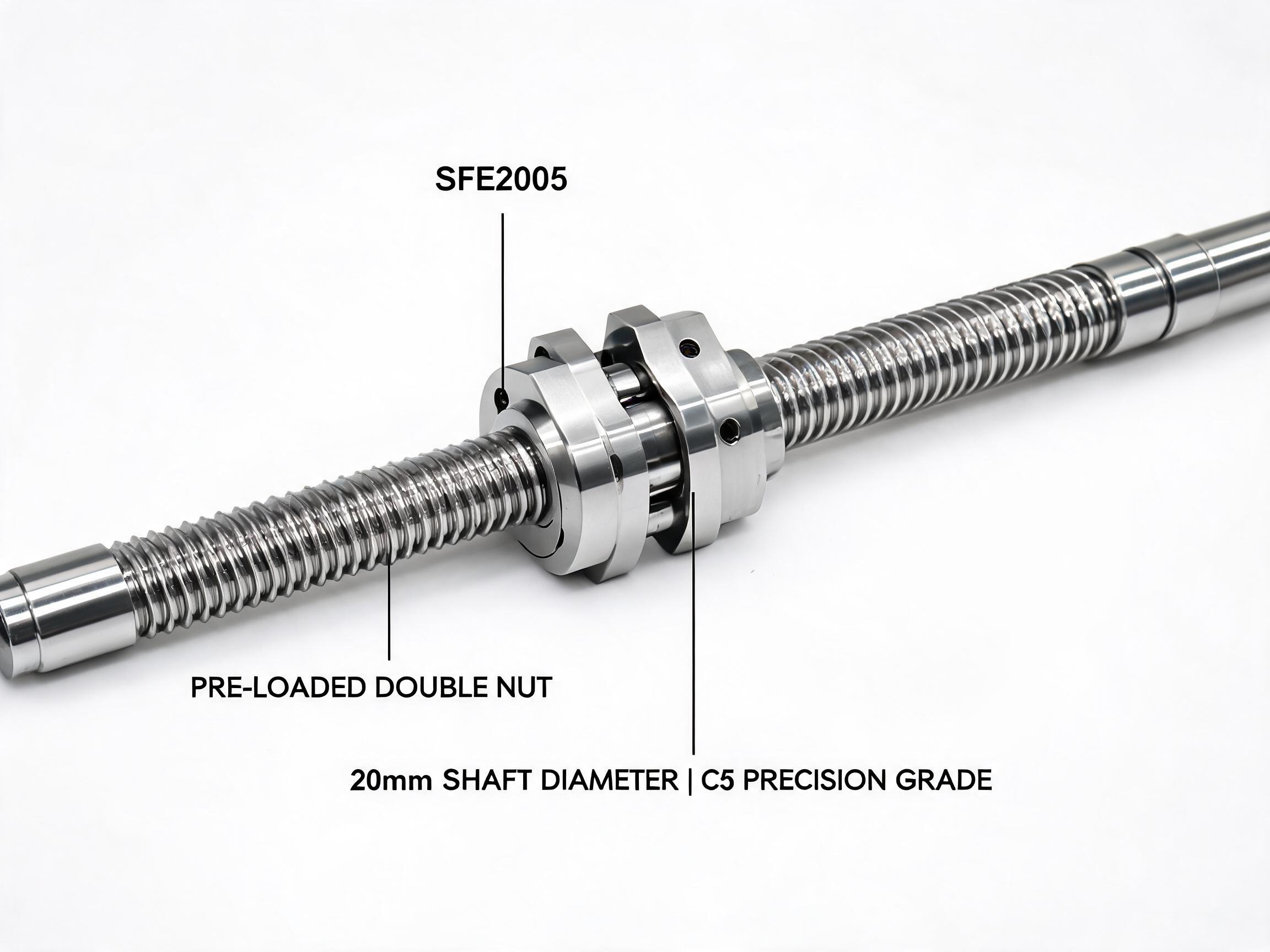
If the axis is a machine tool feed, a metrology stage or any application where the commanded position is the delivered position, the C5 tolerance and the sub-0.005 mm axial play of a preloaded double nut are what make the difference. Higher dynamic load and 280 N/µm axial rigidity also matter on a high-speed axis because they keep deflection under acceleration low. That points to the SFE Series ground ball screw assemblies with a 20 mm shaft diameter (journal).
Notice also what the table does not resolve. Ground screws with a preloaded double nut run with more friction than a standard rolled screw, so at the same travel rate the ground option puts more heat into the screw. On a long, fast axis that can be the decision point. The accuracy advantage is not automatic; it has to be supported by the lubrication and thermal arrangement around it.
Matching the Screw to a Travel Requirement
A worked comparison makes the lead choice concrete. Suppose an axis has to cover 400 mm of travel in 0.8 s, which is 500 mm/s, and must hold position repeatably to a few hundredths of a millimetre. With a 5 mm lead the motor would have to turn 100 revolutions per second to reach that rate; with a 25 mm lead the same travel needs 20 revolutions per second. The long lead is the only one of the two that a typical machine-tool servo will reach at rated speed, and the trade is coarser resolution and higher torque demand from the table mass and process load.
That example is hypothetical, but the structure is what a real sizing exercise looks like. Fix travel rate, fix resolution, then see which lead lets a reasonable motor deliver both, then check the heat and preload consequences. The maximum operating speed for the chosen diameter and lead must be confirmed against the supplier datasheet, because it depends on the nut and the mounting, not on the lead alone.
A short selection checklist
- Required travel rate and required positioning resolution, stated separately
- Table mass and process force, to estimate torque demand at the chosen lead
- Mounting arrangement at each end, because it sets how thermal growth translates into position error
- Lubrication method and interval, matched to the recirculation rate at operating speed
- Accuracy class and preload class, with the friction they add treated as an input
- Noise baseline recorded at commissioning for later comparison
One point to settle with the supplier: the maximum operating speed of any specific ball screw, given its diameter, lead, nut style and mounting, must be confirmed against its datasheet. Sizing the drive before that check is confirmed can leave an axis that meets the accuracy requirement at low speed but cannot reach the required travel rate.
Next Step
If the axis is speed-critical, send the travel requirement, resolution, table mass and mounting arrangement to Xiamen Dongfeng. With those, the lead choice and the accuracy class can be matched against the SFU and SFE ranges, and the operating speed can be confirmed for the specific diameter and lead you select.