
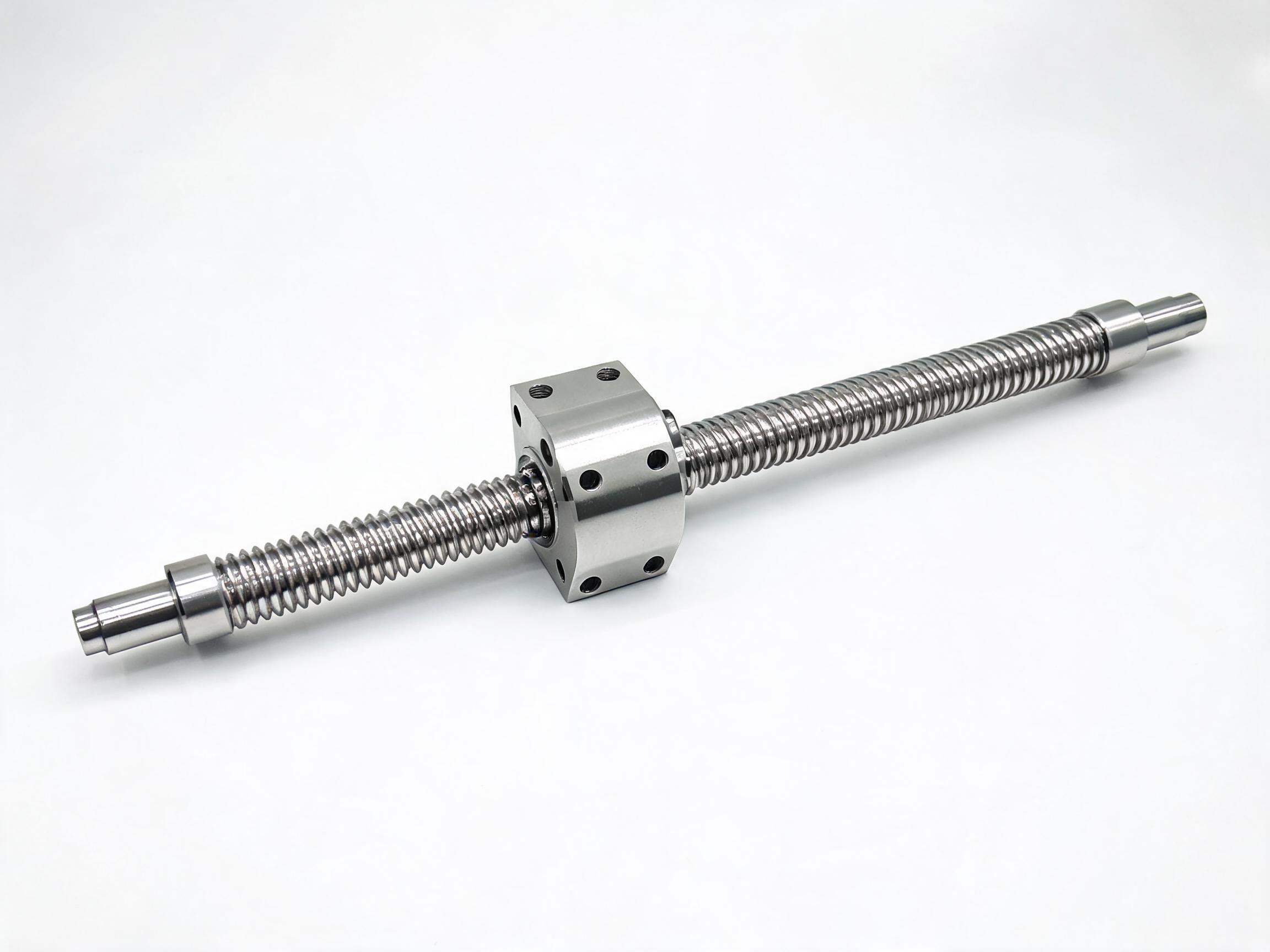
A troubleshooting guide for machine builders and lab-equipment buyers: learn to separate normal ball recirculation sound from warning signs such as dirt, dry running, misalignment and end-support play, and see which fixes actually lower noise, plus honest measured data where it exists.
Troubleshooting guide
A ball screw that hums is doing its job. A ball screw that knocks, grinds or shrieks is telling you something is wrong with the installation, the lubrication or the environment. The difficulty for machine builders and lab-equipment buyers is knowing which sound belongs to which category, because a noisy axis on an open-frame engraver and a noisy axis inside a cleanroom instrument are not automatically the same problem.
This guide separates the normal recirculation sound of a healthy screw from the warning signs that justify stopping the machine, and then covers the fixes that address the most common noise causes: correct lubrication, a clean running environment and properly aligned end supports. Where a measured number exists, it is quoted. Where it does not, that is stated plainly.
Key takeaways
- A continuous soft whir from the ball nut is normal recirculation noise, not a fault.
- Rhythmic knocking usually points to misalignment or end-support play; gritty or dry sounds point to contamination or loss of lubricant.
- The fixes that matter most are lubrication discipline, contamination control and correct support alignment, in that order of effort.
- One measured reference point exists for the SFU1605 rolled screw: typically below 55 dB at 600 RPM in bench testing. Other SFU sizes and the ground SFE series carry no published noise figure; request test data if noise is a design constraint.
What normal ball screw noise sounds like
A ball screw transmits motion through steel balls rolling in a recirculating circuit. As the nut travels, each ball leaves the loaded track, passes through a return channel and re-enters the track. That circulation is continuous while the screw turns, so the sound it produces is continuous too: a soft, steady whir or hiss that rises slightly with speed and is broadly even across the stroke.
This is by design, not a defect. On a small rolled screw running at moderate speed, the sound is quiet enough to sit below normal workshop or instrument-room background. For the SFU1605 rolled ball screw, bench measurements typically show running noise below 55 dB at 600 RPM. That figure is useful context for open-frame engravers and lab equipment, where the axis is often exposed and audibly close to the operator. It is a bench measurement at one speed and one model, not a guarantee for every installation; confirm against the datasheet and your own test conditions.
Two characteristics help you classify a sound as normal before you reach for tools:
- It is steady. The pitch may change with speed, but the pattern does not stutter or repeat at a fixed interval.
- It is position-independent. The sound level at the start of the stroke is close to the level at the end.
Warning signs: four faults and how each one sounds
Abnormal noise almost always has a mechanical or tribological cause. The table below maps the sound pattern to the likely cause and the first check to make. Treat these as diagnostic directions, not confirmed diagnoses; the actual condition has to be verified on the machine.
| Sound pattern | Likely cause | First check |
|---|---|---|
| Rhythmic knock, once or twice per revolution | Misalignment between screw and support, or play in the end-support bearing | Dial indicator on the screw end and on the housing; check bearing preload and locknut tightness |
| Gritty, rasping or scraping | Contamination in the ball track or return channel | Wipe the exposed screw, inspect wipers and the return path, review the sealing and cleaning regime |
| Dry squeal or rising whine that worsens with running time | Insufficient lubrication, or lubricant that has degraded or been washed out | Inspect grease or oil film at the nut; re-lubricate through the nut lubrication port and re-check |
| Loud rumble or vibration across the whole frame | Resonance or looseness in the surrounding structure, not necessarily the screw itself | Check mounting bolts, coupling alignment and frame stiffness before blaming the nut |
Misalignment and end-support play
A knock that repeats at a fixed interval per revolution is the classic alignment signature. The screw is being forced into a slightly bent or offset path, and the ball circuit takes the load once per turn as the high point passes the nut. End-support bearings that are loose, under-preloaded or worn produce a similar effect, sometimes accompanied by visible axial movement when you push the screw by hand.
On machines where the screw is long relative to its diameter, this fault is easy to introduce during assembly and easy to miss afterwards. It is worth checking alignment as a matter of routine before any noise investigation goes further.
Contamination and dry running
Balls and track surfaces are hardened, but they are not immune to particles. Chips, dust and dried coolant that reach the ball circuit get rolled between the balls and the track, producing the gritty, rasping quality that distinguishes contamination from misalignment. Dry running sounds different again: a thin squeal or a whine that grows as the film breaks down. Both faults accelerate wear, so noise here is an early warning rather than a cosmetic issue.
What actually reduces noise
Three interventions account for most real-world noise reduction. They are ordered below by effort, not by importance.
1. Lubrication done properly
Correct lubrication is the single most effective fix for dry-related noise and the cheapest to apply. The SFU series nut has a lubrication port that gives direct access for grease or oil maintenance, so re-lubrication does not require dismantling the axis.
- Follow the lubricant type and interval in the machine documentation, and confirm the recommended grade against the datasheet for your specific screw and duty cycle.
- Re-lubricate before the film breaks down, not after noise appears. Noise is a late indicator of dry running.
- After any cleaning operation that could strip the film, re-lubricate immediately.
- If a screw has been running dry long enough to squeal, re-lubrication may reduce noise but will not undo wear already done; inspect the track and balls if the sound persists.
2. A clean running environment
Contamination control is a design decision as much as a maintenance one. Bellows, telescopic covers and effective wipers keep the ball circuit clean; open-frame machines without them depend entirely on the surrounding environment being clean and on frequent inspection. In dusty or chip-heavy processes, protection at the screw is more reliable than cleaning at the screw.
3. Aligned, correctly preloaded end supports
Correct support alignment removes the once-per-revolution knock and reduces the cyclic loading that drives both noise and wear. Check that the screw runs true, that the bearing housings are seated squarely and that preload and locknuts are set to specification. This is the one fix that often needs a dial indicator and a patient hour, and it is worth both.
On measured numbers: the below-55 dB figure applies to the SFU1605 rolled screw at 600 RPM in bench testing. No published noise figure exists for other SFU sizes or for the SFE ground series; if noise is a specification item for your application, request test data rather than assuming a value.
Where the screw type fits in
Screw construction affects friction, heat and consistency, which in turn affect how stable the running sound stays over long production runs. It is worth being precise about what each series does and does not claim.
The SFU series rolled ball screw assembly is a C7 grade screw with lead accuracy of ±0.05 mm/300 mm, made from GCr15 chrome steel with a ball track induction hardened to HRC 58-62. Its recirculating ball circuit geometry is the basis for the bench-measured running noise of typically below 55 dB at 600 RPM recorded on the SFU1605. For open-frame engravers, lab equipment and general automation where C7 accuracy is sufficient, that is a workable starting point.
The SFE series ground ball screw assembly is ground after heat treatment, reaches C5 grade with ±0.008 mm/300 mm lead accuracy, and its ground thread geometry produces lower friction heat at high feed rates than a rolled screw. That is a thermal and consistency benefit relevant to sustained high-feed operation. It is not a measured noise claim, and this article will not present it as one. Ground geometry and quiet running frequently go together in practice, but without test data for a given screw and installation, treat it as something to verify rather than assume.
A practical noise investigation sequence
When a noisy axis arrives on your bench, work in this order so that you do not chase a symptom while the cause sits elsewhere:
- Listen and classify. Steady whir means normal; knocking, grit or squeal means fault.
- Run the axis slowly by hand where possible. Feel for roughness, binding or axial play.
- Check lubrication first. It is fast, cheap and reversible.
- Check for contamination. Inspect wipers, covers and the visible track.
- Check end-support alignment and preload with a dial indicator.
- Only then consider the screw or nut itself as the source.
If the sound persists after all five checks, the next step is to contact the supplier with the sound pattern, the speed at which it occurs, the lubrication history and the mounting arrangement. That information shortens diagnosis considerably.
FAQ
- Is some ball screw noise always present?
- Yes. The recirculating ball circuit produces a continuous soft sound by design while the screw turns. It is the steady, position-independent whir that indicates healthy operation.
- At what point should I stop the machine?
- Stop when the sound becomes rhythmic, gritty or sharply tonal, or when it changes suddenly. These patterns indicate misalignment, contamination, dry running or structural looseness, and running further risks wear.
- Does a ground screw run quieter than a rolled screw?
- Ground thread geometry reduces friction heat at high feed rates, which is a documented benefit of the SFE series. No published noise figure exists for it, so noise should be verified with test data for your specific application rather than assumed.
- What is the measured noise level for the SFU series?
- Bench-measured running noise is typically below 55 dB at 600 RPM for the SFU1605 rolled screw. This figure applies to that model and test condition only; other sizes should be confirmed against the datasheet for your configuration.
- Can I re-lubricate without dismantling the axis?
- Yes. The SFU series nut includes a lubrication port for grease or oil maintenance, giving direct access without removing the nut from the screw.
If you are specifying an axis where noise is a constraint, tell us the speed, the mounting arrangement and the acceptable sound level. We can confirm which series fits and what test data is available for your configuration.