
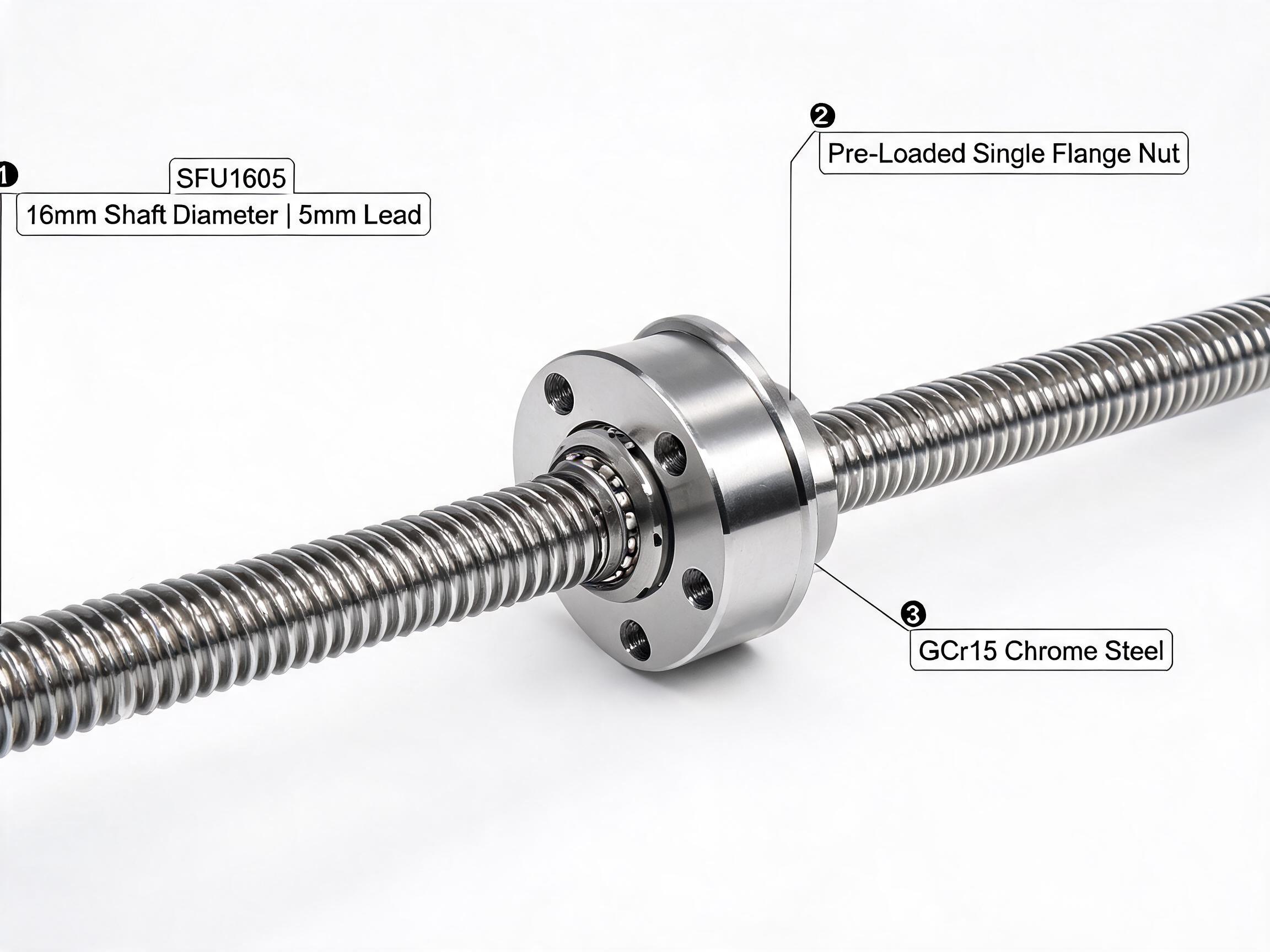
A buyer's guide to ball screw nut dimensions — what each entry on a spec sheet means, which values decide fit and function before ordering, and how ground (SFE) and rolled (SFU) assemblies read differently on paper. Worked examples use the SFE2005 and SFU1605 assemblies.
A ball screw nut dimension sheet is not one number to read; it is a set of values that each answer a different question. Shaft diameter and lead decide what the nut physically is. Accuracy grade and lead accuracy decide what it holds over travel. Flange pattern and mounting holes decide whether the nut bolts onto your housing. Preload and axial clearance decide how the assembly behaves under load. This guide walks through each entry in the order a buyer checks it, using two real assemblies as worked examples.
What matters most before you order
- Match the interface first. Shaft diameter, lead, flange bolt pattern and nut housing compatibility decide whether the part fits at all.
- Read accuracy grade and lead accuracy together. The grade sets the tolerance band; the per-300 mm figure is your positioning over length.
- Know the preload/clearance statement. A preloaded double nut and a single nut are different assemblies, not the same part with a different label.
- Check the mounting-hole detail. Hole count and thread size may be listed; hole diameters and pitch circle often need the datasheet or an inquiry.
Start with the two values in the model name
Most ball screw assemblies encode the two most important dimensions in the part number. SFU1605 reads as a 16 mm shaft with a 5 mm lead; SFE2005 reads as a 20 mm shaft with a 5 mm lead. That naming convention is why buyers often search by model rather than by dimension, but the model alone does not tell you whether the nut will clear your housing or whether the flange holes line up.
Shaft diameter sets the load envelope and the stiffness of the screw body. Lead sets how far the nut travels per revolution — a 5 mm lead on both examples is a fine-lead configuration, meaning more turns per unit of travel and a shorter linear move per rotation of the shaft. What a 5 mm lead means for your machine depends on your drive's rotation speed and the feed rate you need, which is your calculation, not the spec sheet's.
Shaft diameter, lead and length range as a set
Length is a separate entry from diameter and lead, and it deserves its own check because standard length ranges differ between the two assemblies.
| Dimension entry | SFE Series (ground) | SFU Series (rolled, SFU1605) |
|---|---|---|
| Shaft diameter | 20 mm | 16 mm |
| Lead | 5 mm | 5 mm |
| Standard length range | 200–1200 mm | 300–1500 mm |
| Accuracy grade (ISO 3408) | C5 | C7 |
| Lead accuracy | ±0.008 mm/300 mm | ±0.05 mm/300 mm |
| Axial clearance / preload | Below 0.005 mm (preloaded double nut) | Single nut |
| Dynamic load | 12.7 kN (double nut) | 6.8 kN (single nut) |
| Material | GCr15/52100, ground | GCr15 |
If your travel needs more than 1200 mm, the SFE standard range ends before the SFU range does; that is a length-range question, not a diameter question. Read the length entry against your actual stroke plus any over-travel allowance, and treat a length outside the standard range as a separate conversation rather than assuming it is covered.
Accuracy grade and lead accuracy: read them as a pair
Grade C5 (ISO 3408) and grade C7 sit in different tolerance bands. The grade alone tells you the class; the lead accuracy figure tells you how much error you accept per 300 mm of travel. On the ground SFE assembly that is ±0.008 mm/300 mm, and on the rolled SFU1605 it is ±0.05 mm/300 mm.
For a buyer, the practical distinction is this: the per-300 mm value is what you scroll into any positioning-error budget, because it accumulates over length. A ±0.05 mm/300 mm tolerance suits applications where a few hundredths of a millimetre over 300 mm is acceptable; a ±0.008 mm/300 mm tolerance is chosen when that error budget is much tighter. The grade is the shorthand; the lead accuracy is the number you actually add up.
Preload, clearance and the nut type
The SFE assembly is specified as an axial clearance below 0.005 mm using a preloaded double nut. The SFU1605 is a single nut. These are different assemblies, and the dimension sheet is telling you which one you are buying — do not read a preload figure onto a single-nut product.
What preload does in practice is reduce backlash: the double nut arrangement holds the contact so the axial clearance stays below 0.005 mm. Whether you need that level of control depends on whether your machine reverses direction under load and how much reversal error you can tolerate. The dynamic load figures follow the nut type — 12.7 kN for the double nut, 6.8 kN for the single nut — so the load rating on a sheet is tied to the nut configuration printed beside it.
Flange pattern and mounting holes: the entry that trips people
The flange entry is where a spec sheet often gives you the nut type and the hole layout but not the full geometry. The SFU1605 is listed as a flange nut with 4×M4 mounting holes. That tells you there are four holes and their thread size; it does not tell you the hole diameters or the pitch circle.
Those two dimensions — hole diameter and bolt-circle diameter — are what actually decide whether the nut bolts onto your housing without an adapter. They must be confirmed against the datasheet or by inquiry before you commit to an order. A 4×M4 bolt pattern is a useful identification, but two flanges with four M4 holes can still differ in pitch circle.
The same rule applies to the ground assembly: the SFE series uses a metric flange pattern, but the exact flange dimensions are not fixed by the general specification. Confirm the exact flange dimensions per datasheet or inquiry. On the ground line, the assembly is also stated as compatible with standard BK/BF20 end supports and SFE2005 nut housings — that compatibility statement is a strong starting point for the housing side, and still worth checking against your drawing.
Housing compatibility: a compatibility statement, not a dimension
Spec sheets frequently include a line like “compatible with common SFU1605 nut housings.” Read that as a statement about the intended housing family, not as a dimensional guarantee. The SFU1605 nut is designed to fit the SFU1605 housing family; the SFE assembly is designed around SFE2005 nut housings and BK/BF20 end supports.
If your machine already uses a particular housing, the housing model number is the fastest cross-check you can hand a supplier. If it does not, the flange hole pattern and pitch circle become the deciding dimensions, and those belong on the confirmation list.
Ground vs rolled: how the sheet changes
Ground and rolled assemblies do not produce the same spec sheet. The ground SFE Series ground ball screw assembly carries a tighter grade (C5), a tighter lead accuracy (±0.008 mm/300 mm), a preloaded double nut, a stated axial rigidity up to 280 N/µm, and ground GCr15/52100 material. The rolled SFU Series rolled ball screw assembly is listed at grade C7 with ±0.05 mm/300 mm lead accuracy, a single nut, and GCr15 material at shaft hardness HRC 58-62.
The differences you see on paper map to different questions you should be asking. If your error budget is very tight, the grade and lead accuracy entries on the SFE sheet answer it. If you need a broad standard length range and a simple single-nut assembly, the SFU sheet is the one to read. Be careful not to treat the tighter ground values as an upgrade you can just bolt onto a rolled housing — the nut type and housing family are part of the same dimensional package.
Other sheet entries worth reading
- Lubrication. The SFU1605 is lubricated with grease or oil via a nut port. That port is part of the nut's physical layout, so check it does not collide with your housing or guard.
- Dynamic load. 12.7 kN on the double nut, 6.8 kN on the single nut. Compare this with your actual axial load, not with a rule of thumb.
- MOQ. 10 pcs for the SFE series, 50 pcs for the SFU series. This is a commercial entry rather than a dimensional one, but it affects order planning and should be read alongside the length range.
What to put on your inquiry sheet
When you send a request, the most useful thing you can do is separate fixed requirements from open detail. Fixed: shaft diameter, lead, length, accuracy grade, nut type, and housing model if you have one. Open: flange hole diameter, pitch circle, and any mounting detail the sheet does not state.
State the open items as questions, not assumptions. Ask for the flange drawing showing hole diameters and bolt-circle diameter; ask whether the stated housing compatibility covers your specific housing model; ask whether the lead accuracy figure applies across the full length you need. Those three answers close most of the gap between a spec sheet and a part that fits.
Frequently asked
Does the model number tell me all the nut dimensions?
No. The model encodes shaft diameter and lead (SFU1605 = 16 mm shaft, 5 mm lead; SFE2005 = 20 mm shaft, 5 mm lead). Flange hole diameters, pitch circle and housing fit are separate entries that need the datasheet or a direct inquiry.
Is a preloaded double nut always better than a single nut?
They are different assemblies with different stated characteristics: the SFE double nut holds axial clearance below 0.005 mm and carries 12.7 kN dynamic load, the SFU single nut is listed at 6.8 kN. Whether the double nut is the right choice depends on your reversal error budget and load, not on a general rule.
Can I read lead accuracy as total error over the whole screw?
The sheet gives lead accuracy per 300 mm (±0.008 mm for C5, ±0.05 mm for C7). That is the figure to build into a positioning budget over length; if you need the error statement for your full stroke, confirm it with the supplier rather than multiplying blindly.