A ball screw nut housing or bracket locates the nut, carries its load and keeps the screw axis aligned with the driven load. This guide explains what the part does, what to verify when sourcing one — bore fit, flange pattern, mounting holes, lubrication port clearance — and how nut housings differ from BK/BF end supports. It also clarifies a common category mix-up: the KH series sold here is a smooth-shaft linear bearing pillow block (JIS B 1185), not a ball screw nut housing.
A ball screw nut housing (also sold as a ball screw nut bracket) is the part that holds the nut, carries its load and fixes the nut's position relative to the machine frame. It is a small component, but the fit decisions behind it — bore size, flange pattern, hole pitch, lubrication access — determine whether the screw assembly installs cleanly or not. This guide separates what the part does from what you need to verify before ordering, and then draws a line that trips up many first-time buyers: a pillow block linear bearing housing is not a ball screw nut housing.
What a nut housing actually does
A ball screw converts rotary motion into linear motion. The nut is the moving element on the screw; the housing or bracket ties that nut to whatever it drives — a table, a slide, a lifting platform, a pusher. Three jobs follow from that:
- Locate the nut. The housing fixes the nut's position axially and radially, so the load is transferred through a defined interface rather than through the nut body itself.
- Carry the driven load. The housing transmits the nut's thrust to the machine frame. Its own rigidity adds to the stiffness of the joint.
- Hold alignment. The housing must keep the nut concentric with the screw axis. If the housing's bore and mounting face are not square to the screw, the nut sees side loads it was not designed for.
A nut housing does not support the screw's ends. That is the shaft end support's job — more on the difference below.
What to verify when sourcing a nut housing
Specific housing geometries are not universal. Flange diameters, hole pitch and bolt sizes vary between series and makers, so the values on the drawing you receive are the ones that matter. Four checks decide whether a housing will work with the nut you already have, or the nut you plan to buy.
Bore fit with the nut
The housing bore has to match the nut's outside diameter and its locating features — the flange spigot, the shoulder, or the pilot diameter, depending on nut design. Ask for the nut's dimensional drawing and compare it to the housing bore drawing rather than relying on a series name alone. A housing that shares the nut series' designation but not its bore tolerance can still fail to seat.
Flange pattern and hole pitch
The nut's flange carries the mounting holes, and the housing's matching pattern must accept them. The hole count and pitch circle come from the nut datasheet; confirm per datasheet or inquiry before committing to a housing, because the pattern is not standardized across all suppliers. Our SFU series rolled ball screw assembly, for example, uses a flange nut with 4×M4 mounting holes and is stated as compatible with common SFU1605 nut housings.
Mounting holes on the housing side
The housing's own mounting face attaches to the machine. That pattern is a separate interface from the nut flange pattern. Check bolt size, hole spacing and whether the mounting face is machined flat enough to sit against the load bracket without shimming. If the drawing does not state the pattern, request it.
Clearance for the lubrication port
The nut needs grease or oil, usually through a port on the nut body. Your housing must leave that port accessible — not buried under the housing wall or blocked by the load bracket. On our SFU series rolled ball screw assembly, the lubrication point is on the nut, so the housing's relief or cut-out has to line up with it. Confirm the port position on the nut drawing and the corresponding relief on the housing drawing together.
How end supports (BK/BF) differ from nut housings
BK and BF supports are shaft end supports, not nut housings. They hold the two ends of the screw: BK on the motor side with angular-contact bearings for axial fixing, BF on the free end with a simpler radial bearing. A nut housing does none of that. It mounts the moving nut and transfers thrust to the load.
| Feature | Nut housing / bracket | BK / BF end support |
|---|---|---|
| What it holds | The ball screw nut | The screw shaft ends |
| Moves with the load? | Yes — travels along the screw | No — fixed to the frame |
| Load direction | Carries thrust from nut to load | Carries radial and axial shaft loads |
| Key fit checks | Bore, flange pattern, mounting holes, lube port clearance | Bearing bore to shaft journal, housing seat, locknut thread |
| Typical pairing | Any nut of matching bore and flange | BK at driven end, BF at free end |
Because the two are different categories, they are ordered separately. A screw assembly may need both: an end support set at each end plus a nut housing for the nut. Our SFE series ground ball screw assembly is stated as compatible with standard BK/BF20 end supports and SFE2005 nut housings, so the complete installation needs both items and they are specified from the assembly's own datasheet.
Category clarification: the KH series is not a ball screw nut housing
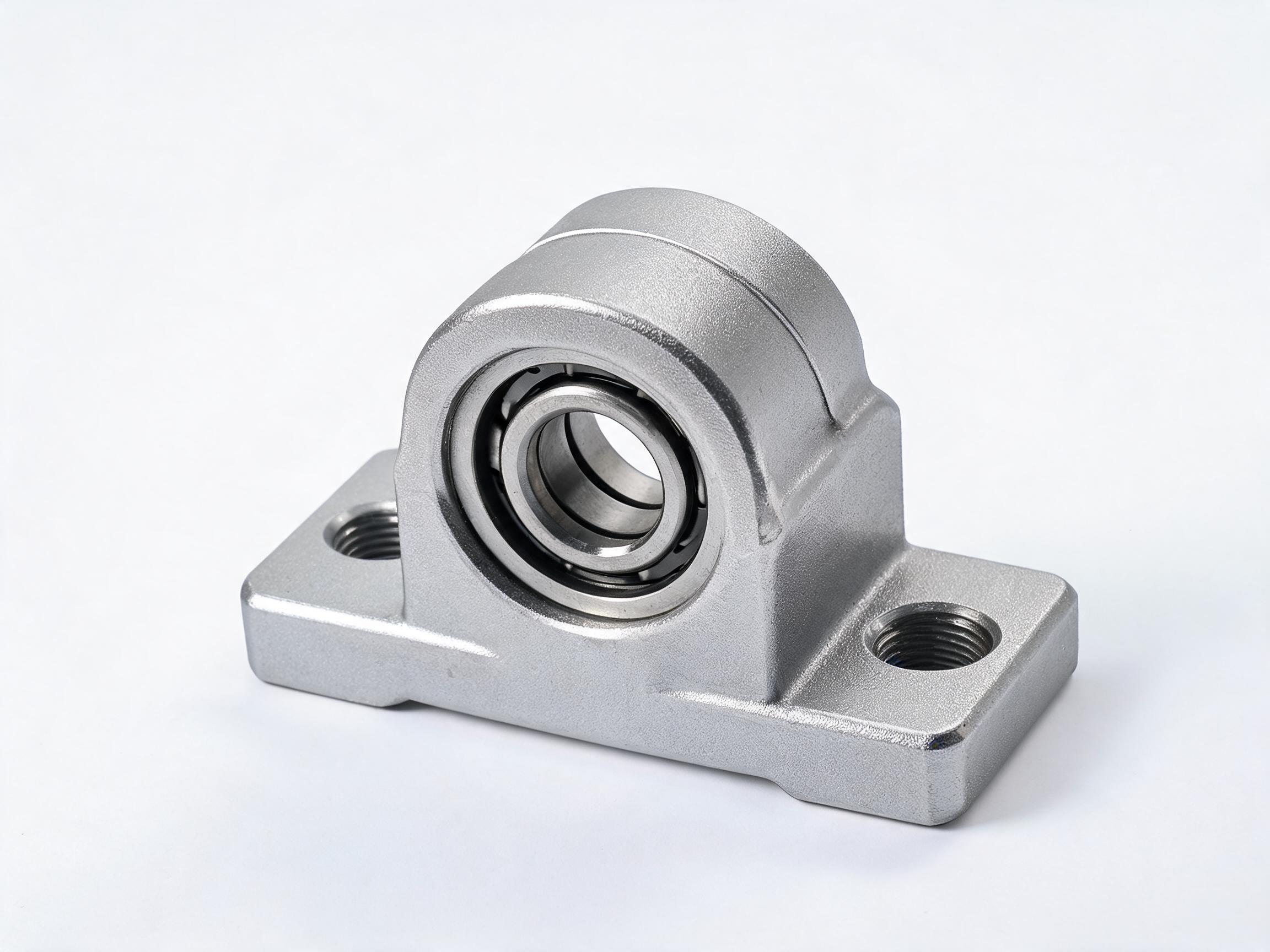
This has to be stated plainly because the two parts look similar in a catalog photo — a bored block with mounting holes — but function differently. The KH series sold on this site is a pillow block linear bearing housing unit: a smooth-shaft linear bearing support, built to JIS B 1185. It is not a ball screw nut housing, and it must not be ordered as one.
- What it is: a 2-bolt pillow block in ADC12 cast aluminum with an anodized finish, supplied with pre-installed sealed LM..UU linear bearings. It is available in KH 8–50, ten sizes, for shaft diameters 8–50 mm. Base bolts are M5/M6/M8; KH16 lists a dynamic load of 980 N; the unit self-aligns ±3°.
- What it does: it supports a smooth shaft running through a linear bearing — the shaft slides through the bearing; the shaft does not rotate to produce motion.
- What it cannot do: it cannot mount a ball screw nut. A ball screw nut is driven by a rotating threaded shaft and has its own flange and bore interface. The KH bore and bearing are sized for a smooth shaft, not for a nut.
If you need a linear bearing pillow block, see the KH series pillow block linear bearing housing unit page for sizes and MOQ. If you need the part that mounts a ball screw nut, that is a different product category and should be specified from the nut datasheet.
How to specify a nut housing in a request
A clear request shortens the back-and-forth. Send the nut's dimensional drawing, and state:
- Nut series and bore interface the housing must accept.
- Flange mounting pattern and hole pitch — taken from the nut datasheet, not assumed.
- Housing-side mounting face pattern and bolt size.
- Orientation of the lubrication port and any relief needed.
- Whether you need the nut, the housing or both as a matched set.
If the nut is already in hand, measure its bore and flange and put the measured values in the request. If the nut is being purchased with the housing, ask for the assembly-level compatibility statement rather than a housing-only quote. Where a dimension is not in the records, the correct instruction is: confirm per datasheet or inquiry — not an estimate.
Quick answer
A ball screw nut housing mounts the nut and transmits its thrust to the load. Verify bore fit, flange pattern, housing mounting holes and lubrication port clearance against the nut drawing. BK/BF end supports are a separate category and hold the shaft ends. The KH series on this site is a smooth-shaft linear bearing pillow block (JIS B 1185) and cannot mount a ball screw nut — order the right category.
Specifications quoted above are as listed for each product series. Housing flange dimensions vary by supplier and should be confirmed against the nut datasheet before ordering.