
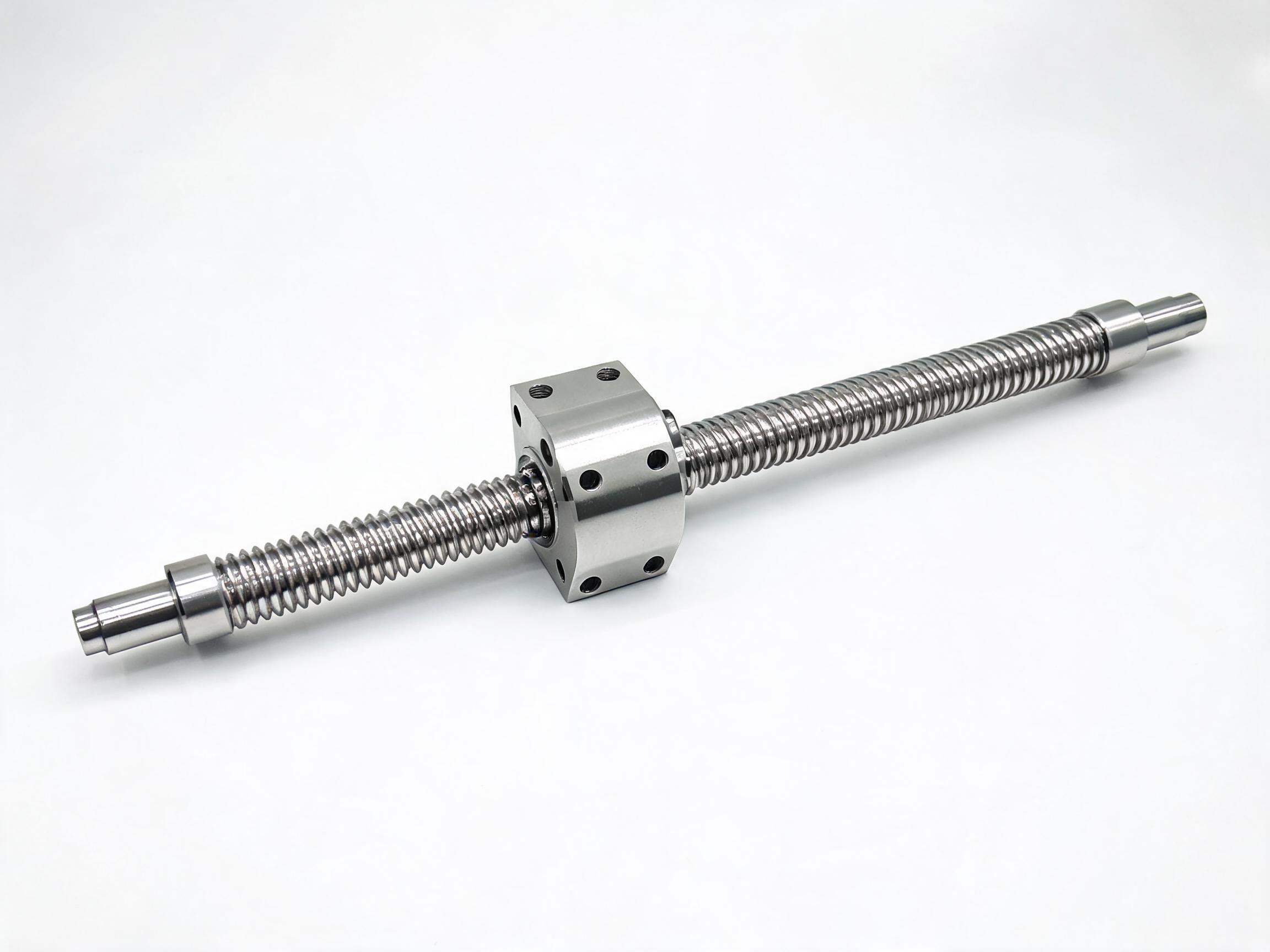
Long ball screws fail in transit more often from bending and corrosion than from handling speed, so the packing specification matters as much as the freight schedule. This article sets out our actual SFU packing methods by shaft length, the straightness checks made before packing, and the points to confirm with a supplier before shipment.
Procurement logistics
Ball screw shipping is where a correctly manufactured shaft can still arrive unusable. A rolled screw that passed its straightness check in the workshop can be bent by a fork-truck tine, or corroded by condensation inside a container, if the packing does not match the shaft length. The methods below are the ones we use on SFU series assemblies, with the lengths and checks that go with each.
- Shafts up to 1500 mm ship in standard export cartons with foam tube protection.
- For shafts of 1501-1999 mm, the packing method and corrosion treatment are confirmed at order stage.
- Shafts from 2000 mm upward ship in custom wooden crates with steel-reinforced V-block supports to prevent bending.
- From 2000 mm upward, each shaft is anti-corrosion oiled and wrapped in moisture-barrier film before crating.
- Straightness is checked before packing: ≤0.05 mm/m on SFU2510 and ≤0.03 mm/m on SFU3205.
- The longest standard shafts (3001-4000 mm) may attract an oversized cargo surcharge by sea freight.
On this page
- Why shaft length decides the packing method
- Packing by length: what arrives in the box or crate
- Straightness before packing, not after
- Sea freight transit ranges by product
- Trade terms and payment terms
- What to confirm with a supplier before shipment
Why shaft length decides the packing method
A ball screw is a slender steel bar carrying a ground or rolled thread and, usually, a nut riding on it. The longer and thinner it is, the more easily it deflects. That is a geometry problem, not a handling-speed problem: a 3000 mm shaft supported only at its two ends can sag under its own weight, and a crate that lets it move sideways during sea transit applies exactly the load the shaft is least able to take.
Short shafts behave differently. Up to 1500 mm, a carton with foam tube protection is enough to isolate the thread from impact and keep the shaft from shifting against other parts in the same box. From 2000 mm upward, cardboard stops being a structural material, and the packing has to supply rigid supports along the shaft rather than just cushioning it; for shafts between 1501 mm and 1999 mm, the packing method is confirmed at order stage.
Corrosion is the second reason length changes the packing. A long shaft presents far more exposed thread surface, and a container crossing climate zones produces condensation. From 2000 mm upward we therefore oil each shaft and wrap it in moisture-barrier film before it goes into the crate, so the barrier is doing its job at the moment the crate is closed.
Packing by length: what arrives in the box or crate
| Shaft length | Packing | Supports | Corrosion protection |
|---|---|---|---|
| Up to 1500 mm | Standard export carton with foam tube protection | Foam tube cushioning | Confirm against the datasheet |
| 1501-1999 mm | Packing and corrosion treatment confirmed at order stage | Packing and corrosion treatment confirmed at order stage | Packing and corrosion treatment confirmed at order stage |
| 2000-3000 mm | Custom wooden crate | Steel-reinforced V-block supports | Anti-corrosion oil plus moisture-barrier film |
| 3001-4000 mm | Custom wooden crate | Steel-reinforced V-block supports | Anti-corrosion oil plus moisture-barrier film |
Shafts from 2000 mm upward are packed in custom wooden crates with steel-reinforced V-block supports; each shaft is anti-corrosion oiled and wrapped in moisture-barrier film before crating. For shafts between 1501 mm and 1999 mm, the packing method and corrosion treatment are confirmed at order stage.
Cartons for shafts up to 1500 mm
The carton is an export-grade box, and the foam tube is the part that matters. It holds the shaft away from the carton walls and keeps the thread from contacting the nut or any other component packed alongside. For a buyer ordering a short SFU2510 rolled ball screw assembly with flange nut, this is the packing to expect: a boxed assembly rather than an open crate, which also makes onward storage simpler.
Cartons suit air freight and LCL sea freight equally well, and they do not attract the oversized cargo surcharge described below.
Custom crates for shafts from 2000 mm upward
At this length the crate, not the cardboard, carries the load. The shaft sits in V-blocks so it is supported along its length rather than balanced between two ends, and the supports are steel-reinforced so the crate cannot rack and load the shaft as a bending moment during transit.
This is the packing used for a SFU3205 heavy-duty rolled ball screw for CNC machining centers at these lengths. When the crate is opened, expect to find the shaft oiled and wrapped; the wrapping should be removed only when the screw is about to be installed, not on the day it arrives on site.
The longest standard shafts (3001-4000 mm)
These travel in the same custom wooden crates with steel-reinforced V-block supports, with the same anti-corrosion oil and moisture-barrier film. The additional point for procurement is commercial rather than mechanical: an oversized cargo surcharge may apply for the longest standard shafts on sea freight. It is worth asking for that surcharge to be identified separately in the quotation, so it is not absorbed into an unclear freight line.
Straightness before packing, not after
The packing protects a shaft that has already been checked. Straightness is measured before packing, at ≤0.05 mm/m for SFU2510 and ≤0.03 mm/m for SFU3205. The two figures belong to those two products and are not interchangeable; if straightness tolerance is a decision criterion for your application, take the value for the specific model you are ordering rather than a general figure.
The relationship between the check and the shipping is straightforward. A shaft verified to 0.03 mm/m and then strapped loosely in a crate that flexes is a shaft whose tolerance no longer describes the delivered part. That is why the steel-reinforced supports and V-blocks exist: to keep the verified geometry intact between the inspection bench and your receiving bay.
More specification detail for the wider range is on the SFU series rolled ball screw assembly page.
Sea freight transit ranges by product
Transit ranges differ between product families, and it is more useful to quote them per product than to average them into one figure. The ranges below are sea freight figures for bulk shipments.
| Product | Sea freight to Europe | Sea freight to USA |
|---|---|---|
| SFU2510 | 25-35 days | 18-25 days |
| SFU3205 | 28-35 days | 20-28 days |
These are transit ranges, not production lead time. Production scheduling is a separate subject covered elsewhere; what matters here is that packing and freight planning sit after the shaft is finished and inspected, and the crate specification should be settled before that point so nothing waits at the loading dock for a crate decision.
Trade terms and payment terms
Our trade term is FOB Xiamen. Under FOB, the supplier's responsibility runs to loading the packed goods on board at the named port, and the buyer arranges the main carriage. For a first order this keeps the freight negotiation with the party you choose, while the packing specification remains with us.
Payment terms commonly used are T/T with 30% deposit and 70% before shipment. For orders above USD 20,000, L/C at sight is also used. If your finance team requires an L/C for a smaller order, raise it at enquiry stage rather than after the crate is built.
What to confirm with a supplier before shipment
Most of the packing above is determinable in advance from the shaft length alone. The items that still need a written answer before the goods leave are the ones where a mismatch only becomes visible on arrival.
- Crate dimensions and total shipment volume. The crate for a 3000 mm shaft has to be longer than the shaft, and that extra length affects container loading and, in some cases, the oversized surcharge. Ask for the packed dimensions and gross weight, not just the product dimensions.
- Whether the surcharge is quoted separately. For the longest standard shafts, confirm the oversized cargo surcharge is a distinct line so you can compare freight quotes on a like-for-like basis.
- How the nut is secured. On a crated assembly, ask how the nut is held in position on the shaft, so it cannot travel along the thread during transit.
- Whether the anti-corrosion wrapping should stay on. If the goods will be stored before installation, confirm with the supplier in writing whether the wrapping and oil are intended to remain in place, and for how long, based on the datasheet.
- The receiving condition at your end. A 3000 mm wooden crate needs equipment to lift and open it. Confirm the unloading arrangement at destination before dispatch.
- The straightness figure for the exact model. If the delivered geometry is critical, confirm the applicable straightness value for your order rather than relying on a figure quoted for a sibling model.
Any packing detail not covered above, such as pallet configuration for mixed orders or supplementary wrapping for a specific route, should be confirmed against the datasheet and agreed in writing before production is completed.
If you are weighing a carton-packed short assembly against a crated long shaft for the same machine build, start from the SFU2510 and SFU3205 product pages above and send the shaft length, quantity and destination port; the packing specification and the freight line can then be settled before the goods are packed.