
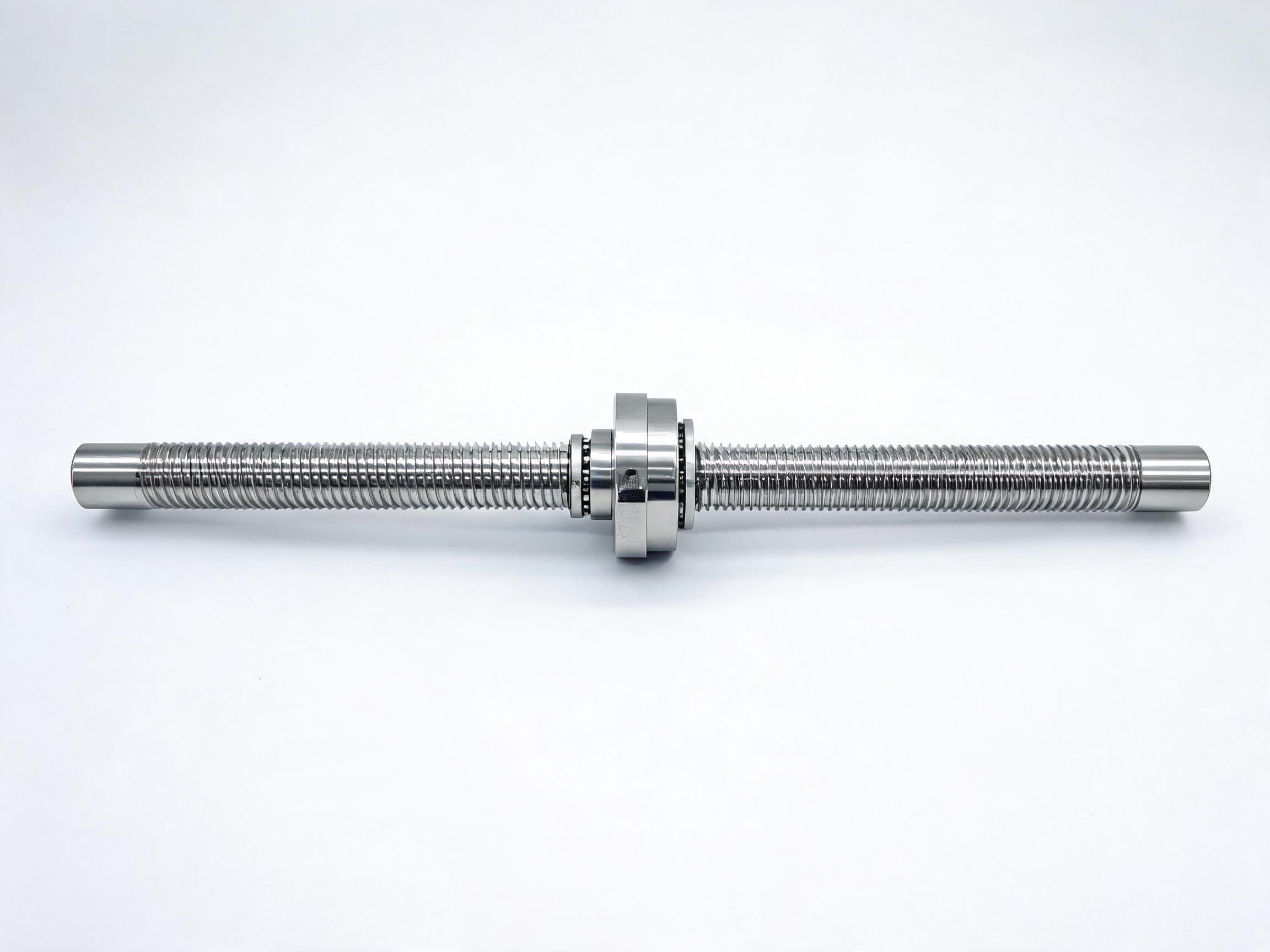
A practical check order for machine builders and maintenance engineers: isolate frame, bearing block and coupling problems before attributing axis vibration to the ball screw, then inspect nut preload feel, shaft straightness and end support, with speed-related resonance examined last.
Machine diagnosis
An axis that shakes during travel sends most builders straight to the ball screw. In many cases the screw is not the source. This check order starts at the machine side, moves to the screw only after the frame is cleared, and treats speed-dependent vibration as a resonance question rather than a component defect.
Key takeaways
- Vibration and noise are different symptoms with different likely causes. A screw can be audible and still run smooth.
- Check bearing block seating, coupling alignment and base flatness before removing or replacing the screw.
- Nut preload feel along the full travel, shaft straightness at the end supports, and bearing block condition point to the screw side.
- Vibration that appears only in a speed band is a resonance question, not a verdict on the screw.
- Where a threshold, tolerance or grade is unknown, confirm it against the supplier datasheet rather than assuming a value.
Check order in this article
First, separate vibration from audible noise
Vibration is felt or measured as movement of the axis, carriage or machine frame. Noise is what you hear. They can occur together, but one without the other changes the diagnosis.
A screw assembly can produce a steady running sound and still be mechanically clean. For reference, the SFU1605 rolled ball screw assembly in the SFU series is listed with bench-measured running noise typically below 55 dB at 600 RPM. That figure describes sound under a stated bench condition. It is not a vibration limit and should not be used as one.
The distinction matters because a builder who hears a screw and immediately replaces it may spend a day on a problem that sits in a loose bearing block or a misaligned coupling. Before any screw work, record where the vibration is felt: the carriage, the screw end, or the machine base. That location is the first useful piece of evidence.
Machine side: check the frame before the screw
The screw transmits motion, but it is held by the machine. Three machine-side conditions can produce axis vibration that looks like a screw problem.
Bearing block seating
Check that the bearing blocks at both ends of the screw are seated flat against their mounting surfaces. A block resting on a burr, paint ridge, or a partially seated dowel pin loses stiffness and can let the screw end move. Confirm the mounting face is clean, the block is fully seated, and the fasteners are tightened to the machine drawing's specified torque. If the drawing does not state a torque value, confirm with the machine designer or the bearing block supplier.
Also check that the block type matches the screw's end machining. The SFU2510 assembly is end-machined for BK25 and BF25 bearing blocks. Pairing a screw with a different block size leaves the end support loose in a way no amount of screw inspection will fix.
Coupling alignment
A motor-to-screw coupling that is angularly or radially misaligned forces the screw to orbit slightly on every revolution. This shows up as a once-per-revolution shake at the drive end and often grows with speed. Check the coupling's alignment with the method its datasheet specifies. Flexible couplings tolerate some misalignment but not unlimited misalignment, and the acceptable figure belongs to the coupling maker, not to the screw.
If the axis vibrates at a frequency that tracks motor RPM closely, inspect the coupling before touching nut preload.
Base and rail flatness
On a long axis, the screw follows the machine base. If the base is twisted or the linear rails are not coplanar, the screw is bent into a curve each time the carriage passes, and the resulting load change reads as vibration. Check the base flatness against the machine drawing, and check that the rails are parallel and level over the full travel.
A quick test is to run the carriage by hand, with the drive disconnected if the design allows, and feel whether the resistance changes in the same place each pass. If it does, measure the base and rails at that position before assuming shaft straightness.
Screw side: preload feel, straightness, end support
Once the machine side is cleared, the screw becomes the likely candidate. Three checks narrow it down.
Nut preload feel along the full travel
A preloaded nut should feel consistent along the whole stroke. Turn the screw by hand, or move the axis slowly, and note whether the resistance changes at a particular band. A tight spot that repeats at the same travel position suggests a shaft geometry problem, a nut load change, or debris on the screw. A tight spot that follows the nut position rather than a fixed screw position suggests the nut itself.
Dongfeng Bearing verifies nut running torque at three points along full travel on the SFU2510 assembly, which gives the builder a baseline for consistent preload feel. If the machine's feel differs sharply from that baseline, confirm the acceptable range with the screw supplier before rejecting the part.
Shaft straightness
Straightness affects vibration because a bent shaft changes the load on the nut once per revolution. The SFU2510 assembly is listed with shaft straightness of ≤0.05 mm/m. That is a catalog specification for that product; the acceptance figure for your machine must come from the machine drawing or agreed with the supplier.
Measure with a dial indicator at the screw mid-span and at the end supports, rotating the screw slowly. Compare the readings to the agreed figure. Record the angular position of the highest reading so you can tell a bow in one plane from a wobble at the support.
End support condition
Inspect the fixed-end bearing block for bearing play, worn seals, and correct axial preload. A worn or incorrectly preloaded fixed bearing lets the screw move axially, which reads as a sharp shake at reversal. Confirm the block's preload setting against its datasheet. Where the preload method is not documented, ask the block supplier rather than adjusting by feel.
| Where the vibration is felt | First check | What would point to the screw |
|---|---|---|
| Drive end, once per revolution, grows with speed | Coupling alignment | Nothing at this stage; clear the coupling first |
| Sharp shake at direction reversal | Fixed-end bearing preload and block seating | Consistent axial play at the screw end after the block is verified |
| Tight band at a fixed travel position | Base and rail flatness at that position | Straightness reading over the agreed figure |
| Resistance varies with nut position | Nut preload feel along travel | Torque feel outside the supplier's verified range |
| Vibration only in a narrow speed band | Speed sweep, checked last | Only if the band persists after support and alignment are verified |
Speed-related resonance comes last
If the vibration appears only within a particular speed range and disappears above and below it, the axis is responding to a natural frequency. The screw, the base, the carriage mass and the motor mount all contribute to that response. Replacing the screw rarely fixes a resonance, because the new screw is mounted in the same structure.
Run a slow speed sweep from low to high and record where the vibration starts and stops. Then change one variable at a time: carriage mass if the design allows, motor mounting stiffness, or an intermediate support on a long screw. Confirm the screw's critical speed from the supplier datasheet, since the safe maximum speed depends on screw length and end support configuration. Where that data is not available, request it before running the axis at higher speed.
Only after the support, alignment and structure are verified should resonance be attributed to the screw itself.
When vibration points to the screw, and when it does not
The screw is the likely cause when the vibration follows screw rotation with a fixed angular position, when running torque varies outside the supplier's verified range, or when straightness measures outside the agreed figure after the base and rails are confirmed good.
The frame is the likely cause when the vibration tracks motor RPM regardless of screw position, when it appears only in a speed band, or when the resistance change repeats at a fixed travel position that corresponds to a base or rail defect. In those cases the screw is reporting a machine problem, not causing one.
Before ordering a replacement, record the vibration location, the speed at which it appears, the travel position if it repeats, and the measured straightness and running torque against the supplier's datasheet. That record lets Dongfeng Bearing or your machine designer confirm whether the screw is within its listed specification, and it shortens the next step either way.
Specifications quoted in this article are catalog values for the products named. Acceptance figures for a specific machine should be confirmed against the machine drawing or agreed with the component supplier.