A same-conditions comparison of ball screws and lead screws for machine builders and automation equipment makers. It covers precision and backlash, efficiency and heat, load and duty cycle, and cost and lead time, then gives if/then selection guidance and a pre-quote data checklist.
Motion Axis Selection Guide
When you specify a linear motion axis, the screw inside it decides how the machine behaves for the next several years. A ball screw and a lead screw can look similar in a catalog drawing, but they are built and priced for different jobs. This comparison keeps the conditions the same — same load direction, same travel length, same mounting arrangement — and only changes the screw type, so you can see where each one actually fits your motion budget.
Key takeaways
- Ball screws use recirculating balls between the screw and nut. They are the usual choice when you need low friction, smooth motion at low speed, and tight positioning with minimal backlash.
- Lead screws use direct sliding contact between the nut and thread. They handle simpler axes where cost and self-locking behavior matter more than positioning accuracy.
- The decision is driven by four variables: precision and backlash, efficiency and heat, load and duty cycle, and cost and lead time.
- No single screw type wins every axis. A machine often uses ball screws on the critical axes and lead screws on secondary ones.
What is a lead screw, and what is a ball screw?
If you are searching what is lead screw or what is ball screw, the short answer is that both convert rotary input into linear motion, but they transfer force differently.
A lead screw — also called a power screw or trapezoidal screw — uses a threaded shaft paired with a matching nut. The nut slides on the thread flanks, so motion depends on the friction between two mating surfaces. That friction is why lead screws can hold position when the motor is unpowered, and why they lose more input energy as heat and wear.
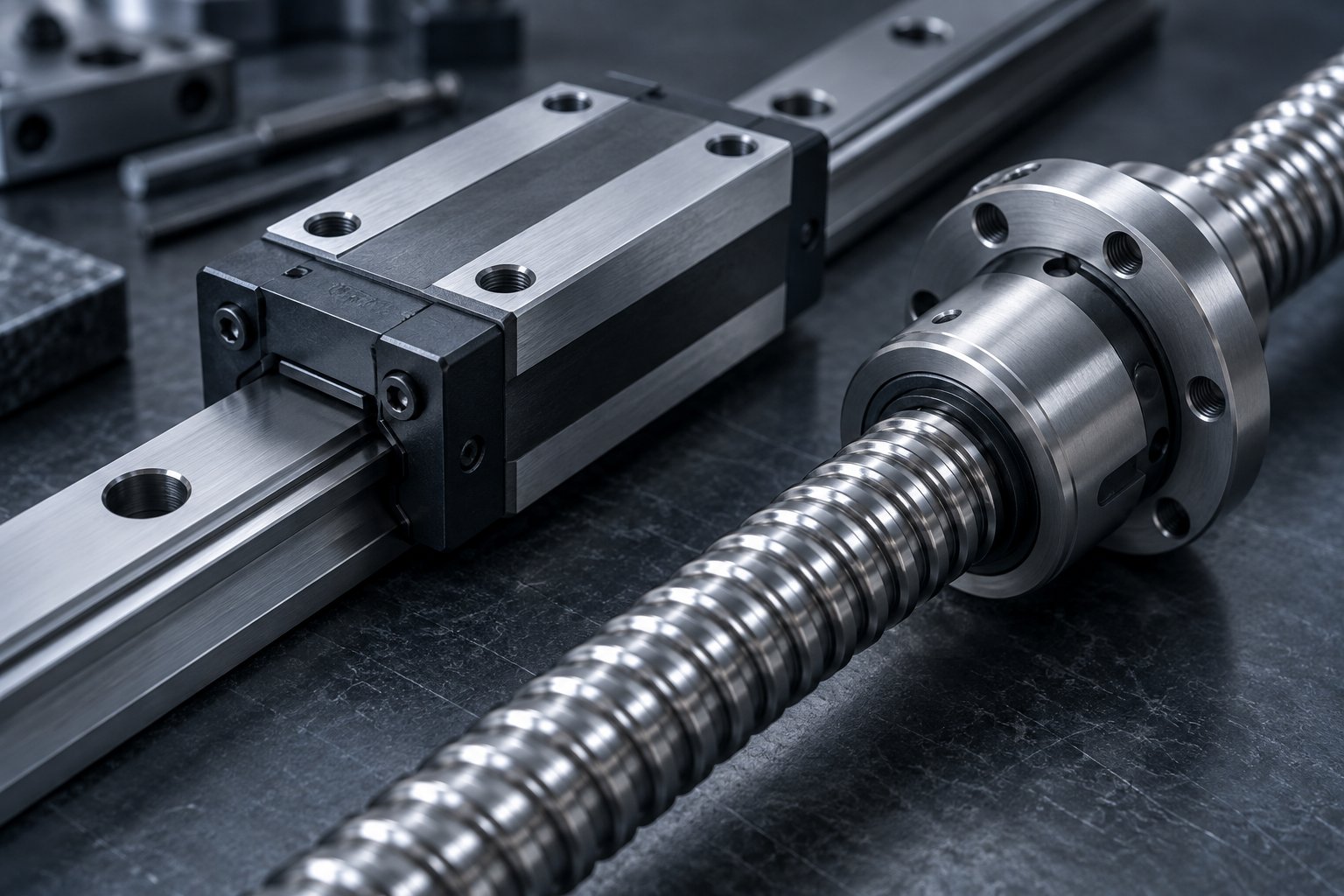
A ball screw places recirculating steel balls between the screw groove and the nut. The balls roll rather than slide, which reduces friction and makes the motion smoother at low speed. The trade-off is a more complex nut assembly and a higher purchase cost.
Both types are made from hardened bearing steel. In the supply chain behind Xiamen Dongfeng Bearing, ball screw shafts are specified in the 58–62 HRC range, verified through SGS material verification, which is the hardness window that supports long rolling contact life. Lead screws are commonly supplied in a lower, more machinable hardness because the nut does the wearing.
Precision and backlash
This is usually the first filter in a how to choose lead screw or ball screw decision.
Ball screw behavior: The rolling contact keeps friction low and repeatable, so a ball screw can be preloaded to reduce or virtually eliminate axial backlash. That makes it the standard choice for CNC positioning, pick-and-place heads, dispensing axes, and any axis where the commanded position must match the actual position after many cycles.
Lead screw behavior: The sliding nut interface wears gradually, so backlash grows with use. Some lead screw designs use an anti-backlash nut that takes up clearance, but the correction is mechanical and has limits. For manual adjustment axes, slow actuators, or non-critical transfer movements, that level of backlash is often acceptable.
Two conditions must match before you compare accuracy numbers: screw length and mounting method. A long screw supported only at the ends will sag and whip; a screw supported at both ends with a pre-tensioned bearing arrangement behaves differently. Ask the supplier for the accuracy grade and backlash specification for your specific length and mounting, because catalog values are not transferable between configurations.
Efficiency and heat
Rolling contact converts more input torque into linear thrust than sliding contact. In practice, that means a ball screw usually needs a smaller motor for the same axial load, or it moves faster with the same motor. A lead screw loses a larger share of input energy to friction, which shows up as heat at the nut and higher required torque.
Heat matters for two reasons. First, thermal expansion changes the effective lead over a long travel, which affects positioning on long axes. Second, sustained heat accelerates nut wear. If your axis runs continuously at high speed, the friction difference between the two designs becomes a duty-cycle and maintenance question, not just an energy question.
Do not estimate efficiency from a rule of thumb. Efficiency depends on lead angle, thread form, lubrication, and load. Ask the supplier for the efficiency value at your actual speed and load, and size the motor from that figure.
Load and duty cycle
Both screw types can carry heavy axial loads, but they fail differently.
- Ball screws are rated by dynamic and static load capacity and by travel life. The rolling elements spread load across many contact points, so a ball screw generally tolerates higher speed and longer continuous duty before replacement.
- Lead screws are limited by the sliding wear rate of the nut. Bronze or polymer nuts are common, and the nut is often the replaceable wear item. For low-speed, intermittent, or low-duty axes, this is a practical and inexpensive arrangement.
Two operating conditions change the answer:
- Vertical axes. A lead screw with a low lead angle can self-lock, holding the load without a brake. A ball screw generally cannot self-lock, so a vertical ball screw axis needs a brake or counterbalance. Confirm this with the supplier before you finalize the drive train.
- Contamination. Chips, dust, and coolant shorten life in both designs. Ball screws need effective wipers and, in dirty environments, a bellows or telescopic cover. A lead screw in a dirty environment needs the same protection plus a nut material selected for the conditions. Never treat either screw as maintenance-free in a machine shop environment.
Cost and lead time
The purchase price gap between the two types is real, but the installed cost is what belongs in your motion budget.
| Cost factor (same axis conditions) | Ball screw | Lead screw |
|---|---|---|
| Screw and nut purchase price | Higher — precision grinding, ball recirculation, preload | Lower — simpler thread and nut |
| Motor and drive size | Often smaller motor for the same thrust | Larger motor or gearbox may be needed |
| Brake or holding device | May be required on vertical axes | Often avoided through self-locking |
| Replacement parts over life | Ball nut or complete screw assembly | Nut, which is usually the wear item |
| Lead time | Driven by grinding, preload setup, and inspection | Generally shorter for standard sizes |
For both types, non-standard lengths, end machining, and custom nut flanges add engineering and inspection time. That is why a quote request should carry your drawing or end-machining details, not just a screw diameter.
Xiamen Dongfeng Bearing has manufactured linear guideways, linear bearings, and ball screws since 2014, and supplies automation equipment makers and machine builders with OEM/ODM custom engineering. The company holds ISO 9001:2015, CE, and SGS material verification, and provides a 24-month warranty. Ask your supplier to state which of these apply to the exact item you are buying, since a company-level certificate does not automatically cover every part number.
If/then selection guide
Read each condition as a starting point, then confirm the final specification against your load calculation and duty cycle.
Choose a ball screw if…
- Your positioning tolerance is tight and you need low, stable backlash over many cycles.
- The axis runs continuously or at high speed, and heat build-up is a concern.
- You want a smaller motor for a given thrust, or smooth motion at very low feed rates.
- The axis is horizontal, or you can add a brake or counterbalance on a vertical axis.
- Downtime cost is high and you want a longer replacement interval.
Choose a lead screw if…
- Positioning tolerance is moderate and some backlash at end of life is acceptable.
- The axis moves intermittently, at low speed, or for short duty cycles.
- You need self-locking on a vertical or inclined axis without a brake.
- Budget and lead time dominate the decision, and the axis is not the accuracy-critical one.
- You want a simple, easily replaced nut as the wear item.
A mixed approach is normal
Many machines use ball screws on the main positioning axes and lead screws on adjustment, transfer, or clamping axes. This is not a compromise — it puts the higher-cost component where its precision is used, and the lower-cost component where it is not.
What to prepare before requesting a quote
A supplier can only recommend a screw type when the operating conditions are on the table. Prepare the following before you ask for pricing or a lead time:
- Axis drawing or end-machining sketch — overall length, thread length, journal diameters, keyways, and thread direction.
- Axial load — continuous and peak, including the direction of the load.
- Speed profile — maximum speed, acceleration, and how often the axis moves per minute or per hour.
- Duty cycle — running hours per day and expected service life in cycles or years.
- Required positioning accuracy and backlash — with the mounting method and support arrangement stated.
- Environment — chips, coolant, dust, humidity, washdown, or cleanroom conditions.
- Drive details — motor type, coupling, and whether a brake is available on the axis.
- Quantity and annual demand — this affects tooling and lead time, and it is the first question a factory will ask for OEM/ODM work.
With those inputs, a supplier can propose a screw type, accuracy grade, nut style, and end machining, and can quote a realistic lead time. Without them, any recommendation is a guess that may cost you a redesign later.
FAQ
Can I replace a lead screw with a ball screw on the same axis?
Sometimes, but the mounting, nut housing, and motor may all change. A ball screw generally needs a different nut envelope and may need a brake on a vertical axis. Check the mechanical interface before assuming a drop-in swap.
Does a ball screw always position more accurately than a lead screw?
Under the same mounting and load conditions, a properly preloaded ball screw gives lower backlash and more consistent positioning. But a poorly mounted ball screw can perform worse than a well-designed lead screw axis. Mounting and support stiffness matter as much as the screw type.
How do I compare a ball screw and a lead screw from different suppliers?
Compare at the same length, the same mounting method, and the same load and speed. Ask each supplier for accuracy grade, backlash, dynamic load capacity, and nut material. If one quote gives catalog values and the other gives application values, they are not comparable.
What does the 58–62 HRC range tell me about a ball screw?
It describes the hardness range of the bearing steel in the screw shaft, as verified by SGS material verification. Hardness within this range supports rolling contact life. It does not by itself define accuracy grade, load capacity, or service life — those come from the finished product specification.
Next step
If you are selecting a screw for a new axis or replacing one that wears too fast, send your axis drawing, load, speed, duty cycle, and required accuracy to the supplier. Ask for the recommended screw type, the accuracy and backlash specification at your actual length, the nut material and lubrication plan, and the replacement interval for your duty cycle. Compare both options on installed cost — motor, brake, housing, and expected replacement — not on screw price alone.