
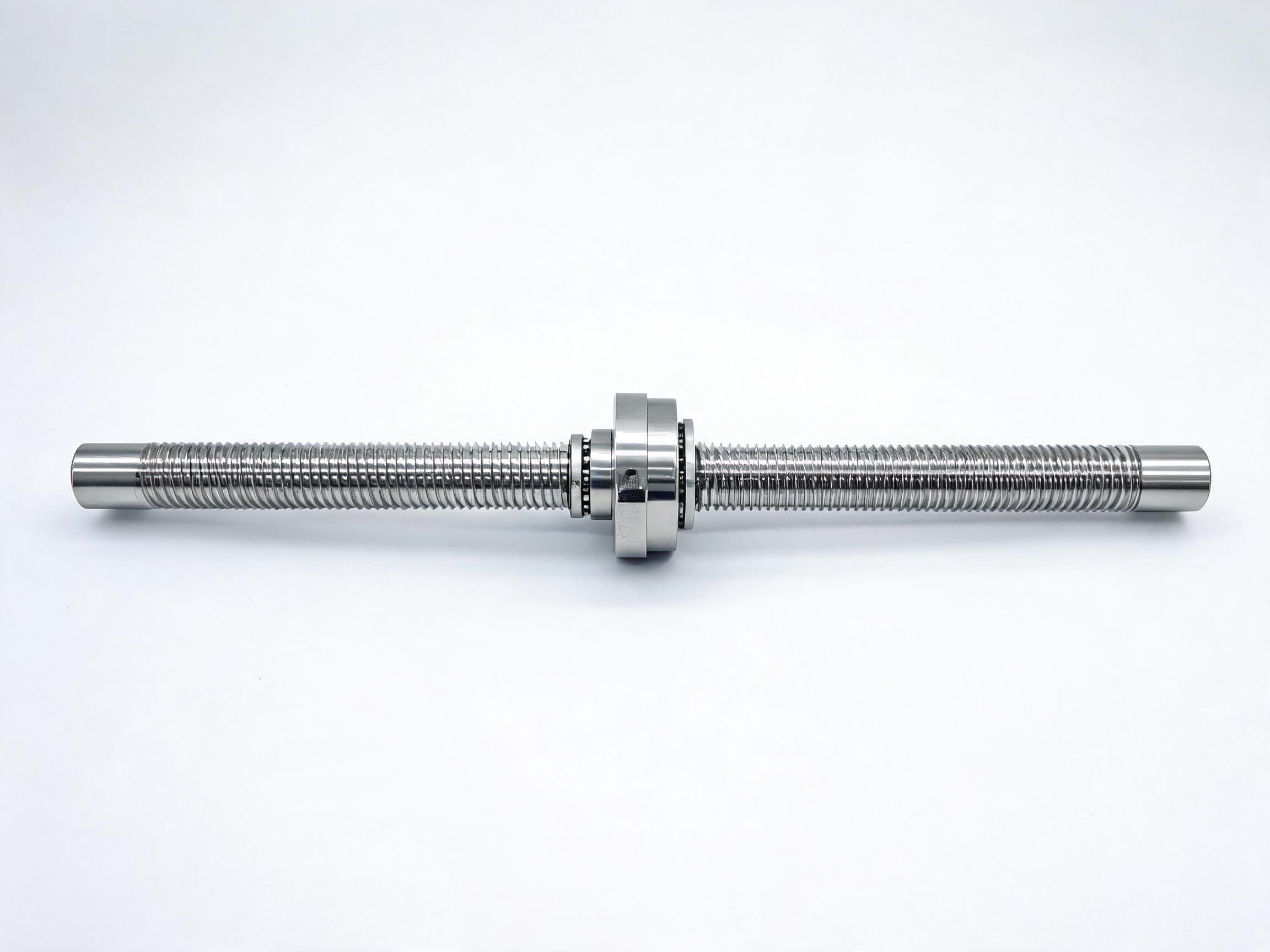
A five-dimension decision guide for linear drive selection — stroke, speed, accuracy, environment and cost — with the correct order of evaluation and the single misjudgement that most often sends buyers to the wrong technology.
Linear Motion Selection
Ball screws and rack and pinion drives both convert rotary motion into linear travel, and both are sold as "linear drive solutions." They solve different problems. This guide sets out the five dimensions that actually separate them, the order in which to check those dimensions, and the one shortcut that most often produces an expensive wrong answer.
The short answer
- Choose a ball screw when the axis needs repeated positioning accuracy, a compact drive package, and a self-contained thrust-bearing arrangement.
- Choose rack and pinion when the stroke is long, the axis moves fast, several axes must stay synchronised, or the machine works in a harsh environment.
- In the middle ground, decide in this order: accuracy and stroke first, then cost. Cost is the last filter, not the first.
Why the comparison is easy to get wrong
The two technologies look interchangeable on a spec sheet because both are described by lead, thrust capacity and backlash. They are not interchangeable in the machine. A ball screw carries its own thrust bearings at each end, turns a short rotary input into a long linear output through a screw shaft, and is delivered as a matched assembly. A rack and pinion drive separates the rotary element from the linear element: the pinion stays on the moving carriage, the rack is fixed to the machine frame, and the drive is assembled on site.
That structural difference is what drives every downstream trade-off. Once you understand it, the selection questions become answerable without quoting a single catalogue number.
The five dimensions, in the order that matters
1. Stroke and frame architecture
A ball screw is a shaft in tension or compression. As the screw length grows, so does its tendency to whip at speed, and so does the diameter and support needed to keep it stable. Very long screws become impractical for reasons of shaft dynamics and handling, not because the screw cannot be made. Rack and pinion reverses the geometry: the rack is fixed to the frame in sections and joined end to end, so the travel length is limited mainly by how far the machine frame extends.
This is the dimension where the common misjudgement starts. Stroke alone does not decide the technology. A long-stroke axis that must stop and hold position precisely at every point is not automatically a rack and pinion job, and a short-stroke axis that must move quickly is not automatically a ball screw job. Stroke tells you which mounting problems you will face, not which drive is correct.
2. Speed and duty cycle
The ball screw has to spin its shaft. Rotational speed, screw lead and shaft length together set the achievable traverse rate, and a long, slender shaft spinning at high speed is the weak point of the design. Rack and pinion does not rotate a long element: the pinion turns at its own station, and travel speed is a function of pinion pitch and rotational speed, with the rack simply providing continuous support along the path.
For an axis that repeats a fast move-and-return cycle, siting the drive at the carriage rather than at the far end of a long shaft removes the whip problem from the calculation. Confirm achievable speed against the drive and bearing arrangement in the supplier's datasheet; do not assume a figure carries over from one mounting to another.
3. Repeatability and positioning accuracy
This is the strongest argument for the ball screw in most machine builds. A rolled or ground screw is sold as a matched assembly with its end bearings, and the screw-to-nut relationship is enclosed and protected. Repeatability of the assembly is a property of that package, which makes the ball screw the natural choice for axes where the carriage must return to the same position repeatedly, such as pressing, dispensing, gauging or indexing stations.
Rack and pinion can also position accurately, but the drive must be designed for it: backlash control at the pinion, adequate stiffness in the rack mounting, and often a reduction stage or a second pinion to remove reversal play. Those measures belong in the specification before you compare prices. For a discussion of how a matched screw and bearing package is specified in practice, see the SFU series rolled ball screw assembly, keeping in mind that the applicable values are the ones on its datasheet.
4. Environment and mechanical exposure
A ball screw is an open or shielded mechanism. Chips, dust, coolant and abrasive particles reaching the screw surface or the nut path shorten the life of both. Protective covers help, and the quality of that protection is part of the selection. Rack and pinion faces a different exposure profile: the rack is a fixed linear element carrying a moving pinion, which tolerates contamination in different ways and does not need a long shaft to remain straight and clean.
Where washdown, weld spatter, grit or heavy chips are routine, the environment argument shifts the decision before speed or accuracy are reached. Where the machine is enclosed and clean, the environment dimension drops out and the accuracy dimension dominates again.
5. Cost, at the right point in the process
Cost comparison between these two technologies is only meaningful once stroke, speed, accuracy and environment are fixed. The installed cost of a ball screw assembly includes the screw, the nut, the end bearings, the support and the alignment work. The installed cost of a rack and pinion includes the rack in the required number of sections, the pinion and its gearbox, the carriage-mounted drive, and the labour to align and join the rack on the machine frame.
A short axis in a clean cell can favour the ball screw on both purchase price and assembly labour. A long axis usually reverses the comparison, because the screw-side cost grows with shaft length, support and whip mitigation while the rack-side cost grows mainly with the number of rack sections. Neither direction is guaranteed. Compare the two quotations on the same functional requirement, resolved at the same level of detailing.
| Dimension | Ball screw advantage | Rack and pinion advantage |
|---|---|---|
| Stroke | Compact, self-contained to moderate travel | Travel extended by joining rack sections along the frame |
| Speed | Short leads, enclosed rotating element | Long travel rate without long-shaft whip limitation |
| Accuracy | Matched assembly with enclosed screw-nut relationship | Achievable with backlash control and stiff rack mounting |
| Environment | Workable in enclosed, clean machines with covers | Rack tolerates harsh exposure better than a long screw shaft |
| Cost basis | Screw, nut, bearings, support, alignment | Rack sections, pinion, gearbox, carriage drive, rack alignment |
The decision sequence
Use the following order. It reflects which questions rule out a technology outright and which only refine the choice.
- First, fix the required repeatability and the required stroke, and state both as defined requirements rather than as desirable targets. If repeatability is the dominant requirement and the stroke is moderate, the ball screw is the starting candidate.
- Second, check the speed and duty cycle against the stroke you just set. If the shaft length needed to cover that stroke cannot support the traverse rate, the rack and pinion becomes the candidate.
- Third, check the environment. If the axis will see chips, grit or washdown on a regular basis, evaluate rack and pinion before evaluating price.
- Fourth, check multi-axis synchronisation. Rack and pinion allows gantry axes to be driven independently along a common rack, which is a structural advantage rather than a performance claim.
- Fifth, and only now, compare the two quotations on identical requirements. If the first four steps have not ruled out one option, the cost comparison decides.
Where the common misjudgement lands
The misjudgement is deciding on stroke length alone. A buyer with a long axis sees the length, concludes that a screw would be too long, and orders a rack and pinion. A buyer with a short axis concludes the opposite. In both cases, the decisive dimension — repeatability, speed, or environment — was never examined.
The failure mode of a long-stroke ball screw is mechanical and understood: shaft dynamics and support. The failure mode of a rack and pinion selected for the wrong axis is often in the positioning requirement, where backlash control was not specified at the beginning and cannot be added cheaply afterwards. Whichever direction the stroke points, the accuracy requirement should be written down before the drive type is chosen.
Middle ground: an honest checklist
Some axes genuinely sit between the two, with moderate stroke, moderate speed and modest accuracy demands. For those, the following points should be settled with the supplier before comparing prices:
- State the repeatability as a requirement and ask which configuration is offered to meet it, not which is cheapest.
- Confirm the traverse rate against the proposed drive, bearing arrangement and mounting — for a ball screw that includes the shaft support length, for a rack and pinion it includes the pinion and any reduction stage.
- Confirm whether the rack is supplied in sections and how the joints are aligned and pinned.
- Confirm the protection offered for the screw or the rack in your actual machine environment.
- Ask for the quotation to separate the drive from the structural work, so that a low component price does not hide part of the installed cost.
Any dimension, load, backlash or repeatability figure quoted in a proposal should be confirmed with the datasheet for the specific part number offered. Values from one model or mounting do not transfer to another.
Putting it together
When a machine needs repeated positioning accuracy in a compact drive package, the ball screw is the natural starting point. When the axis is long, fast, part of a synchronised multi-axis group, or exposed to a harsh environment, rack and pinion is the natural starting point. Everything else is negotiable, but in one order only: settle accuracy and stroke first, then verify speed and environment, and compare cost last, on identical functional requirements. A decision made on stroke alone is a decision that has skipped four of the five dimensions.