
Short-stroke forming, sealing and punch axes on a blister packaging machine can run millions of cycles per year. This guide explains how miniature linear rail and stainless linear guide selection should be driven by stroke length, cycle rate, load direction, lubrication access and washdown exposure — and which parameters buyers should require from a supplier before ordering.
Machine Design & Component Selection
On a blister packaging machine, the forming, sealing and punch stations move a few millimetres to a few centimetres, thousands of times per hour, every production day. The linear motion elements on those axes are chosen once and then live with the machine for years. This article covers how to specify miniature linear rails and stainless linear guides for short-stroke, high-cycle axes — and which parameters to pin down with a supplier before placing an order.
Key takeaways
- Short-stroke, high-cycle axes are governed by acceleration and duty cycle, not by stroke length alone.
- Load direction, moment arms and mounting flatness usually determine rail size more than the nominal load rating does.
- Stainless linear guides matter mainly where washdown, condensation or caustic cleaning agents are present.
- Lubrication interval and re-lubrication access should be decided at the design stage, not after commissioning.
- The specification checklist at the end of this article lists the data worth requesting before quoting.
In this article
- Which axes on a blister packaging machine need miniature guides
- Why cycle rate changes the sizing calculation
- Load direction, moments and mounting conditions
- When to specify a stainless linear guide
- Lubrication, seals and service access
- Miniature rail vs. other short-stroke guide options
- A specification checklist for buyers
- FAQ
Which axes on a blister packaging machine need miniature guides
Not every axis on a blister line benefits from a miniature linear rail. It is worth separating the machine into two groups before specifying anything.
- Long-travel axes: the index conveyor, reel unwind and rewind shafts and the web tensioning dancer generally travel far enough that a standard profile rail, a shaft-and-bushing arrangement or a cam drive is the more economical choice.
- Short-stroke, high-cycle axes: these are the candidates for compact linear motion. Typical examples include the forming platen, the heated sealing platen, the punch or perforation head, the cutting station, and — on some machines — a short pusher or ejector motion.
The common features of the second group are a small stroke (often under 100 mm, sometimes only 5–20 mm), a high repetition rate, a load that is largely perpendicular to the mounting face, and limited space around the moving member. Miniature linear rails fit these constraints because the carriage and rail form a compact, preloaded assembly that resists both radial and moment loads without the play that a plain bushing or a cam follower may develop over time.
Why cycle rate changes the sizing calculation
A guide that would last indefinitely on a manual test rig can wear out in a matter of months on a production line. The reason is that the duty cycle, not the distance travelled, sets the pace of fatigue and lubrication consumption.
Suppose a sealing axis runs one stroke per machine cycle at a rate of a few thousand cycles per hour, two or three shifts a day. Over a year that is tens of millions of direction reversals. Each reversal produces a small acceleration peak and a brief change in load direction on the rolling elements. The following parameters drive the outcome:
- Stroke length: determines how much of the rail length is actually used for rolling contact. If the stroke is short, ball or roller circulation can be concentrated in a narrow band of the rail, which affects local wear.
- Cycle rate and acceleration: peak acceleration during reversal is what the carriage experiences as dynamic load. A gentle S-curve motion profile can be more important to guide life than a 10 % change in the static load rating.
- Duty cycle: the proportion of time the axis is in motion. A platen that moves continuously for a full shift has a different life calculation from an intermittent axis.
- Environment: ambient temperature near a heated sealing platen, and the presence of dust from the forming web or punch station, affect both lubricant life and seal performance.
In practice, the guide supplier's life calculation is only as good as the motion profile it is given. Buyers should expect to supply the stroke, the cycle rate, the moving mass and the acceleration or the time available for the move. Without these, any quoted life figure should be treated as indicative.
Load direction, moments and mounting conditions
It is common to see a miniature linear rail selected on the basis of its published load rating and then to fail because the actual load acts as a moment rather than as a pure downward force. Three questions to settle early:
- Where is the centre of gravity of the moving assembly relative to the rail? If the sealing platen, heater block or punch die hangs off to one side, the carriage sees a moment load. Overhanging loads are often the real reason a larger rail is required.
- How many blocks per rail, and how many rails per axis? A single block on a single rail resists moment loads poorly. Two blocks on one rail, or two rails in parallel, change the load distribution substantially. The rail spacing becomes a design variable, not a default.
- How flat is the mounting surface? Miniature rails are less forgiving of base unevenness than larger profile rails. If the machine frame is welded and machined, the flatness and parallelism of the mounting faces should be stated as a requirement, not assumed.
Practical note: a rail that is over-specified on load but under-specified on mounting flatness can still bind, run hot or wear unevenly. Mounting tolerances are part of the guide specification, not a machine-shop detail to be resolved later.
When to specify a stainless linear guide
Standard miniature rails are commonly available with carbon steel raceways and a corrosion-resistant surface treatment. For some blister packaging environments that is sufficient. For others, a stainless linear guide is the appropriate choice.
Consider stainless construction when one or more of the following applies:
- The machine is cleaned with water or a detergent spray, and moisture reaches the guide area.
- The packaging room has high humidity or frequent condensation, for example where the plant operates a cold chain or a steam-heavy process nearby.
- Cleaning agents include chlorides or other substances aggressive to coated steel.
- Pharmaceutical or food-contact zoning rules require materials that are easier to clean and less prone to coating damage.
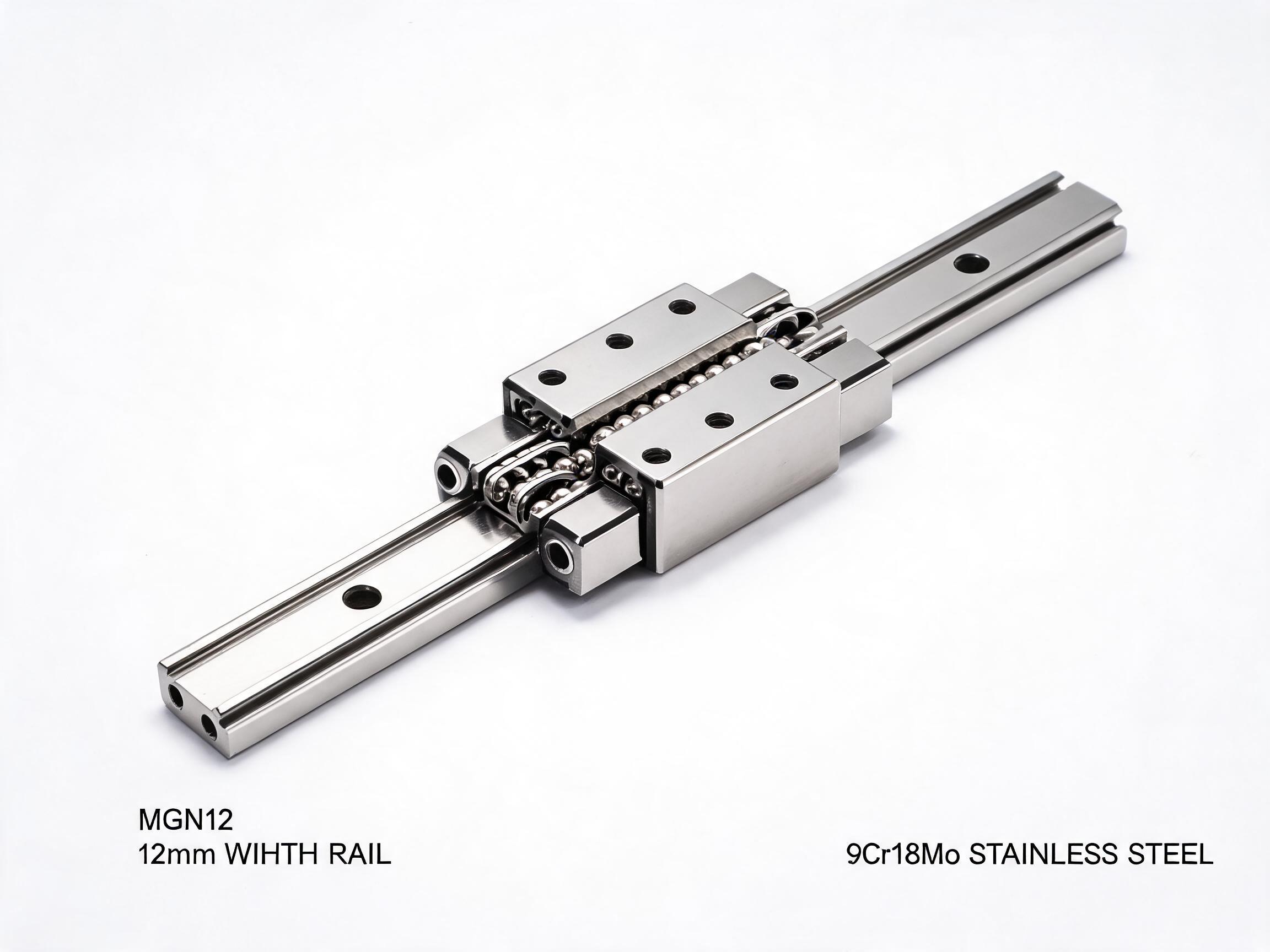
Stainless linear guides are not automatically the right answer for every washdown line. They can cost more, and the achievable preload or stiffness classes may differ from the carbon steel range. The selection question is therefore not "stainless or not" in the abstract, but "what does the cleaning procedure actually expose the guide to, and how often?" The supplier should be able to describe the material of the rail, the block and the rolling elements separately, because a stainless block on a coated rail is not the same product as an all-stainless assembly. As a reference point, our MGN12 stainless miniature linear rail is built in 9Cr18Mo stainless steel with a P-grade straightness of 0.01 mm per 300 mm — the kind of full-material disclosure worth requesting for any compact packaging axis.
Lubrication, seals and service access
On short-stroke, high-cycle axes, lubrication is the single most common reason for premature guide failure in the field. Two design decisions prevent most of it.
Re-lubrication interval and access
A guide sealed for life may be adequate on a low-duty axis, but on a platen cycling continuously, the grease film is being redistributed with every stroke. If the interval at which the guide needs fresh lubricant is shorter than the interval at which maintenance can reach it, the axis will run dry between services. This should be checked against the customer's planned maintenance schedule before the machine is built, not after the first complaint.
Seal configuration and contamination
Punch and forming stations generate fine dust from the packaging web and occasionally from the product itself. End seals and, where needed, double seals or scraper options on the block help keep that dust out of the rolling contact. If the guide sits below the tooling, a simple cover or a change in mounting orientation may be more effective than a heavier seal. The point is to decide where the debris goes, and to keep it away from the raceway.
Miniature rail vs. other short-stroke guide options
Miniature linear rails are one option among several. The table below summarises the trade-offs as they usually appear on packaging machinery. Final selection depends on the actual load, stroke and service conditions.
| Option | Typical short-stroke use | Strengths | Limitations to check |
|---|---|---|---|
| Miniature linear rail with recirculating balls | Forming and sealing platens, punch heads, short pushers | High stiffness, low friction, good repeatability, compact cross-section | Mounting flatness sensitivity; lubrication access and seal choice must be planned |
| Miniature linear rail with rollers | Higher moment or stiffness demand on short strokes | Higher load capacity per unit size | Roller guides may have different preload and cost characteristics |
| Shaft and linear bushing | Simple, low-precision short strokes | Low cost, simple mounting | Clearance and wear can affect repeated positioning |
| Cam follower on a track | Axes where a mechanism provides the motion profile | Robust in dirty environments | Motion curve is fixed by the cam; harder to tune acceleration |
| Dovetail or plain slide | Slow, infrequent adjustment | Very stiff when locked | Stick-slip and wear; generally unsuitable for high-cycle actuation |
The comparison should be made at the axis level. A rail that performs well on a sealing platen may be the wrong shape for a punch station where the load is offset and the space envelope is different.
A specification checklist for buyers
The following data items are the ones most likely to change the recommended guide. Requesting them from the machine builder before approaching a guide supplier reduces the number of quotation rounds.
- Number of short-stroke axes and the function of each (forming, sealing, punching, cutting, ejection).
- Stroke length and, if known, the actual rolling band used on the rail.
- Cycle rate at full production speed and the expected duty cycle.
- Moving mass and the position of its centre of gravity relative to the rail axis.
- Required repeatability and the permitted play at the tooling.
- Mounting surface finish, flatness and available space envelope.
- Environmental conditions: temperature near heated stations, presence of dust, washdown chemicals and frequency.
- Maintenance plan: how often the axis can be reached for re-lubrication.
- Any material or zoning requirement that affects the choice of stainless linear guide.
For a quick pre-selection conversation, the supplier will usually need at least the stroke, the cycle rate, the load and the environment. Everything else refines the answer.
FAQ
Is a miniature linear rail strong enough for a sealing platen?
It depends on the load case, not on the rail family. A platen that is well supported and centred on the carriage can be handled by a compact rail; one that overhangs or is driven from one side may need a larger size or a two-block arrangement. The moving mass, centre of gravity and number of blocks per rail are the deciding inputs.
How do I know whether I need a stainless linear guide?
Match the guide material to the actual cleaning and humidity exposure at the axis. If the area is dry and cleaned with a damp cloth, a coated carbon steel rail may be adequate. If water, detergent spray or aggressive cleaning agents reach the guide, stainless construction is worth evaluating. Ask the supplier to state the material of each component — rail, block and rolling elements — rather than only describing the product as corrosion-resistant.
Can I replace a worn guide with one from a different brand?
Interchangeability depends on the mounting hole pattern, rail height, block width and preload class. Even where dimensions match, load ratings and stiffness may differ. Treat the replacement as a re-selection: confirm the mounting interface and the required preload, not just the nominal size.
What is the most common specification mistake on high-cycle axes?
Sizing on static load alone while ignoring acceleration and lubrication access. A guide selected only for the weight it carries may still run dry or experience peak loads at each reversal that shorten its service life. The motion profile and the maintenance interval belong in the selection discussion from the start.
Next step
If you are specifying linear motion for a new blister packaging machine or replacing guides on an existing line, the useful first step is to collect the checklist data above for each short-stroke axis. With stroke, cycle rate, load case and environment in hand, a guide supplier can recommend a miniature linear rail or stainless linear guide size and confirm the mounting and lubrication requirements before the design is frozen. For axes where the data is not yet finalised, it is worth confirming with the supplier which parameters are most sensitive to change, so that the design can proceed without over-specifying every axis.