A pre-order checklist for buyers sourcing pillow block bearings — shaft diameter and bearing series matching, housing material selection, mounting pattern, self-aligning allowance, integrated versus separate bearing units, MOQ and lead time, and the documents to request before you commit to a purchase order.
Buyer's Pre-Order Checklist
Pillow block bearings are rarely bought on looks. They are bought against a shaft, a mounting surface, an environment, and a delivery date. Most order errors trace back to one of six details that were never confirmed before the PO was issued. This checklist covers them in the order they affect cost and lead time.
Key Takeaways
- Confirm shaft diameter and bearing series together — a nominal bore alone does not define the unit.
- Housing material decides whether the application survives wash-down, corrosion, or load cycling.
- Measure the bolt-hole pattern on the machine before you accept a drawing.
- Ask for the self-aligning allowance in degrees, not as a vague claim.
- Settle MOQ, sample quantity, and shipping window before pricing discussions.
- Request inspection documents that match the batch you will actually receive.
Shaft Diameter and Bearing Series Must Match Together
Two separate numbers define a pillow block unit: the shaft diameter it accepts, and the bearing series inside the housing. Buyers often quote only the first. A 25 mm shaft, for example, can be carried by more than one insert configuration, and the housing bore is machined to suit the insert — not the shaft directly.
Before ordering, write down three values from the equipment side:
- Measured shaft diameter, checked with a micrometer at the actual seating position — not the nominal drawing callout.
- The bearing series or insert reference already used on that machine, if one exists.
- The load direction and whether the shaft is horizontal or vertical in service.
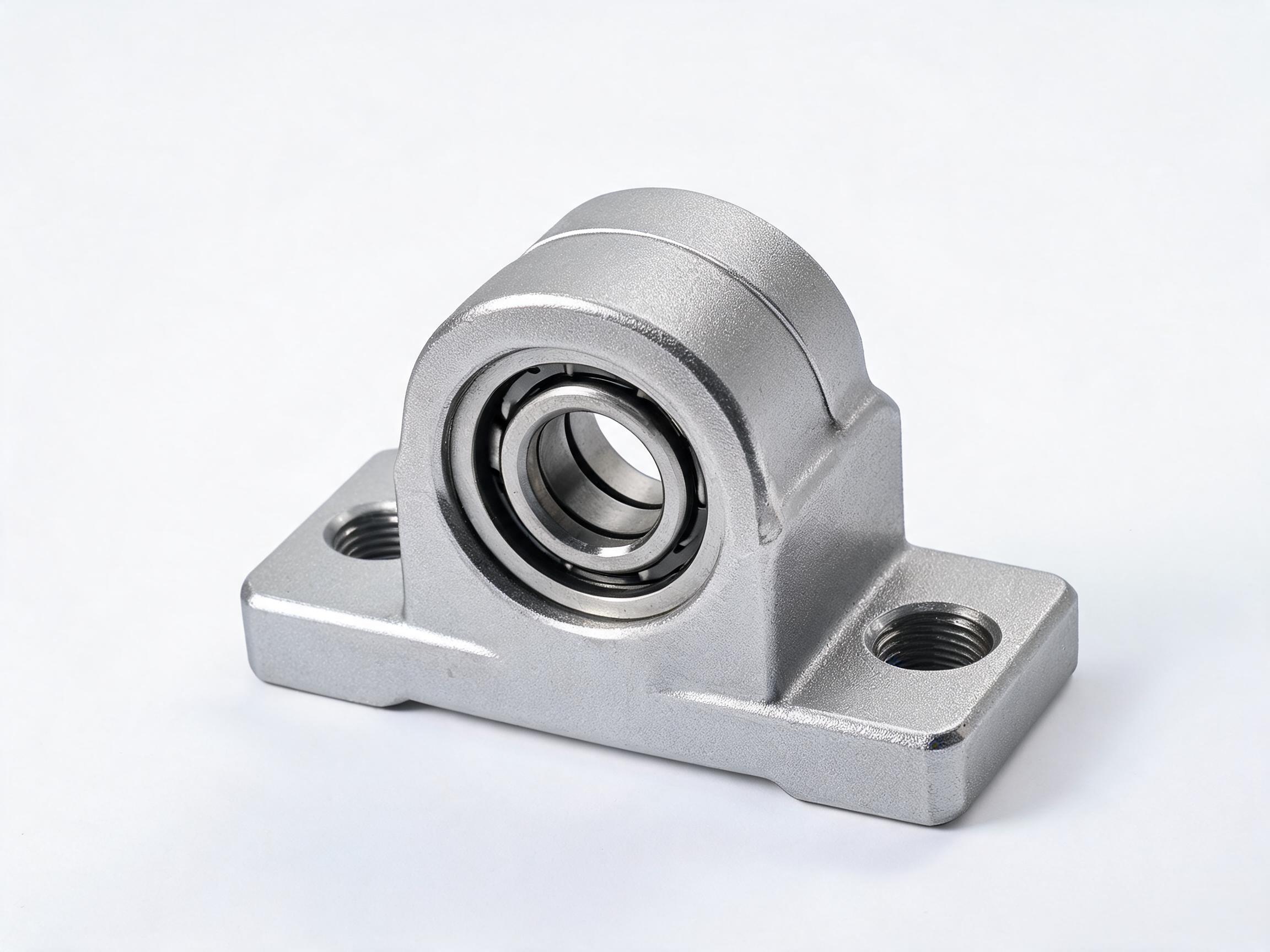
If the machine is a new build with no existing reference, send the shaft drawing and the mounting interface drawing together. A supplier can then match both the insert and the housing instead of guessing from bore size alone. Where the unit already carries a linear bearing insert, our KH Series Pillow Block Linear Bearing Housing Unit covers shaft diameters from 8 mm to 50 mm, which is wide enough to absorb most shaft-diameter revisions without changing the housing family.
Housing Material: Cast Aluminum, Cast Iron, or Stainless
Housing material is the single decision that most often gets revisited after installation. It changes weight, corrosion behaviour, mounting rigidity, and price.
| Housing option | Typical reason buyers choose it | Points to confirm |
|---|---|---|
| Cast aluminum (e.g. ADC12) | Lower weight, faster handling on light-to-medium duty frames and linear motion assemblies | Thread depth and bolt grade; whether the frame surface is flat enough to avoid point loading |
| Cast iron | Heavier vibration damping and rigidity where loads are sustained | Coating or paint specification for the actual environment |
| Stainless (e.g. 304) | Wash-down areas, humid rooms, food-adjacent lines where corrosion drives replacement cost | Whether the insert and fasteners are also corrosion-resistant — a stainless housing with a standard insert is a partial solution |
Our KH series uses a cast aluminum ADC12 housing with a stainless 304 housing variant available on request. If the deciding factor is wash-down exposure, confirm the full bill of materials rather than the housing alone.
Mounting Pattern and Bolt Geometry
A pillow block that fits the shaft but not the bolt holes is scrap on arrival. The two-bolt pattern looks interchangeable across suppliers; it is not. Check:
- Bolt-hole centre distance, measured on the machine, both directions if the base is not square.
- Hole diameter and slot versus round hole — some designs allow lateral adjustment during alignment, some do not.
- Base thickness and the bolt length that will remain engaged after the washer.
- Whether the mounting surface is machined flat or as-welded, because cast housings do not compensate for a warped frame.
The KH series is a two-bolt pillow block pattern and references JIS B 1185 for fastener geometry. That reference tells you which bolts and threads belong with the unit; it does not tell you what your frame was drilled for. Measure the frame.
Self-Aligning Allowance — Get the Number
Self-alignment is what lets a pillow block tolerate shaft deflection, frame weld distortion, or a slightly out-of-parallel mounting face without loading the bearing edges. It is a real functional allowance, and it should be quoted in degrees.
The KH series insert self-aligns ±3°. Whether that is enough depends on the application. A short shaft on a rigid machined plate may need nothing. A long shaft spanning a welded frame, or a machine that sees thermal growth, will consume part of that allowance before any misalignment is left for assembly error. If the existing installation shows uneven wear on one side of the insert, the alignment allowance was likely insufficient or was used up by the frame.
Ask the supplier to state the allowance as a figure. "Self-aligning" without a number cannot be compared between two quotations.
Integrated Bearing vs. Separate Bearing and Housing
You can buy a complete unit — housing plus pre-installed insert — or buy the two parts separately. The trade-off is lead time against flexibility.
- Complete unit: one part number, one inspection record, less assembly labour. Replacing the insert later still works if the housing is reusable.
- Separate parts: useful when the housing is a special casting and the insert is a standard catalogue item, or when two suppliers already cover the two halves.
The KH series ships as an integrated unit with a pre-installed LM..UU sealed bearing. That matters for maintenance planning: the retaining cap allows bearing replacement without tools, in roughly five minutes, so the housing stays on the machine and only the insert is changed. Confirm with any supplier whether the housing is designed to be re-used this way, or whether replacement means replacing the whole block.
MOQ, Sample Quantity, Lead Time, and Trade Terms
Commercial terms should be nailed down in writing before drawings are finalised, because they sometimes change the answer. On the KH series, MOQ is 100 pieces per size, sample orders of 5–10 units can be arranged, and in-stock KH8–KH25 sizes ship in 7–10 business days. Terms are FOB Xiamen.
Two things worth clarifying with any supplier at this stage:
- MOQ per size versus per order — a mixed-size order may have a different rule than a single-size order.
- Which sizes are held in stock and which are made to order, because the difference shows up in your planning date, not in the quotation.
Also confirm the packing unit and carton count if the goods are going into a warehouse that receives by pallet.
Documents to Request Before the Order
Documentation is cheap to ask for and expensive to chase later. Request it with the quotation, not after the goods ship.
- Dimensioned drawing of the exact unit, including bolt pattern and base thickness.
- Material declaration for the housing, stating the alloy or grade.
- Inspection record for the batch, with the measurement items listed.
- Company-level quality certification — Xiamen Dongfeng Bearing holds ISO 9001:2015, CE, and SGS certification as a company, which is supporting evidence about the factory's quality system rather than a certificate issued for any single bearing model.
- Packing specification: carton dimensions, unit weight, and quantity per case.
- Commercial documents: invoice format, HS code suggestion, and origin documentation.
If the application is regulated — food handling, medical equipment, or an export market with its own conformity requirements — say so at the enquiry stage. It affects what the supplier can legitimately put in writing.
Common Ordering Mistakes
- Quoting a shaft diameter from a drawing revision that has already changed.
- Specifying a stainless housing but accepting a standard insert and standard bolts.
- Assuming a two-bolt pattern from one supplier matches another supplier's pattern.
- Leaving self-alignment as an unquantified expectation.
- Discovering the MOQ per size after the drawings are approved.
- Requesting inspection documents only when a problem appears at the receiving inspection.
How to Shortlist a Pillow Block Bearing Supplier
Price comparison is easy; the harder question is whether a supplier will still be answering emails in year three. Practical signals to check:
- Do they answer a technical question with a number, or with marketing language?
- Can they send a dimensioned drawing, or only a catalogue page?
- Do they tell you which sizes are in stock without you asking twice?
- Is the quoted lead time tied to a specific size and quantity, or stated as a general range?
Xiamen Dongfeng Bearing has manufactured bearing products in Xiamen since 2014. That is background on the factory, not a substitute for checking the drawing and inspection record of the exact size you intend to buy — which is the same standard you should apply to any pillow block bearing supplier.
FAQ
What does a pillow block bearing actually do?
It supports a rotating or sliding shaft while holding the bearing insert in a fixed position on the machine frame. The housing carries the mounting load; the insert carries the shaft. That division is why housing material and insert specification are chosen separately, even when they ship as one part number.
How do I know which grease to use in a pillow block bearing?
It depends on the insert. A pre-installed sealed LM..UU bearing is lubricated and sealed for its service life, so there is nothing to re-grease. Inserts with grease fittings follow the insert maker's specification, and the correct choice depends on operating temperature and speed. Ask the supplier for the lubrication instruction that belongs to your specific insert reference — do not assume a general-purpose grease applies.
Where to buy pillow block bearings?
Buy from a manufacturer or distributor who will give you a dimensioned drawing, a material declaration, and an inspection record for the batch, and who states MOQ, stock status, and lead time per size in writing. Buyers comparing sources usually find the technical response time, not the unit price, is what separates suppliers.
Can I order a small quantity first?
On the KH series, sample orders of 5–10 units can be arranged before a full production order. This is worth doing when the mounting pattern or shaft fit is uncertain, because a sample verifies the fit at low cost.
Before You Place the Order
Send us the shaft diameter, the mounting bolt pattern, and the operating environment. We will confirm the matching housing material and insert, the MOQ for that size, and the shipping window — in writing, with a drawing. If you already have a part number from an existing machine, include it and we will check it against the KH series range.
Contact our engineering team through the enquiry form on this page with your shaft and mounting details.