
A buyer's guide to the ISO 3408 C7 rolled ball screw grade: what the ±0.05 mm/300 mm lead tolerance actually controls, how thread rolling produces it (using the SFU1605 as a worked example), which machines it covers, and the specific signals on a project that justify stepping up to a C5 ground screw.
When a quotation lists a ball screw as C7, it is naming a lead accuracy class from ISO 3408, not a loosely used marketing label. The number tells you how far the nut may drift from the commanded position over a measured travel. For most buyers the practical question is whether a rolled C7 screw with ±0.05 mm per 300 mm is sufficient for the machine, or whether the job needs a ground C5 screw instead. This article explains what that tolerance controls, how thread rolling reaches it, and the signals that justify the upgrade.
Key points for buyers
- C7 is a rolled-thread class with lead accuracy of ±0.05 mm per 300 mm.
- A ground C5 screw delivers ±0.008 mm per 300 mm, roughly six times tighter.
- Desktop routers, laser engravers and 3D printer axes are common C7 applications.
- Semiconductor stages, medical imaging and precision feed axes are C5 territory.
- Step up to C5 when accumulated error, not the per-300 mm figure, drives the position budget.
What the ±0.05 mm/300 mm figure measures
Lead accuracy describes the difference between the axial distance the nut should travel for a given rotation and the distance it actually travels. A C7 screw is specified at ±0.05 mm per 300 mm of travel. That does not mean the assembly is within 0.05 mm across a 1,500 mm shaft. The tolerance is a slope measured over a defined length, so a longer travel accumulates error along the lead trend.
The tolerance does not describe backlash, axial play, or how rigidly the nut connects to the load. Those are separate properties of the nut and preload arrangement. A quotation that states only the grade is telling you about lead accuracy, so ask for the other values that your positioning budget depends on.
How rolling forms the thread and where the accuracy comes from
Rolled screws are formed, not cut. Hardened blank material passes between rotating dies that press the thread profile into the shaft. Because the process displaces material rather than removing it, the basic geometry is created in one pass, and the accuracy depends on the die setup and the consistency of the blank.
The SFU1605 is a typical rolled C7 assembly in this class. It uses a 16 mm shaft with a 5 mm lead, a GCr15 shaft that is induction hardened to HRC 58-62, and a pre-loaded flange nut on a four-hole M4 flange pattern. Standard lengths run 300-1500 mm, and the assembly ships with the pre-loaded flange nut already fitted. The single-nut dynamic load rating is 6.8 kN.
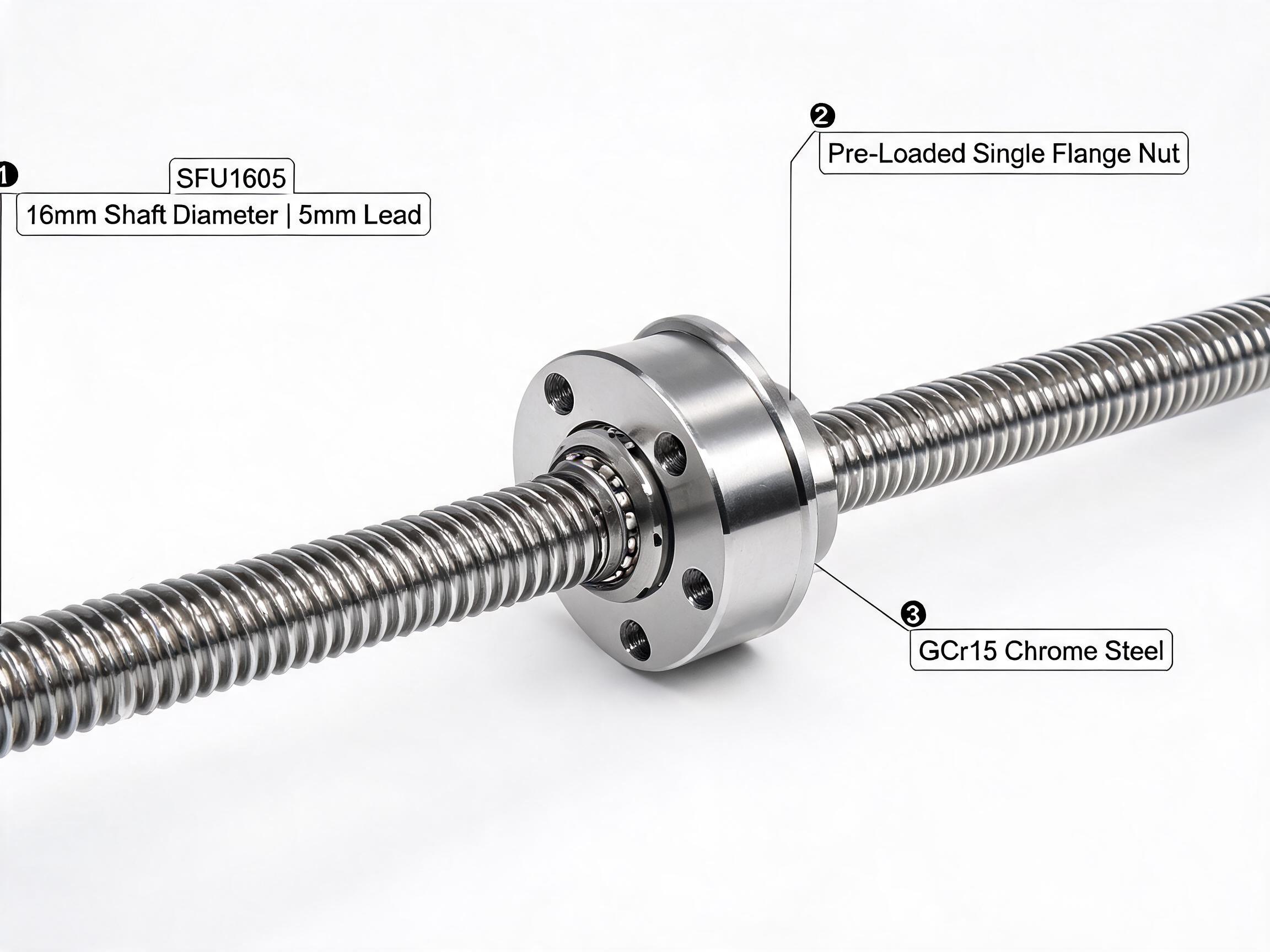
Rolling is the economical route to a C7 thread at volume, and the resulting ±0.05 mm/300 mm figure fits a wide band of motion axes where the final position is corrected by the machine's own reference or feedback.
Where a C7 screw is the right call
The applications that typically accept C7 accuracy share a trait: positioning is either relative, visually corrected, or short-travel.
- Desktop CNC routers. Wood and plastic cutting tolerances are usually larger than the lead-accuracy budget, and the job is set by a tool or fixture reference.
- Laser engravers. The beam path does the useful work; the axis moves the head or the bed, and fine absolute positioning is not the limit.
- 3D printer axes. Layer heights and extrusion control dominate the final part, and the axis is often commanded in small relative increments.
In these machines, the extra precision of a ground screw usually does not change the outcome — unless your own error budget or an absolute-position requirement says otherwise. The sensible spend is on the nut preload and on shaft straightness, mount fit and support bearing alignment, because those decide whether the C7 tolerance reaches the machine at all.
Signals that justify stepping up to ground C5
A ground screw is machined after heat treatment, which is why it can hold a tighter lead. The SFE2005 is the ground counterpart to the rolled SFU1605 geometry: 20 mm shaft with a 5 mm lead, ground after heat treatment, ±0.008 mm per 300 mm lead accuracy, and axial play below 0.005 mm with a pre-loaded double nut. Dynamic load rating is 12.7 kN, axial rigidity is up to 280 N/µm, and lengths run 200-1200 mm.
| Property | Rolled C7 (SFU1605) | Ground C5 (SFE2005) |
|---|---|---|
| Lead accuracy | ±0.05 mm/300 mm | ±0.008 mm/300 mm |
| Axial play | Not specified here; set by nut preload | Below 0.005 mm with pre-loaded double nut |
| Dynamic load (single nut) | 6.8 kN | 12.7 kN |
| Axial rigidity | Not specified here | Up to 280 N/µm |
| Standard lengths | 300-1500 mm | 200-1200 mm |
| Typical applications | Desktop routers, laser engravers, 3D printer axes | Semiconductor stages, medical imaging, precision feed axes |
C5 lead accuracy is roughly six times tighter than C7 over the same measured length.
Use the following conditions as decision triggers. Any one of them warrants a C5 quote; several of them together usually make the upgrade unavoidable.
- The position error budget cannot absorb accumulated lead error. Run your full travel length through the C7 slope. If the axis must land within a window that the accumulated drift eats up, C7 is out.
- The machine is verified against absolute position. Metrology, inspection and imaging axes that measure or index in absolute terms leave no room for a lead trend that must be corrected in software.
- Axial play below 0.005 mm is required. A pre-loaded double nut on a ground assembly is built to that figure; a rolled assembly with a single pre-loaded nut is not specified to it in the same way.
- Rigidity and load carry the design. Precision feed axes under continuous load see the difference between a 6.8 kN single-nut rating and a 12.7 kN ground assembly, and the axial rigidity figure matters when the nut is part of the stiffness chain.
- Vibration or surface finish is the limit, not travel. Where machine performance is defined by quiet, uniform feed rather than lead accuracy alone, there is no single C7-versus-C5 threshold — the duty, speed and finish requirements need to be evaluated with the supplier against the actual application.
Reading a C7 quotation correctly
Three items on the sheet deserve attention before you decide.
- Grade plus length. C7 is stated per 300 mm. Confirm that the supplied length and the measuring convention match what your error budget assumed.
- Nut preload. A pre-loaded flange nut reduces axial play, but the quoted grade does not define it. Ask what axial play the nut assembly is set to.
- Mounting side. The supported end, the bearing block and the alignment of the nut to the load path decide how much of the accuracy the machine sees. That is a machine-building issue, not a screw-grade issue.
If you are quoting a C5 screw on the same project, ask the supplier to state the ground lead accuracy, the double-nut axial play, the rigidity figure and the available lengths in the same way, so the comparison is like for like rather than a single grade letter.
FAQ
Is C7 the same as C7 per ISO 3408?
Yes, the C7 designation refers to the ISO 3408 accuracy class. When a supplier states C7 and ±0.05 mm per 300 mm together, the two match.
Can a rolled C7 screw be pre-loaded to remove play?
The SFU1605 is supplied with a pre-loaded flange nut. Preload reduces axial play, but the resulting play figure is a nut property, not part of the C7 lead-accuracy class, so ask for it separately.
Does a longer screw stay within ±0.05 mm?
No. The tolerance is specified over 300 mm of travel. Longer travels accumulate error, and the full-length error is the figure to check against your position budget.
When should I jump straight to C5?
When absolute position, sub-0.005 mm axial play, high rigidity or sustained precision feed define the application. Semiconductor stages, medical imaging and precision feed axes are the usual examples.
Choosing between a rolled C7 and a ground C5 screw for a specific axis? Send the travel length, the load, the required axial play and the position budget, and the matching assembly can be quoted against those values.
SFU series rolled ball screw assembly and SFE series ground ball screw assembly.