Curved linear rail runs are rarely off-the-shelf. This guide explains realistic arc-motion options—bent round-shaft systems, custom-curved profile rail, and rotary stages—and what to confirm with your supplier before ordering.
If you are designing a conveyor curve, a carousel transfer, or a curved section of a packaging machine, the honest answer is this: a curved linear rail is almost never a catalog item. Most profile rails and shaft rails leave the factory straight. Arc motion is built from a straight rail platform plus either a custom-formed rail, an articulated carriage, or a rotary unit. Below are the realistic routes, what each is good for, and the points to confirm before you place a purchase order.
On this page
Why standard rails ship straight
A linear guide rail is a precision-ground or hardened rolling surface. Its running accuracy depends on the straightness of that surface, the parallelism of the mounting holes, and the preload between the carriage and the rail. Bending a finished rail after hardening introduces residual stress and distorts the raceway geometry. That is why catalogs list straight lengths in standard increments rather than radii.
On the supply side, a straight rail is also a stock item: cut to length, drilled on a fixed hole pitch, and shipped. A curved rail is a made-to-drawing part. The distinction matters for lead time, price, and how much engineering dialogue you need before ordering.
Three realistic routes to arc motion
In practice, arc motion in industrial machinery is achieved in one of three ways. The right choice depends on load, radius, speed, and how much of the arc needs full rolling support.
Bent round-shaft rail systems
Supported round-shaft rail is the most common starting point for a curved run. Because the shaft is a round bar carried in an aluminum support profile, it can, in some cases, be formed to a large radius before assembly. The carriage is a ball bushing or a linear bearing block that slides along the shaft. Large-radius, low-to-moderate-load curves—such as a wide transfer arc on a packaging line—are the typical fit.
The limitation is the carriage. A standard ball bushing travels on a straight shaft; on a bend, the shaft surface curves away from the ball track. Whether the carriage can follow the arc depends on the bearing clearance and the bushing length relative to the radius. This is why a bent round-shaft run is a custom project, not a stock part, and why the radius must be reviewed with the supplier.
Custom-curved profile rail made to drawing
Where the application needs a recirculating profile rail's stiffness and load capacity along an arc, the rail itself has to be produced to a drawing rather than cut from stock. This is a genuine custom-manufacturing route: the rail is formed and heat-treated to a specified radius, and the carriage is matched to it. It is suitable for higher loads and tighter arc control, but it demands a clear drawing, an agreed tolerance on the radius, and a longer lead time. Curved runs of this type are a custom project; confirm feasibility, radius range, and inspection method with the supplier before ordering.
Rotary components for the turn itself
For some layouts the arc is not a curved track at all—it is a rotation. A carousel transfer, an indexing table, or a curved guide section can use a rotary bearing, a slewing ring, or a shaft-and-hub arrangement, with straight linear rails feeding in and out of the turn. This often gives better load support and a more predictable service life than bending a rail, because the rotating element is designed for the moment load at the turn. In many conveyor and packaging machines, the practical answer is a straight rail for the linear segments plus a rotary unit for the corner.
Key takeaways
- A curved linear rail is not a standard catalog item; treat any arc run as a custom project.
- Supported round-shaft rail is the platform most buyers start from, but the carriage's ability to follow a bend depends on radius and clearance.
- Custom-curved profile rail is made to drawing and needs an agreed radius tolerance and inspection method.
- For corners, a rotary unit plus straight rails is often the more robust solution.
- Confirm radius, load at the curve, carriage articulation, sealing, and lubrication before you order.
The straight rail platform buyers usually start from
Because a curved run is assembled from straight rail segments and a turn, most projects begin with a reliable straight rail platform. The supported round-shaft rail units below are the kind of stock items that feed the linear sections of a curve.
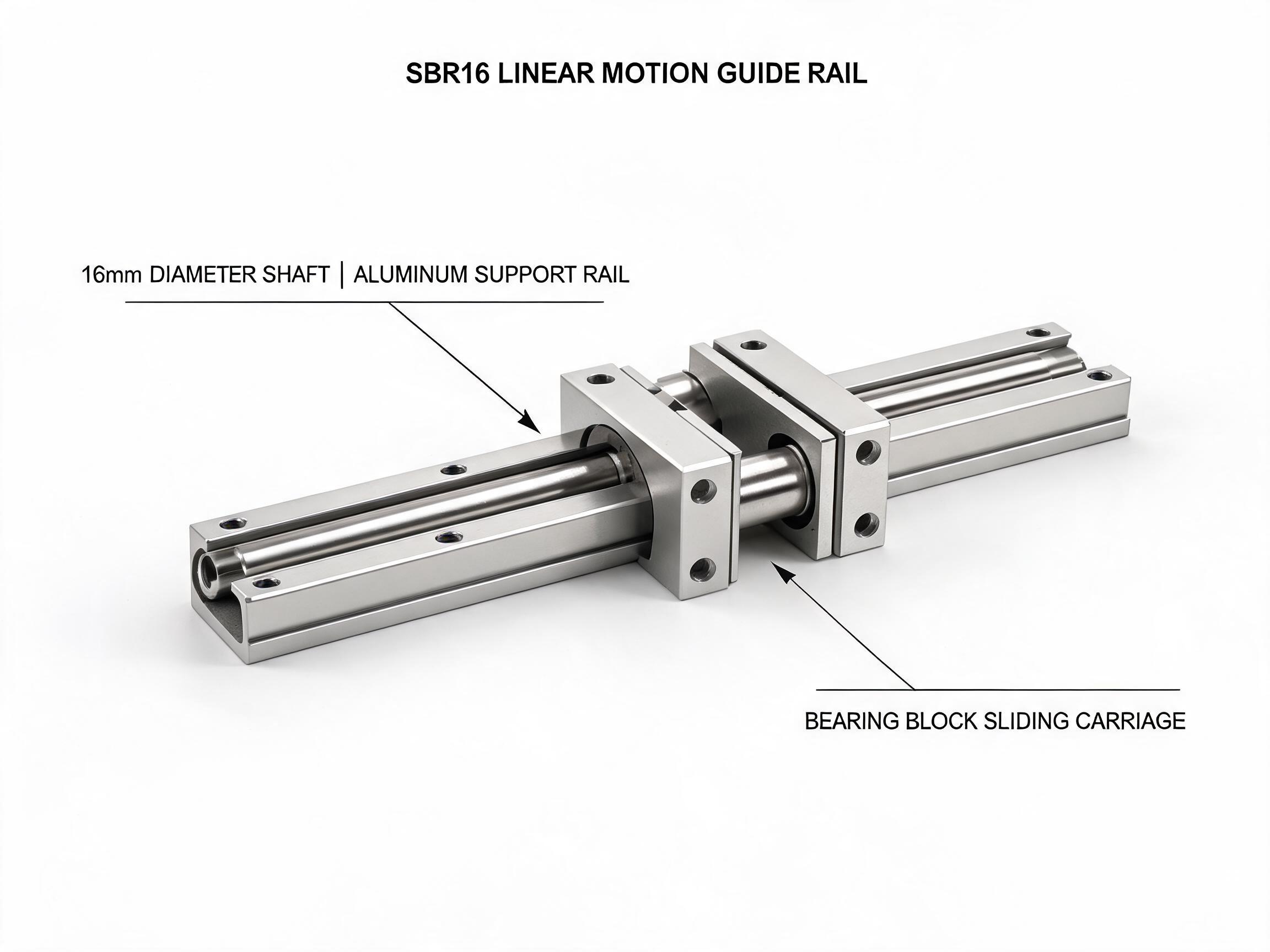
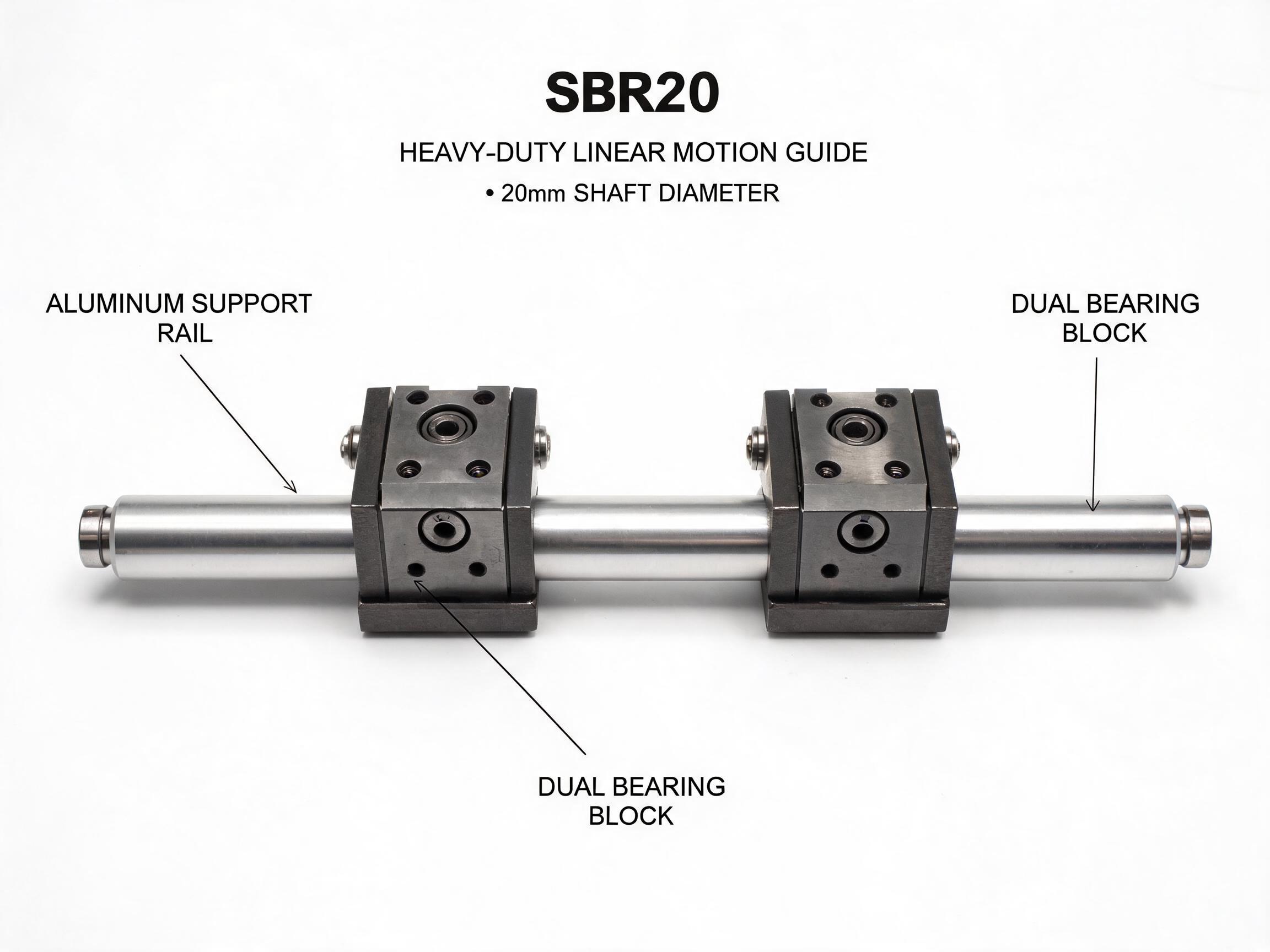
The SBR20 heavy-duty linear motion guide unit uses a 20 mm hardened shaft in a 6063-T5 aluminum support. A single block carries 11.2 kN dynamic and 17.5 kN static load; with dual blocks the rating is 22.4 kN per rail. Standard lengths run to 3000 mm on a 50 mm hole spacing. For lighter axes, the SBR16 linear motion guide rail unit uses a 16 mm shaft in GCr15 hardened to HRC 58–62, with a 6063-T5 support, and dual-block ratings of 7.8 kN dynamic and 12.0 kN static, in lengths to 2000 mm.
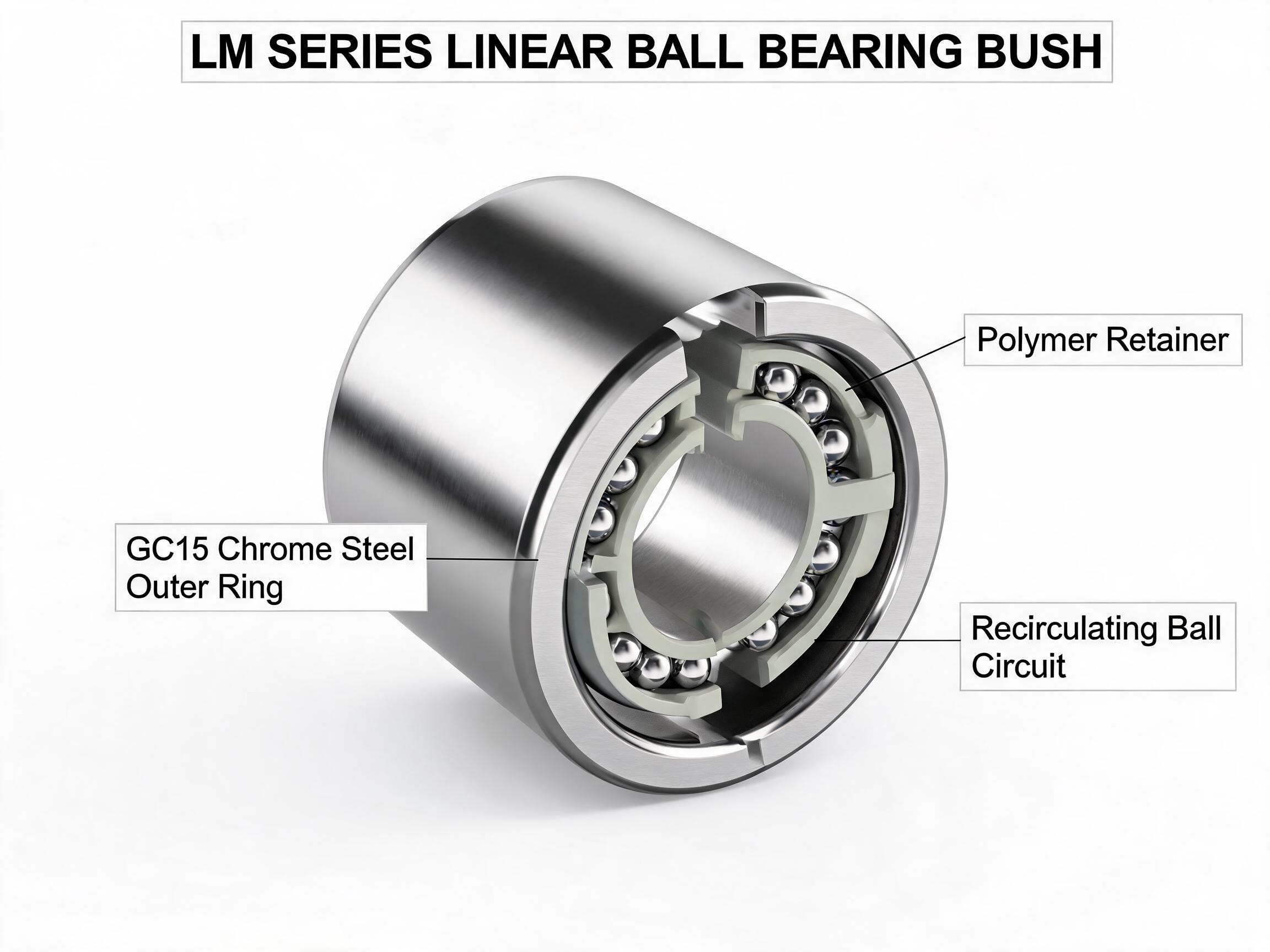
Where a round shaft is used as the track, the carriage is a linear ball bearing bushing such as the LM series linear ball bearing bush. The LM series covers 6–60 mm shaft diameters, with GCr15 rings hardened to HRC 60–64 and a PA66-GF retainer, in UU and open (OP) types; LM16UU, for example, is rated 980 N dynamic. If the arc is handled by a profile rail instead, the HGR series runs HGR15–45 in 55# steel, induction hardened to 58–62 HRC, in lengths to 4000 mm.
| Series | Track | Support | Notable rating | Standard length |
|---|---|---|---|---|
| SBR20 | 20 mm hardened shaft | 6063-T5 aluminum | 11.2 kN dyn / 17.5 kN static, single block; 22.4 kN per rail with dual blocks | To 3000 mm, 50 mm hole spacing |
| SBR16 | 16 mm shaft, GCr15 HRC 58–62 | 6063-T5 aluminum | 7.8 kN dyn / 12.0 kN static, dual blocks | To 2000 mm |
| LM bushing | Shaft 6–60 mm, GCr15 HRC 60–64 | PA66-GF retainer | LM16UU 980 N dynamic | — |
| HGR profile | 55# steel, induction hardened 58–62 HRC | — | HGR15–45 range | To 4000 mm |
Pre-order checklist for a curved run
Because a curved run is custom, the supplier needs more than a part number. Have these points ready before you request a quotation.
- Required radius. State the center-line radius and the arc length or sweep angle. The supplier will confirm whether that radius is feasible for the selected rail and carriage.
- Can the carriage articulate? On a bent round shaft, the carriage has to follow the curve. Discuss bearing clearance, bushing length, and whether a self-aligning or articulated carriage is needed.
- Load at the curve. Loads and moments at the arc are not the same as on a straight run. Provide the actual load, its direction, and any moment, so the rating can be reviewed against the curve.
- Sealing and lubrication. A curved run may need additional sealing and a lubrication plan, because the carriage geometry and the way lubricant travels along the track change.
- Drawing and inspection. For custom-curved profile rail, agree on the drawing, the radius tolerance, and how the finished radius will be inspected.
FAQ
Do you sell curved linear rails as a catalog item?
No. Curved runs are a custom project. The straight SBR, LM, and HGR items are standard stock; an arc has to be reviewed against its radius and load before any offer can be made.
Can I bend a standard profile rail myself?
Finished profile rail is hardened and ground for straight running. Bending it after hardening distorts the raceway. A curved profile rail should be produced to a drawing, not formed from a stock length on site.
When is a rotary unit better than a curved rail?
When the motion is a rotation—such as a carousel transfer or an indexing table—a rotary bearing or slewing ring handles the moment at the turn more directly. Straight rails then feed the linear segments. The choice depends on the geometry and the load case.
What is the first number to give a supplier?
The required center-line radius, together with the arc length and the load at the curve. Those three values let the supplier judge whether a bent round-shaft run, a custom-curved profile rail, or a rotary solution is the practical route.
Curved runs are made to drawing and reviewed case by case. Send your radius, arc length, load, and drawing to confirm feasibility and lead time before ordering; the straight rail units above are the standard starting point.