
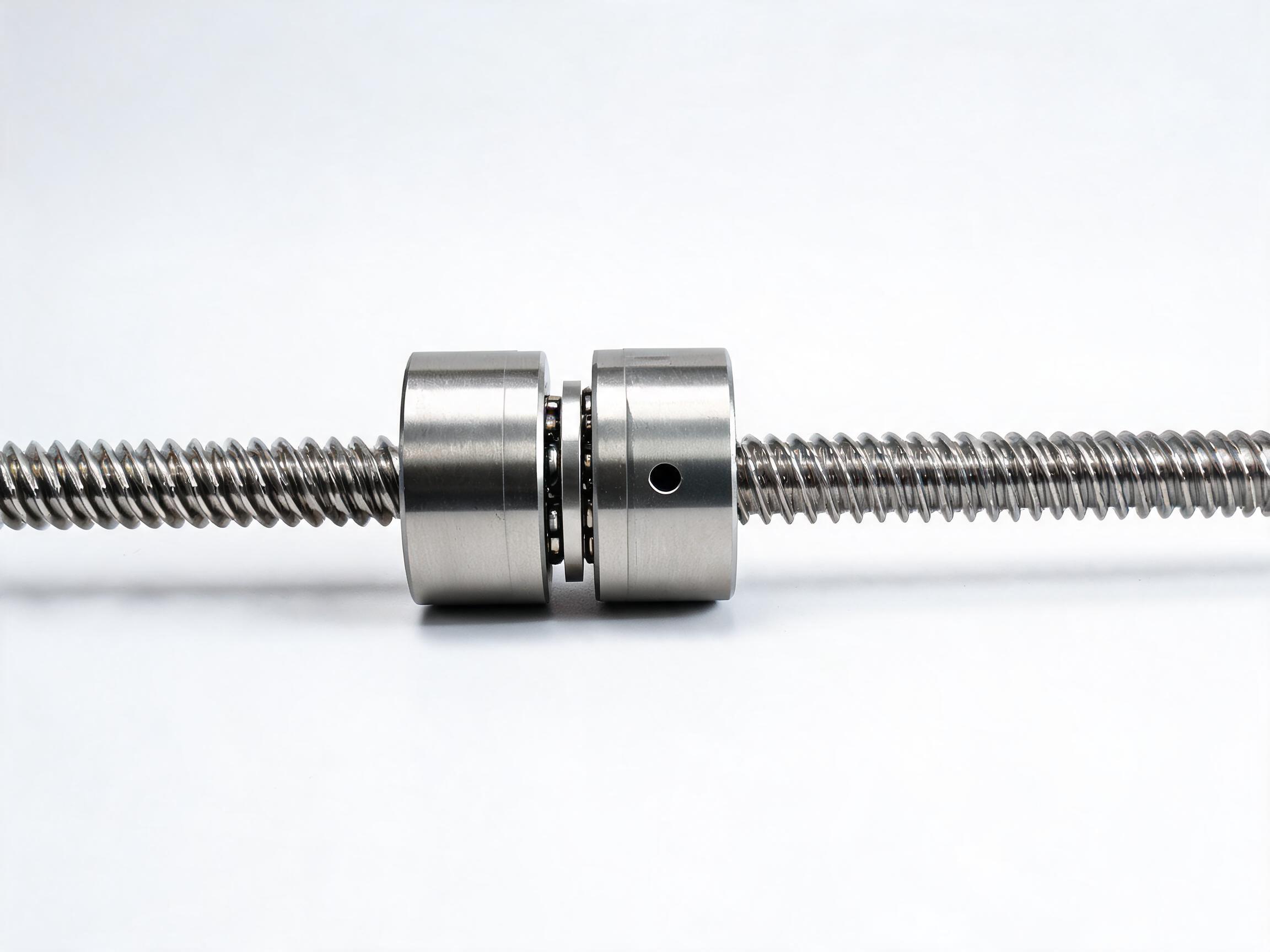
A technical guide for B2B buyers on double nut zero-backlash ball screws. Understand the difference between standard and pre-loaded assemblies, when backlash elimination is critical, and how to select the right ball screw drive for your CNC or linear actuator application.
BALL SCREW TECHNOLOGY
• Double nut pre-load eliminates axial backlash (play) in ball screw drives, typically achieving 0.01–0.03 mm positioning accuracy.
• Required for CNC machining, laser cutting, and any application where reverse-direction positioning error is unacceptable.
• Not all applications need pre-load — standard single-nut ball screws are sufficient for general material handling or low-precision transfer.
• Pre-load level (light, medium, heavy) must match the duty cycle and load profile to avoid premature wear or heat generation.
What Is Backlash in a Ball Screw Drive?
In any ball screw drive, backlash is the axial clearance between the nut and screw shaft. When the screw reverses direction, this clearance causes a momentary loss of motion — the nut travels a small distance before the balls re-engage the opposite flank of the thread groove.
For a standard single-nut assembly, typical backlash ranges from 0.05 mm to 0.20 mm depending on diameter and lead. In many industrial applications this is acceptable. But when you need precise positioning, repeatable cuts, or tight tolerances, even 0.05 mm of play can ruin a part or crash a tool.
That is where the double nut zero-backlash ball screw comes in.
How a Double Nut Assembly Eliminates Backlash
A pre-loaded assembly uses two nuts instead of one. Between them, a spacer, spring washer, or ground shim creates an axial force that pushes the nuts apart. This force removes the clearance between the ball tracks and the screw shaft, effectively "pre-loading" the system.
There are three common pre-load methods:
| Pre-load method | Typical pre-load value | Best suited for |
|---|---|---|
| Oversized ball (DB) | 3–5% of dynamic load | Light to medium pre-load, general CNC |
| Spacer / shim | 5–10% of dynamic load | Medium pre-load, high-speed positioning |
| Spring washer | 2–5% of dynamic load | Variable load, vibration damping |
Among these, the double nut with a ground spacer is the most common construction for CNC ballscrews requiring zero-backlash performance. It provides consistent pre-load over the entire travel length and maintains it through thermal cycles.
When Do You Need a Pre-Loaded Ball Screw?
Not every linear motion application requires zero-backlash. Below is a practical decision guide based on real-world use cases.
You definitely need pre-load when:
- CNC machining centers — milling, turning, drilling. Any reversal of axis direction must produce exact tool path without lag.
- Laser cutting and engraving — beam positioning requires micron-level repeatability across the entire work area.
- EDM and wire cutting — electrode positioning tolerances are often under 0.01 mm.
- Coordinate measuring machines (CMM) — measurement error from backlash directly affects inspection results.
- High-speed pick-and-place — rapid direction changes with tight placement accuracy.
You can use standard (non-pre-loaded) ball screws when:
- Material transfer and conveyor systems — positioning accuracy of ±0.1 mm is acceptable.
- Simple lifting or clamping — direction reversal is rare or load direction is constant.
- Manual adjustment axes — operator can compensate for any play.
- Low-cost automation where budget constraints outweigh precision requirements.
Ball and Screw Linear Actuator: Integrating Pre-Load into the Assembly
When you source a complete ball and screw linear actuator, the pre-load decision is often made by the actuator manufacturer. But as a buyer, you should specify the requirement explicitly in your RFQ. Key parameters to communicate:
- Required axial clearance (e.g., "0.01 mm max" or "C3 pre-load class")
- Operating load range — pre-load too high for light loads causes excessive friction and heat; too low for heavy loads loses the zero-backlash benefit.
- Travel speed and acceleration — high-speed applications need lighter pre-load to avoid overheating the nut.
- Duty cycle — continuous operation requires thermal management considerations.
For a screw drive linear actuator used in a closed-loop servo system, pre-load also improves system stiffness. The elimination of dead zone means the servo controller sees immediate response to position commands, reducing settling time and improving cycle rates.
Double Nut vs. Single Nut: A Practical Comparison
| Parameter | Single nut (standard) | Double nut (pre-loaded) |
|---|---|---|
| Backlash | 0.05–0.20 mm | 0.00–0.03 mm (zero-backlash) |
| Axial stiffness | Low to moderate | High (pre-load dependent) |
| Cost (relative) | 1x (baseline) | 1.5–2.5x |
| Nut length | Shorter (2–3 ball circuits) | Longer (4–6 ball circuits) |
| Friction torque | Low | Moderate to high |
| Max speed | Higher (less friction) | Lower (heat generation limit) |
| Maintenance | Standard lubrication | Pre-load check after 5000–10000 hours |
How to Specify Pre-Load Level in Your RFQ
When you send an inquiry for CNC ballscrews or a complete ball screw drive system, include these specifications:
- Nominal diameter and lead (e.g., 32 mm diameter, 10 mm lead)
- Pre-load class — use ISO or DIN designations: C0 (zero-backlash), C1 (light pre-load), C2 (medium pre-load), C3 (heavy pre-load)
- Pre-load value — expressed as percentage of dynamic load rating or as a specific axial force in Newtons
- Nut configuration — double nut with spacer (standard), or spring-loaded (for variable loads)
- Flange mounting pattern — provide drawing or standard (e.g., DIN 69051)
- Lubrication and sealing — specify if you need wiper seals, grease fitting, or oil lubrication ports
Example RFQ line: "Ball screw assembly, 32x10 mm, double nut, C2 pre-load (7% of dynamic load), with flange nut per DIN 69051, side port lubrication, wiper seals both ends."
Common Mistakes to Avoid
- Over-pre-loading for high-speed applications — excessive pre-load generates heat that reduces lubricant life and can cause thermal expansion, actually reducing accuracy.
- Under-pre-loading for heavy cutting — the pre-load must be higher than the cutting force component in the axial direction, or the nut will separate under load and reintroduce backlash.
- Mixing nut and screw from different manufacturers — pre-load is a matched system. Always source the nut and screw as a matched pair from the same production batch.
- Ignoring screw support bearings — pre-load in the nut is useless if the screw shaft itself has axial play from loose bearings. Use angular contact bearing pairs at the fixed end.
Frequently Asked Questions
Can I retrofit a single-nut ball screw with a double nut?
Yes, if the screw shaft has the same lead and thread profile. However, the nut housing and flange dimensions are different, so you may need to modify the mounting bracket. It is often more economical to replace the entire assembly as a matched pair.
How long does pre-load last?
Pre-load degrades gradually as the ball tracks wear. In a properly lubricated system with light to medium pre-load, the assembly maintains zero-backlash performance for 5000–10000 operating hours. After that, the pre-load force drops below the design threshold, and you may need to replace the nut or adjust the shim.
Does pre-load affect the screw's critical speed?
No. The critical speed (rotational speed at which the screw shaft begins to resonate) depends only on the shaft diameter, unsupported length, and end fixity. Pre-load in the nut does not change these parameters. However, the increased friction torque from pre-load can reduce the maximum achievable RPM if the motor torque is limited.
Is a pre-loaded ball screw always better than a standard one?
No. For applications where backlash is not a concern, a standard single-nut assembly offers lower cost, higher speed capability, and less heat generation. The double nut also adds length to the nut housing, which may be a constraint in compact designs. Choose based on your specific accuracy requirement, not as a blanket upgrade.
Next Steps for Buyers
When you are sourcing a ball screw drive for a precision application, start by defining your positioning tolerance and load profile. Share these with your supplier so they can recommend the correct pre-load class and nut configuration.
For standard CNC ballscrews and screw drive linear actuator assemblies, we offer matched double nut sets with pre-load levels from C0 to C3. Our technical team can help you select the right assembly based on your machine specifications and duty cycle. Contact us with your application details for a recommendation and quotation.