
Reciprocating filling nozzles can run millions of cycles in humid, caustic washdown conditions. This article explains how self-lubricating linear bushings differ from grease-dependent bearings, which specifications matter for filling machine motion, and how to evaluate a washdown linear bearing before it goes into production.
Linear Motion in Filling Equipment
Most filling machine linear bearing failures are not caused by load. They are caused by the lubricant that was supposed to protect the bearing. In a washdown environment, grease is washed out, diluted, or contaminated; once the film is gone, the bushing wears fast. Self-lubricating linear bearings are designed for exactly this condition. This article explains what changes when a linear bushing carries its own lubrication, which specifications govern high cycle linear motion in filling machines, and what to verify before specifying a washdown linear bearing.
Key takeaways
- The duty cycle of a filling nozzle is measured in millions of strokes, not hours. Relubrication intervals become a production constraint, not a maintenance task.
- Self-lubricating bearings release lubricant from the bearing material itself, so the running film does not depend on a grease fitting that washdown will eventually reach.
- Shaft hardness, surface finish, and load direction matter as much as the bushing catalogue number.
- IP-rated construction and self-lubrication are separate properties. Confirm both against the actual machine condition.
Why filling machine motion is a hard duty cycle
A piston or servo-driven filling head can complete a full up-down stroke in a fraction of a second. On a high-output line running three shifts, the nozzle carriage and its guide bushings accumulate strokes far faster than the machine accumulates operating hours. A line producing tens of thousands of containers per shift turns a single guide position into a wear part within weeks if the lubrication film is not maintained.
Three conditions combine to make this worse than a typical linear axis:
- Short stroke, high frequency. The bearing travels back and forth over a narrow band of shaft. Wear concentrates, and any lubricant starvation affects the same contact zone every stroke.
- Washdown exposure. Water, steam, and cleaning chemicals reach the guide area. A water-based cleaner can emulsify or displace conventional grease.
- Product contact risk. In food, beverage, pharmaceutical, and cosmetics filling, lubricant migration toward the product zone is a quality and compliance concern, not just a mechanical one.
The practical result: the maintenance schedule becomes the limiting factor on line availability. If a bushing needs relubrication every few hundred operating hours, someone has to open the machine, clean the area, and re-grease it — often during a washdown window that was already too short.
What changes when the bushing lubricates itself
A conventional linear bushing relies on an external lubricant film, applied through a fitting or a reservoir, to keep metal or polymer surfaces separated. A self-lubricating linear bearing carries the lubricant in the bearing itself — typically a polymer or composite liner with embedded lubricant, or a sintered structure that holds oil in its porosity. During motion, a thin transfer film forms on the shaft and maintains separation without an external supply.
This changes several things at once:
- No relubrication interval to schedule. Because the lubricant source is integral to the bearing, the maintenance task disappears for the life of the liner. The bearing is replaced when the liner is worn, not re-greased on a calendar.
- Less sensitivity to washdown. There is no external reservoir to flush out and no grease channel that a pressure spray can clear.
- Cleaner operation. A self-lubricating liner does not require a continuous grease supply that could migrate. This matters where the linear guide sits near an open container or a product path.
- Predictable wear rather than unpredictable starvation. A liner wears gradually across its rated load and travel. A starved grease bearing can fail abruptly once the film breaks down.
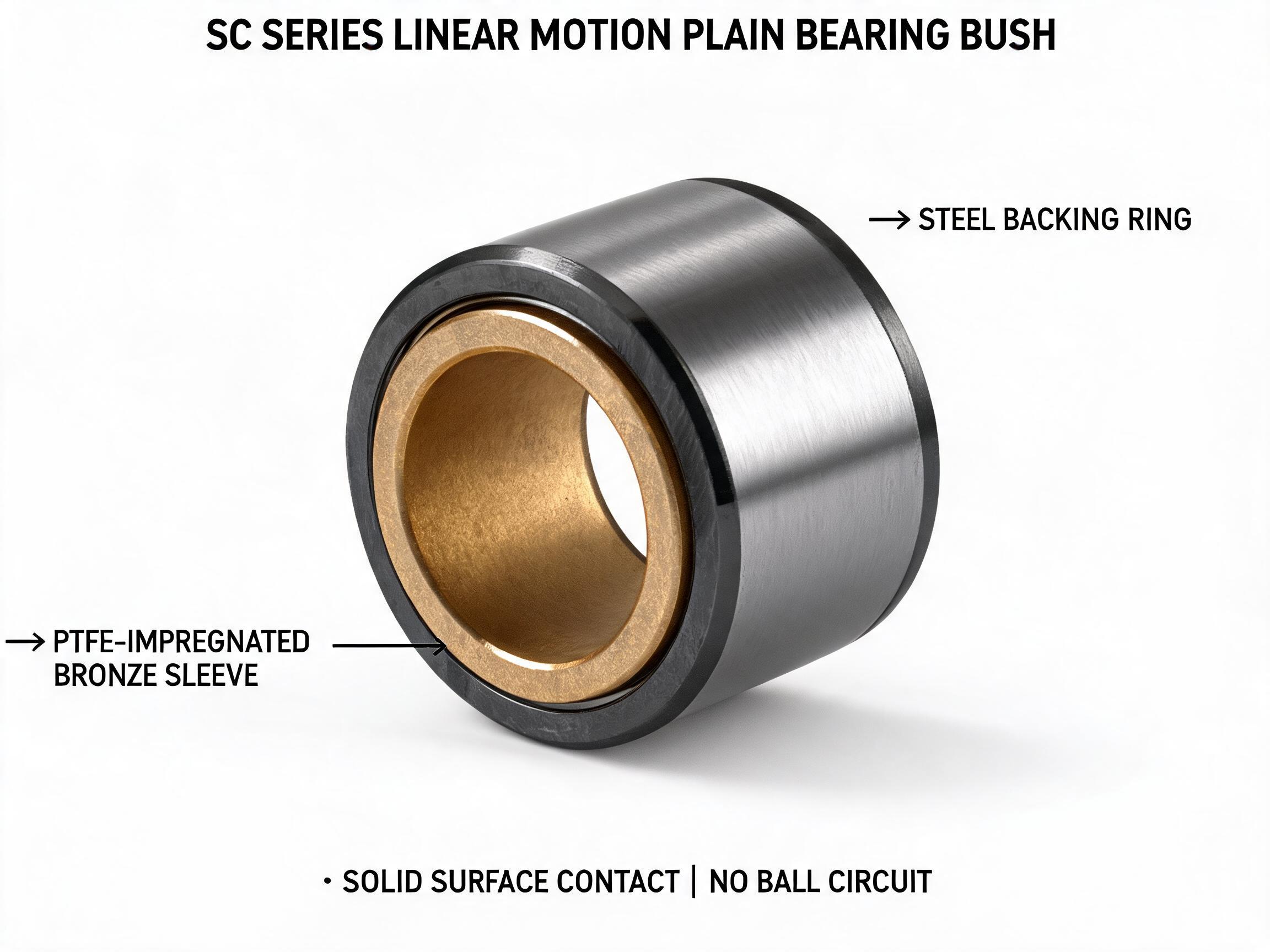
Self-lubrication is a property of the bearing construction, not a coating applied afterwards. A polymer-lined bushing and a sintered bronze bushing both qualify, but they behave differently in load capacity, speed, and chemical exposure. Match the material to the application rather than treating "self-lubricating" as a single category. A ready example of the sintered-composite family is our SC series self-lubricating linear motion plain bearing bush, a PTFE-impregnated bronze (DU-type) liner that runs dry at a friction coefficient of 0.08–0.12 and covers −50 to +200 °C.
Specifications that decide service life
For a filling machine guide, the following parameters govern whether a self-lubricating bushing reaches its expected cycle count.
| Parameter | Why it matters in filling machines | What to check |
|---|---|---|
| Shaft hardness | A soft shaft wears before the liner, changing the fit and increasing clearance | Compatible shaft hardness and recommended shaft material from the bearing supplier |
| Shaft surface finish | Too rough abrades the liner; too smooth can reduce transfer-film formation | Finish range stated for the specific bushing type |
| Radial load and direction | Filling heads often present combined radial and moment loads; a moment load reduces rated capacity | Load per bearing after dividing by the number of guide positions, with the moment load included |
| Stroke and speed | Short, fast strokes concentrate wear over a narrow shaft band | Maximum sliding speed and the product of load and speed for the liner material |
| Operating temperature | Washdown and steam cleaning raise the guide-area temperature above ambient | Continuous temperature limit of the liner or sintered material |
| Chemical exposure | Detergents and sanitizers vary widely in aggressiveness | Bearing material compatibility with the specific cleaning agents in use |
| Mounting clearance | Housing bore tolerance affects preload and clearance | Housing bore grade and any recommended adhesive or press fit |
Two of these are frequently underestimated on a filling machine. The first is the moment load: if the nozzle carriage hangs off the side of the guide, the bushings see a load that a simple vertical load figure does not capture, and the rated life drops below the catalogue value. The second is temperature. A machine that is steam-cleaned in place can expose the guide to temperatures well above the production ambient, and the liner, not the housing, sets the ceiling.
Washdown, chemistry, and clean-in-place
A washdown linear bearing is not defined by a single rating. It is the combination of bearing material, seal or scraper arrangement, and the housing design around it. Consider the cleaning regime as a design input:
- Pressure and direction. High-pressure spray directed at the guide can force liquid past a scraper that would resist incidental splash. Where the guide sits in the spray path, a secondary seal or a shield may be needed.
- Chemistry. Caustic cleaners, acid-based descalers, and chlorine-based sanitizers attack different polymers and different shaft materials. A liner that survives one may swell or soften in another.
- Temperature cycling. Repeated heating and cooling changes clearance and can draw moisture into an otherwise protected guide area.
- Clean design. Smooth, non-porous bearing surfaces and minimal crevices reduce the places where product residue and cleaning liquid collect.
Where requirements are demanding — for example, a guide in a food or pharmaceutical filling zone — the cleaning protocol and the bearing material should be evaluated together. Material compatibility data and, where appropriate, sample testing under the actual cleaning agents give a firmer answer than a general washdown claim. Where a supplier cannot provide that data, plan a bench or pilot test before committing a full line.
How to specify a linear bushing for a filling machine
Work from the machine condition inward, not from a catalogue page outward.
- Define the duty. Strokes per minute, stroke length, hours per shift, and shifts per week give the cycle count the bearing must survive between planned maintenance windows.
- Resolve the loads. Sum the moving mass, add the process force and any spring or cam reaction, then distribute across the guide positions. Include the moment load from nozzle offset.
- Fix the shaft. Choose shaft material, hardness, and surface finish that match the bushing type. In many cases the shaft, not the bushing, is the cheaper replacement and can be specified slightly harder to protect the liner.
- Match the environment. Select liners or materials compatible with the cleaning agents, the temperature range, and the required level of cleanliness. Confirm the seal or scraper arrangement for the spray conditions.
- Verify the fit. Confirm housing bore tolerance, retention method, and alignment targets for the two guide positions.
- Plan the proof. If the combination of load and washdown is outside published data, run a pilot with the actual cleaning cycle before releasing the design.
This sequence also helps when comparing suppliers. A supplier who asks for the duty cycle, the chemistry, and the moment load is working to the application; one who quotes a self-lubricating bushing on the basis of bore diameter alone is leaving the service life to chance.
What to ask a supplier
Use these questions when evaluating a linear bushing for filling machine service:
- What is the rated load and speed for the specific liner material, and how is the life figure affected by the moment load in my arrangement?
- Which shaft hardness and surface finish do you require for this bushing?
- What is the continuous and peak temperature limit of the bearing material?
- Is there compatibility data for the cleaning agents we use, and can you supply a sample for a pilot test?
- What is your recommended seal, scraper, or shielding arrangement for washdown spray?
- What is the replacement strategy — is the liner field-replaceable, or is the complete bushing replaced?
Requests for compatibility data, samples, and pilot support are part of normal technical evaluation. If a supplier cannot provide material data or a sample, treat the washdown suitability as unverified and test before production.
FAQ
Can a self-lubricating linear bearing replace a recirculating ball bearing in a filling machine?
It depends on the load and the speed of the axis. Self-lubricating polymer or sintered bushings generally offer lower load and speed limits than recirculating ball bearings, but they avoid the external lubrication that washdown disrupts. For high-frequency, relatively light filling-head motion in a wet environment, they are often the better fit. For heavy loads or long strokes, compare the rated capacity of the specific bushing against the calculated duty before deciding.
Does a self-lubricating bushing never need maintenance?
The relubrication task is eliminated, but the bushing is still a wear part. It should be inspected for liner wear and shaft condition at planned intervals, and it is replaced when the liner reaches its wear limit. The maintenance change is from frequent re-greasing to periodic inspection and scheduled replacement.
Is a self-lubricating bushing automatically suitable for washdown?
No. Self-lubrication and washdown protection are separate properties. A bearing can lubricate itself and still be damaged by a cleaning agent that is incompatible with its liner material, or by spray that reaches the running surface past the seal. Confirm chemical compatibility, temperature, and sealing against the actual cleaning regime.
What causes a filling machine bushing to wear out early?
The most common causes are a starved or displaced lubricant film, a shaft that is too soft or too rough, an underestimated moment load, and cleaning chemistry or temperature that the bearing material was not selected for. Inspecting the worn part and the shaft surface together usually identifies which of these applies.
Specifying the guide system for a filling machine comes down to aligning the bushing material with the duty cycle, the shaft, and the cleaning regime. When that alignment is right, the linear motion stops being a maintenance constraint. To evaluate a self-lubricating linear bushing or a washdown linear bearing for a specific filling machine, share the stroke, cycle rate, load arrangement, and cleaning agents with your supplier and request the corresponding material data and samples for a pilot test.