
A decision framework for mid-size CNC router and plasma table builders: when an integrated SBR unit (shaft plus aluminum support rail) is the honest choice for a gantry axis, and when the load per axis forces you onto profile rails such as HGR20 or HGR45. Includes per-axis load math using published dynamic and static ratings, mounting and travel-length trade-offs, and a selection checklist.
Gantry Axis Selection
Two rail families dominate the linear slides used on heavy duty gantry axes: the integrated SBR unit, where a hardened shaft is bolted to an aluminum support rail, and the profile rail, where a carriage runs on a profiled guideway. The choice is not about which is "better." It is about how much load one axis actually carries, how you want to mount it, and how far it has to travel.
Key takeaways
- SBR is an honest choice when per-axis load stays inside the shaft-and-block rating and travel fits the standard shaft length.
- Profile rail wins when load per axis exceeds what an SBR shaft can take, or when you need a stiffer, lower-deflection structure.
- Do the math per axis, not per machine. A gantry has at least two different load conditions: the cross beam and each side of the bridge.
- Mounting simplicity is a real cost factor. SBR ships as a unit with a support rail; profile rail needs a machined, flat, parallel mounting surface.
What this article covers
What an SBR unit actually is
An SBR linear motion guide rail unit combines three parts into one bolt-on assembly: a hardened and ground shaft, a bearing block that carries recirculating balls, and a 6063-T5 anodized aluminum support rail under the shaft. The support rail is not cosmetic. It carries the shaft so the unsupported span does not flex the way a bare round shaft would, and it provides a bolt pattern along its length.
On the SBR20 version, the support rail is drilled with mounting holes every 50 mm, which is what makes the assembly practical to align on a welded or bolted gantry beam. The standard shaft length reaches 3000 mm, with custom lengths to 4000 mm.
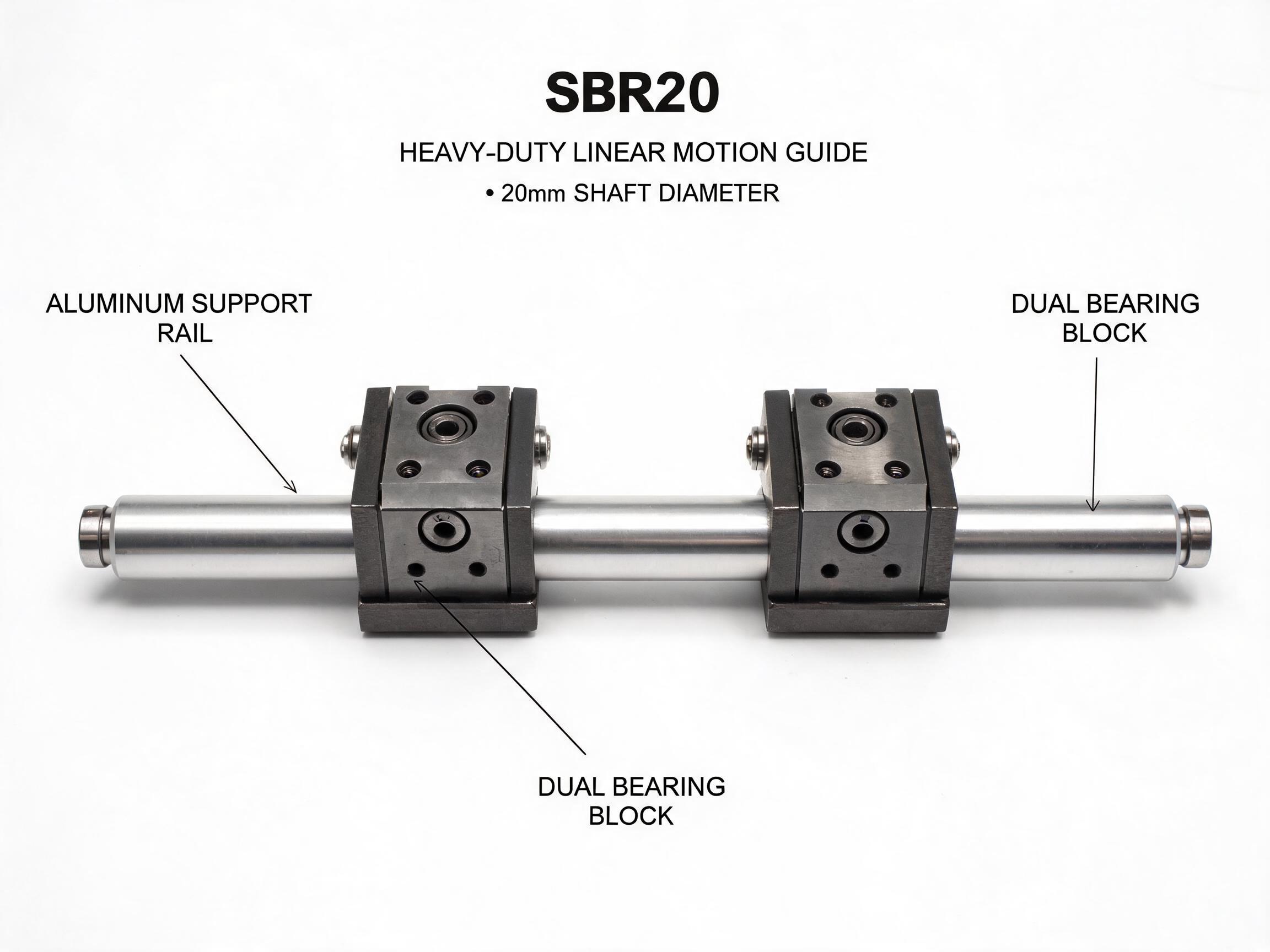
The ball material is GCr15 through-hardened to HRC 58-62. That is the working surface the balls roll on, and it is the number that matters when you compare load ratings between suppliers.
The practical consequence of the design: you do not machine a flat and parallel seat for the rail, shim it, and then dial it in. You bolt the unit down, and the support rail holds the geometry for you.
Per-axis load math with published ratings
Load ratings are per bearing block, not per rail. That single fact changes the arithmetic on almost every gantry axis, because most gantry axes use two blocks per rail, or two blocks per carriage assembly.
SBR ratings
- SBR16 (16 mm shaft): 7.8 kN dynamic per block.
- SBR20 (20 mm shaft): 11.2 kN dynamic per block, 17.5 kN static per block.
- SBR20 with dual blocks on one axis: 22.4 kN dynamic for that axis.
Profile rail ratings
- HGR20 with HGH20CA carriage: 18.0 kN dynamic, 29.5 kN static (carriage rating).
- HGR45 with HGW45CA carriage: 62.8 kN dynamic, 112 kN static for genuinely heavy axes.
Put side by side, the picture is clear. A single SBR20 block is rated below a single HGH20CA carriage. But an SBR20 axis run with dual blocks reaches 22.4 kN dynamic, which is above one HGH20CA carriage and below two of them. This is why you cannot settle the question by comparing one block to one carriage.
| Slide | Dynamic per block / carriage | Static per block / carriage | Notes |
|---|---|---|---|
| SBR16 | 7.8 kN | — | 16 mm shaft |
| SBR20 | 11.2 kN | 17.5 kN | 20 mm shaft, GCr15 HRC 58-62 |
| SBR20, dual blocks per axis | 22.4 kN | — | Per axis with two blocks |
| HGR20 + HGH20CA | 18.0 kN | 29.5 kN | Carriage rating |
| HGR45 + HGW45CA | 62.8 kN | 112.0 kN | For genuinely heavy axes |
Ratings quoted above are the published figures for these specific products. Dynamic and static ratings describe different loading conditions and are not interchangeable; the static figure is the relevant one when the axis is stationary or subject to shock, and the dynamic figure is the one that applies while the axis is moving under load.
When profile rail is the required answer
Three conditions push a gantry axis onto profile rail, and none of them are about brand preference.
Condition one: per-axis load exceeds the SBR20 dual-block figure. If a calculated axis load lands above 22.4 kN dynamic, SBR20 with two blocks is out of range. You either add blocks and lengthen the carriage, move to a larger SBR shaft, or step to profile rail. In the HGR family, HGR20 with HGH20CA gives 18.0 kN dynamic per carriage, so a two-carriage axis reaches well past the SBR20 dual-block figure. When the axis is genuinely heavy, HGR45 with HGW45CA at 62.8 kN dynamic and 112 kN static per carriage is the appropriate class.
Condition two: the structure cannot tolerate the deflection of a supported round shaft. An SBR shaft is supported, but it is still a round rail carried by an aluminum extrusion. A profiled guideway with a carriage that wraps the rail resists moment loads differently. On a plasma table where cut quality depends on keeping the torch at a consistent height, that difference is a design input, not a detail.
Condition three: the axis carries a significant overhung or cantilevered load. Round-rail blocks handle radial load well; a profiled carriage handles moment loading across its width better. If your Z axis hangs out in front of the gantry beam, the moment is real.
For builders comparing options across the range, the HGR series heavy duty linear guideway rail is the profile-rail counterpart to the SBR units discussed here, and its carriages carry the ratings listed in the table above.
Mounting simplicity and travel length
This is where SBR earns its place even when the load math would allow profile rail.
An SBR unit mounts to a beam with a drilled pattern. Because the support rail is drilled every 50 mm, a fabricator can transfer that pattern, drill, and bolt. There is no requirement to machine a flat and parallel seat for the rail, and no separate rail-alignment step before the blocks are loaded. For a shop building mid-size CNC routers or plasma tables in batches, that removes a machining operation and a setup from every machine.
Profile rail is a different job. The guideway needs a flat, parallel mounting surface across its full length, and the two rails on an axis need to be parallel to each other within the tolerance the carriage can absorb. That surface is usually machined. On a welded steel gantry beam, that means either machining after welding or accepting a tolerance stack you then have to compensate for in alignment.
Travel length cuts in two directions:
- SBR: standard length to 3000 mm, custom to 4000 mm. For most mid-size routers and plasma tables, that covers the axis. Very long gantries need a different approach.
- Profile rail: length is not the constraint in the same way, but the cost and difficulty of achieving a flat, parallel seat grow with length. A long profile rail on a poorly prepared surface is a worse outcome than a shorter one on a good surface.
The honest summary: if your axis fits inside the SBR20 dual-block rating and inside the standard or custom shaft length, SBR gives you a bolt-on unit that a fabrication shop can install without a machining step. If it does not, profile rail is not an upgrade — it is a requirement, and you should budget for the mounting surface it needs.
For builders who want to evaluate the unit directly, specifications for the SBR16 linear motion guide rail unit with bearing block and the SBR20 heavy duty linear motion guide unit with dual bearing blocks are published per model, including the per-block ratings used in the table above.
A selection framework you can apply today
Work through these steps per axis, not per machine.
- List the load conditions for the axis. At minimum, the moving mass plus the cutting or process force, and whether the load is centered or overhung.
- Convert to a per-axis dynamic load figure. This is the number you compare against ratings.
- Compare against SBR20 dual-block at 22.4 kN dynamic. If the axis figure is comfortably below it and you have no significant moment load, SBR is a legitimate candidate.
- Compare against HGR20 with HGH20CA at 18.0 kN dynamic per carriage. Count carriages per axis. Two carriages clear the SBR20 dual-block figure with margin.
- If the axis is genuinely heavy, look at HGR45 with HGW45CA at 62.8 kN dynamic and 112 kN static.
- Then check the practical constraints. Can you machine a flat, parallel seat for profile rail, or is the beam a bolt-together assembly? What travel does the axis need, and does it fit inside 3000 mm standard or 4000 mm custom shaft length?
A useful sanity check: an axis that passes on paper but sits on a beam you cannot machine flat will perform below its rating. The mounting condition is part of the load path.
Buyer questions
What is a linear load, in this context?
It is the force the bearing has to carry in the direction the block is loaded — typically the load pulling down on the carriage plus any moment from an overhung tool. It is not the same as the mass of the moving parts. A light gantry with a heavy cutting force can have a higher linear load than a heavier one that cuts lightly.
Can I mix SBR and profile rail on the same machine?
Yes, and it is common. A machine can use SBR on a lightly loaded axis and profile rail on the axis that carries the cutting head, provided each axis is evaluated against its own load conditions. The ratings above are per product, so the comparison stays valid.
Do I need to derate SBR ratings for two blocks?
The 22.4 kN dynamic figure for SBR20 already reflects two blocks on one axis. It is not a single-block rating doubled for convenience; it is the per-axis figure that applies when both blocks share the load. If load sharing between the two blocks is uneven — for example, from a misaligned mounting surface — the assumption weakens.
Is the support rail on an SBR unit structural?
Yes. That is its function. It supports the shaft along its length and provides the mounting pattern. Removing it and bolting only the shaft would be a different, unsupported-shaft design with different deflection behavior.
How do I confirm the right slide before ordering?
Give the supplier the axis load figure, the travel length, the mounting surface condition, and whether the load is centered or overhung. Those four inputs are enough to place an axis against the ratings above. Where a figure is uncertain, it is better to confirm it than to assume margin.
The decision in one line
If the per-axis dynamic load fits under 22.4 kN with dual SBR20 blocks, the travel fits inside the shaft length, and you want a bolt-on unit without a machining step, SBR is the honest choice. If the load is higher, the moment load is significant, or the cut quality depends on stiffness, profile rail — HGR20 with HGH20CA, or HGR45 with HGW45CA for genuinely heavy axes — is what the application requires.