
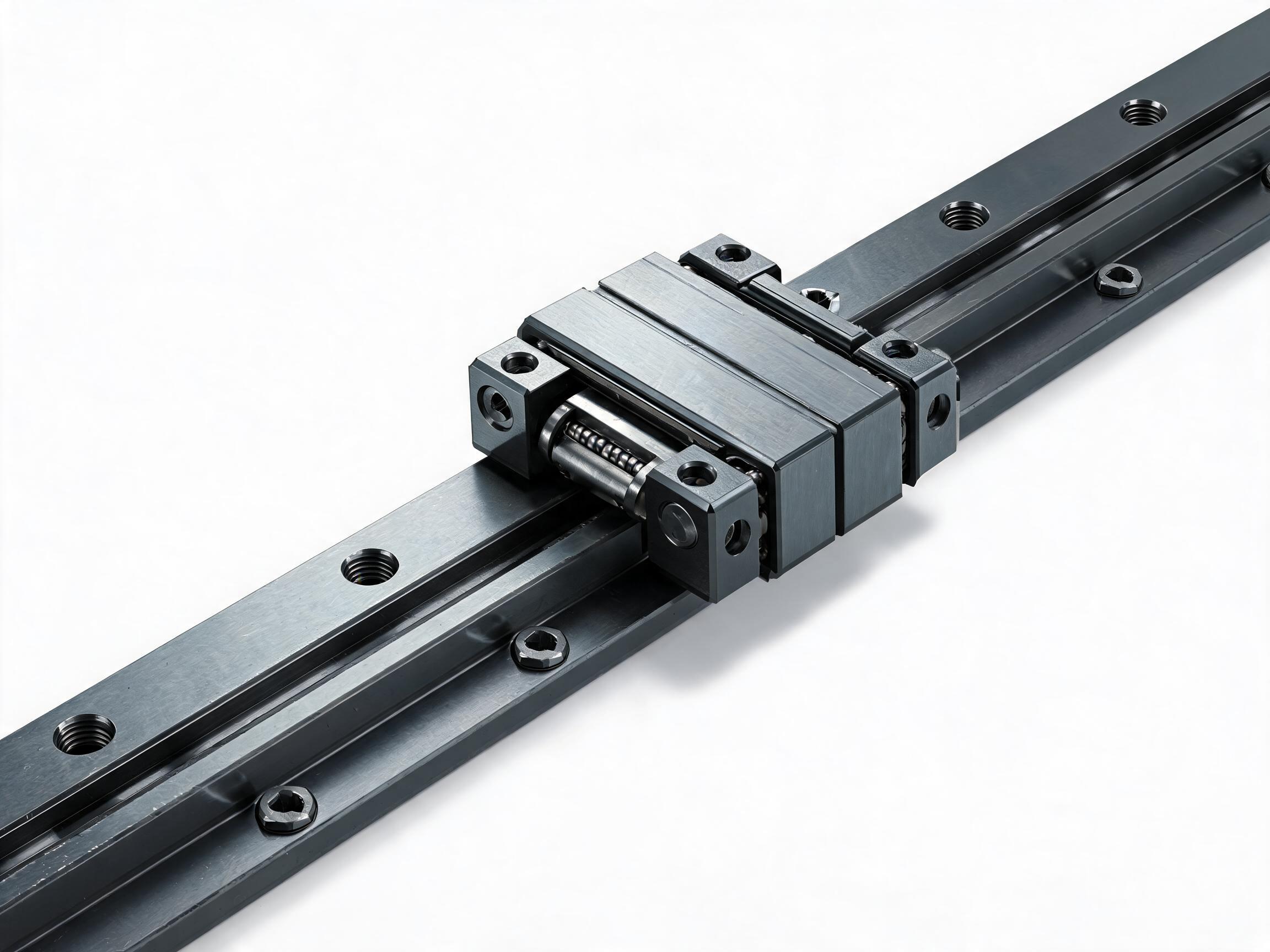
"Heavy duty" is a claim, not a specification. This article translates it into four checkable numbers — static load margin, raceway hardness and case depth, mounting hardware, and moment direction — and shows where track-roller systems fit versus hardened profile rails, using HGR45 catalog data as a worked example.
Specification Guide
"Heavy duty" on a datasheet tells a buyer almost nothing. What decides whether a guidance system survives a high-load axis is a small set of numbers you can write into an RFQ and check against a response. This guide isolates four of them, then shows how they are actually expressed in a hardened profile-rail catalog.
Key takeaways
- Static load rating is a starting point, not a margin. Ask for both dynamic and static figures for your chosen carriage, not only the rail.
- Raceway hardness and case depth together describe the loaded surface; a hardness figure alone does not.
- Mounting bolt size, thread and pitch define how load transfers into the machine frame.
- Moment direction determines whether a two-rail profile system or a track-roller system is the right architecture.
Why "heavy duty" needs to be re-stated as numbers
Buyers searching for heavy duty track rollers and guide rails usually have the same underlying question: will this guidance survive the load and the direction of that load in my machine? Suppliers answer with adjectives because adjectives are unconstrained. A specification answers with a value, a unit and a condition, and that is what you can compare across quotations.
Four checkable items cover most of the difference between a light and a genuinely heavy-duty axis: static load margin, raceway hardness and case depth, mounting hardware, and the direction of the moment. None of them requires proprietary testing to verify — each can be read off a catalog or a drawing, or asked for directly.
1. Static load margin
Dynamic rating covers fatigue life under motion; static rating covers the load that a stationary or slowly moving bearing can resist without permanent deformation of the raceway and balls. For a high-load axis with shock, parking loads or a heavy vertical head, the static rating is the number that describes the resting state of the machine.
A useful margin rule is to compare the static rating to the calculated worst-case load, including the moment contribution, and require the supplier to state which figure is per rail and which is per carriage. Those are different numbers and mixing them up is a common source of under-specification.
Worked example from a profile-rail catalog: the HGR20 rail is listed at 16.7 kN dynamic and 26.7 kN static. On the larger HGR45 heavy-duty large linear guideway rail, the catalog pairs the rail with an HGW45CA carriage at 62.8 kN dynamic and 112 kN static per carriage. The static-to-dynamic ratio is the quick sanity check — about 1.6 on the HGR20 and about 1.8 on the HGR45 — and the absolute static figure is what you size against your machine load.
2. Raceway hardness and case depth
Hardness tells you the surface resistance to indentation; case depth tells you how much hardened material stands behind that surface. A hard but thin case can be broken through by a shock load or by a ball that is slightly misaligned, and the failure then progresses into softer core material. Both values belong in a specification.
The HGR series heavy-duty linear guideway rail uses a 55# high-carbon steel body with the raceway induction hardened to 58–62 HRC. The HGR45 variant is listed with a case depth of 2.0–2.5 mm on a 45# high-carbon steel body, sized 45 mm wide by 38 mm high. That is the form of statement to look for: base material, process, hardness range and depth, all together. Note that the base material is not uniform across the series — the series listing states 55# while the HGR45 is listed on a 45# body — so confirm the material for the specific size you order.
Two related details are worth extracting from any catalog before you compare: the number of ball circuits and the load directions they carry. The HGR rails use a four-row ball circuit that carries radial, reverse-radial and lateral loads simultaneously. A single-row design carrying only downward load is a different product for a different job, regardless of how it is marketed.
3. Mounting hardware
The rail does not carry the load; the bolted joint between rail and frame does. Bolt diameter, thread and pitch set the clamp force available and the spacing of load transfer into the machine structure. A rail with excellent ratings on a coarse bolt pattern can still deflect between fixings on a thin frame.
For HGR45, the catalog specifies M12 mounting bolts at 60 mm pitch, with a rail weight of 6.2 kg/m. For the buyer, those three numbers decide the frame drilling pattern, the frame wall thickness needed to develop the bolt preload, and the handling weight during assembly. Ask for the same three values on any competing offer and the comparison becomes concrete.
4. Moment direction
This is the item most often left out of an RFQ, and it is the one that changes the architecture of the guidance. A profile rail on a carriage resists a moment through the ball rows and the spacing between carriages and rails. A track-roller or V-roller system resists it through the geometry of the roller against the track and the preload between opposed rollers. They are not interchangeable in every direction, and the direction of the dominant moment — pitch, yaw or roll — decides which is practical.
State the dominant moment direction and its magnitude in the inquiry, not just the vertical load. A cantilevered vertical axis with an offset tool produces a large pitch moment; a wide gantry with a central load may produce very little. The same rail can be adequate for one and marginal for the other.
Where track-roller systems fit versus profile rails
Track rollers and V-rollers run on a hardened track and are typically chosen where the track can be long, where debris is present and can be pushed aside by the roller, or where the track itself can be mounted to a structure rather than machined into it. Profile rails carry load in three directions through recirculating ball rows and are chosen where stiffness and repeatable positioning matter on a machined mounting surface.
This catalog does not include a track-roller product, so no ratings are given here for that family. If your application is a track-roller or V-roller design, ask the supplier for their static and dynamic ratings, roller hardness, track hardness and case depth, and the preload adjustment method, and evaluate them against the four items above rather than against profile-rail numbers. The two systems are sized differently and the values are not directly comparable.
Practical specification notes for long axes
Long travel introduces its own questions. The HGR series is available in sizes HGR 15/20/25/30/35/45 with a maximum standard length of 4000 mm. Beyond that, the HGR45 rails are supplied as precision splice joints up to about 8000 mm. If your axis exceeds the standard length, the joint location relative to the carriage travel and the bolting either side of the joint belong in the drawing, not in a verbal agreement.
Two further items are worth confirming in writing for any high-load axis. First, the precision grade: the HGR range is offered in Ground H (P5) and Rolled N (P7), and the grade selected affects both straightness and cost. Second, lubrication: the HGR rails carry a continuous oil-groove lubrication channel, so the inlet position and the lubrication interval need to match your machine's service access.
Finally, if the machine is a replacement or a second source for an existing design, check the cross-section and bolt pitch. The HGR range matches the standard Taiwanese HGR profile in cross-section and bolt pitch, which allows drop-in replacement of the rail without redrilling the frame — a detail worth verifying against your existing drawing rather than assuming.
What to put in the inquiry
A short, specific list gets you a comparable answer. Include: calculated worst-case vertical and lateral load; dominant moment direction and magnitude; required travel length; mounting surface material and thickness; bolt size you can accommodate; required precision grade; lubrication access; and environment (debris, coolant, washdown). Ask the supplier to state, per rail and per carriage, the static and dynamic ratings, raceway hardness, case depth and base material. Any offer that answers those points can be compared line by line with another.
Buyer questions
Is a higher static load rating always better?
Not on its own. A larger static rating usually comes with a larger rail section, a taller overall height and a heavier rail, which changes the machine envelope and the frame stiffness required. Size the rating against your calculated load with an agreed margin, and check that the section fits the space you have.
Can I substitute a track roller for a profile rail on an existing machine?
Only with a redesign of the mounting surface and the preload arrangement. Track rollers run on a separate hardened track and are adjusted by preload; profile rails mount directly to a machined surface with a fixed bolt pattern. The interfaces are not interchangeable, and the catalog ratings are not directly comparable between the two families.
How do I handle an axis longer than the maximum standard rail length?
Use splice joints. The HGR45 rails beyond 4000 mm are supplied as precision splice joints up to about 8000 mm. Specify where the joint may fall relative to the carriage travel, and inspect the joint alignment at assembly rather than relying on the rail alone to establish straightness.
What hardness should I ask for?
Ask for the hardness and the case depth, on a stated base material. The HGR series rails are listed at 58–62 HRC on an induction-hardened raceway in a 55# high-carbon steel body, while the HGR45 is listed on a 45# high-carbon steel body with 2.0–2.5 mm case depth — so state the size when you request the material and hardness. A hardness value without depth does not describe the loaded surface fully.