A decision guide for selecting a linear guide carriage body type. Compare the standard flange HGH for general CNC axes, the wide-body HGW carriage for moment loads and gantry axes, and the EGH miniature guideway for compact instruments. Includes footprint differences, load direction handling, sealing, lubrication, and size and preload options.
Carriage Body Selection Guide
A linear guide carriage is not one product. The questions buyers send us most often — "what is a linear motion guide", "what is an LM guide" — usually turn into a more specific problem at the drawing stage: which carriage body fits the axis in front of me? The rail size is often already fixed by the load and the available mounting space. What causes rework is the carriage body, because the three common series differ in footprint width, height, and how they carry moment.
This guide compares three real series by the machine requirement each one serves: the HGH standard flange carriage for general CNC axes, the HGW wide-body carriage for moment loads and gantry or inverted axes, and the EGH miniature guideway for compact instruments. Load ratings are given only where a verified figure exists; no rating is extrapolated from one model to another.
Key takeaways
- The HGW wide-body carriage carries a 20–30% wider mounting footprint than the standard HGH flange type and is used where pitch and yaw moment loads appear on heavy gantry or inverted axes.
- The HGH standard flange carriage suits general CNC axes where the load is mainly downward and lateral, and the mounting surface is a conventional machined pad.
- The EGH miniature guideway is a rail-and-carriage set for compact machines and instruments where section height and travel space are the limiting dimensions.
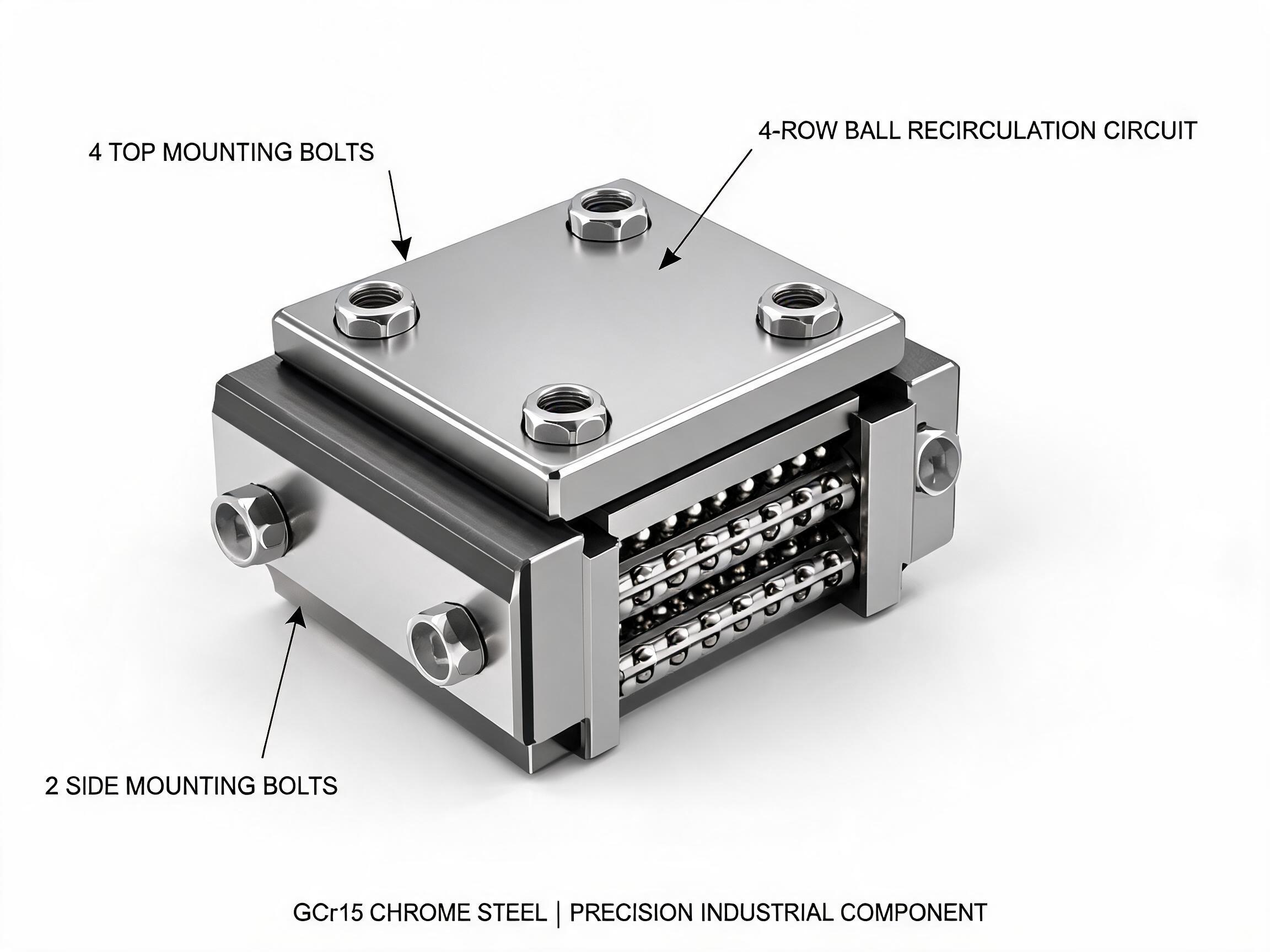
- The HGH and HGW share a four-row ball recirculation geometry — radial, reverse-radial and both lateral loads — with self-aligning angular tolerance of ±0.5°; confirm the EGH miniature's internal details against its series drawing.
In this article
Start from the axis, not the catalogue page
Two questions separate the three series faster than any load calculation.
- Does the axis apply a moment load to the carriage? A moment appears whenever the driving force or the payload centre of gravity sits away from the carriage centre — typical on gantry cross-beams, cantilevered Z axes, and any axis mounted upside down. A carriage that is wider across the mounting face spreads that moment over a longer base.
- How much section height and mounting width is available? If the machine frame is a small instrument housing, a full-size carriage may not fit at all, regardless of its rating.
Answer those two first. The series then follows, and you use the catalogue to pick size and preload rather than to pick the body type.
HGH standard flange carriage: for general CNC axes
The HGH is a standard flange-type carriage. Its mounting holes are arranged on a flange whose width matches the conventional footprint used across general machining axes — the X, Y and Z slides of standard CNC machines, automation transfer axes, and linear stages where the load is primarily radial with some lateral component.
Choose the HGH when:
- The mounting surface is a flat machined pad with standard hole spacing, and you are replacing or standardising an existing carriage footprint.
- The load is mainly downward (radial) or sideways (lateral), with no significant cantilever from the payload.
- The axis is horizontally mounted, so the carriage is not called on to resist a persistent tipping moment.
Details such as ball recirculation rows and self-aligning tolerance are series- and model-specific. On the wide-body series these are documented as four-row recirculation carrying radial, reverse-radial and both lateral loads with a ±0.5° self-aligning tolerance; confirm the corresponding HGH figures on the series page before finalising your drawing.
Full dimensions and mounting-hole data for the standard flange body are on the HGH series flange-type carriage page.
HGW wide-body carriage: for moment loads and gantry axes
The HGW is the wide-body carriage. Its mounting footprint is 20–30% wider than the standard HGH flange type of the same nominal size. That extra width is the whole point: a wider base increases the distance between the reaction points that resist pitch and yaw, so the carriage tolerates moment loads that would deflect a narrower body.
Choose the HGW when:
- The axis is a heavy gantry beam, where the load travels far from the rail centreline.
- The axis is inverted or side-mounted, so gravity itself creates a tipping moment around the rail.
- You need one carriage to resist both pitch (front-to-back tilt) and yaw (twist about the vertical axis) at the same time.
Verified figures for one representative model: at HGW25CA the dynamic load rating is 28.4 kN and the static load rating is 42.1 kN. Use these as the reference point for that model only; each size in the series has its own rating, and the correct value should be read from the series table for the size you are specifying.
HGW sizes run 15 / 20 / 25 / 30 / 35 / 45 with C0, C1 and C2 preload grades. The full size and preload table is on the HGW wide-body carriage page.
EGH miniature guideway: for compact instruments
The EGH series is a miniature linear guideway — rail and carriage supplied as a matched set for compact machines. The decision driver here is installation envelope, not maximum load: small optical stages, bench-top test rigs, medical and laboratory instruments, and compact handling units where a full-size carriage simply has no room.
Choose the EGH when:
- Section height is limited and the frame cannot accept a standard-height carriage.
- The moving mass is light and travel is short.
- The design calls for a rail-and-carriage assembly as a single matched unit rather than a carriage fitted to an existing rail.
Details of the miniature rail and carriage are on the EGH series miniature guideway page. Because miniature carriages are usually selected against a tight envelope, confirm the rail length, hole pitch and carriage width against your actual frame drawing before ordering.
Side-by-side comparison
| Requirement | HGH standard flange | HGW wide-body | EGH miniature |
|---|---|---|---|
| Typical axis | General CNC slides, automation axes | Heavy gantry, inverted or side-mounted axes | Compact instruments and bench-top stages |
| Mounting footprint | Standard flange footprint | 20–30% wider than HGH at the same nominal size | Miniature section, matched rail and carriage |
| Moment load behaviour | Adequate where no significant cantilever exists | Resists pitch and yaw on gantry and inverted axes | Selected by envelope; light moving mass |
| Load direction | Confirm per series drawing | Radial, reverse-radial, both lateral | Confirm per series drawing |
| Self-aligning tolerance | Confirm per series drawing | ±0.5° | Confirm per series drawing |
| Available sizes | Per HGH series table | 15 / 20 / 25 / 30 / 35 / 45 | Miniature sizes per series table |
| Preload grades | Per series table | C0 / C1 / C2 | Per series table |
Load ratings are model-specific. The only rating quoted in this article is HGW25CA at 28.4 kN dynamic and 42.1 kN static. Ratings for other models in any series should be taken from that series table.
Sealing, lubrication and preload
These points matter for every carriage body, and they change how the axis behaves over time. The specifics below are documented for the HGW series; confirm the corresponding arrangements for the HGH and EGH on their series pages before finalising maintenance access.
Triple-seal system
The HGW carriages use a triple-seal arrangement: an end seal, a side seal strip, and a bottom scraper. The end seal closes the front and rear openings; the side strip runs along the carriage flanks; the bottom scraper clears the rail mounting shoulder. Together they reduce the amount of chips, dust and coolant that reaches the ball tracks.
Dual lubrication ports
Two lubrication access points are provided on the HGW series: a top M6 grease nipple and a side oil port. The top port suits re-lubrication with the machine assembled, from above. The side port is useful where the top face is blocked by a bracket, or where the axis is inverted and a top nipple would be difficult to reach. Decide which port the maintenance schedule will use before finalising the surrounding structure.
Preload grade
C0, C1 and C2 preload grades let one carriage body serve different stiffness requirements. Higher preload reduces clearance and increases stiffness, and simultaneously raises running resistance and heat. The choice depends on whether the axis is positioning against a cutting force or gliding with minimal resistance — not simply on the largest available number.
FAQ
Can I use an HGW carriage as a drop-in replacement for an HGH carriage of the same size?
No. The HGW mounting footprint is 20–30% wider than the HGH flange footprint at the same nominal size, so the bolt pattern on your mounting pad will not match. The change has to be designed into the machine, not swapped at the maintenance window.
Which series should I choose for a cantilevered Z axis?
A cantilevered Z axis applies a moment, so the wide-body HGW carriage is the relevant body type. Confirm the actual moment and the required rating against the HGW series table for the size you intend to use.
Does the EGH series share the same seals and lubrication ports?
Triple-seal and dual lubrication port arrangements are documented for the HGW series. For the miniature EGH, confirm port size and lubrication points against the EGH series drawing, since the reduced section can change the fitting dimensions.
Which is better — the size or the preload grade?
Treat them as separate decisions. Size is set by load and moment; preload is set by required stiffness and acceptable running resistance. Selecting a larger carriage to compensate for an unsuitable body type usually costs more without fixing the moment problem.
What to send when requesting a quote
To get an accurate carriage recommendation you do not need a finished specification. A sketch of the axis with the load position, the rail size already fixed, the mounting-hole spacing on the pad, and whether the axis is horizontal, vertical or inverted is enough to identify the body type. Add the expected travel and the environment (chips, coolant, dust) so the seal and lubrication arrangement can be confirmed at the same time.
DFLinear manufactures these series under an ISO 9001:2015 quality system, with CE and SGS documentation, and offers a 24-month warranty. OEM and ODM requests for special preload or alternative materials can be quoted against your drawing. For selection support, send your axis details and we will confirm the carriage body, size and preload grade for the application.