
HGR20 linear rail carries a 16.7 kN dynamic and 26.7 kN static load per the HGR series specification, but the HGH20CA carriage rating of 18.0 kN dynamic and 29.5 kN static caps the pair. This guide reads out what the size actually delivers, how the rail and carriage ratings interact, and the two conditions that should trigger a step up the HGR ladder.
HGR20 linear rail is rated at 16.7 kN dynamic and 26.7 kN static in the HGR series specification. The constraint buyers usually miss is that the carriage, not the rail, sets the working ceiling: an HGH20CA block is rated 18.0 kN dynamic and 29.5 kN static. This article reads out what that pairing actually delivers on a CNC or automation axis, and the two conditions that justify stepping up the size ladder.
Key points
- HGR20: 16.7 kN dynamic, 26.7 kN static, 55# high-carbon steel, 58-62 HRC induction hardened raceway, four-row ball geometry.
- HGH20CA carriage: 18.0 kN dynamic, 29.5 kN static. The lower of the two numbers governs the assembled pair.
- Ground H (P5) and rolled N (P7) grades cover different speed and accuracy demands on the same 20 mm envelope.
- Step-up triggers are static-limit exceedance under shock loads, and moment loads that exceed a single carriage row.
- The top of the ladder, HGR45 with HGW45CA, is rated 62.8 kN dynamic and 112 kN static with M12 bolts at 60 mm pitch.
On this page
What the HGR20 load rating contains
The published figure for HGR20 rail is 16.7 kN dynamic load and 26.7 kN static load. The dynamic figure is the one that matters for a moving axis; the static figure is the ceiling for a stationary or near-stationary load, including the moment when a machine is parked and a workpiece is clamped or transferred.
These are rail ratings. They describe what the raceway can carry when a qualified carriage runs on it. They are not an axis rating, and they are not a machine rating. Bearing capacity along a rail depends on the carriage used, the number of carriages carrying the load, how the load is distributed between them, and the direction of the load relative to the block.
Dynamic and static, read separately
Dynamic capacity governs fatigue life under travel. Static capacity governs permanent deformation risk under a load that is applied while the axis is at rest. A routing table axis that moves constantly and a load-transfer axis that indexes heavily but travels rarely can sit on the same rail size with very different margins, because they stress different numbers.
Why the carriage caps the pair
An HGR20 rail becomes an HGR20 assembly only when a carriage is mounted on it. The HGH20CA carriage block is rated 18.0 kN dynamic and 29.5 kN static. That is higher than the rail rating, which means the rail is the limiting element on paper. In practice, both numbers belong to the assembly, and the lower one sets the ceiling for the pair.
Drawing the load path makes this clearer. Force enters through the carriage mounting face, passes through the ball rows into the raceway, and exits through the rail into the mounting surface. Every element in that chain has its own limit, and the assembly is only as strong as the weakest link. Two rails and four blocks on a gantry do not simply quadruple the single-rail figure either, because load sharing between mounting points depends on the flatness and stiffness of the machine bed.
Material, hardening, and four-row ball geometry
HGR series rail is made from 55# high-carbon steel with an induction hardened raceway at 58-62 HRC. That hardness range is what allows a 20 mm rail section to accept the rated load without the raceway yielding under a concentrated ball contact. The case depth on the large end of the series, HGR45, is specified at 2.0-2.5 mm.
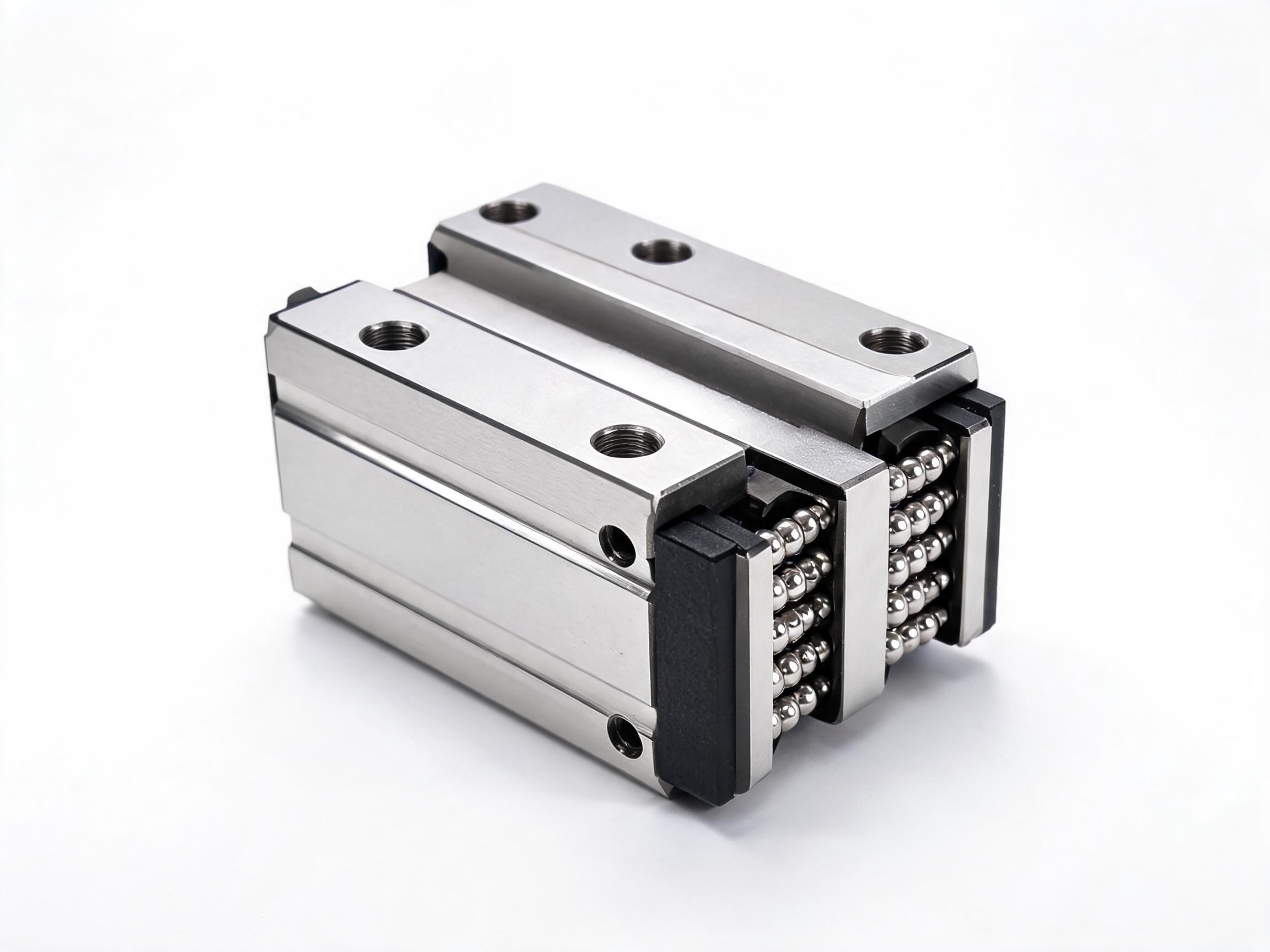
The four-row ball geometry is the reason a single block can accept load from several directions at once. The ball rows are arranged so the block carries radial load, reverse-radial load, and both lateral directions. That is why a horizontal axis can use the same block to resist the weight of the moving mass and the side thrust from cutting or acceleration, without adding a separate bearing for each direction.
For a buyer sizing an axis, the practical consequence is that you do not need to add a second rail set simply because the load has both a vertical and a horizontal component. You need to confirm that the combined load still sits inside the block rating, and that the moment generated by the offset between the load and the block center stays within what one carriage row can carry.
Grades and rail length
HGR20 is available in two accuracy classes. Ground H, designated P5, is the higher grade and suits axes where running parallelism and repeatability are the main concern. Rolled N, designated P7, is a lower-cost grade for applications where the rail sets the path but the accuracy budget is looser. Both grades use the same rail section and the same carriage interface, so the choice is a performance and cost decision, not a mounting decision.
Standard maximum rail length is 4000 mm. Beyond that, rails are supplied in sections joined with splice joints. A spliced rail introduces a joint in the raceway, and the mounting and alignment at that joint matter more than the joint hardware itself. If an axis is longer than 4000 mm, plan the joint position away from the region where the carriage dwells under full load, and check the straightness of the supporting surface across the joint.
Lubrication is handled through the oil groove and grease nipple on the carriage. The groove distributes lubricant along the ball path; the nipple is the service point. How often to re-lubricate depends on speed, load, and environment, and should be set against the carriage manufacturer's maintenance guidance for the specific block.
When to step up a size
There are two clean triggers for moving off HGR20. Either one alone is enough.
- Static limit exceeded under shock loads. A rail can be well inside its dynamic rating while a shock or a sudden stop pushes the momentary load past 26.7 kN static. Shock loads are not averaged out by travel; they act on the raceway in one event. If an axis indexes hard against a stop, or if a transferred workpiece lands on the table, calculate the peak static load rather than the nominal running load.
- Moment load beyond a single carriage row. When the load center sits far from the carriage, the block sees a moment rather than a pure force. A single carriage row handles a limited moment; once the overhung load grows, adding a second carriage on the same rail is the first option, and stepping up to a larger rail section is the second. A larger block carries more moment because the ball rows are further apart.
Two more situations deserve a look even if the numbers pass. If the axis accelerates or reverses quickly, the inertial force can exceed the gravity load used in the original estimate. And if the rail length needed runs well past 4000 mm with several splices, the cost and alignment burden of a spliced HGR20 setup may be better spent on a larger section that carries the load with fewer blocks.
The size ladder up to HGR45
HGR series sizes are 15, 20, 25, 30, 35, and 45. Moving up a size changes the rail section height and the carriage mounting dimensions, so a step-up is a redesign of the mounting interface, not a swap. Plan the bolt pattern and the rail height into the machine bed before committing to HGR20 to avoid re-machining later.
| Item | HGR20 / HGH20CA | HGR45 / HGW45CA |
|---|---|---|
| Dynamic load rating | 16.7 kN rail / 18.0 kN carriage | 62.8 kN |
| Static load rating | 26.7 kN rail / 29.5 kN carriage | 112 kN |
| Mounting bolt | M5 class (confirm per block) | M12 |
| Bolt pitch | Confirm per rail length | 60 mm |
| Case depth | Confirm per section | 2.0-2.5 mm |
The jump from HGR20 to HGR45 is the heavy end of the ladder: roughly a 3.7 times increase in dynamic rating and about 4.2 times in static rating. Intermediate sizes 25, 30, and 35 exist between them, and the right choice depends on the calculated load and moment at the block, not on a rule of thumb. For the full series description, see the HGR series heavy-duty linear guideway rail range; the large end is covered by the HGR45 heavy-duty large linear guideway rail, and the carriage options by the HGH series flange-type linear guideway carriage block.
FAQ
Is 16.7 kN the load an HGR20 axis can carry?
It is the dynamic rating of the rail itself. The assembled axis is limited by the carriage used and by how many carriages share the load, so use the lower of the rail and carriage ratings for the pair.
Does a ground P5 rail carry more load than a rolled P7 rail?
The grade describes accuracy class, not load capacity. Both grades use the same rail section and the same carriage interface; the choice between H (P5) and N (P7) is about running accuracy and cost.
Can I add a second carriage instead of going up a size?
Often yes. A second carriage on the same rail increases both load capacity and moment resistance by spreading the load over more ball rows. It requires more mounting length, so check the travel envelope before deciding.
What happens past 4000 mm rail length?
Rails are supplied in sections with splice joints. The joint position and the straightness of the supporting surface across it should be planned as part of the axis design.