
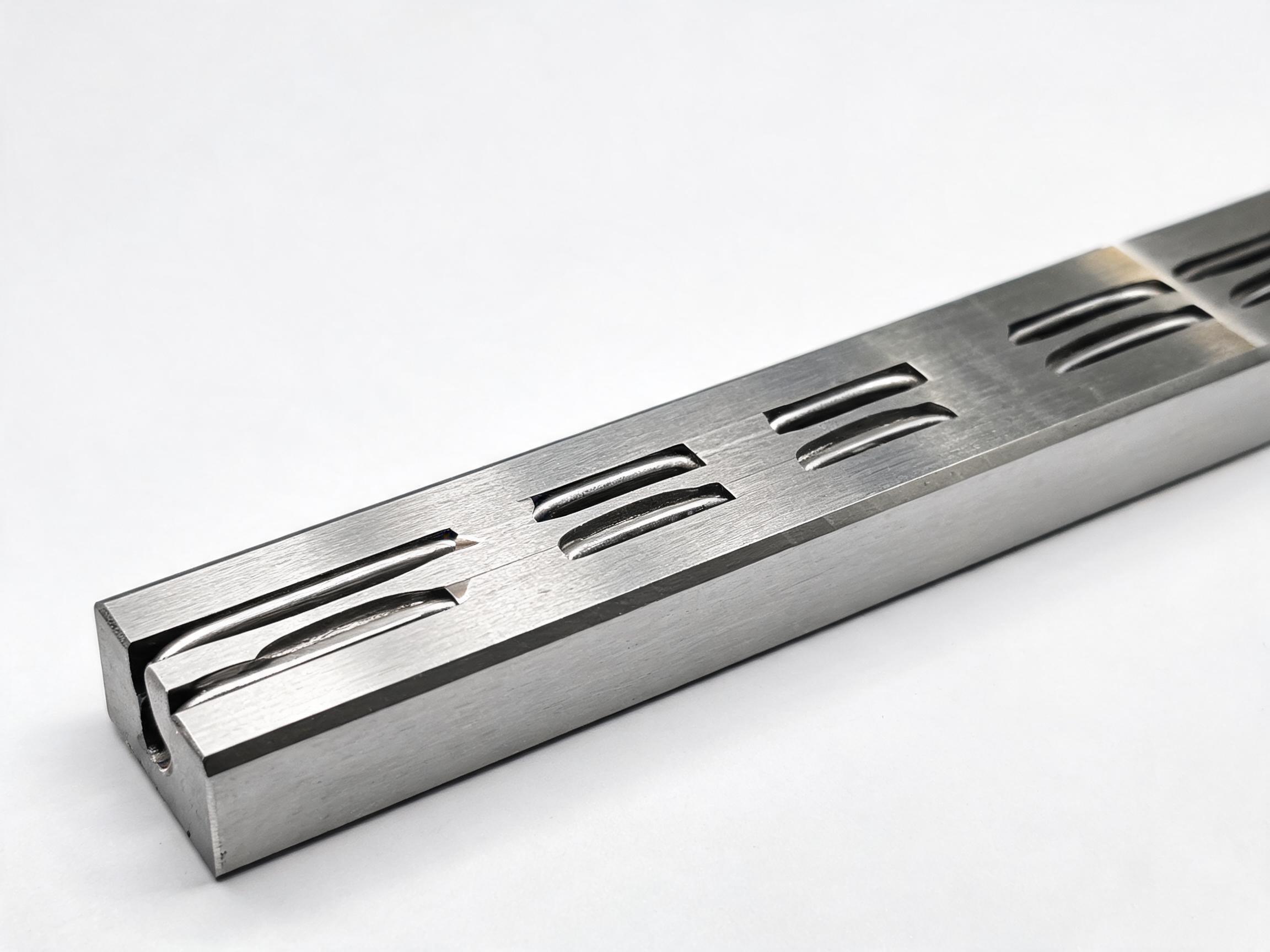
HGR20 is the 20-size profile rail in the HGR series. This explainer covers what the "20" designates, the dynamic and static load ratings, how the four-row ball circuit carries radial, counter-radial and lateral loads together, and the ordering facts buyers need before shortlisting a 20mm linear rail.
When a machine builder shortlists a 20mm linear rail, the question is rarely "is it big enough?" in the abstract. The real question is whether the 20-size profile rail matches the carriage load, the mounting pattern, the travel length and the precision the design calls for. This article explains what the "20" designates on an HGR rail, what HGR20 is rated to carry, and the ordering facts that decide whether it goes on the shortlist.
What the "20" designates on a profile rail
The number in an HGR model name is the size class of the profile rail, not a load figure and not a length. The HGR series covers sizes 15, 20, 25, 30, 35 and 45, so HGR20 is simply the 20-size profile rail within that range. The same size designation is used consistently across the series for the rail and the matching carriage blocks.
That matters for procurement because the size class fixes the interchange logic. Blocks and rails in a given size are designed to work together as a set, and the HGR profile and hole spacing follow the Taiwan-style standard, so HGR20 rails and blocks match the profile and hole spacing of standard HGR-series components in the same size. A replacement still has to match the required precision grade, and carriage and rail fitting dimensions should be confirmed per datasheet. A buyer specifying a 20 mm rail is therefore choosing a size class first and a precision grade second.
What HGR20 is rated for
HGR20 is a 55# steel rail, induction hardened to 58–62 HRC. The listed load ratings are the numbers to design around:
| Property | HGR20 value |
|---|---|
| Dynamic load rating C | 16.7 kN |
| Static load rating C0 | 26.7 kN |
| Rail material / hardness | 55# steel, induction hardened to 58–62 HRC |
| Ball circuit | Four-row ball circuit |
| Load directions | Radial, counter-radial and lateral, simultaneously |
| Standard max rail length | 4000 mm |
The four-row ball circuit is the mechanism behind the load statement. Because four rows of balls run in the block, the assembly carries radial loads, counter-radial loads and lateral loads at the same time rather than only down onto the rail. In practice, a carriage on an HGR20 can be loaded from above, from the side, or with an overhung moment, and the rating figures describe the assembly's capacity under those combined conditions.
The dynamic rating C = 16.7 kN is the figure used for moving loads, and the static rating C0 = 26.7 kN applies to loads at rest or at very low speed. Design work should compare the actual carriage load against these ratings rather than against a vague impression of what "20 mm" means. The rail cross-section, carriage dimensions and permissible speeds are not part of the listed data here; those values should be confirmed per datasheet before the design is locked.
Precision options: ground H (P5) and rolled N (P7)
HGR20 is offered in two precision grades. Ground H corresponds to P5, and rolled N corresponds to P7. The choice is not a quality ranking; it is a matching exercise between the grade and what the machine needs to hold.
Ground rail involves a ground raceway and is the grade to specify when the running accuracy requirement is tighter. Rolled rail is produced by a rolling process and is specified where the application tolerates the rolled grade's accuracy. Both are the same 55# steel, both are induction hardened to 58–62 HRC, and both carry the same dynamic and static load ratings. The grade changes the accuracy class, not the load class. Engineers comparing the two should set the required running accuracy first, then select the grade that meets it, and confirm the grade-specific tolerance values per datasheet.
Length, splicing and lubrication
The standard maximum rail length is 4000 mm. For longer travel, the rail is supplied as butt-joined splicing: individual rails are joined end to end to reach the required run. Buyers planning a long axis should specify the total length and the splice positions rather than assuming a single continuous rail is available beyond the standard maximum. Lubrication is handled at the rail body: there is a continuous oil groove with a grease nipple. That gives maintenance a defined grease point on the rail rather than requiring the block to be reworked. The recommended grease interval and quantity are not part of the listed data and should be confirmed per datasheet.
Ordering facts before you shortlist HGR20
The commercial details below are the ones that decide whether a prototype inquiry turns into a production order.
- MOQ: 50 pcs per size. Mixed SKUs are allowed within that minimum, so a first order can combine several lengths or grades.
- Stock and lead time: HGR20, HGR25 and HGR30 are in stock and ship in 7–10 business days.
- Interchange: Taiwan-style HGR profile and hole spacing; a same-size replacement still has to match the precision grade, with fitting dimensions confirmed per datasheet.
- Length: standard maximum 4000 mm; longer runs by butt-joined splicing.
- Required rail length and, for runs beyond 4000 mm, the splice positions.
- Precision grade: ground H (P5) or rolled N (P7).
- Expected carriage load and its direction, to compare against C = 16.7 kN and C0 = 26.7 kN.
- Rail cross-section, carriage dimensions and permissible speeds: confirm per datasheet.
For the full series overview and the other size classes, see the HGR Series Heavy-Duty Linear Guideway Rail. The same page is the reference for how the 20-size rail fits into the 15/20/25/30/35/45 range.
Where the 20-size rail fits
The 20 mm class sits above the 15-size rail and below the 25, 30, 35 and 45 sizes in the HGR range. That position makes it a candidate for carriage loads that exceed what a 15-size rail is rated for but do not require the larger sizes, with the exact fit decided by the load calculation against C = 16.7 kN rather than by the number alone.
Two practical points follow. First, because the profile and hole spacing follow the Taiwan-style standard, an HGR20 rail can bolt into an existing design built on the same profile and hole pattern without redrilling the mounting holes; the precision grade and the carriage and rail fitting dimensions still have to be matched and confirmed per datasheet. Second, because the MOQ is 50 pcs per size with mixed SKUs allowed, a buyer can qualify more than one length or grade in a single first order and test the real configuration before committing to a larger volume.
A hypothetical example shows how the rating figure is used. If a carriage carries a combined radial and lateral load near the dynamic rating, the design has little margin and the next size up or a different block configuration may be the better answer; if the load is well below 16.7 kN, the 20-size rail is the appropriate class to price. The calculation belongs to the machine designer, and the result should be checked against the datasheet values for the exact block and rail combination.
Frequently asked questions
What loads can HGR20 handle?
HGR20 uses a four-row ball circuit that carries radial, counter-radial and lateral loads simultaneously. Its dynamic load rating is C = 16.7 kN and its static load rating is C0 = 26.7 kN. The rail is 55# steel, induction hardened to 58–62 HRC. Compare the actual carriage load and its direction against these ratings; rail cross-section, carriage dimensions and permissible speeds should be confirmed per datasheet.
Should I choose ground H (P5) or rolled N (P7)?
Both grades are the same rail material and carry the same load ratings, so the choice is about accuracy, not capacity. Ground H (P5) is the grade for tighter running accuracy requirements; rolled N (P7) is the rolled grade for applications that tolerate its accuracy class. Set the required running accuracy first, then select the grade that meets it, and confirm the grade-specific tolerance values per datasheet.
What is the MOQ and lead time for HGR20?
The MOQ is 50 pcs per size, and mixed SKUs are allowed within that minimum. HGR20, HGR25 and HGR30 are in stock and ship in 7–10 business days. The standard maximum rail length is 4000 mm; longer runs are supplied by butt-joined splicing.
Bottom line
HGR20 is the 20-size profile rail in a series that spans 15/20/25/30/35/45. It handles radial, counter-radial and lateral loads together through a four-row ball circuit, rated at C = 16.7 kN dynamic and C0 = 26.7 kN static, in 55# steel hardened to 58–62 HRC. Buyers shortlisting a 20mm linear rail should fix the precision grade (ground H/P5 or rolled N/P7), the rail length against the 4000 mm standard maximum, and the load calculation against the rating figures, then confirm the remaining dimensions per datasheet before ordering at the 50 pcs per size minimum.