
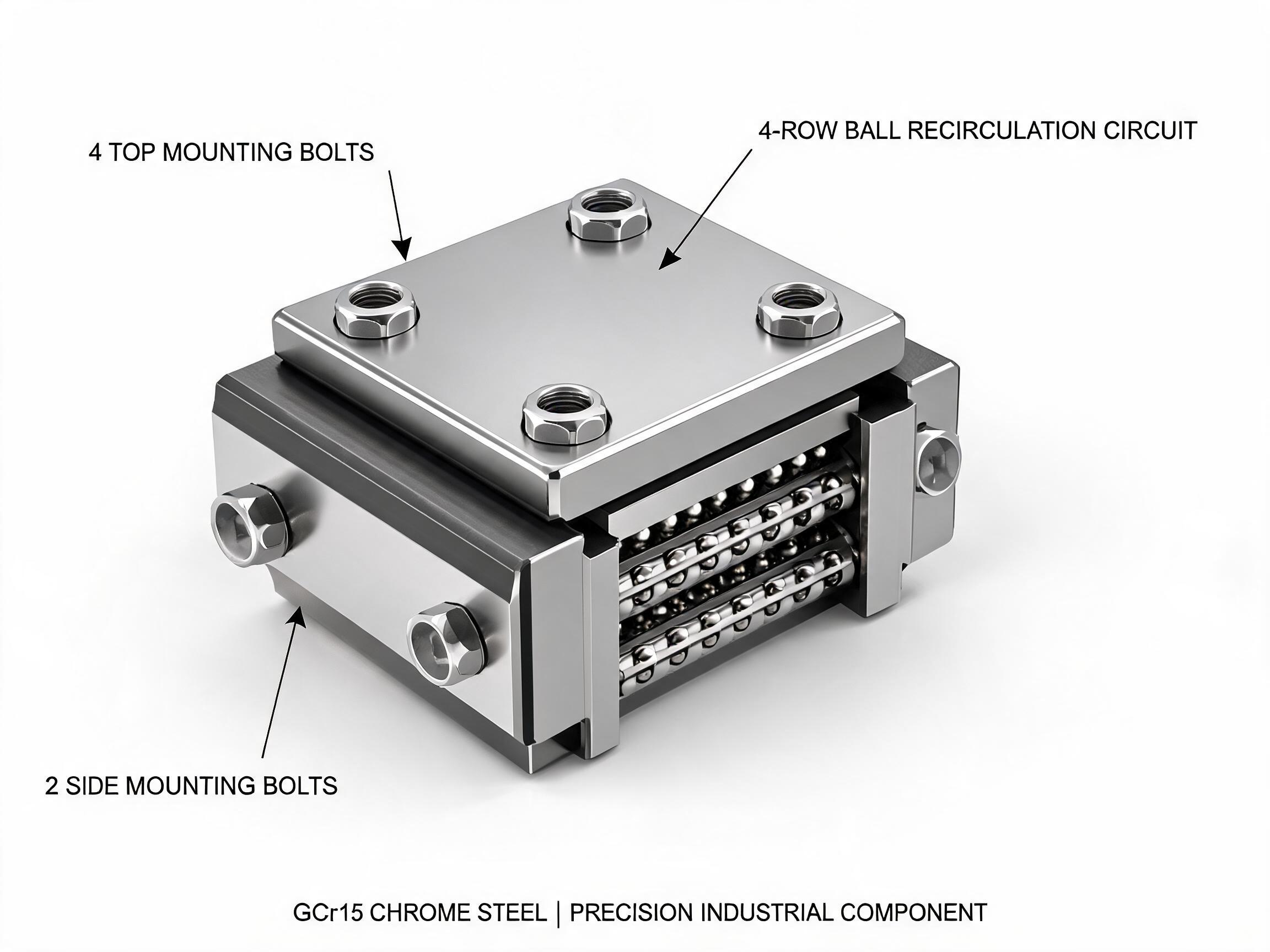
What the HGW20CC code means, how it fits HGR20 rail, and when the wide-body carriage is worth choosing over a standard HGH block.
The HGW20CC carriage is a wide-body linear guideway block sized for 20 mm HGR rail. Decoded: HGW is the wide-body carriage series and 20 is the rail size. The trailing CC is the carriage configuration code for this series; the datasheet for the exact part number states the configuration and the preload option. It mounts on HGR20 rail with the same four-circuit ball recirculation used throughout the series, so if you already run HGR20, the question is usually not whether it fits but whether the wider body is the right call for your load case.
What the HGW Code Tells You
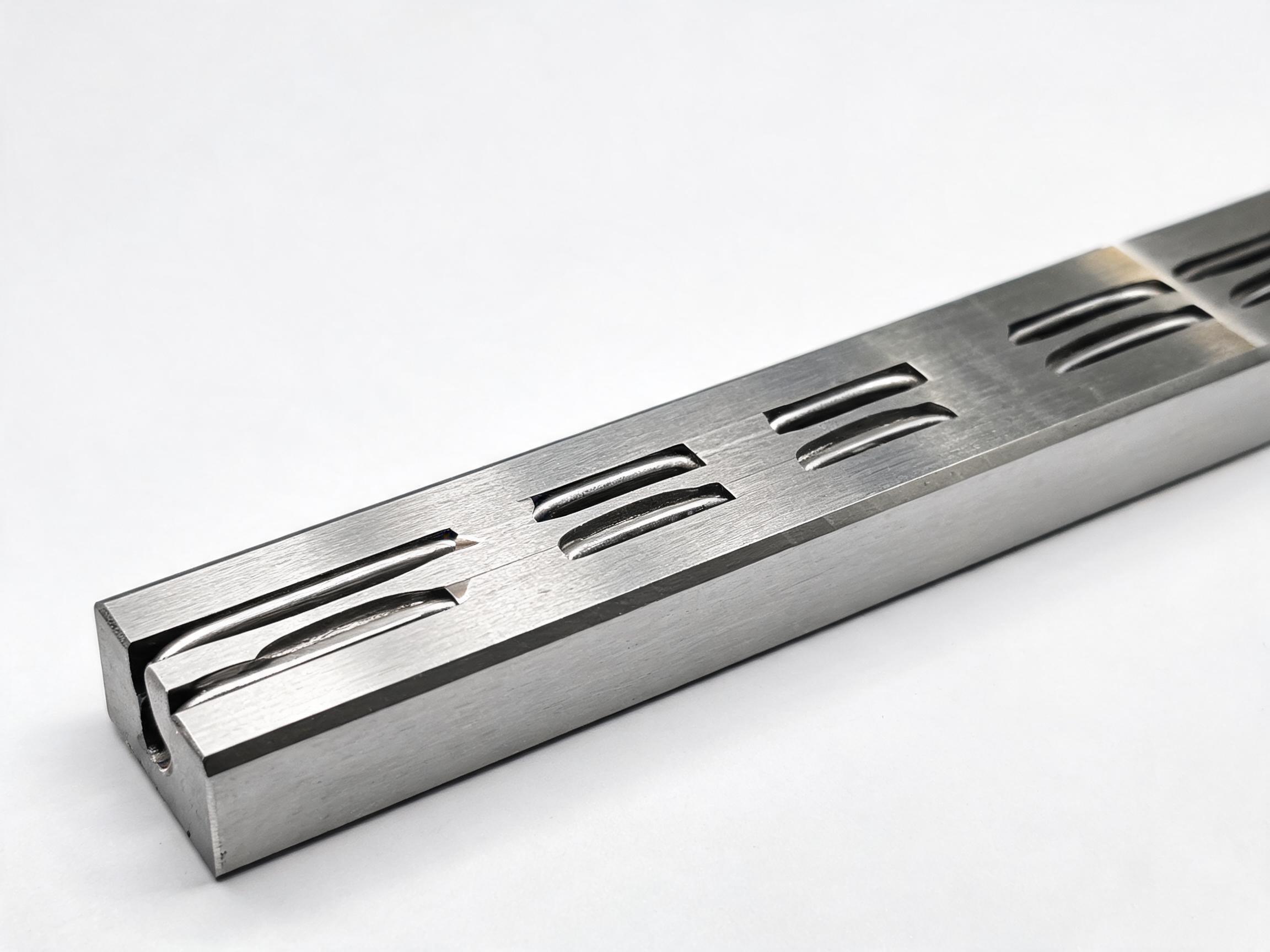
HGW is a wide-body carriage. HGH is the standard-body equivalent. The wide body is 20–30% wider than the standard HGH body, which is the whole point of the series: more mounting footprint on the same rail width.
Preload is a separate choice from the size code. The series offers C0 as the lightest preload, C1 as medium, and C2 as the heaviest. For a 20 mm carriage, preload affects stiffness and running drag, so the choice should match how much rigidity the application needs and how much drag the drive can tolerate. The carriage body is GCr15 bearing steel, with four-circuit ball recirculation, and the series uses triple sealing.
The CC suffix identifies the carriage configuration within the wide-body 20 mm series. It does not, by itself, tell you the dynamic and static load rating for that size. Ratings are published per size on the datasheet, and the configuration and preload option must be confirmed there before ordering.
Fit on HGR20 Rail
The carriage is built for the corresponding HGR rail size. HGR rail is available in 15 through 45 sizes, made from 55# steel, induction hardened to 58–62 HRC, and supplied in ground H (P5) or rolled N (P7) accuracy grades, with standard lengths up to 4000 mm. Pairing an HGW20CC with HGR20 rail keeps the interface consistent: the same rail width, the same ball track geometry.
Two fit checks matter before the order goes out:
- Mounting pattern. The wide body carries 4 top mounting bolts plus 2 side mounting bolts. Confirm your machine plate has clearance for that pattern, not just the two rows a standard HGH block would use.
- Sealing and environment. Triple sealing is standard on the series. If the axis runs in a dusty or chip-heavy environment, check that the end seals and side seals stay clear of any hard stops or guards through the full travel.
If either the rail or the carriage is being replaced on an existing machine, measure the actual rail width and bolt spacing rather than relying on the nominal size alone. The nominal 20 designation tells you the series; the measured dimensions tell you the fit.
When the Wide Body Pays Off
The decision between HGW and HGH is a mounting-footprint decision. The wide body gives you a broader bolt pattern on the same rail, which raises the effective resistance to overhung and moment loads. That matters in a few recurring situations:
- Single-rail cantilever axes. When one carriage has to carry a load that sits off to one side, the wider mounting face spreads the bolt load over a larger area.
- Heavy overhung tooling. A gantry head, a gripper, or a welding torch mounted outboard of the rail puts a moment on the block. The wider body handles this with a lower bolt stress than a standard block of the same rail size.
- Retrofits where the plate is already drilled. If the mating plate already has the wider pattern, matching it with an HGW body avoids an adapter plate.
The standard HGH body remains the better choice when the load is centered, the envelope is tight, or the existing plate only offers the narrower bolt pattern. In those cases the extra width of an HGW body buys nothing and can force a redesign of the surrounding structure.
Series reference point, not a 20 mm rating: the documented HGW25CA figure is 28.4 kN dynamic and 42.1 kN static. That is a 25 mm carriage. Do not scale it down by eye to estimate the HGW20CC rating. Confirm the exact per-size dynamic and static ratings on the HGW20CC datasheet before you size the application.
HGW20CC at a Glance
| Item | Specification |
|---|---|
| Series | HGW wide-body carriage |
| Size | 20 (for HGR20 rail) |
| Body width | 20–30% wider than the standard HGH body |
| Configuration suffix | CC — confirm exact configuration and preload option on the datasheet |
| Ball recirculation | Four-circuit |
| Body material | GCr15 bearing steel |
| Sealing | Triple sealing |
| Mounting bolts | 4 top + 2 side |
| Matching rail | HGR20, from the HGR15–45 range |
| Rail material | 55# steel, induction hardened 58–62 HRC |
| Rail accuracy grades | Ground H (P5) or rolled N (P7) |
| Standard rail length | Up to 4000 mm |
| Dynamic / static rating for 20 mm | Confirm on the datasheet |
The carriage is catalogued in the HGW series wide-body linear guideway carriage range, and the matching rail is catalogued in the HGR series heavy-duty linear guideway rail range.
Mounting and Sealing Checks Before Ordering
These are the points that most often come back as a fit problem after delivery:
- Bolt pattern, both rows. The 4 top and 2 side bolts are a fixed feature of the wide body. Measure the hole pitch on your plate and compare it with the carriage drawing, not with the rail drawing.
- Rail grade vs. carriage preload. Ground H (P5) and rolled N (P7) rail behave differently in terms of running accuracy and smoothness. Match the rail grade to the positioning tolerance the axis actually needs, and match the preload class to the stiffness requirement.
- Rail length and joint position. Standard lengths go up to 4000 mm, but if the axis is longer than one rail, check where the joint falls. A carriage should not cross a rail joint under full preload if it can be avoided.
- End-seal clearance. Triple sealing adds a small stack at each end of the block. Confirm the stroke envelope accounts for it.
- Lubrication access. Check that the lubrication port on the chosen carriage is reachable once the plate is installed.
FAQ
Does HGW20CC fit HGR20 rail?
Yes. The 20 in both codes denotes the same rail size, and the carriage is designed for HGR20 rail.
What does CC mean in HGW20CC?
It is the carriage configuration code within the series. Preload is ordered as a separate option — the series offers C0, C1, and C2 — so confirm both the configuration code and the preload option for your exact part number on the datasheet.
What is the load rating of the HGW20CC?
The series reference figure of 28.4 kN dynamic and 42.1 kN static is for the HGW25CA, a 25 mm carriage. It is not the 20 mm rating. Request the HGW20CC datasheet and confirm the per-size dynamic and static ratings before sizing the axis.
HGW20CC or HGH20 — which should I choose?
Choose HGW when the mounting plate can accept the wider bolt pattern and the load is overhung or moment-heavy. Choose HGH when the load is centered, the envelope is tight, or the existing plate only supports the narrower pattern.
Can I use a ground rail with a rolled rail in the same axis?
The two grades are supplied as separate rail options. Mixing grades on one axis is a machine-design decision; if you need to do it, confirm the running accuracy and joint detail with the supplier first.
Next Step
Before ordering an HGW20CC, have the rail size, rail grade, required preload, bolt-pattern drawing, and stroke length ready. Those five items are enough to confirm that the wide-body carriage fits your plate and that the preload matches the axis. Send them with your inquiry and the datasheet rating for the exact 20 mm size can be matched to your application.