
Linear rail weight affects moving mass, motor sizing, machine base design, and freight cost. This article breaks down verified weights for HGR45 heavy-duty rail and MGN/EGH miniature carriages, shows how to estimate axis mass before ordering, and lists what to confirm with your supplier.
Linear rail weight enters a build at three points: the loads your motors have to accelerate, the structure that carries the rail, and the freight bill when the machine crosses a border. For a DIY CNC router or a small automation cell, the difference between a miniature and a heavy-duty rail can be several kilograms per axis. Knowing the numbers before you order prevents undersized motors, flexing bases, and surprise shipping charges.
- HGR45 rail weighs 6.2 kg per meter; MGN12C carriage 0.025 kg; EGH15CA carriage 0.038 kg.
- Rail weight adds moving mass and affects motor torque and inertia for a given acceleration.
- Carriage mass matters most in high-cycle automation; a lighter carriage is easier to accelerate.
- Machine base design must support rail weight plus payload, not payload alone.
- For export, rail weight is a direct driver of shipping cost per meter.
Where rail weight shows up in a build
Moving mass and motor sizing
On a CNC router or gantry, the rail is often fixed to the base while the carriage moves—or the rail itself moves with the gantry. In the second case, rail weight is part of the moving mass. For any target acceleration, motor torque must overcome that inertia. A heavier rail raises the inertia the motor sees, and for a given torque curve the achievable acceleration drops. This is not a fixed formula; it depends on how the rail is mounted and which axis moves. But the direction is clear: add rail weight, and you either accept slower acceleration or specify a larger motor and drive.
Machine base and structure
Even when the rail is stationary, its weight contributes to the load on the machine base. A base sized only for the payload may deflect under the rail's own mass, especially on long unsupported spans. In practice, base design considers rail weight plus carriage weight plus payload, plus the dynamic forces from acceleration. If you are retrofitting a heavier rail series onto an existing frame, that frame may need additional bracing or a different section profile.
Shipping cost per meter
Linear rails are shipped as long bars, and freight is billed on weight and dimensions. For an export order, per-meter rail weight translates directly into shipping cost. A project using several meters of heavy-duty rail can pay a meaningful freight premium compared with a design using miniature rail. This is one reason to match rail size to the actual load rather than over-specifying.
Heavy-duty vs. miniature: verified weights
The table below lists weights for specific products so you can compare series directly. All values are per single rail or single carriage.
| Product | Type | Weight |
|---|---|---|
| HGR45 rail | Heavy-duty rail | 6.2 kg per meter |
| MGN12C carriage | Miniature carriage | 0.025 kg |
| EGH15CA carriage | Miniature carriage | 0.038 kg |
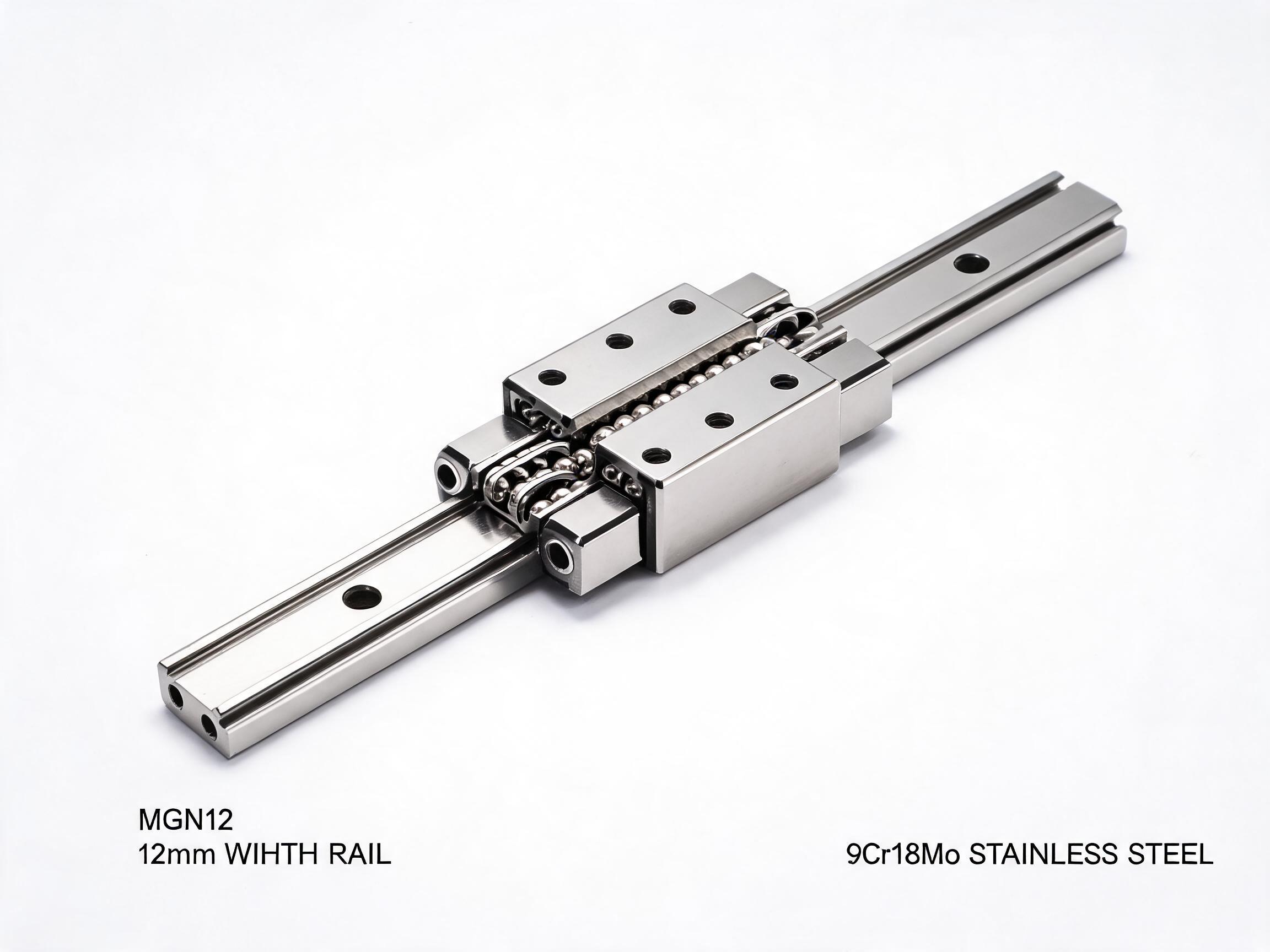
HGR45 is a 45 mm wide, 38 mm high rail with M12 bolts at 60 mm pitch. That is a large, stiff profile intended for heavy loads. At 6.2 kg per meter, a 3-meter rail alone is over 18 kg. By contrast, the MGN and EGH series are two-row Gothic-arch miniature circuits. Their carriages weigh in grams, not kilograms. The MGN12C carriage at 0.025 kg is roughly one-sixth the mass of the EGH15CA carriage at 0.038 kg—a difference that matters when an axis cycles thousands of times per hour.
For the full specifications of these products, see the HGR45 heavy-duty large linear guideway rail, the MGN series stainless steel miniature linear guide, and the EGH series miniature linear guideway rail carriage.
How to estimate axis mass before ordering
You can get a useful first estimate without CAD. Work through the moving parts of one axis and add their masses:
- Rail length × per-meter weight. For an HGR45 rail, multiply 6.2 kg by the number of meters in the moving section.
- Carriage count × carriage weight. Use the carriage weight for the series and size you plan to order (0.025 kg for MGN12C, 0.038 kg for EGH15CA).
- Carriage plate, tooling, and workpieces. Add the plate, fixture, spindle, or other payload that travels with the axis.
- Any moving frame material. If the rail is mounted on a moving gantry beam, include that beam.
The total is your moving mass. Compare it against the acceleration you need and the torque available from your chosen motor and drive. If the margin is thin, three options are open: lower the target acceleration, reduce moving mass (smaller rail or lighter carriage), or specify a larger motor. This is an estimate, not a substitution for a full dynamic calculation, but it catches gross mismatches early.
What to confirm with your supplier before ordering
Two numbers drive most of the planning: rail weight per meter and carriage weight. Confirm both for the exact series and size you intend to use, because these values change with profile size. For rail, ask for weight per meter of the specific model, not a generic figure for the series. For carriage, ask for the weight of the exact carriage type and block style. Other details worth confirming at the same time:
- Rail length tolerance and cut length options.
- Carriage preload class and accuracy grade, which affect fit and drag.
- Mounting hole pattern and bolt size—HGR45 uses M12 bolts at 60 mm pitch.
- Whether the rail is supplied pre-drilled for the stated hole pitch.
- Packing method for long rails, since packaging adds to shipping dimensions.
FAQ
- How much does a linear guide rail weigh per meter?
- It depends on the series and size. A heavy-duty HGR45 rail weighs 6.2 kg per meter. Miniature series are much lighter per meter. Always use the per-meter weight for the specific model you plan to order.
- Does rail weight affect accuracy?
- Rail weight itself is not an accuracy specification. It affects accuracy indirectly: heavier moving mass can make it harder to hold a target acceleration, and under-sized machine bases may deflect under the rail's weight. Select rail size for stiffness and load, then check that the structure and drive can handle the resulting mass.
- Is carriage weight important for high-cycle automation?
- Yes. In high-cycle automation, the carriage accelerates and decelerates many times per hour. Lower carriage mass reduces the inertia the motor must drive. A 0.025 kg MGN12C carriage is lighter than a 0.038 kg EGH15CA carriage, so the MGN12C is easier to accelerate for the same payload.
- Should I choose the lightest rail available?
- No. Choose the rail that matches your load, stiffness, and travel requirements. Lighter rails may not provide the stiffness needed for heavy cutting or large payloads. Weight is one selection factor among load capacity, rigidity, mounting dimensions, and available travel.
If you are planning an axis and need per-meter rail weights or carriage weights for a specific model, send the series, size, and travel length. Xiamen Dongfeng Bearing, founded in 2014 and exporting to more than 50 countries, can provide the weight data you need to complete your mass estimate.