
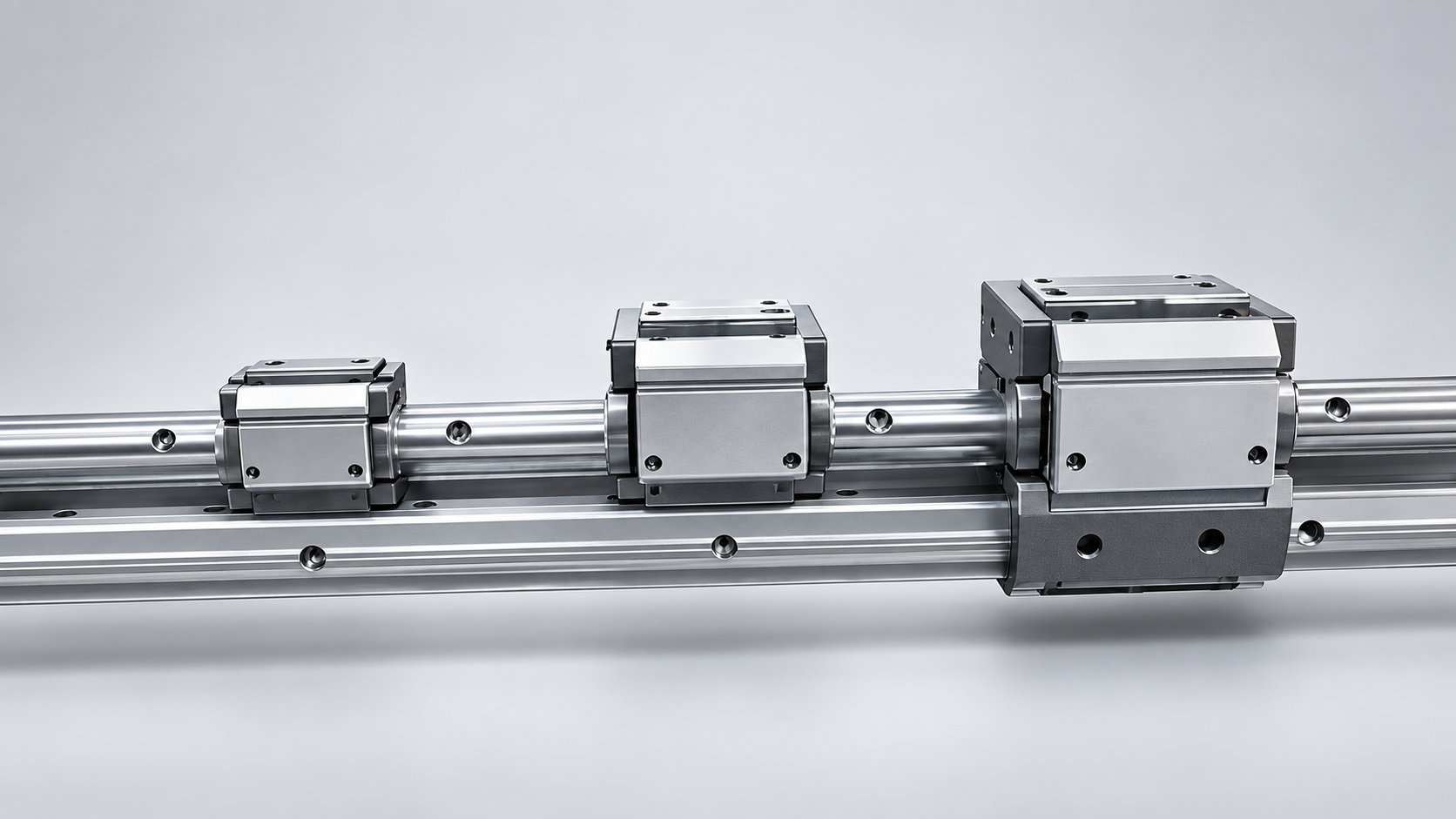
A practical, manufacturer-informed selection order for linear guide rails: define load and moment direction, stroke and mounting space, precision needs, speed and duty cycle, then environment and sealing/lubrication implications. Includes a repeatable checklist and common buyer mistakes.
Most linear guide rail inquiries that arrive without enough information fail for the same reason: the buyer picks a rail size first, then tries to justify it. A better order is to define the load and moment direction, then the stroke and mounting space, then precision, then speed and duty, and finally the environment. Each step narrows the rail and carriage options that remain. This article walks through that order and ends with a checklist you can use before requesting quotes.
- Load and moment direction determine carriage type and rail spacing before any size is chosen.
- Stroke and mounting space set the envelope; precision and speed refine the rail grade and preload.
- Environment decides sealing, lubrication, and material options — and often rules out a low-cost rail.
- Confirm rail length, hole spacing, and end conditions with the supplier rather than assuming a catalog value.
Step 1: Define Load and Moment Direction
The first question is not "what size rail?" but "what forces does the carriage see, and in which direction?" A linear guide rail selection depends on how the load is distributed across the carriage, not just its total weight.
Work through these points:
- Load direction. Is the load pressing down on the carriage, pulling it up, or acting sideways? A load applied above the carriage creates a moment that a single carriage resists differently than a load centered on it.
- Moment axes. Identify whether the application produces pitch, yaw, or roll moments. A cantilevered tool head, for example, produces a pitch moment that must be accounted for separately from the vertical load.
- Number of carriages. Two carriages on one rail share a moment more effectively than one. If the moment is significant, the answer may be a wider rail spacing or a second rail rather than a larger single rail.
- Dynamic vs. static conditions. Acceleration, deceleration, and impact loads add to the static weight. Ask the supplier how they treat these in their sizing method.
A common mistake is to size the rail by total weight alone. Two assemblies of the same weight can require very different rails if one has an offset load and the other is balanced. Describe the load position relative to the carriage centerline when you request a quote.
Step 2: Stroke and Mounting Space
Once the load picture is clear, define the travel and the space available to mount the rail.
- Stroke length. The required travel plus carriage length plus end stops determines the minimum rail length. Confirm whether the stroke is measured from a home position or is the total travel.
- Mounting surface. Check the flatness and stiffness of the machine base. A rail mounted on a flexible or uneven surface can deflect under load, which affects positioning and rail life.
- Rail spacing. Two parallel rails give more resistance to moment loads than one. The spacing is often set by the machine structure, so confirm it early.
- Mounting orientation. Horizontal, vertical, and inverted mounting change how lubrication reaches the raceway and how debris drains. Mention the orientation in the inquiry.
At this stage, ask the supplier for the rail hole spacing and the recommended mounting bolt size. These dimensions determine whether the rail fits your existing base plate without re-machining.
Step 3: Precision Needs
Precision is often over-specified. A rail grade that is tighter than the application requires adds cost without improving the result. Instead of naming a grade, describe what the machine must achieve:
- Positioning repeatability. Does the carriage need to return to the same point within a defined tolerance, or is the motion only for transport?
- Running parallelism. For multi-axis systems, the parallelism between rails affects the squareness of the motion. This is a system-level property, not only a rail property.
- Preload. Preload removes clearance and can improve stiffness, but excessive preload increases friction and heat. The right preload depends on whether the load is primarily in one direction or reverses.
- Application type. A pick-and-place unit, a CNC axis, and a packaging pusher have different precision demands. State the application so the supplier can suggest a suitable grade.
Do not assume that a higher precision class automatically solves a positioning problem. If the mounting surface is not flat or the structure is not stiff, a tighter rail alone may not deliver the expected result.
Step 4: Speed and Duty Cycle
Speed and duty cycle affect lubrication interval, heat generation, and the choice of carriage seals.
- Maximum speed. High speed increases the demand on lubrication and can require a different seal or a larger rail to keep the carriage stable.
- Acceleration. Rapid acceleration and deceleration create dynamic loads that can exceed the static load. Describe the motion profile, not just the top speed.
- Duty cycle. Continuous operation, frequent starts and stops, and short strokes all change the lubrication requirement. Short strokes can prevent the lubricant from redistributing along the rail.
- Expected life. Ask the supplier how they calculate travel life and what inputs they need. Do not accept a life figure without knowing the load and speed assumptions behind it.
If the application runs continuously, discuss the lubrication method — manual, automatic, or through a lubrication port — before the rail is ordered.
Step 5: Environment, Sealing, and Lubrication
Environment is the step most often left to the end, and it is the one that can invalidate an otherwise correct selection.
| Environment | What to confirm | Selection implication |
|---|---|---|
| Dust, chips, or abrasive particles | Particle size, source, and whether a cover or bellows is used | Seal type and wiper design; possibly a protective cover |
| Moisture or washdown | Water spray, condensation, or immersion | Corrosion-resistant rail and carriage materials; drainage |
| High or low temperature | Operating temperature range and any heat source nearby | Lubricant type and seal material; thermal expansion of the rail |
| Vacuum or cleanroom | Permitted outgassing and particle limits | Lubricant and material choice; special handling |
| Corrosive atmosphere | Chemical exposure and concentration | Surface treatment or alternative materials |
For each row, ask the supplier what they recommend and why. The answer should reference the specific seal, lubricant, or material, not a generic "suitable for harsh environments" statement.
Common Mistakes Buyers Make
- Sizing by weight only. Ignoring moment direction leads to a rail that deflects or wears unevenly.
- Choosing precision before defining the application. Over-specifying adds cost; under-specifying causes positioning errors that are blamed on the rail.
- Leaving environment to the end. A rail selected for a clean room may fail in a dusty workshop, and vice versa.
- Assuming catalog dimensions match the mounting surface. Always confirm rail length, hole spacing, and end conditions against your base plate drawing.
- Ignoring lubrication access. If the carriage cannot be reached for lubrication, the rail life will be shorter than expected.
- Requesting a quote without a load description. A supplier cannot recommend a rail from a photo alone; provide the load, stroke, speed, and environment.
A Repeatable Selection Checklist
Use this checklist before contacting a supplier. It does not replace their engineering review, but it makes the conversation faster and more accurate.
- Load: total weight, direction, and position relative to the carriage centerline.
- Moments: pitch, yaw, and roll present in the application.
- Number of carriages and rails, and the rail spacing.
- Stroke length and mounting orientation.
- Mounting surface flatness and stiffness.
- Positioning requirement and whether preload is needed.
- Maximum speed, acceleration, and duty cycle.
- Environment: dust, moisture, temperature, chemicals, vacuum.
- Lubrication method and access.
- Expected life and the assumptions behind it.
When you send this information, ask the supplier to confirm which rail and carriage they recommend and which assumptions they used. A good supplier will tell you what they need to know before they can answer.
FAQ
Can I choose a linear guide by load capacity alone?
No. Load capacity is one input. Moment direction, stroke, speed, and environment can each change the recommended rail and carriage. A rail that meets the load rating may still be unsuitable if the moment is high or the environment is abrasive.
How do I know if I need one rail or two?
If the load is centered and the moment is small, one rail with two carriages may be enough. If the load is offset or the moment is significant, two parallel rails usually provide better stability. Describe the load position to the supplier for a specific recommendation.
What information should I include in a quote request?
Include the load and moment description, stroke, mounting orientation, speed and duty cycle, environment, and the space available for the rail. A sketch or drawing of the mounting surface helps. If you do not have all of this, say so — the supplier can tell you what else is needed.
Does a higher precision class always improve performance?
Not necessarily. Precision must match the application and the mounting surface. A tighter rail on a flexible base may not improve positioning. Discuss the required result with the supplier before selecting a grade.
Next Step
If you are comparing linear guide options, start with the checklist above and send the load, stroke, speed, and environment details to your supplier. That information lets them recommend a rail and carriage combination that fits the application rather than the catalog. If any item on the checklist is unclear, ask the supplier to confirm it before you request a final quote.