
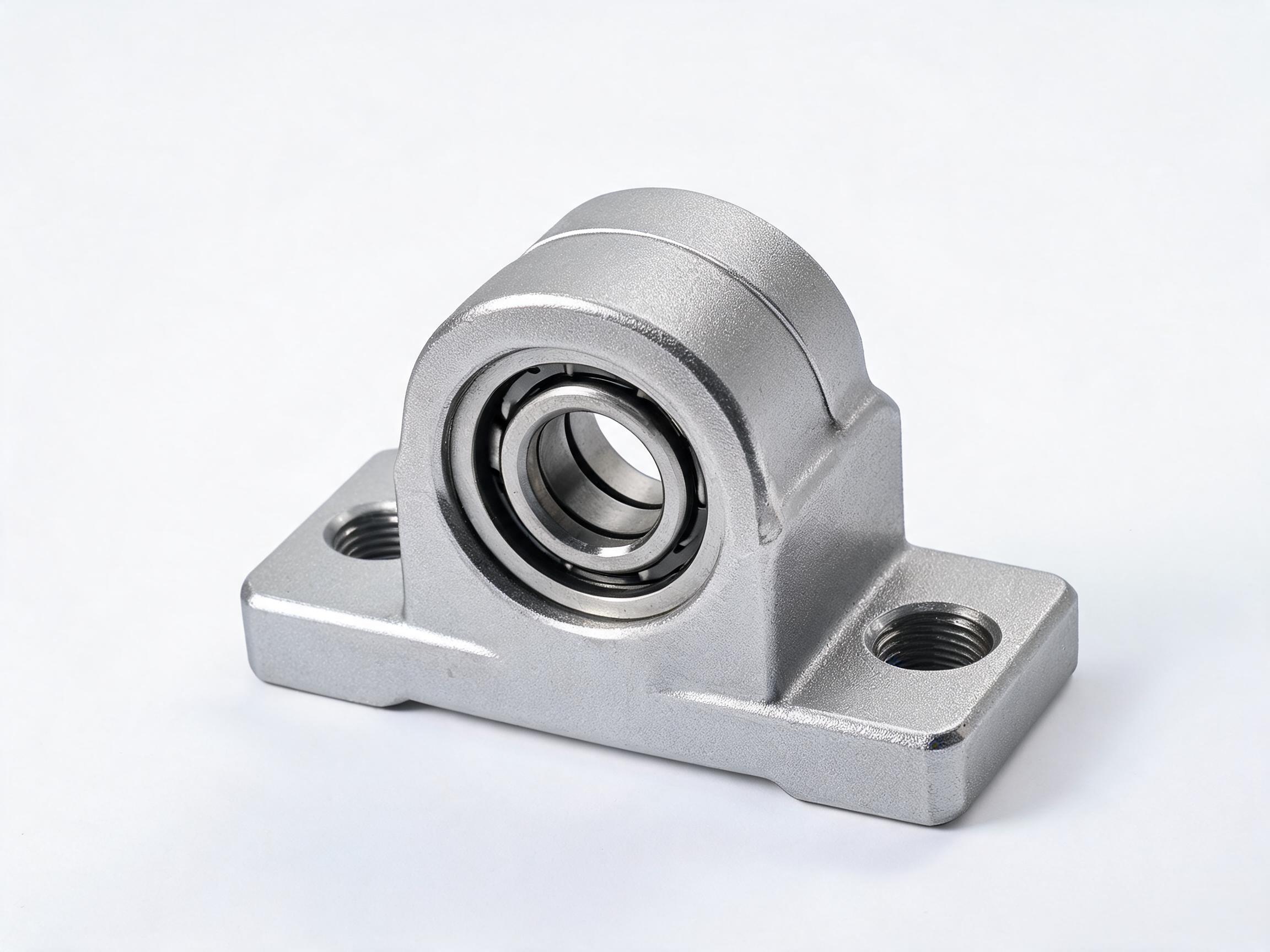
A step-by-step fit-out guide for maintenance and design engineers: mounting base flatness, shaft support, alignment checks, misalignment symptoms, lubrication points, and when to re-check — applied to the KH Series Pillow Block Linear Bearing Housing Unit.
Once you have selected a pillow block linear bearing unit, the fit-out decides whether it runs smoothly for years or fails in weeks. This guide follows the order of a real installation — base, shaft, alignment, lubrication, re-check — and applies each step to the KH Series Pillow Block Linear Bearing Housing Unit.
Key takeaways
- Flatness and rigidity of the mounting base come before the bearing is placed — machining the base later means re-aligning everything.
- Support the shaft over its full length; a shaft that sags between supports will load the housing unevenly even if the base is perfect.
- Check alignment in two planes (height and lateral) and confirm it with a dial indicator or laser, not by eye.
- Misalignment shows up as heat, noise, seal wear, and uneven raceway contact — treat these as symptoms, not as normal running.
- Lubricate at the points the housing actually provides, and re-check geometry after the first hours of running, not only at installation.
Before you start: what the base has to provide
A pillow block linear bearing housing unit transfers load into the machine frame through its mounting base. If that base is not flat and rigid, the housing distorts when you tighten it, and the bore is no longer round or parallel to the shaft. The bearing then runs on a contact pattern you did not intend.
Practical checks before mounting:
- Flatness: check the mounting face with a straight edge and feeler gauge, or a precision level, across the full footprint of the housing — not just at two bolt positions.
- Rigidity: a base that flexes under hand pressure will flex more under running load. Thin sheet, unsupported spans, and bases welded after machining are common causes of distortion.
- Cleanliness: remove burrs, weld spatter, paint, and chips. A single chip under the base tilts the housing.
- Bolt condition: confirm the bolt grade and thread condition match the housing. Torque values are set by the machine builder or the housing documentation — do not apply a general value from another assembly.
The KH Series unit is a housing with a linear bearing bore. Its base is designed to sit on a machined surface; the flatness and parallelism of that surface set the starting geometry for everything that follows.
Step 1 — Mount the base and seat the housing
Place the housing on the prepared surface and bring the bolts up finger-tight first. Tightening one bolt fully before the others pulls the housing down on one corner and can spring the bore.
- Set the housing in position and check that it sits without rocking.
- Bring all bolts to a light snug condition, alternating across the housing.
- Check the housing is not being pulled down onto a high spot. If it rocks or the gap changes as you tighten, stop and re-check base flatness.
- Tighten progressively, in a cross pattern, to the torque specified for the application.
After final tightening, re-check that the housing has not moved. On a long rail with several housings, this is the point where you confirm each unit is still on its reference line.
Step 2 — Support the shaft correctly
The shaft is not rigid. Over an unsupported span it deflects under its own weight and under load. If the housing is aligned to the shaft at one end while the shaft sags in the middle, the bearing sees a changing angle along its travel.
- Support the shaft at intervals that keep deflection within the limits set by the machine design — the span depends on shaft diameter, material, and load, so use the shaft supplier's data rather than a rule of thumb.
- Check that support points are on the same reference plane as the housing base. A support that sits high or low tilts the shaft line.
- Confirm the shaft is straight and free of bends before fitting the housing over it. A bent shaft cannot be aligned out.
- Keep the shaft and bore clean during assembly; grit carried into the bearing on first travel causes immediate damage.
The KH Series unit is a housing unit, so the shaft support and the housing base are two separate interfaces. Both have to be on the same datum before alignment means anything.
Step 3 — Alignment checks
Alignment has two components: the height of the shaft centre relative to the housing, and the lateral position of the shaft along the housing. Both need checking, and both need checking along the full travel, not only at the mounting position.
- Rough alignment first. Bring the housing close to position on its bolts before any precision measurement. Do not measure a unit that is still far out.
- Check height. Use a dial indicator on the shaft or housing to see whether the shaft centre sits consistently relative to the housing along the rail.
- Check lateral position. Confirm the shaft stays centred in the bore through the travel. Side-to-side movement means the housing and the shaft line are not parallel.
- Check along the full stroke. A housing that is aligned at one end and out at the other is a parallelism problem, not a point error.
- Lock and re-verify. After tightening to final torque, re-measure. Tightening moves housings.
| Check | What you are confirming | Typical cause if it fails |
|---|---|---|
| Base flatness | Housing seats without distortion | Machining error, weld distortion, chips under base |
| Shaft support spacing | Shaft line is straight within design limits | Spacing too wide, supports off the datum plane |
| Height alignment | Shaft centre consistent along travel | Housing on a high or low spot, worn base surface |
| Lateral alignment | Shaft stays centred in the bore | Housing not parallel to shaft line |
| Full-stroke check | Parallelism over the whole travel | Rail or shaft not straight, accumulated error |
Step 4 — Symptoms that mean misalignment, not wear
Misalignment does not always announce itself immediately. These signs, seen early, point back to geometry:
- Heat in the housing. A bearing running warm after a short period is a classic sign of load on the wrong part of the raceway.
- Noise or a repeating sound. A rhythmic noise that tracks travel distance points to a geometric error, not to a single damaged ball.
- Uneven contact or wear marks. Contact on one side of a raceway, or wear biased to one edge of the bore, shows the shaft is not centred.
- Seal or wiper wear on one side. A seal rubbing harder on one edge is a lateral alignment symptom.
- Loose mounting after running. If bolts need re-tightening early, check whether the base is compressing or the housing was distorted at installation.
Do not compensate for these symptoms by over-tightening or by adding shims under one corner until the noise stops. Find which measurement in the alignment checks above is out, and correct the cause.
Step 5 — Lubrication points
Lubricate where the housing actually provides a lubrication point, and follow the machine builder's or the housing documentation's schedule and lubricant type. Installation decisions that affect lubrication:
- Confirm the lubricant reaches the bearing bore, not just the housing exterior.
- Keep the lubrication path clean. Contaminated grease carries grit into the raceway.
- Do not mix incompatible lubricants without confirming compatibility; a change in grease can affect running behaviour.
- Re-lubricate after the running-in period and at the intervals set for the application, not only at installation.
The KH Series unit is a housing; the lubrication arrangement is defined by the assembly and the surrounding design. Where the documentation is silent, confirm the point and interval with the supplier before running the machine.
When to re-check alignment
Alignment is not a one-time event. Re-check:
- After the first hours of running. Joints settle, and bolts take up their final position.
- After any base welding or machining nearby. Heat distorts frames.
- After a collision, overload, or unexpected stop. Geometry can shift even when nothing looks damaged.
- After replacing a housing or shaft. New components restart the fitting sequence.
- At planned maintenance intervals, as part of the same routine that checks lubrication and bolt condition.
A short, repeatable check — height, lateral, full stroke — takes minutes and catches problems before they become raceway damage.
What Xiamen Dongfeng Bearing supplies with each unit
The KH Series Pillow Block Linear Bearing Housing Unit is produced by Xiamen Dongfeng Bearing, founded in 2014 and certified to ISO 9001:2015, CE, and SGS. Bearing steel is verified by third-party SGS material verification. Every shipment includes CMM inspection reports and material certificates, so the dimensions of the unit you receive can be checked against the drawing before it goes onto the machine. Linear guideway and bearing products carry a 24-month warranty.
For fit-out planning, the company provides free technical selection support and OEM/ODM custom engineering. If your application needs a modified base, a different bore arrangement, or a specific housing interface, that is a design conversation rather than an off-the-shelf choice.
FAQ
Can I align a pillow block linear bearing by eye?
No. Height and lateral errors small enough to pass a visual check can still bias the load onto one side of the raceway. Use a dial indicator or a laser alignment tool, and check along the full travel.
What torque should I use on the mounting bolts?
The torque is set by the machine design and the bolt specification, not by a universal number. Confirm it against the housing documentation and the bolt supplier's data for the grade and size used.
How often should the bearing be lubricated?
The interval depends on the application, load, speed, and environment. Follow the machine builder's schedule and the lubricant specified for the assembly; where that information is missing, confirm it with the supplier before running.
Do I need to re-align after the machine has been running?
Yes. Joints settle and bolts move under load. Re-check after the initial running period and after any event that could shift the frame or shaft line.
If you are specifying a pillow block linear bearing unit for a new build or a retrofit, the KH Series Pillow Block Linear Bearing Housing Unit page lists the housing options, and the technical team can review your base and shaft conditions before you commit to a mounting arrangement.