
Dust, speed, and heat decide whether a laser cutter's linear motion system lasts or fails early. This guide compares profile rails, ground ball screws, and common sealing options so you can specify motion components that hold accuracy in real cutting environments.
Linear Motion Guide
A laser cutting machine's motion system lives a hard life. The gantry accelerates and reverses hundreds of times a day, the cutting head sits within centimeters of a nozzle spitting molten spatter, and fine metal dust or plastic fume settles everywhere. When a machine loses accuracy, the first suspects are usually the rails and ball screws. The question buyers and maintenance engineers actually ask is narrower: which linear rail and which ball screw construction hold their geometry under this combination of dust, speed, and heat?
This article breaks down the mechanics, the common failure modes, and the specification choices that separate a motion system that lasts from one that starts drifting within months. It covers heavy duty linear rails, ground ball screws, sealing strategy, mounting practice, and a supplier evaluation checklist you can use when comparing quotes.
- How Dust, Speed and Heat Attack Linear Motion
- Heavy Duty Linear Rails: What Actually Resists Dust
- Ball Screws: Ground vs. Rolled, and Why It Matters Here
- Sealing and Lubrication: The Cheap Parts That Decide Life
- Heat Management for Repeatable Accuracy
- Specification Checklist for Laser Cutting Machines
- Comparison Table: Rail and Screw Options at a Glance
- FAQ
- Next Steps for Buyers
How Dust, Speed and Heat Attack Linear Motion
Before choosing a rail or screw, it helps to understand what each environmental factor does to the interface between rolling elements and raceway.
Dust and spatter. Laser cutting produces two particle streams: coarse spatter from the cut zone and fine airborne fume. Coarse particles that land on an exposed raceway get crushed between the ball and the groove, creating dents that show up as vibration and positioning error. Fine particles mix with lubricant and form an abrasive paste. In plasma or oxy-fuel cutting, the spatter load is heavier; in fiber laser cutting of thin sheet, fume and metal condensate dominate.
Speed. High traverse rates and rapid acceleration mean the recirculating balls in a linear guide reverse direction many times per minute. The retainer and return path must handle that cycling without deforming. Higher speed also means less time for lubricant to redistribute, so starvation at the end of a long travel is a real risk.
Heat. Heat reaches the motion system from three directions: motor and drive heat conducted through the screw, friction heat inside the ball nut, and radiant heat from the cutting process. Thermal expansion changes the effective lead of a ball screw and the preload of a rail carriage. On a machine expected to hold ±0.05 mm or better over a full sheet, a few degrees of temperature difference across the gantry is enough to push parts out of tolerance.
Key Takeaways
- Dust protection is a sealing and mounting problem first, a rail-hardness problem second.
- Ground ball screws hold lead accuracy and smoothness better than rolled screws under reversing loads, but only if the nut seal and lubrication circuit are right.
- Heat management is a system design issue: motor placement, screw support bearings, and rail preload all interact.
Heavy Duty Linear Rails: What Actually Resists Dust
In laser cutting machine linear motion, the gantry and cutting-head axes almost always use profile rail guides rather than round shafts. Profile rails offer higher moment load capacity, better stiffness, and — critically — a shape that can be sealed effectively. For a reference part sized for heavy gantry duty, our HGR45 heavy-duty linear guideway rail pairs a 45 mm hardened rail (HRC 58–62) with HGW45CA carriages rated at 62.8 kN dynamic load.
Raceway geometry and ball contact
A heavy duty linear rail uses a four-row or two-row ball contact design. Four-row designs distribute load across more contact points, which reduces the stress per ball and makes the guide more tolerant of small dents. That tolerance matters in dusty environments: a rail that can survive a few contamination dents without losing preload will hold accuracy longer between services.
Surface hardness and material
Rails are typically made from bearing steel and hardened through the raceway zone. The hardened depth and the core hardness together determine how much contamination a rail can absorb before the raceway deforms permanently. When comparing suppliers, ask for the material and heat treatment specification — not just the load rating.
Carriage sealing: the first line of defense
A standard carriage end seal is a single lip that wipes loose dust off the rail top. In laser cutting, that is often not enough. Better protection uses a combination: an end seal, a side seal along the rail flanks, and a scraper or double-lip seal that pushes contamination away before it reaches the lip. Some carriages also include a lubricant reservoir that continuously feeds the raceway, which helps flush particles out rather than letting them accumulate.
The practical test is to look at the seal stack, not the datasheet. If a supplier cannot show you an end seal, a side seal, and an internal scraper arrangement, the rail is likely intended for a clean room, not a cutting table.
Ball Screws: Ground vs. Rolled, and Why It Matters Here
The ball screw drives the axis and sets the relationship between motor rotation and linear position. In laser cutting, two properties matter most: lead accuracy and running smoothness.
Ground ball screw advantages
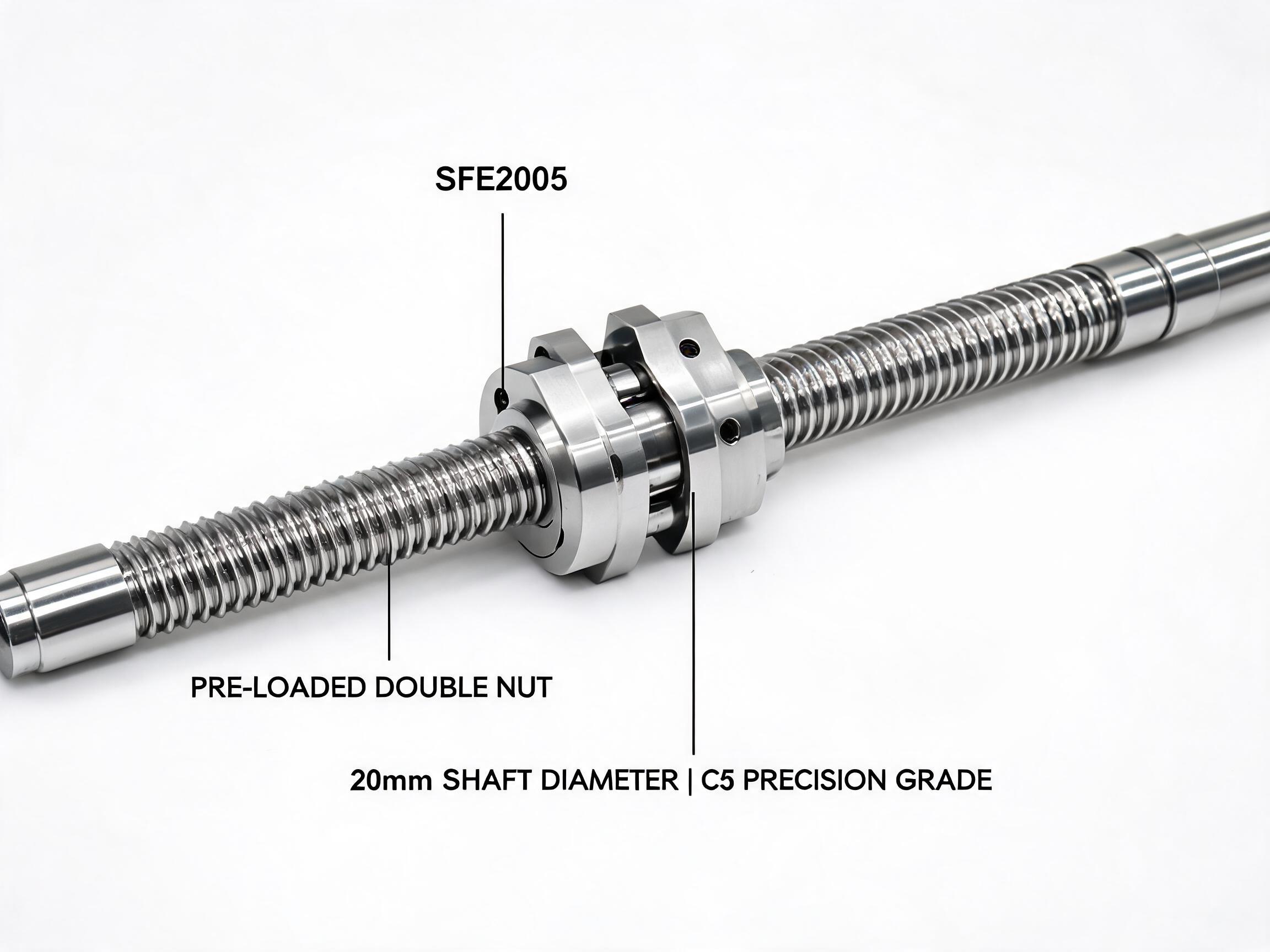
A ground ball screw is produced by grinding the thread form after heat treatment. Compared with a rolled screw, the ground version typically offers tighter lead accuracy across the usable length, a smoother thread surface, and more consistent preload. For a cutting machine that must position at speed and then hold still while the laser fires, this consistency shows up as less following error and less vibration at the cut edge. For a concrete specification, our SFE series ground ball screw assembly is ground to C5 (±0.008 mm per 300 mm) with a double-nut preload holding axial clearance below 0.005 mm.
Ground screws also tend to handle higher axial loads for the same diameter, which is relevant when the axis must push a heavy gantry or a cutting head with a long focal-length lens assembly.
Rolled ball screws: where they can still work
Rolled ball screws are not automatically wrong. For a light-duty or hobby-class machine, or for an axis where lead accuracy is not the limiting factor, a rolled screw with a good nut seal can be cost-effective. The problem arises when a rolled screw is specified on a machine that is marketed as high-precision. Ask the supplier which accuracy grade the screw carries and how that grade was verified — not just the nominal diameter and lead.
Nut sealing and contamination
The ball nut is where contamination does the most damage. A nut with a simple brush seal will let fine particles into the recirculation path. A nut with a labyrinth or double-lip seal, plus a wiper, gives the balls a cleaner track. On a laser cutter, the nut should also be positioned so that it does not sit directly under the cut zone where spatter falls.
Sealing and Lubrication: The Cheap Parts That Decide Life
Rails and screws are the expensive components; seals and lubrication are the cheap ones that determine whether the expensive ones reach their rated life.
- End seals and side seals on every carriage, with a scraper where dust is heavy.
- Double-lip or labyrinth nut seals on ball screws, not single-lip.
- Bellows or telescopic covers over exposed screw sections on long-travel axes.
- Positive lubrication — an automatic pump or a reservoir that feeds the raceway, rather than manual greasing at long intervals.
- Grease selection matched to the temperature range and the type of contamination; a grease that hardens in cold or bleeds in heat will fail differently in each season.
The buyer-side question is simple: what is the recommended lubrication interval, and what happens if the machine runs a double shift? If the answer is a fixed interval with no consideration of dust load, the maintenance plan is incomplete.
Heat Management for Repeatable Accuracy
Thermal behavior is the hardest part to see in a quotation and one of the most common reasons a machine that cuts accurately in the morning drifts by the afternoon.
Heat sources and paths
The drive motor heats the screw end. The ball nut generates friction heat. The cutting process radiates heat into the cutting head and, in some designs, into the gantry structure. If the screw is fixed at one end and supported at the other, thermal expansion pushes the free end outward and changes the effective lead. If the rail is bolted to an aluminum gantry, the rail and the structure expand at different rates.
Design responses
- Pre-tensioned screw mounting. Fixing both ends with controlled pre-tension reduces the effect of thermal growth on lead error, but only if the bearing supports are sized for the resulting load.
- Symmetrical rail mounting. Mounting the rail on a machined surface with a reference edge, and using the same material or a compatible one for the gantry, reduces differential expansion.
- Forced cooling on the cutting head. Keeping the head cool reduces radiant heat into the motion components, even if it does not change the screw's own friction heat.
- Warm-up routine. A machine that runs a warm-up cycle before cutting brings the screw and rail to a stable temperature, which makes the first part and the last part of a shift behave more alike.
None of these is a substitute for specifying the right components, but together they determine how much of the rated accuracy a buyer actually sees on the shop floor.
Specification Checklist for Laser Cutting Machines
Use this list when comparing linear motion options for a new machine or a rebuild.
| Item | What to ask / confirm |
|---|---|
| Rail type | Profile rail with four-row ball contact, or another design? Load rating and moment capacity for the actual cutting head weight. |
| Rail material and heat treatment | Bearing steel grade, case depth, core hardness. Is the raceway ground after heat treatment? |
| Carriage sealing | End seal, side seal, scraper, and whether a lubricant reservoir is included. |
| Ball screw type | Ground or rolled? Lead accuracy grade, usable length, and how the grade is verified. |
| Nut sealing | Single lip, double lip, or labyrinth? Wiper included? |
| Mounting and support | Fixed-fixed or fixed-supported? Pre-tension value and bearing support rating. |
| Lubrication | Automatic pump or manual? Grease type, temperature range, and recommended interval. |
| Environmental protection | Bellows, telescopic covers, or other shielding for screw and rail on exposed axes. |
Comparison Table: Rail and Screw Options at a Glance
| Option | Dust resistance | Speed / accuracy | Heat behavior | Typical role in a laser cutter |
|---|---|---|---|---|
| Standard profile rail, single-lip seal | Low — needs clean environment | Good for light loads | Moderate; preload sensitive to temperature | Not ideal for exposed cutting axes; may suit enclosed gantry |
| Heavy duty linear rail, multi-seal + scraper | High — handles spatter and fume | High load, good stiffness | Stable if mounted on compatible structure | Main gantry and cutting-head axes |
| Rolled ball screw, single-lip nut seal | Low to moderate | Lower lead accuracy, adequate for positioning | More lead drift if not pre-tensioned | Light-duty or entry-level machines |
| Ground ball screw, labyrinth or double-lip nut seal | High with covers and lubrication | High lead accuracy and smooth running | Best when fixed-fixed and pre-tensioned | High-precision cutting axes |
FAQ
Covers help, but they do not replace carriage seals. The carriage seal wipes the rail top; covers keep spatter off the seal. A standard rail with a single-lip seal is still vulnerable to fine fume that reaches the raceway from the side. For an exposed axis, a heavy duty rail with a full seal stack is the more reliable choice.
No. If the machine's positioning requirements and cutting head weight are modest, a rolled screw can be acceptable. The deciding factors are the required lead accuracy over the usable length and the axial load. Ask the supplier to state the accuracy grade and how it was measured, then match that to your tolerance target.
The interval depends on the grease, the dust load, and the duty cycle. A machine running two shifts in a spatter-heavy environment needs a shorter interval than a single-shift machine in a clean room. Request a lubrication schedule based on your actual cutting conditions, and check whether the machine supports automatic lubrication.
Thermal growth and contamination usually rank above mechanical wear in the short term. If the first part of the day is accurate and later parts drift, look at screw pre-tension, rail mounting symmetry, and whether the cutting head is being cooled. If accuracy drops after months of operation, inspect the carriage seals and ball nut seals for contamination damage.
Next Steps for Buyers
When you evaluate a laser cutting machine or a linear motion retrofit, ask for the rail and screw specification in writing: rail type, material and heat treatment, seal configuration, screw type and accuracy grade, nut sealing, mounting method, and lubrication plan. A supplier who can answer these questions in detail is more likely to deliver a machine that holds tolerance in a working shop rather than only on a test stand.
If you are specifying linear motion components for a new build or replacing a worn axis, share your cutting process, material, duty cycle, and tolerance target with your supplier. Those four inputs determine whether a heavy duty linear rail and a ground ball screw are the right fit — or whether a different combination serves the application better.