
A buyer's guide to choosing between a sliding lead screw assembly and a ball screw, judged on duty cycle, load and precision — including an honest account of where lead screws are the right answer and where a rolled C7 or ground C5 ball screw earns its cost.
A lead screw assembly and a ball screw both turn rotation into linear travel. They do it through different contact mechanics, and that difference decides which axis belongs to which technology. The decision rests on three questions about the axis, not on which screw sounds more advanced.
- A lead screw moves the nut by sliding friction on a trapezoidal or Acme thread. It is the quieter, lower-cost choice and is self-locking at many common leads.
- Sliding friction means lower efficiency, more heat and faster wear under continuous duty. That is a duty-cycle limit, not a quality defect.
- Ball screws recirculate rolling elements between screw and nut, which suits high duty cycles, higher loads and demanding repeatability.
- The manufacturer's range is ball screws: SFU rolled (C7) and SFE ground (C5) assemblies. Lead screw characteristics are described here as general engineering knowledge.
What a lead screw assembly actually is
A lead screw assembly consists of a threaded screw, a nut that travels along it, and whatever end support and coupling the axis needs. The thread is usually a trapezoidal or Acme profile, chosen because it is straightforward to cut, tolerant of ordinary workshop conditions, and able to carry thrust through a broad flank contact area.
The defining feature is the contact. Screw and nut threads slide against each other. Every revolution therefore costs some energy to friction, and that friction appears as heat at the sliding interface. In light use this is unremarkable. Under continuous motion it becomes the parameter that governs life.
Many common lead geometries are self-locking: with the drive released, friction holds the nut in place. On a vertical axis this can mean the load stays put without a holding brake. Whether a specific screw is self-locking depends on its lead angle and the friction conditions in the nut, so it belongs on the list of things to confirm with the supplier rather than assume.
How the two technologies convert rotation differently
In a lead screw, the nut slides along the thread flank. In a ball screw, hardened balls roll in a groove between screw and nut and recirculate through a return path. Rolling contact replaces sliding contact, which is why ball screws run at higher efficiency and generate less heat per unit of travel.
That change of contact also changes the behaviour that matters to a machine builder:
- Backdriving. A ball screw is generally easier to backdrive, so a vertical axis usually needs a brake or a self-locking ratio elsewhere in the drive train.
- Precision. Ground ball screws can be supplied with controlled lead accuracy and preloaded nuts that remove axial play, which is difficult to achieve to the same degree with a sliding nut.
- Noise and cost. A sliding nut is typically quieter and cheaper to produce than a recirculating ball nut of comparable size.
- Contamination sensitivity. Ball recirculation depends on clean running surfaces; sliding threads are comparatively more forgiving of debris and poor lubrication in slow, intermittent service.
Where a lead screw is genuinely the better answer
It would be convenient to say ball screws are simply better. They are not. There are axis requirements where a lead screw assembly is the correct engineering choice, and recommending otherwise adds cost without adding capability.
- Slow axes. When the axis moves occasionally rather than continuously, the friction penalty has little time to accumulate. A sliding nut handles this without complaint.
- Manual adjustment. Hand wheels, levelling stages, tensioning screws and similar adjustments suit a lead screw: the thread gives fine, controllable movement and often holds position when released.
- Vertical holding. Where an axis must stay in place with the motor de-energised and no brake is desired, the self-locking behaviour of many common leads is a real advantage.
- Light duty and cost-sensitive builds. For low loads at low cycling rates, the lower cost of the screw and nut is a legitimate design decision.
- Noise-sensitive benches. A sliding nut is generally quieter than a ball nut. Where acoustic comfort matters more than throughput, a lead screw can be the right fit.
If none of these describes your axis, the case for a lead screw weakens. Continuous reciprocation, high load per screw size, or a repeatability target that leaves no room for sliding wear all point the other way.
Where ball screws earn their cost
The manufacturer supplies ball screws rather than lead screws, and the reasons builders move to them follow from the axis requirements:
- Duty cycle. Rolling contact avoids the sliding wear that limits a lead screw in continuous service. For high-cycle axes, the screw becomes a wear item in the sliding case and a long-life component in the rolling case.
- Load. A ball nut distributes load across multiple balls, giving a high dynamic load rating in a compact envelope — the figures below show what is available in standard sizes.
- Repeatability. Preloaded double nuts remove axial play and raise axial rigidity, so positioning repeatability does not drift with wear as a sliding nut would.
Choosing between rolled C7 and ground C5 ball screws
Once the axis has been assigned to a ball screw, the next decision is grade. The two series differ in how the screw is produced and, consequently, in lead accuracy, axial play and cost.
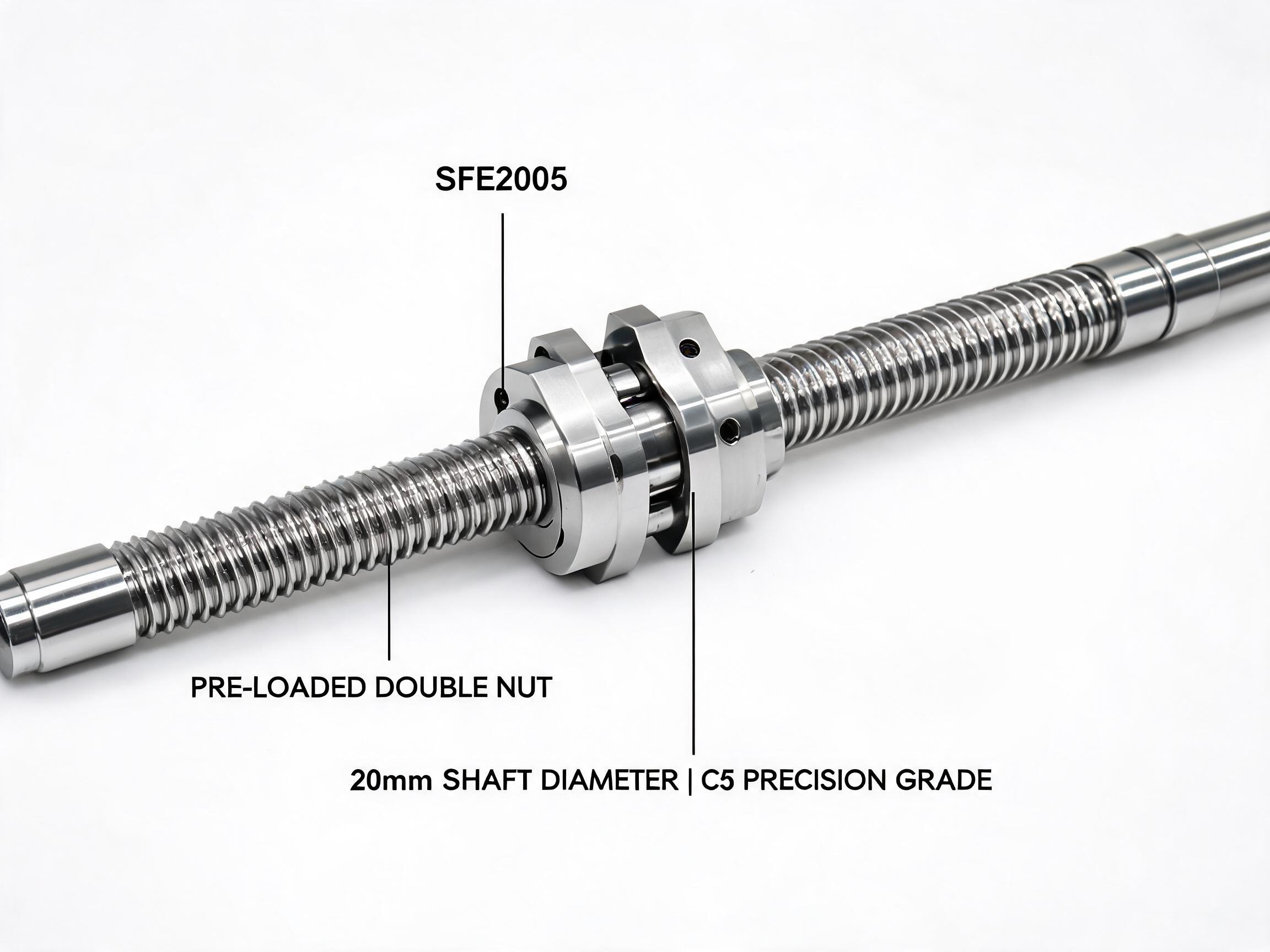
| Attribute | SFU1605 rolled ball screw | SFE2005 ground ball screw |
|---|---|---|
| Grade | C7 per ISO 3408 | C5 per ISO 3408 |
| Lead accuracy | ±0.05 mm per 300 mm | ±0.008 mm per 300 mm |
| Shaft and lead | 16 mm shaft, 5 mm lead | 20 mm shaft, 5 mm lead |
| Dynamic load | 6.8 kN | 12.7 kN |
| Axial play | 0.005–0.02 mm (inherent single-nut play) | <0.005 mm with pre-loaded double nut |
| Axial rigidity | Per standard assembly | Up to 280 N/µm |
| Noise | Typically below 55 dB at 600 RPM (bench-measured) | — |
| Standard lengths | 300–1500 mm | 200–1200 mm |
The rolled SFU series suits general positioning where ±0.05 mm per 300 mm of lead error is acceptable and the axis is not pushing the load limit. Its 6.8 kN dynamic rating and 16 mm shaft cover a wide band of automation, and the sub-55 dB bench noise figure at 600 RPM matters on equipment where the screw sits close to the operator.
The ground SFE series is the choice when the accuracy or rigidity requirement leaves no margin. Ground-after-hardening keeps the thread geometry stable in high-cycle duty, and the pre-loaded double nut holds axial play below 0.005 mm while contributing up to 280 N/µm of axial rigidity. The 12.7 kN dynamic load on a 20 mm shaft supports heavier axes than the rolled equivalent.
Both are documented on the series pages: SFU rolled ball screw assemblies and SFE ground ball screw assemblies.
Decision checklist for the axis
Work through these questions in order. The first three usually settle the technology before cost is considered.
- How many cycles per hour, and for how many hours? Continuous or near-continuous motion favours rolling contact.
- What axial load does the screw carry, and in which direction? A vertical load held without a brake points toward a self-locking lead if the duty is light.
- What positioning tolerance must the axis hold over its life? Sliding wear changes position gradually; rolling contact with preload does not to the same degree.
- How quiet must the machine be? A sliding nut is generally the quieter option.
- Is the environment dirty or poorly lubricated? Slow, intermittent duty in a harsh environment can suit a lead screw; a ball nut needs its running surfaces protected.
- If a ball screw is chosen, is lead accuracy of ±0.05 mm per 300 mm (rolled) sufficient, or is ±0.008 mm per 300 mm with preload (ground) required?
FAQ
Can I replace a lead screw with a ball screw directly?
Mechanically the envelope may allow it, but the drive train usually needs review. A ball screw is easier to backdrive, so a vertical axis that relied on the lead screw's self-locking behaviour will normally need a brake. Check the nut dimensions, the end support and the motor torque requirement before committing.
Are lead screws only for low-precision applications?
No. A lead screw assembly can be made to good accuracy. The practical constraint is wear under duty: sliding contact changes the thread over time, so repeatability that must hold for millions of cycles is better served by a preloaded ball screw.
Does a ball screw always run louder than a lead screw?
Not always, but a recirculating ball nut is generally the noisier of the two at speed because the balls pass through the return path. The SFU1605 rolled ball screw is typically below 55 dB at 600 RPM (bench-measured), which is adequate for many benches; where the screw sits next to an operator, that figure is worth checking against the machine's acoustic target.
Which series suits a high-cycle vertical axis?
The SFE2005 ground screw is the more suitable of the two for demanding duty: ground-after-hardening keeps geometry stable, the pre-loaded double nut holds axial play below 0.005 mm, and the 12.7 kN dynamic rating covers heavier loads. It will still need a brake or a self-locking ratio elsewhere in the drive.
Can the manufacturer supply lead screws?
The range is ball screws — rolled SFU and ground SFE assemblies. Lead screw behaviour is described in this article as general engineering background so that the comparison is fair, not as a product offer.
If you can describe the axis — duty cycle, axial load, travel, tolerance and acoustic target — the screw technology and grade follow from those inputs rather than from preference. Send your enquiry with those figures to confirm the right grade for your duty.