
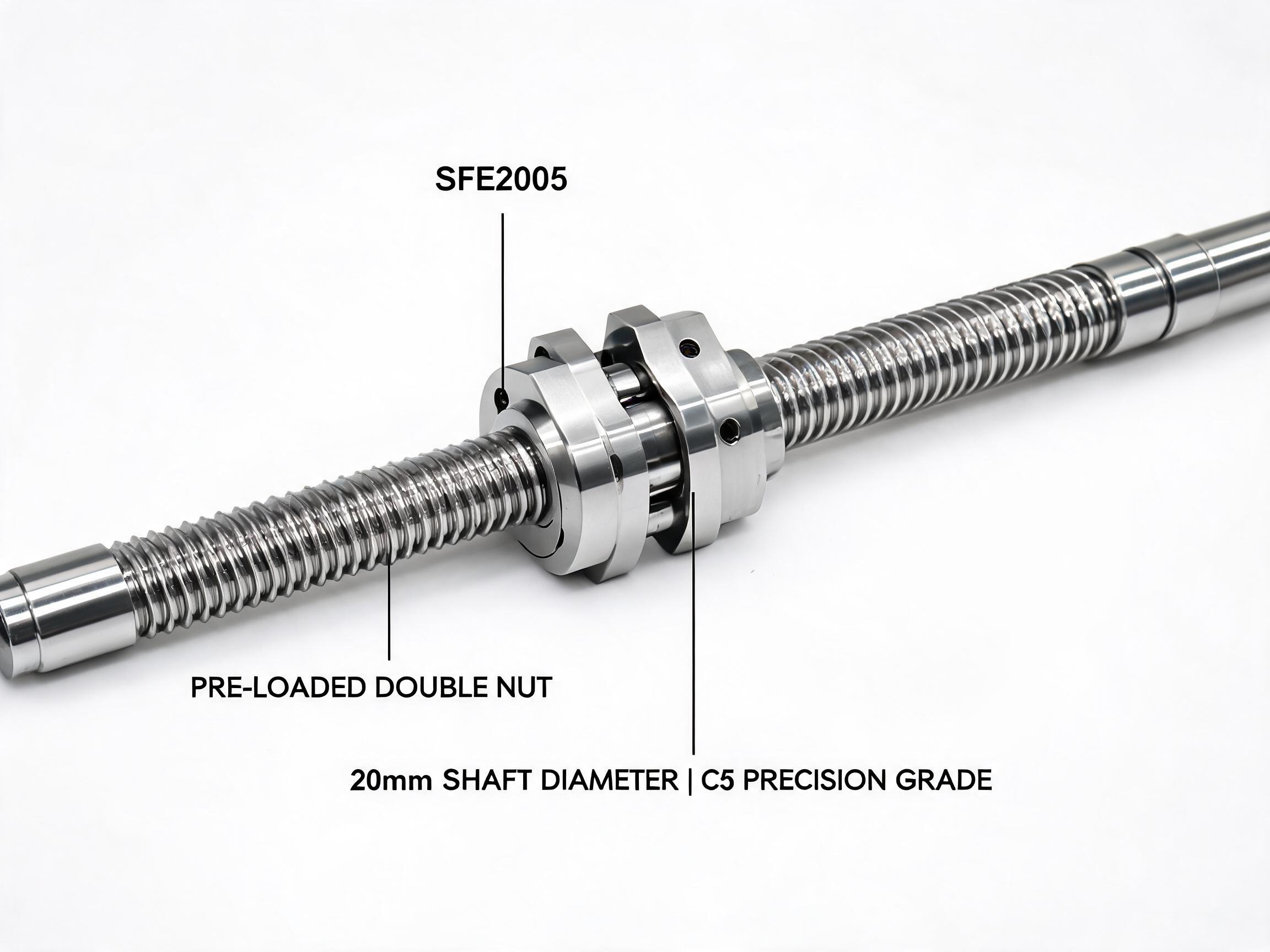
A left-hand ball screw reverses the standard helix so that rotation and travel move in opposite directions—essential for mirror axes, opposed slides and certain positioning layouts. This guide explains how thread hand affects motion, where a left-hand screw is genuinely required, and why the only reliable way to receive one is to state thread hand explicitly in the inquiry and verify it on the drawing before production.
Left Hand Ball Screws: How to Confirm Rotation Direction
A left-hand ball screw is not a different grade or a different material. It is the same ball screw geometry wound the other way. The helix runs counter to a right-hand screw, so when the shaft turns in a given direction the nut travels the opposite way. Buyers specify these screws for mirror or opposed axes, and the part that trips up sourcing is not the mechanism—it is the naming. Different suppliers and drawings describe thread hand in different ways, and a screw that arrives with the wrong hand cannot be corrected at assembly. The safe path is simple: state the required hand explicitly in the inquiry and check it on the approved drawing before production.
What this article covers
- How thread hand maps rotation to travel
- Where a left-hand screw is genuinely required
- Why catalog names and drawings disagree on hand
- How to confirm hand in inquiry and drawing review
How thread hand works: helix direction sets travel direction
A ball screw converts rotation into linear motion through the helix angle of its groove. The hand of that helix—right or left—determines the direction the nut moves for a given shaft rotation.
- Right-hand screw: turn the shaft clockwise as viewed from one end and the nut travels in one axial direction. Reverse the rotation and the nut reverses travel.
- Left-hand screw: the same clockwise rotation drives the nut the other way. The rotation-to-travel mapping is inverted relative to a right-hand screw of the same diameter and lead.
This matters because most motion systems are designed around a convention. If a drawing, a CAD model or a commissioning procedure assumes a right-hand screw, a left-hand screw will move the load in the wrong direction for the commanded rotation. On a single axis this may be corrected in software. On a paired or opposed axis it usually cannot, because the two screws must move in opposite senses from the same rotation command.
Where a left-hand screw is genuinely required
The requirement is structural, not a preference. A left-hand screw is needed when the machine's geometry demands opposite travel from the same drive input, or when a single rotation must produce a specific axial direction that a right-hand screw cannot supply in that mounting orientation.
Mirror and opposed axes
Two parallel screws driven from one shaft or one motor are a common arrangement for synchronized clamping, centering or opposed slides. One screw can be right-hand and the other left-hand, so that a single rotation closes or opens both sides symmetrically. If both screws were the same hand, the two slides would travel the same way and the center point would shift.
Opposed-winding assemblies
Some assemblies use two nut positions on one shaft wound in opposite hands to create converging or diverging motion. The hand determines which way each nut moves along the same shaft, which is fixed at manufacture.
Mounting orientation and service access
Where the drive is fixed and the screw cannot be reversed end-for-end, a left-hand screw may be the only way to obtain the required travel direction without changing the gearbox or motor rotation. This is a layout constraint, not an industry standard.
What is not a reason to specify left-hand
A left-hand screw does not add load capacity, improve accuracy or change the grade. Lead, diameter, preload and grade determine those properties. Hand only changes the direction of motion. Treat any claim that a left-hand screw improves performance as a sign to check the specification rather than accept it.
The sourcing reality: naming conventions vary
Thread hand is expressed in several ways across the supply chain, and they do not always agree:
- Written as LH / RH, left / right, or handedness on a drawing note.
- Shown only as a helix drawn in a particular direction on the cross-section, with no text label.
- Implied by the direction of the arrow on a motion diagram, which can be drawn from either end of the shaft.
- Omitted entirely when the part is assumed to follow the drawing's convention.
Inquiry language can also differ from production language. A buyer may ask for a “left-hand” screw while the factory drawing labels hand relative to a viewing direction that is not stated. The result is an ambiguity that survives quotation and only surfaces at inspection or, worse, at assembly.
There is no universal product code for hand that every supplier shares, and no marking convention that can be relied on across vendors. The only method that removes the ambiguity is to fix the requirement in words on both the inquiry and the drawing, and to verify that both describe the same hand from the same stated viewing direction.
How to confirm hand in inquiry and drawing review
A confirmation that actually protects the order needs to be explicit and tied to the drawing. Use the following sequence for every left-hand ball screw requirement.
In the inquiry
- State the required hand in words: “left-hand thread” or “right-hand thread,” not only an abbreviation.
- State the viewing direction used to define the hand: for example, “viewed from the motor end,” or attach a marked photo or model.
- State the required direction of nut travel for a given shaft rotation, so the hand is tied to function rather than label.
- Ask the supplier to confirm the hand in the quotation and to identify it on the drawing before production.
In the drawing review
- Check that the hand is written as text on the drawing, not only implied by the helix line.
- Check that the viewing direction on the drawing matches the one in the inquiry.
- Check that the travel-direction note agrees with the hand shown.
- Record the approved drawing revision; hand changes after approval are a change, not a detail.
This is the substance of the article's recommendation: the hand is confirmed through the inquiry and the drawing, and that confirmation is what the buyer checks before accepting the parts. It is not a claim about any particular supplier's stock.
Reference specifications: same family, hand confirmed at inquiry
Two rolled ball screw assemblies from the same family illustrate how hand confirmation sits alongside ordinary specification. Both are listed with grade, diameter, lead, accuracy, load and length range; neither publishes a hand-of-thread designation.
| Property | SFU Series Rolled Ball Screw Assembly (SFU1605) | SFU2510 Rolled Ball Screw Assembly with Flange Nut |
|---|---|---|
| Grade | C7 (ISO 3408) | C7 |
| Shaft diameter | 16 mm | 25 mm |
| Lead | 5 mm | 10 mm |
| Accuracy | ±0.05 mm/300 mm | ±0.05 mm/300 mm |
| Hardness | HRC 58–62 | — |
| Dynamic load (single nut) | 6.8 kN | 17.2 kN |
| Static load | — | 26.5 kN |
| Length range | 300–1500 mm | 300–3000 mm |
| Nut / preload | Single nut | Single flange nut, preload |
| Mounting compatibility | — | BK25 / BF25 compatible |
| MOQ | 50 | 50 (custom end machining 30 pcs per drawing) |
| Hand of thread | Confirm rotation direction / hand via inquiry | Confirm rotation direction / hand via inquiry |
The SFU series rolled ball screw assembly covers the 16 mm size with a 5 mm lead and lengths up to 1500 mm. The SFU2510 rolled ball screw assembly with flange nut is the larger anchor in the same family, with a 25 mm shaft, 10 mm lead, 17.2 kN dynamic load and 26.5 kN static load, available in lengths up to 3000 mm. Where a left-hand screw is required, the hand is not taken from the catalog listing; it is confirmed at inquiry for the specific order, and that confirmation is attached to the drawing review.
Common points of confusion
“Left-hand” on a drawing versus “left-hand” in an email
These can mean different things if the viewing direction is not stated. Specify the viewing direction once and use it in both places. If the supplier's drawing uses a different convention, resolve it before approval rather than assuming agreement.
Reversing the motor instead of changing the hand
On a single axis, reversing motor rotation produces reverse travel and can look like a substitute for a left-hand screw. The substitution does not work on opposed axes, where two screws must move in opposite senses from the same command. Identify whether the requirement is single-axis direction or paired opposed motion; that determines whether hand is structural.
Preload and hand
Preload affects stiffness and backlash; it does not change the direction of travel. A preloaded nut can be specified in either hand, and the preload requirement should be stated separately from the hand requirement.
What to send with a left-hand ball screw inquiry
- Required diameter, lead and length, with grade if specified.
- Required hand stated in words and tied to a stated viewing direction.
- Required nut travel direction for a defined shaft rotation.
- Nut type and preload requirement, stated separately from hand.
- End machining drawing if custom ends are needed, with hand noted on the drawing itself.
- A request that the quotation and the production drawing both restate the confirmed hand.
The hand of thread is not a published attribute of the products on this page. It is confirmed via inquiry for every order, and the drawing review is where that confirmation becomes a production requirement. That is the only method that reliably delivers a left-hand ball screw rather than a right-hand one with a left-hand label.