A practical buyer's guide to linear ball bearing slides and cross slide tables for XY stage automation. Covers construction differences, load and accuracy considerations, application fit, and what to specify when requesting a quote from a supplier.
BUYER GUIDE — LINEAR MOTION COMPONENTS
If you are sourcing linear motion components for an automated machine, you have likely compared a linear ball bearing slide against a cross slide table and wondered which one fits your XY stage application. The answer is not about which is "better." It is about load direction, travel length, accuracy class, and how the unit will be mounted in your assembly.
This guide covers the construction differences, key specifications to compare, typical applications, and the information you should send to a supplier to get an accurate quotation.
- A linear ball bearing slide is a single-axis linear guide; a cross slide table stacks two axes to form an XY stage.
- Load capacity, travel length, and accuracy grade are the three numbers that matter most when comparing quotes.
- Cross slide tables save design time because the orthogonal alignment between axes is already machined at the factory.
- For dirty or high-vibration environments, ask about wiper seals and preload options before ordering.
What Is a Linear Ball Bearing Slide?
A linear ball bearing slide is a single-axis motion component. It consists of a base rail, a carriage that moves along it, and recirculating ball bearings between the two. The balls roll between the rail and the carriage, which converts sliding friction into rolling friction. This gives smooth, low-friction movement with high positional repeatability.
These slides are available in several construction styles. The most common are:
- Ball bushing type: The carriage runs on a hardened steel shaft. Simple, low cost, and suited to moderate loads.
- Profile rail type: The carriage runs on a ground steel rail with a profiled raceway. Higher rigidity and load capacity than ball bushing types.
- Dovetail type: A sliding dovetail joint, often with an adjusting screw to take up clearance. Lower cost but higher friction; used for manual positioning more than high-cycle automation.
When buyers search for a "bearing linear slide," they usually mean the ball bushing or profile rail type. Both offer the low friction that makes them suitable for automated pick-and-place, inspection, and assembly equipment.
What Is a Cross Slide Table?
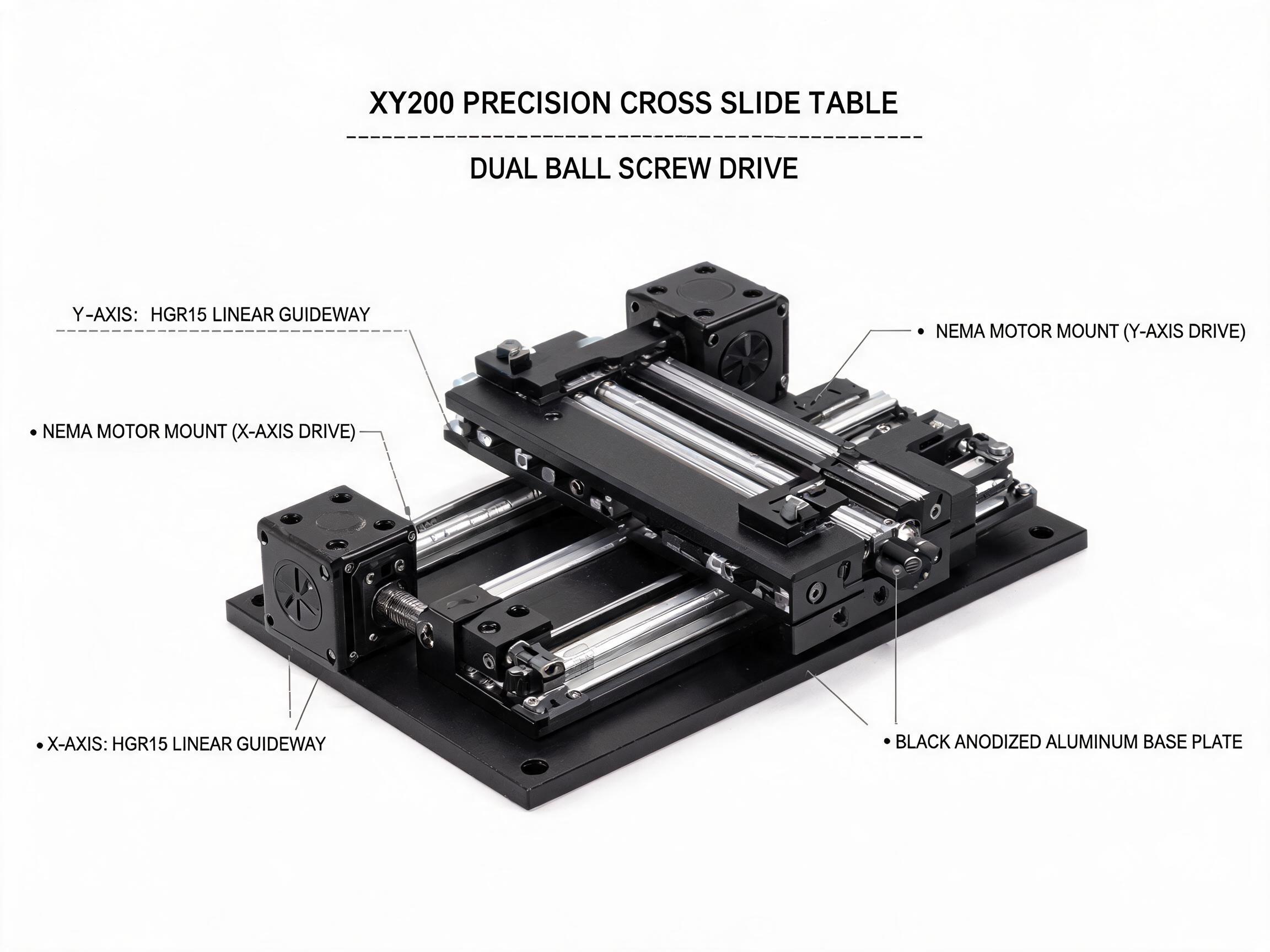
A cross slide table combines two linear slides mounted at right angles to each other. One axis moves in X, the other in Y. The result is an XY stage that can position a workpiece or tool anywhere within a rectangular footprint.
The key advantage of a cross slide table is that the orthogonal alignment between the two axes is fixed at the factory. You do not need to design a bracket to mount two separate slides at exactly 90 degrees. This saves machining time and removes a common source of assembly error.
Cross slide tables are available with different drive options:
- Manual lead screw: A hand crank or knob turns a screw that advances the carriage. Used for setup, calibration, and low-speed positioning.
- Ball screw drive: A motor turns a ball screw for automated, high-efficiency motion. Suitable for CNC and robotic applications.
- Linear actuator: A motor drives the carriage directly through a belt or screw. Used where speed and stroke length matter more than ultra-high precision.
XY Stage Precision: What the Numbers Mean
When comparing a linear ball bearing slide or a cross slide table, you will see specification sheets with several accuracy-related terms. Here is what they mean in practice.
| Specification | What It Measures | Why It Matters |
|---|---|---|
| Travel length (mm) | Maximum distance the carriage moves | Defines the working envelope of your machine |
| Dynamic load capacity (N) | Maximum load during motion | Prevents premature bearing failure under cycling loads |
| Static load capacity (N) | Maximum load when stationary | Critical for clamping or pressing operations |
| Positioning accuracy (mm) | Difference between commanded and actual position | Determines whether parts meet tolerance |
| Repeatability (mm) | Spread of positions when returning to the same point | Matters for consistent assembly and inspection |
| Straightness / flatness (mm) | Deviation of the travel path from a straight line | Affects quality in scanning and measuring systems |
Note that accuracy and repeatability are not the same. A stage can be repeatable but inaccurate if it consistently lands in the wrong place. For most automation applications, repeatability is the more important number because you can calibrate out a fixed offset.
Selecting Between a Single-Axis Slide and an XY Stage
Your choice depends on how the component will be used. Here is a practical decision framework.
Choose a single-axis linear ball bearing slide when:
- Your machine needs motion in only one direction.
- You are building a multi-axis system with custom brackets and want to control the alignment yourself.
- You need a very long travel length that is not available in a standard cross slide table.
- You want to mix axes from different manufacturers to match load and accuracy requirements independently.
Choose a cross slide table when:
- You need two-axis positioning in a compact footprint.
- You want to eliminate the cost and risk of aligning two slides yourself.
- Your application is a standard XY stage, such as a microscope table, soldering head, or dispensing platform.
- You want a single part number to order and stock, rather than managing separate rails, carriages, and brackets.
A cross slide table is not a higher-grade version of a linear slide. It is a different assembly strategy. The precision of the finished XY stage depends on the quality of the slides inside it, not on the fact that they are pre-mounted.
Load and Rigidity Considerations
Load capacity is often the first number buyers check, but rigidity is just as important. A slide can have a high static load rating yet deflect noticeably under an offset load. This happens because the load is not applied directly over the bearing centerline.
When you request a quote, state the load magnitude and the direction. A vertical load on a horizontal slide behaves differently from a cantilevered load hanging off the carriage. If your application involves an overhung load, ask the supplier whether the slide model has a moment load rating (pitch, roll, and yaw).
For high-vibration environments, consider a slide with preloaded bearings. Preload removes internal clearance between the balls and raceways, which increases stiffness and reduces vibration. The trade-off is higher running friction and slightly shorter life. Specify preload only when your application needs it.
Environmental Factors and Sealing
Recirculating ball bearings are sensitive to contamination. Dust, metal chips, and coolant can enter the raceway and shorten bearing life dramatically. If your machine operates in a dirty environment, look for slides with wiper seals or metal scrapers on the carriage.
For clean-room or dry-running applications, some suppliers offer slides with grease-free or low-outgassing lubrication. Confirm the lubrication type with the supplier before ordering, because retrofitting a seal or changing lubricant after delivery is usually not practical.
Mounting and Integration Checklist
Before you send an inquiry, prepare the following information. This will help the supplier match a product to your application and reduce the back-and-forth in quoting.
- Travel length required on each axis (X and Y, if applicable).
- Load in newtons or kilograms, including direction and any moment loads.
- Accuracy class needed (standard or precision grade).
- Drive type: manual lead screw, ball screw, or motorized actuator.
- Motor interface: shaft size, coupling type, or NEMA frame if motorized.
- Mounting orientation: horizontal, vertical, or inverted.
- Operating environment: temperature, humidity, dust, or clean-room requirements.
- Expected cycle rate and service life target.
Providing these details upfront is the single best way to get an accurate quotation on the first request.
Common Application Examples
Linear ball bearing slides and cross slide tables appear in a wide range of industrial equipment. Typical examples include:
- Inspection systems: An XY stage moves a camera or sensor across a part to capture images at multiple positions.
- Dispensing and soldering: A cross slide table positions a nozzle or soldering iron over a PCB with repeatable accuracy.
- Laser marking: A two-axis stage positions the workpiece under a fixed laser head.
- Assembly automation: Linear slides move components between stations in a pick-and-place cell.
- Laboratory equipment: Manual cross slide tables position probes, pipettes, or sensors during experiments.
Each of these applications has different requirements for speed, load, and accuracy. That is why standard catalogs offer multiple grades of the same slide family rather than a single universal model.
Quality Checks When Evaluating a Supplier
When comparing quotes from different suppliers, look beyond the price per unit. Ask the following questions:
- What is the material grade of the rail and carriage? Hardened and ground steel is standard for profile rails; confirm the hardness rating.
- Is the lead screw rolled or ground? Ground screws offer higher accuracy but cost more.
- What is the backlash specification? For positioning applications, backlash affects repeatability when reversing direction.
- Are certificates available for material or inspection? If your end customer requires traceability, confirm this before ordering.
- What is the lead time for standard and custom configurations?
If a supplier cannot provide these details in writing, treat that as a risk signal. A reputable manufacturer will have specification sheets and test data available upon request.
Custom Configurations and OEM Supply
Many automation builders do not need a standard catalog model. They need a custom travel length, a specific motor mount, or a modified carriage pattern. Most linear motion manufacturers offer OEM customization, but the terms vary.
When requesting a custom configuration, confirm the following with the supplier:
- Minimum order quantity for custom parts.
- Tooling or setup cost for non-standard machining.
- Engineering drawing approval process before production.
- Lead time for the first batch and for repeat orders.
Custom configurations are common in this industry, so do not assume your requirement is unusual. Just be prepared to share drawings or sketches so the supplier can quote accurately.
Final Recommendations
For single-axis motion, a linear ball bearing slide is the straightforward choice. For two-axis positioning in a compact package, a cross slide table saves design and assembly time. In both cases, the key to a successful purchase is specifying your load, accuracy, and environmental requirements clearly.
If you are unsure which configuration fits your machine, send your application details to the supplier and ask for a recommendation. A good supplier will ask about your load direction, duty cycle, and accuracy needs before quoting — not after.
For more information on our linear ball bearing slide and cross slide table product range, or to request a custom quotation, please contact our sales team with your application specifications.