
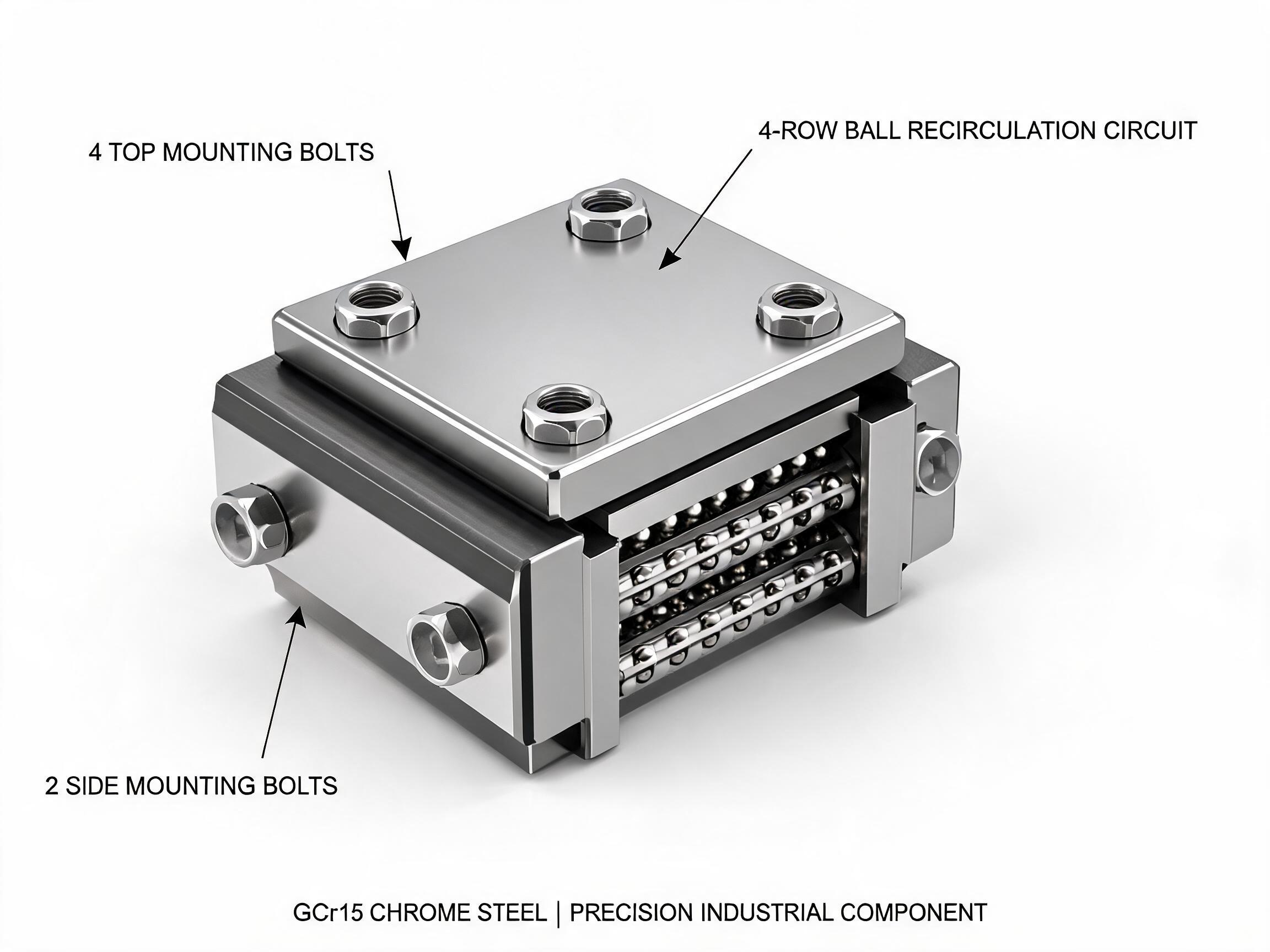
A selection guide for machine builders and automation integrators comparing HGH flange-type carriages, HGW wide-body carriages and SBS16 low-profile slide units by mounting footprint, moment-load resistance, system height and load capacity.
Carriage Selection Guide
Three carriage families dominate linear guideway specification sheets: the HGH flange-type block, the HGW wide-body block, and the SBS16 low-profile slide unit. They are not interchangeable upgrades of one another. Each answers a different combination of mounting footprint, moment-load direction, system height and load capacity. This comparison puts those four variables side by side so you can select by the constraints your machine actually has.
Key takeaways
- HGH suits compact footprints on standard rails where four-row ball load capacity is enough.
- HGW adds a 20–30% wider mounting footprint, four top-face plus two side bolts, and higher moment capacity.
- SBS16 is a pre-assembled low-profile system at 18 mm total height, built for lighter loads and space-limited axes.
- Selection starts with load direction and moment load, then height envelope, then bolt pattern.
Why the carriage family matters more than the size number
Buyers often search for a linear bearing carriage by size first — 20, 25, 16 — and treat the prefix as a styling choice. In practice the prefix defines the structural concept: how the block is bolted to the moving member, how wide the mounting face is, how tall the assembled axis becomes, and which moment directions the ball rows are arranged to resist. Getting the family wrong shows up later as rail deflection, bolt loosening or a carriage that cannot be preloaded to the stiffness the application needs.
The three families below are compared on the dimensions that decide installation and load behaviour, not on catalogue ordering codes.
HGH flange-type carriage: the compact standard
The HGH series flange-type carriage is the baseline four-row ball recirculation block. Balls run in four rows and carry load in radial, reverse-radial and both lateral directions, which is what allows a single rail to resist moderate moment loads without a second guideway.
The block is self-aligning to ±0.5°, so minor rail parallelism error does not immediately translate into uneven ball loading. Preload is specified in three grades: C0 (clearance), C1 (light preload) and C2 (medium preload). Sealing is a standard end seal plus side seal. As a reference point, the HGH20CA is rated at 18.0 kN dynamic and 29.5 kN static.
Where HGH fits: machines with a standard rail width, a mounting face that accepts the flange bolt pattern, and where the required moment capacity is within what one four-row block provides. It is the default choice when the design already assumes a conventional guideway height and the carriage does not have to fit into a thin envelope. Dimensional details beyond the figures listed here should be confirmed with the datasheet before drilling the mounting plate.
HGW wide-body carriage: wider footprint, higher moment capacity
The HGW series wide-body carriage keeps four-row ball recirculation but widens the mounting footprint by 20–30% compared with HGH. That extra width is bolted down through four top-face bolts plus two side bolts, which changes how the block is fixed and how load is distributed into the moving plate.
Like HGH, the four ball rows carry radial, reverse-radial and both lateral directions, and the block is self-aligning to ±0.5°. Preload is offered in the same three grades: C0 (clearance), C1 (light) and C2 (medium). The wider body increases resistance to moment loads about the rail axis and about the transverse axis, so a single HGW block can carry overhung or offset loads that would otherwise require two narrower blocks. The HGW25CA is rated at 28.4 kN dynamic and 42.1 kN static; the block weighs 0.72 kg.
Protection and lubrication are also more elaborate. The HGW uses a triple seal — end seal, side strip and bottom scraper — and provides dual lubrication ports: a top M6 grease nipple and a side oil port. For machine builders running dusty or chip-heavy environments, the bottom scraper is the detail that separates HGW from a two-seal block.
Where HGW fits: cantilevered or gantry axes where the centre of gravity sits away from the rail, single-rail arrangements carrying a moment, and mounting plates where a wider bolt pattern is acceptable. It is not a drop-in replacement for HGH on a plate already drilled for the narrow flange.
SBS16 low-profile slide unit: height-first design
The SBS16 single-axis linear motion slide unit is a different product class. It is a pre-assembled system built on a 16 mm hardened shaft mounted on an anodized aluminum support rail, with a single low-profile double-row bearing block. Total system height is 18 mm, about 40% lower than an SBR16 round-shaft unit at 30 mm.
The trade-off is load capacity: 5.2 kN dynamic and 8.0 kN static. That is a fraction of the HGH20CA or HGW25CA figures above, so SBS16 belongs on lighter axes — pick-and-place heads, transfer slides, light gantries — where the vertical envelope is the binding constraint. Mounting holes run every 25 mm along the rail, and standard rail lengths are 150–500 mm. The unit arrives pre-assembled, so shaft alignment is handled by the support rail rather than by the machine builder.
Where SBS16 fits: low-clearance machine openings, short strokes, and applications where a round-shaft slide can replace a profiled guideway at lower height. It should not be positioned as a substitute for HGH or HGW on high-load or high-moment axes; the double-row block geometry and the 5.2 kN rating set a different boundary.
Side-by-side comparison
| Attribute | HGH flange-type | HGW wide-body | SBS16 low-profile unit |
|---|---|---|---|
| Bearing arrangement | Four-row ball recirculation | Four-row ball recirculation | Single low-profile double-row block |
| Load directions | Radial, reverse-radial, both lateral | Radial, reverse-radial, both lateral | Radial and reverse-radial (low-profile block) |
| Mounting footprint | Standard flange | 20–30% wider than HGH | Shaft support rail, 25 mm hole pitch |
| Bolting | Flange bolt pattern | Four top-face + two side bolts | Rail-mounted, pre-assembled |
| Self-aligning | ±0.5° | ±0.5° | Not specified in listed data |
| Preload grades | C0 / C1 / C2 | C0 / C1 / C2 | Not applicable |
| Sealing | End seal + side seal | Triple: end seal + side strip + bottom scraper | Not specified in listed data |
| Lubrication ports | Not specified in listed data | Top M6 grease nipple + side oil port | Not specified in listed data |
| Reference dynamic / static rating | HGH20CA: 18.0 / 29.5 kN | HGW25CA: 28.4 / 42.1 kN | SBS16: 5.2 / 8.0 kN |
| System height | Confirm with the datasheet | Confirm with the datasheet | 18 mm total (40% lower than SBR16 at 30 mm) |
| Weight (reference size) | Confirm with the datasheet | 0.72 kg (HGW25CA) | Confirm with the datasheet |
| Typical fit | Compact standard axes | High-moment, cantilevered axes | Height-constrained light axes |
Ratings shown are for the specific sizes named. Other sizes within each family must be read from the datasheet.
How to choose: a four-step selection rule
The sequence below resolves most conflicts between the three families without trial fitting.
1. Start with load direction and moment load
If the load is centred over a single rail and the moment is modest, HGH is sufficient. If the load is offset, cantilevered, or carried on one rail with the centre of gravity some distance from the block, move to HGW: the wider body and six-bolt fixing raise moment resistance, and the 28.4 kN dynamic rating gives headroom over HGH20CA’s 18.0 kN. If the axis is light and moment is small, the low absolute capacity of SBS16 may still be adequate, but it should be checked against the 5.2 kN dynamic rating rather than assumed.
2. Then check the height envelope
If the assembled axis must fit inside a thin opening, SBS16’s 18 mm total height is the deciding advantage. If height is not constrained, HGH or HGW should be preferred because their load capacity is roughly three to five times the SBS16 dynamic rating (18.0–28.4 kN against 5.2 kN on the reference sizes). Do not choose SBS16 purely because it is lower; choose it when the 18 mm figure is what makes the machine geometry work.
3. Confirm the bolt pattern and footprint
HGW requires a mounting plate drilled for four top-face bolts plus two side bolts, with a footprint 20–30% wider than HGH. If the plate is already machined for HGH, switching to HGW means re-machining. SBS16 instead requires rail mounting holes at 25 mm pitch and a rail length within the 150–500 mm standard range.
4. Match preload and sealing to the environment
On HGH and HGW, select C0, C1 or C2 according to stiffness and running-resistance targets. In dusty or chip-heavy conditions, HGW’s bottom scraper and triple seal reduce contaminant ingress compared with a two-seal block; its side oil port and M6 top grease nipple also simplify relubrication. Where preload grade or sealing detail is not listed for a given size, confirm with the datasheet before ordering.
Selection rule in one sentence: choose HGH for compact standard-rail axes, HGW when moment load or environment demands a wider, better-sealed block, and SBS16 when an 18 mm system height outweighs the lower 5.2 kN load capacity.
Frequently asked questions
Can an HGW carriage replace an HGH carriage on the same rail?
The rail size family must match, but the mounting plate will not: HGW needs a wider footprint with four top-face and two side bolts. Treat it as a redesign of the moving plate, not a swap.
Is SBS16 a linear bearing carriage in the same sense as HGH?
It is a complete slide unit: pre-assembled shaft, support rail and low-profile block. It performs the same guiding function but is specified as a system with a fixed 18 mm height, not as a block alone.
How do I decide between C1 and C2 preload on HGH?
C1 is light preload and C2 is medium. Higher preload raises stiffness but also running resistance; the right grade depends on the stiffness target and the drive sizing. The datasheet states the grade definitions for each size.
What should I confirm before ordering any of the three?
Confirm the exact size code, the resulting rail and mounting dimensions, the preload grade, and — for HGW — the seal and lubrication configuration. Dimensions outside the figures in this article should be taken from the datasheet for the specific size.
Next step
If the load direction and height envelope are known, the family decision usually follows within the four steps above. For drawings, size-specific dimensions and current configuration options, contact us and specify the axis orientation, estimated load and available height.