A buyer's guide to reading hardness numbers on linear bearing quotations: what HRC 60–64 on a GCr15 raceway actually controls, why the core stays softer, how GCr15, 55# carbon steel and 9Cr18Mo compare, and how to verify hardness claims with test reports and material certificates.
Two quotations land on your desk for the same bore size. One lists "GCr15, HRC 60–64." The other just says "chrome steel." The price gap is small, so does the hardness line matter? On a linear bearing it does, because raceway hardness is one of the few numbers that tells you what happens to the part after thousands of load cycles.
Key takeaways
- Raceway hardness governs wear life and resistance to brinelling, the denting that happens when rolling elements are pressed into a surface under load.
- Hardness is specified on the raceway, not through the whole part. A tough core behind a hard surface is deliberate design, not a shortcut.
- GCr15 chrome steel at HRC 60–64, 55# steel at HRC 58–62 and 9Cr18Mo stainless at HRC 54–58 each suit a different job.
- Higher hardness is not automatically better. Matching hardness to load and environment is the decision.
What raceway hardness actually controls
A linear ball bearing carries load through a small number of contact points. Each ball touches the raceway over an area measured in fractions of a millimetre, so the pressure at that contact is high even when the total load looks modest. Two things follow from that, and both depend on how hard the raceway is.
The first is wear life. Every pass of a ball over the raceway removes or displaces a tiny amount of material if the surface is not hard enough to resist it. Over a few million cycles, that accumulates into measurable groove wear and lost preload. A chrome steel raceway hardened into the HRC 60–64 band is a standard way to hold that wear rate down.
The second is brinelling resistance. Brinelling is permanent denting: a ball pressed hard enough into a softer surface leaves a shallow depression, and every subsequent pass over that depression produces a small shock. Raceway hardness is the material property most directly tied to whether the surface can take the load without yielding. A too-soft raceway dents under load, and once it dents, the bearing's smooth running is gone no matter what the nominal load rating says.
Neither of these is a warranty that a given bearing will last a given number of hours. Load direction, lubrication, contamination and mounting all enter the picture. Hardness is one input, but it is the input a buyer can actually check on paper.
Why the raceway is hard and the core is not
A common misreading of a spec sheet is to assume the whole part should be hard. It should not. A part hardened uniformly to HRC 60+ becomes brittle: a thin-walled bushing or a slender rail section that hard is more likely to crack or chip under shock or misalignment. What you want is a hard working surface backed by a tougher body that can absorb impact and hold its shape.
That is why hardness appears on the drawing as a raceway requirement rather than a single blanket figure. The surface that carries the rolling contact gets the hard case; the material behind it stays tough enough to support it. When you read "raceway hardness HRC 60–64" on a quotation, that phrasing is the supplier telling you which zone the number applies to. For hardening method, case depth and core hardness figures, refer to the datasheet for the specific part, since those values differ by size and series.
Three steels buyers actually compare
Most linear motion quotations in this category come down to three material options. They are not ranked best to worst; they cover different applications.
| Material | Typical raceway hardness | Used in | Best fit |
|---|---|---|---|
| GCr15 chrome steel | HRC 60–64 | LM series linear ball bearing bushes, bores 6–60 mm, PA66-GF cage | General-purpose linear motion with normal loads and a clean, lubricated environment |
| 55# carbon steel | HRC 58–62 | HGR series guideway rails, P5/P7 accuracy grades | Guideway applications where the rail is long and the load is carried by a matched carriage |
| 9Cr18Mo martensitic stainless | HRC 54–58 | MGN stainless miniature guides | Corrosive or wash-down environments where rust resistance outweighs the last few points of hardness |
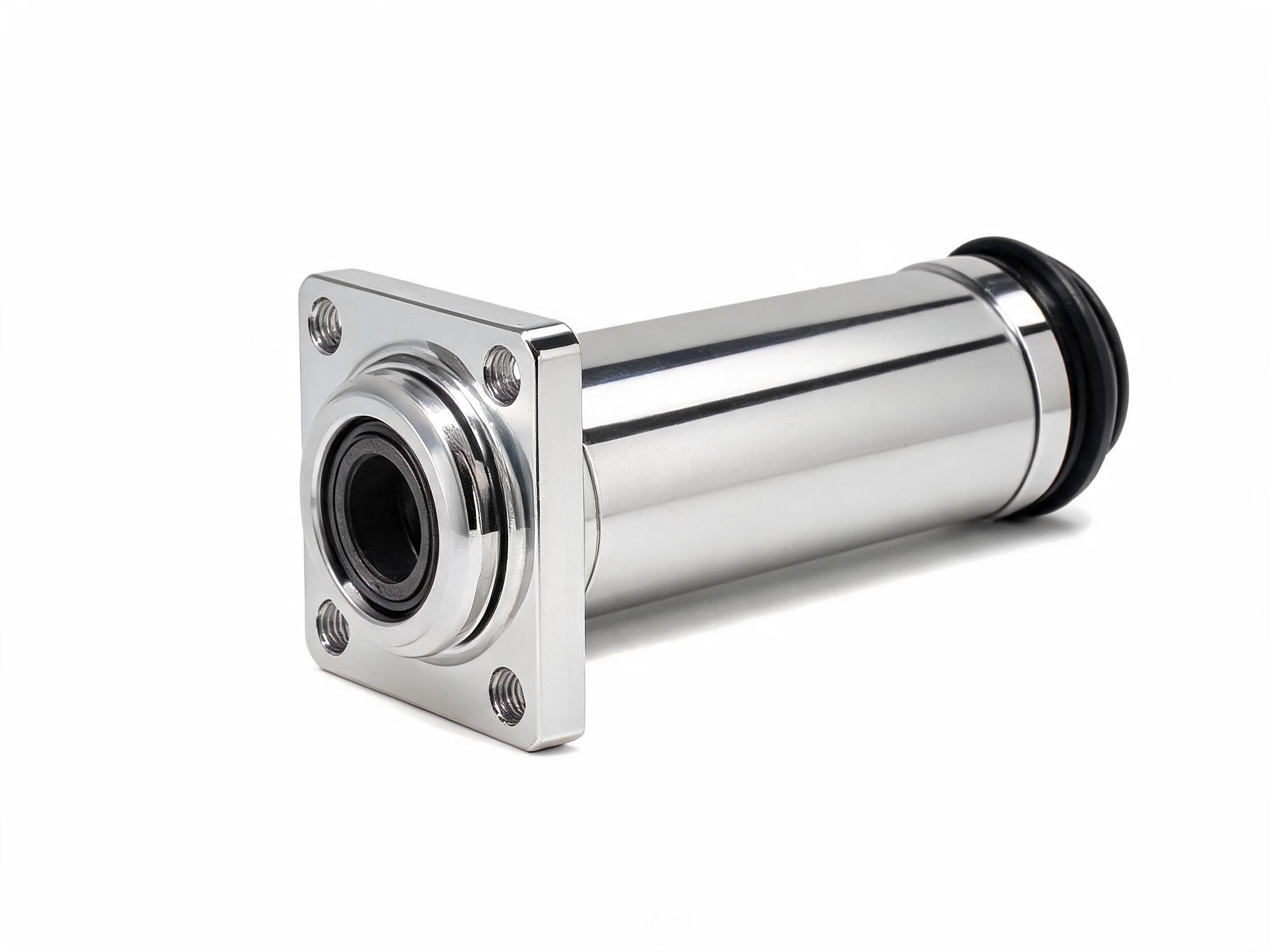
The reasoning behind each choice is worth spelling out. GCr15 is a chrome bearing steel that delivers high wear resistance in the HRC 60–64 band, in a small section such as a bushing wall; hardening method and depth are series-specific, so refer to the datasheet. That is the material used across the LM series linear ball bearing bush range, which covers bores from 6 mm to 60 mm with a PA66-GF cage.
Guideway rails are a different geometry problem. A rail is long, it is mounted along its whole length, and it is ground to an accuracy grade. 55# carbon steel hardened to HRC 58–62 gives a hard raceway while remaining workable for long sections and the grinding operations that follow. The HGR series heavy-duty linear guideway rail, for example, is supplied in P5/P7 accuracy grades, and the HGR20 size carries a 16.7 kN dynamic and 26.7 kN static load rating.
Stainless is the third case. 9Cr18Mo is a martensitic stainless steel, and it hardens to HRC 54–58 — lower than GCr15, deliberately so, because the alloy is chosen for corrosion resistance first. In a humid, wash-down or mildly corrosive setting, a stainless guide that keeps its raceway intact beats a harder carbon steel raceway that has started to corrode. The MGN stainless miniature guide line is built on this trade-off.
Higher hardness is not automatically better. A harder raceway is not a better raceway if the application needs corrosion resistance, shock tolerance or a long, grindable rail section. Pick the material for the environment, then check that the hardness band is consistent with that material.
How to verify hardness on incoming goods
Hardness numbers on a quotation are a claim. Here is what to ask for so the claim can be checked, at quotation stage and again when goods arrive.
- Hardness test reports. Ask for the report covering the batch or lot you are buying, not a generic specimen sheet. Look at which zone was tested and what instrument was used.
- Material certificates. The mill certificate should identify the steel grade against the grade on the order — GCr15, 55# or 9Cr18Mo. A certificate for a different grade is a document problem you want to catch before the parts are in your machine.
- Third-party reports. Where a purchase order or your own quality system calls for independent confirmation, ask whether SGS material reports are available for the product line. Xiamen Dongfeng Bearing supplies SGS material reports for its chrome steel products; readings on the tested products have fallen in the 58–62 HRC band, while the LM series raceway is specified at 60–64 HRC, so treat the test report that ships with your own order — not a range quoted in an article — as the acceptance reference. These documents come alongside ISO 9001 certification; the standard outgoing package includes hardness data and material certificates, with the exact document list confirmed on your order.
- Your own spot check. If you have a portable hardness tester, test the raceway surface of a sample from each lot and compare against the band on the drawing. Record where on the part you tested, because a reading taken on the core will not match a raceway specification.
The point of these documents is not ceremony. They let you compare two suppliers on the same basis, and they give you something to point at if a batch behaves differently from the sample that was approved.
Reading a quotation the practical way
When a quotation gives you a material grade and a hardness band, you now have three things to check. First, is the grade appropriate for the environment — chrome steel for normal conditions, stainless where corrosion is the controlling risk. Second, is the hardness band the normal one for that grade, or has it been pushed somewhere unusual. Third, can the supplier document it with a test report and a material certificate for the actual lot.
A quotation that says only "chrome steel" and nothing else is not necessarily a bad part. It is simply a quotation you cannot compare. Asking for the grade, the raceway hardness band and the inspection documents costs nothing and usually separates the suppliers who know their own product from those who are forwarding someone else's price list.
Xiamen Dongfeng Bearing backs its linear motion products with a 24-month warranty and full inspection documentation. If you are comparing hardness specifications across suppliers, send the drawing or part number and ask for the hardness test report and material certificate that would ship with the order.
Common questions
Is HRC 60–64 the same as "through hardened"?
Not the same statement. HRC 60–64 describes the hardness of the raceway zone. Whether the part is through hardened or case hardened, and how deep the hardened zone runs, is a separate detail — refer to the datasheet for the specific series and size.
Can I substitute stainless for chrome steel to get better corrosion resistance?
9Cr18Mo stainless is the option for corrosive environments, but its raceway hardness is HRC 54–58 rather than 60–64. Whether that suits your load and duty cycle depends on the application; compare the load rating of the specific part against your actual load rather than assuming the substitution is neutral.
Why does the rail use 55# steel instead of GCr15?
55# carbon steel hardened to HRC 58–62 suits long rail sections and the grinding steps that produce P5/P7 accuracy grades. GCr15 at HRC 60–64 is used in the LM bushing range. The two materials serve different part geometries.
What documents should arrive with the goods?
Full inspection documents including hardness data and material certificates. For third-party confirmation, ask in advance whether an SGS material report is available for the product line you are ordering.
Comparing linear bearing quotations?
Send the part number or drawing and tell us the load, stroke and environment. We will confirm the material grade, the raceway hardness band and the inspection documents that ship with the order.
Specifications quoted in this article refer to the LM, HGR and MGN series as published by Xiamen Dongfeng Bearing. Confirm the values for your specific part number before ordering.