
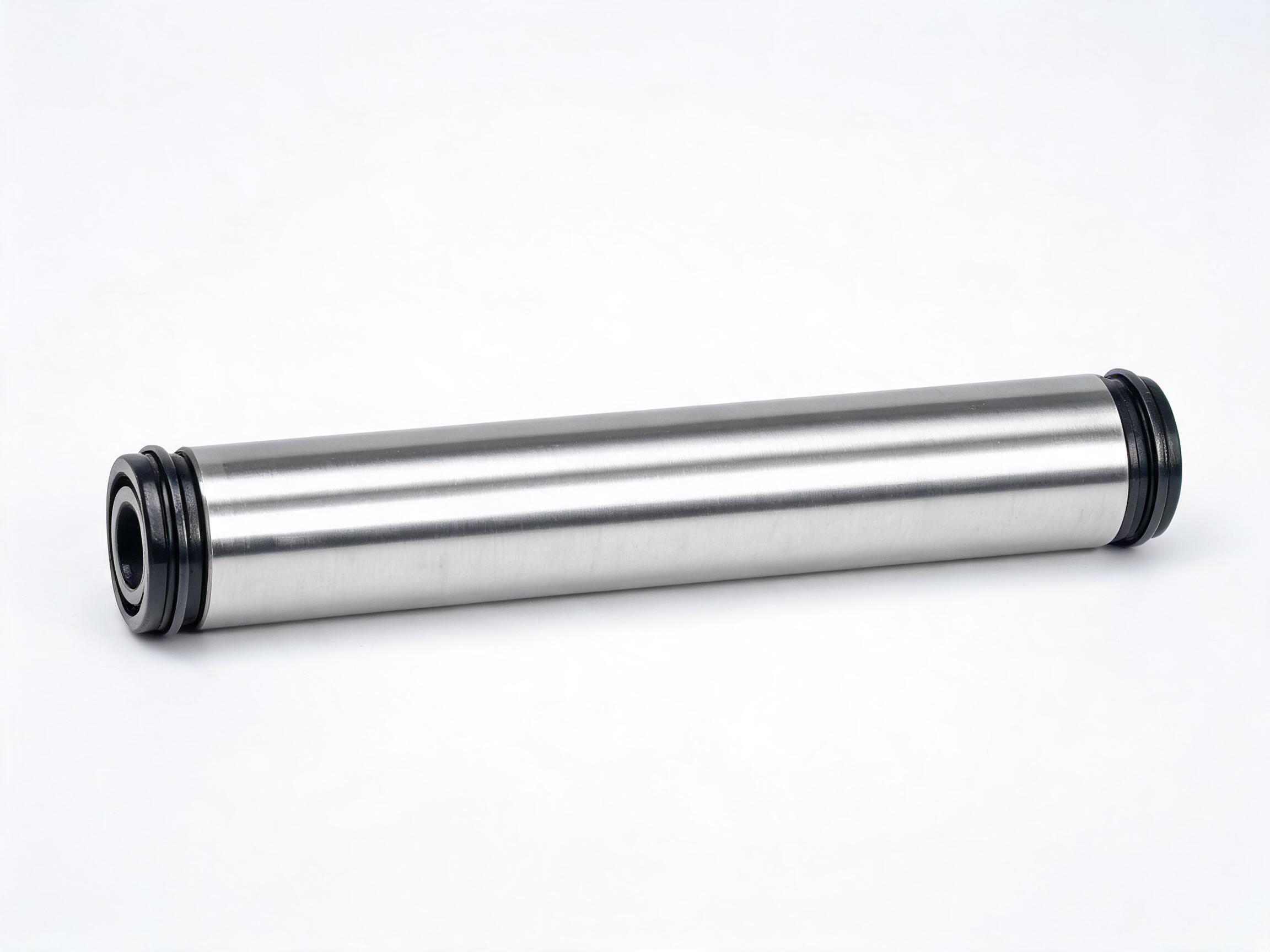
Why linear ball bushings heat up at speed, which friction sources actually matter, and how to select shafts, lubrication, seals and housings to run faster without guessing at invented speed ratings.
A linear ball bushing that heats up at speed is usually not failing from load. It is telling you that the ball circulation, the cage, the seal or the grease is doing more work than the running surface can absorb. The practical fix is rarely one number taken off a chart; it is matching shaft finish, clearance, lubrication and seal choice to the duty you actually run. This guide explains where the heat comes from, what running past the limit looks like, and how to pick a bearing for higher speed without quoting a figure nobody can back up.
Key takeaways
- Heat at speed comes mainly from ball recirculation skidding, polymer cage dynamics, seal drag and grease churning, not from static load alone.
- Open versions run cooler than sealed ones because seals add drag; that trade-off decides many high-speed jobs.
- Shaft surface finish, shaft hardness, correct clearance and grease choice can each shift where overheating begins.
- Honest speed limits come from the datasheet for the exact size and series, not from a generic rule of thumb.
Why linear ball bearings have practical speed limits
A linear ball bushing carries load on balls rolling in a straight line, then turns those balls around in a recirculation channel to bring them back to the start. That return path is where speed limits live. As the travel speed rises, each ball spends a shorter time in the loaded zone and a longer time accelerating and decelerating around the curves of the circuit. If the ball cannot roll cleanly through that turn, it skids. Skidding generates friction, friction generates heat, and heat eventually changes the grease and the geometry of the raceway contact.
The cage adds its own behavior. In the LM series the balls are guided by a PA66-GF cage — a glass-fiber reinforced polyamide. At higher speeds the cage sees rapid cyclic loading, and its pockets must keep every ball spaced and aligned through the turn. Polymer cages are light and run quietly, but they have a working envelope; push the speed and the contact between ball and pocket becomes a friction source of its own. This is why a bearing that feels fine at moderate speed can warm up quickly when the stroke rate climbs, even with the same load.
Lubrication and sealing complete the picture. Grease in a linear bearing is not just a film between ball and raceway; it is also churned and pushed through the circuit. At speed, grease that is too stiff resists this motion and heats. Seals wipe the shaft to keep contamination out, and that wiping action is drag by design. The LMUU Series Sealed Extended-Length Linear Bearing is rated for an operating temperature range of -30 to 110 °C as a sealed extended-length unit, which tells you the temperature the seal and cage are built to see — not how fast you may run it. The speed limit for any given bore and series still has to come from the datasheet.
Symptoms of running past the limit
Overheating in a linear bushing is progressive, and the early signs are easy to miss in a busy machine. Watch for these in order:
- Rising temperature. A housing that used to run warm begins to run hot, and the rise does not level off. Temperature is the first honest signal you have.
- Grease liquefaction and migration. Grease thins as it heats, then gets thrown or pumped out of the loaded zone. Once the film is gone, friction climbs faster.
- Noise. A clean rolling sound turns into a rattle or a rhythmic knock as ball circulation loses synchronization.
- Ball smearing on the shaft. Look for streaks, discoloration or a polished-smeared track on the shaft where balls were sliding rather than rolling. This is the point where the damage is no longer reversible.
If you see smearing, the shaft and the bearing are both suspect. Replacing the bushing alone on a scarred shaft will repeat the failure, because the new balls run on a surface the old ones already damaged.
What actually helps you run faster
Shaft surface finish and hardness
The shaft is half the bearing. The LM series raceways and balls are hardened to HRC 60-64, and a soft shaft will not hold its finish under a fast-rolling ball. A shaft that is too rough abrades the grease film; one that is too polished can starve it. Hardness, straightness and finish should be specified together with the bearing bore, not left to whatever bar stock is on the shelf.
Correct clearance
Clearance affects how the load is shared among balls and how the cage sits in the housing. Too much clearance lets the bushing rattle and loads fewer balls; too little preload raises drag and heat at speed. Choose the clearance that matches your shaft tolerance and load direction rather than defaulting to the loosest fit.
Lubrication choice and interval
A grease suited to the speed and temperature you actually run will do more for heat than most hardware changes. Light, speed-rated grease churns less; a stiff grease chosen for high load can overheat at high stroke rates. Relubrication interval depends on speed, load and contamination, so confirm the interval with the datasheet or ask the supplier for the specific size — do not apply a generic figure from another machine.
Sealed versus open
Seals keep contamination out but add drag, and open versions run cooler. On a clean, high-speed axis, an open or lightly sealed version can be the better thermal choice; on a dusty or wet axis, the seal usually wins because contamination destroys the raceway faster than heat does. That is a judgment about your environment, not a universal rule.
Self-aligning pillow block units
Misalignment gets worse at speed because the error is cyclic and the bushing has to absorb it every stroke. The KH Series Pillow Block Linear Bearing Housing Unit, for example the KH16, is rated at 980 N as a complete unit and self-aligns up to ±3 degrees. That range helps when shaft supports are not perfectly aligned and takes some of the side loading off the ball circuit. Self-alignment is not a cure for a bent shaft or a soft base, but it removes one heat source from a fast axis.
Choosing a linear bearing for higher speed
The LM series bush is available in bore sizes from 6 mm to 60 mm, so the same family covers small pick-and-place axes and larger transfer slides. Size selection for speed is a chain of decisions, not a single rating lookup.
| Decision | What to specify | Why it matters at speed |
|---|---|---|
| Bore and series | LM bore from 6 mm to 60 mm; LMUU for sealed extended length | Larger bores and longer bodies change ball circulation and heat capacity |
| Raceway hardness | Shaft hardness matched to HRC 60-64 balls and raceways | Soft shafts smear and lose finish under fast rolling |
| Clearance | Fit matched to shaft tolerance and load direction | Controls drag and ball load sharing |
| Sealing | Open for clean high-speed axes; sealed where contamination is real | Seals add drag; open runs cooler |
| Lubrication | Speed-rated grease; interval confirmed with the datasheet | Wrong grease churns and cooks the film |
| Mounting | Self-aligning KH unit where supports drift | Reduces cyclic side load from misalignment |
Start with the LM Series Linear Ball Bearing Bush for a standard straight-shaft axis, then add sealing or a pillow block housing as the environment and mounting demand it. If you need a sealed extended-length unit for a longer stroke with protection, step to the LMUU version and check that its temperature range fits your environment.
How to verify a speed limit honestly
Do not accept a speed number that is not tied to a specific bore, series, seal configuration, lubrication state and mounting condition. A single "maximum speed" printed without those qualifiers is marketing, not engineering. Instead, verify in this order:
- Ask the supplier for the rated speed of the exact size and configuration you intend to buy, and confirm the limit with the datasheet.
- Check what lubrication and seal condition the rating assumes — an open bushing with light grease and a sealed bushing with heavy grease do not share a limit.
- Measure the housing temperature on a prototype at your real duty cycle, then compare it with the value the supplier expects.
- Run a short endurance test and inspect the shaft for smearing and grease migration before you commit the design.
- If the supplier cannot state the limit for your size, treat that as an open question to resolve, not a gap you fill with a guess.
That process gives you a number you can defend in a design review and repeat on the next machine. Generic figures copied from a catalog page rarely survive contact with a real axis.
Practical checklist before you order
- Confirm bore size, series and seal choice against the duty, not against what is in stock.
- Specify shaft hardness, straightness and finish alongside the bearing part number.
- Select clearance to match shaft tolerance and load direction.
- Choose a speed-rated grease and get the relubrication interval from the datasheet.
- Decide whether the axis can run open or needs a seal, based on real contamination.
- Use a self-aligning KH unit where shaft supports may drift out of alignment.
- Verify the speed limit for your exact size with the supplier before releasing the design.
The specifications cited here are the listed catalog values for the LM, LMUU and KH series. Speed, temperature rise and relubrication interval depend on your exact size, load, lubrication and mounting, so confirm those with the datasheet or ask the supplier for the specific size before finalizing a high-speed design.