
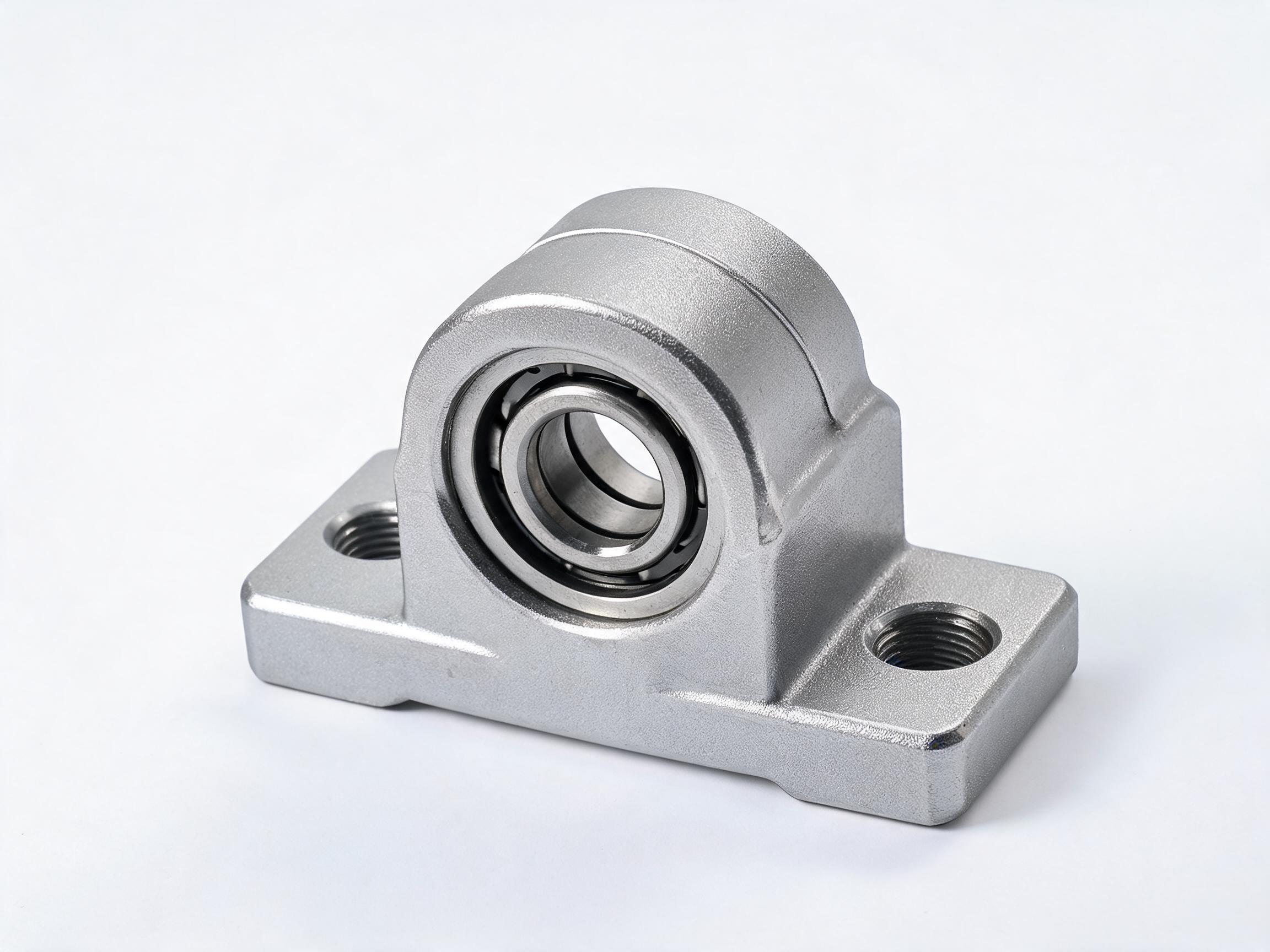
A buyer's guide to choosing between a pre-assembled pillow-block linear bearing housing unit and bare linear bushings machined into your own seats: what the housing adds, when a bare bushing is the better buy, and what to check before ordering.
A pillow-block linear bearing housing unit and a bare linear bushing can carry the same nominal shaft, yet they arrive as different purchases. One is a finished assembly you bolt on; the other is a component you build around. This guide sets out what the housing actually adds, when a bare bushing remains the better choice, and what to verify before you place the order.
Key takeaways
- A pillow block linear bearing housing unit delivers a machined bore, self-alignment, bolt-on mounting and a sealed insert as one item.
- It comes with a warranty and a known fit; a bare bushing lets you choose the seat material and geometry yourself.
- Load ratings are only comparable within the same scope: a housing unit's rating covers the complete assembly, a bearing's rating covers the insert alone.
- Bare bushings still win where your own housing is an integral part of the machine design.
What the housing unit is
In the KH series, a pillow block linear bearing housing unit consists of an ADC12 cast aluminium housing, anodized, with a pre-installed sealed LM..UU linear bearing of GCr15 steel. The series runs from KH 8 to KH 50 in ten sizes, so the same mounting concept is available across a wide range of shaft diameters. The unit is mounted per JIS B 1185, and it is rated for an operating temperature of -20 to +80 °C with NBR seals.
That combination is the product. A buyer who orders bare bushings gets the bearing insert only; everything the housing contributes is then a task for the buyer's own drawings, machining and assembly.
What the housing actually adds
It helps to separate the value into distinct contributions, because each maps to a different cost or risk in your project.
A machined seat with a controlled fit
The bearing insert sits in a bore that was machined to suit it. When you machine your own seat, that bore is your responsibility: diameter, roundness, surface finish and the resulting fit all come from your process. A housing unit shifts that responsibility to the supplier and gives you a seat that is already prepared. The trade-off is that you accept the housing's bore tolerances rather than choosing them.
Self-alignment of plus or minus 3 degrees
The KH housing allows self-alignment of ±3°. On a shaft that is not perfectly parallel to the mounting surface, this small angular freedom lets the bearing settle instead of binding. With a bare bushing in a rigid seat, alignment comes entirely from how accurately you machine and mount that seat. Self-alignment is not a substitute for building the machine true, but it absorbs small residual misalignment that would otherwise translate into friction or edge loading.
Bolt-on mounting
A pillow-block housing mounts per JIS B 1185, so the fastener pattern is defined by the standard rather than designed from scratch. That shortens the route from drawing to installed part: you do not need to design a seat, machine it, and check the fit before you can test the axis. For a prototype or a small batch, this can remove an entire manufacturing step.
A sealed insert, already installed
The LM..UU bearing is supplied sealed and already fitted into the housing. Sealing matters wherever dust or coolant is present, and an installed insert avoids the handling step where a bare bushing can be contaminated or damaged during assembly. If your environment is clean and you would fit sealed bushings anyway, part of this advantage overlaps with what you already planned.
Replacement as a unit
When a housing unit wears, you replace the unit. You do not re-machine a seat, re-check a fit or re-align a bushing in a housing you built. That keeps spare-parts handling simple: one part number, one swap. For maintenance planning across many machines, a single replaceable unit is easier to stock and to document than an insert plus a rework procedure.
Where the housings sit in the range
The KH series covers KH 8 through KH 50. All sizes share the housing construction and the sealed insert arrangement; the differences are dimensional and load-related. As one data point, KH16 is rated at 980 N dynamic — and this figure is for the complete unit, housing and bearing together. It is not the rating of the bearing insert inside it.
That distinction is important enough to state plainly. The LM16UU bearing alone is rated 1580 N dynamic. The two numbers describe different scopes: one is a complete assembly rating, the other is an insert-alone rating. They are not interchangeable and should not be compared directly to decide which configuration is stronger. When you compare options, compare like with like — unit rating against unit rating, insert rating against insert rating.
| Attribute | Housing unit (KH series) | Bare bushing |
|---|---|---|
| What you receive | Cast housing with a pre-installed sealed bearing | Bearing insert only |
| Bearing seat | Machined in the housing | Machined by you |
| Self-alignment | ±3° | Determined by your seat design |
| Mounting | Bolt-on per JIS B 1185 | Designed into your own housing |
| Sealing | Sealed insert, NBR seals | Depends on the part you order |
| Replacement | Replace the complete unit | Replace insert, reuse your seat |
| Load rating scope | Complete unit, e.g. KH16 at 980 N dynamic | Insert alone, e.g. LM16UU at 1580 N dynamic |
When a bare bushing is still the better choice
The housing unit is not automatically the right purchase. A bare bushing remains the stronger option in several situations.
- Your housing is part of the machine design. If the bushing must sit inside a block, plate or proprietary component that also carries other functions, a standalone pillow block does not fit that geometry, and machining your own seat is the only route.
- You already have the machining capability and the quality control. A shop that can hold the bore tolerance and check the fit can take on that work, and keeping it in-house gives you control over the seat's material, finish and tolerances.
- You are replacing an insert in an existing seat. Where a housing already exists and is still serviceable, there is no need to replace the whole unit — order the sealed linear bearing that fits the existing seat. Confirm the exact insert model against your housing size before ordering, since insert lengths and sealing options vary within the series.
- Space or height is constrained. A pillow block adds housing height and footprint. Where the design cannot accommodate that envelope, a bushing pressed into a low-profile seat may be the only option.
- You need a seat material the housing does not offer. The KH housing is ADC12 cast aluminium. If your application calls for a different seat material for thermal, weight or chemical reasons, a bare bushing lets you specify it.
None of these makes the housing unit a poor choice in general. They simply describe where the housing's contributions stop being worth the envelope and the acceptance of its tolerances.
What to check before ordering
The list below is deliberately short and focused on the points that actually change the order, not a generic checklist.
- Confirm the rating you are comparing. If you are weighing a housing unit against a bare bushing, decide whether the number you need is the complete-unit rating or the insert rating. Do not pick one figure from each column.
- Confirm the size against the shaft. The KH series spans KH 8 to KH 50 in ten sizes; check the shaft diameter against the size designation rather than assuming a nominal match.
- Confirm the mounting pattern. Mounting is per JIS B 1185. Check that your mounting surface can accept that fastener pattern without modification.
- Confirm the temperature range against your duty. The rated range is -20 to +80 °C with NBR seals. If your process runs outside it, the standard seal arrangement is the point to discuss with the supplier.
- Confirm the quantity terms. MOQ for the KH series is 100 pcs, which matters if you are ordering for a prototype or a single machine.
- Confirm the warranty terms. The KH series carries an 18-month warranty; make sure you understand what it covers before you commit.
How to frame the decision
A practical way to settle the question is to ask what a failed seat would cost you. If you have the machining, inspection and rework capability to own that risk, a bare bushing keeps control in your hands. If seat machining is a step you would rather not add to the project, the housing unit removes it — at the cost of accepting the housing's own tolerances, envelope and fastener pattern.
For a maintenance or spares context, the unit's replaceability is often the deciding factor. For a new machine design where the bearing sits inside a bespoke structure, the bare bushing usually is. Both are legitimate purchases; the decision is about which set of responsibilities you want to carry.
Frequently asked questions
Is a KH16 housing unit as strong as an LM16UU bearing?
That question cannot be answered by comparing their numbers, because the numbers measure different things. KH16 is rated at 980 N dynamic for the complete unit; LM16UU is rated at 1580 N dynamic as an insert alone. The scopes differ, so the figures are not a like-for-like comparison.
Can I replace just the bearing inside a housing unit?
The housing unit is designed to be replaced as a unit. If you have an existing seat and only need the insert, the sealed LM..UU bearing is available on its own.
Does the ±3° self-alignment mean I can mount the housing on an uneven surface?
No. Self-alignment absorbs small residual misalignment; it is not a substitute for a properly prepared mounting surface. Build the mounting true, and let the ±3° cover the remainder.