
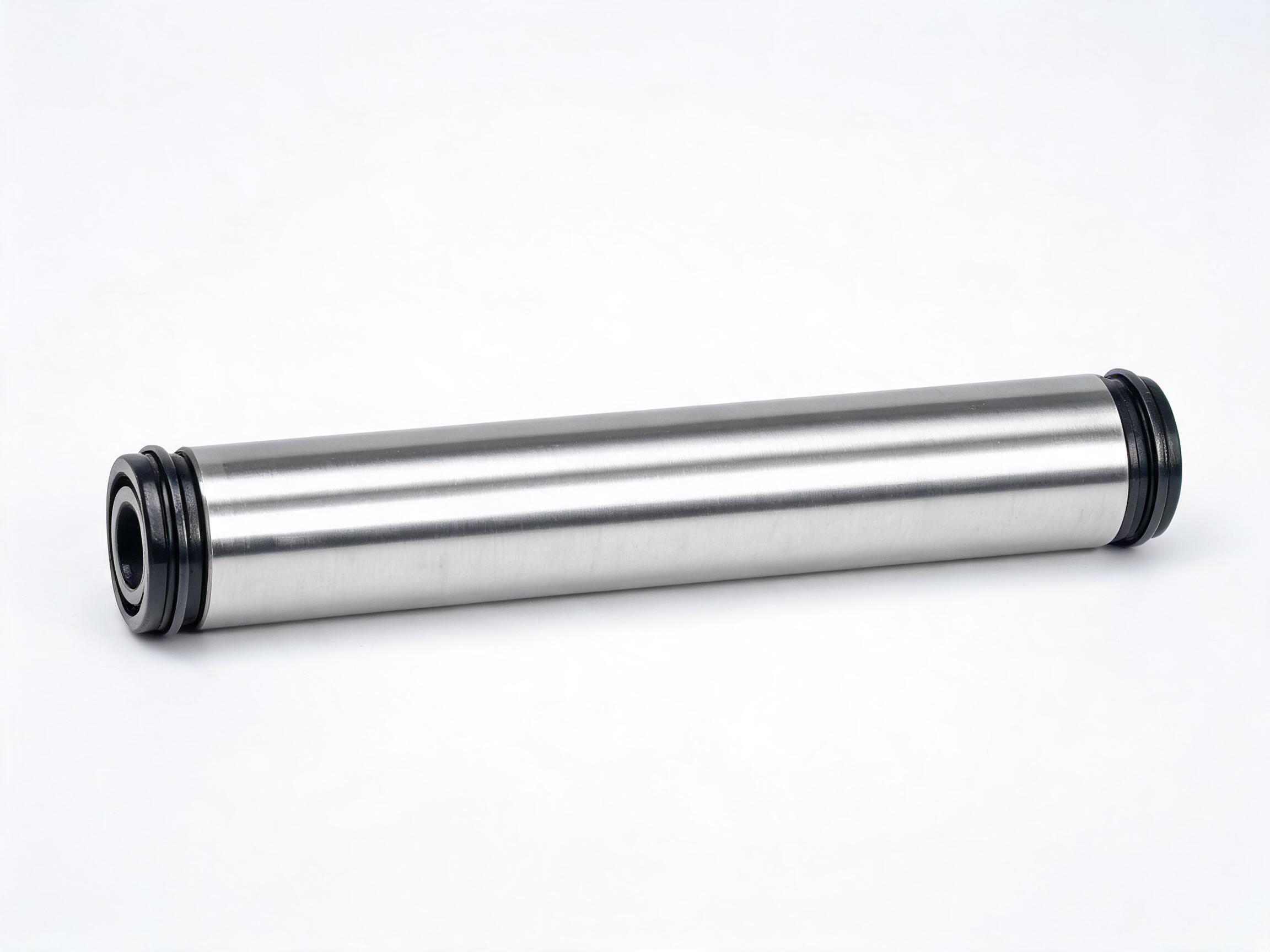
Applying bare LM-type linear ball bushings to hardened shafts is unforgiving work: the shaft tolerance, the housing bore, and how the bushing is driven in all decide whether it rolls freely or fails early. This article sets out the shaft fit, press-in sequence and handling rules for bare bushings, including the sealed LMUU extended version.
Installation guide
- Shaft tolerance is the first gate: the LM product record calls for h6 to hold the correct running clearance.
- Press the bushing into the housing on the outer ring only; force applied through the balls or retainer damages the raceway.
- Closed (UU) and open (OP) types share the same envelope dimensions per JIS B 1185 / ISO 10285, so either fits the same bore.
- For dusty or wet locations, the sealed extended LMUU series adds double-lip NBR seals, a labyrinth groove and 40% more balls than the standard-length design in a 35 mm sleeve.
What bare bushings demand that housed units do not
The LM-series linear ball bearing bushing is supplied bare: an outer ring with a ball circuit held by a PA66-GF glass-fiber nylon retainer, no pillow block, no mounting flange. That means the user supplies both the shaft and the housing bore, and takes responsibility for how the bushing is driven in. The shaft fit and the housing fit each decide a different half of the running quality, and neither can compensate for a mistake in the other. (Housed pillow-block units are covered separately on this site; this article deals only with bare bushings.)
The same family covers shaft diameters from 6 mm to 60 mm, with the outer ring and balls in GCr15 chrome steel hardened to HRC 60–64. Because the whole range shares one material specification, the fit rules below apply across the series rather than to a single size.
Shaft fit: the h6 starting point and what happens outside it
The product record instructs verifying shaft tolerance h6 for correct running clearance. This is not a reject threshold to be loosened at will; it is the condition under which the ball circuit runs with the designed clearance. A shaft that is too large for the tolerance crowds the balls against the raceway and raises friction; a shaft that is too small lets the balls skid and lose the rolling contact the bushing depends on.
Practical handling matters as much as the tolerance band itself. Shafts should be straight, free of burrs at the ends, and clean before the bushing slides on. Any nicks or dirt carried into the ball circuit mark the raceway on first travel and cannot be polished out afterward. Recommended shaft hardness beyond the LM product record should be confirmed with the datasheet or your supplier, together with any surface finish requirement.
Housing bore and press-in rules
The outer ring is the element that seats in the housing bore. Pressing must load the outer ring directly, face to face with a mandrel or sleeve that contacts the ring, never the retainer or the exposed ball track. Mandrel dimensions and the press force appropriate to a given size should be confirmed with the datasheet or your supplier; they depend on bore size and housing material.
- Check the bore before pressing. The housing bore should be round, clean and free of burrs. A raised edge at the bore entry will shave material onto the outer ring as it enters.
- Align the bushing square to the bore. Start the bushing by hand and confirm it sits square before applying force. A bushing started at an angle will cock in the bore and load the outer ring unevenly.
- Press on the outer ring only. Apply steady force through a mandrel that bears on the ring face. Stop if resistance rises sharply; that signals misalignment, not a tight bore.
- Seat the ring fully. The ring should reach its intended position in the bore without being hammered past it. Confirm the final position against the drawing.
- Check the shaft entry. After pressing, slide the shaft through by hand where possible to confirm free rotation before the machine is powered.
The retainer is a functional part of the ball circuit, not a handle. Gripping, twisting or pushing on the retainer during handling displaces the balls and can damage the nylon cage. Keep bushings in their packaging until the moment of installation, and do not drop them; a shock load on a bare bushing can indent the raceway even when no visible damage appears.
Closed or open: same bore, different housing decision
The closed type (UU, with rubber end seals) and the open type (OP, with a slot for split housings) share identical envelope dimensions per JIS B 1185 / ISO 10285. Where the housing design allows either type, the bore preparation and press-in procedure do not change. The choice between them belongs to the housing design and the environment, not to the installation step.
The LM series linear ball bearing bushing product record lists both variants within one family, so a buyer specifying housing dimensions per the standard can plan for either without altering the bore.
Dust, moisture and the sealed extended option
Sealing is the one place where the two series differ in more than envelope. The LMUU sealed extended-length linear bearing uses double-lip NBR seals plus a labyrinth groove; the product record states this reduces dust ingress by 95% versus the open type. The extended sleeve measures 35 mm against 24 mm for the standard size and carries 40% more balls than the standard-length design, which is reflected in its load figures: LMUU16 — the 16 mm member of this series — is listed at 1,580 N dynamic and 2,450 N static, against 980 N dynamic for the standard-length LM16UU (whose record lists no static rating; compare both figures for the size you select in the datasheet).
These figures are catalog values for the listed configuration; they describe the product record, not a measured result in a specific machine. Where a washdown, coolant or fine-dust environment is the reason for choosing the sealed version, the seals are rated −30°C to +110°C, and the operating temperature at the bearing should sit inside that band.
Handling and assembly conditions to confirm
Several parameters around installation are not fixed by the product record and should be confirmed with the datasheet or your supplier before they are written into a build instruction: press tonnage for your bore size and housing material, mandrel dimensions, assembly temperature, recommended shaft hardness beyond the LM record, and any adhesive or clamping method for retaining the outer ring. The safe assumption is that the bushing is retained by its fit in the housing bore, and that any additional retention is a decision to be agreed rather than improvised.
Minimum order quantity for the LM series is 100 pieces per size, which is relevant when a trial installation is planned: a small fit-validation batch is worth running before full assembly, because a bushing pressed into a bad bore cannot be corrected afterward.
FAQ
- Can I ream the housing bore after pressing the bushing?
- No. The outer ring is the precision element. Bore preparation must be completed before the bushing enters; post-press machining would cut into the ring and destroy the ball circuit.
- Does an open (OP) bushing need a different shaft fit than the closed UU type?
- The shaft fit is the same. The two types share envelope dimensions per JIS B 1185 / ISO 10285, and the h6 shaft requirement applies to the family. The open slot is a housing-design feature, not a shaft-fit change.
- How hard should the shaft be?
- The LM product record specifies the shaft tolerance (h6) but does not give a surface hardness figure. Confirm the recommended shaft hardness with the datasheet or your supplier for your application.
- Is the sealed LMUU the right choice for a dusty workshop?
- Its double-lip NBR seals and labyrinth groove reduce dust ingress by 95% versus the open type per the product record, so it addresses that condition. Whether it suits a specific machine still depends on load, speed and temperature, all of which should be checked against the datasheet.