
Catalog load ratings for round-shaft linear ball bearings assume a specific load direction and orientation. Change the direction or add an overhang, and fewer balls carry the load, contact stress rises, and wear accelerates. This guide explains what dynamic and static ratings protect against, how double-length bushings change the picture, and when a profile rail is the more honest choice.
A datasheet gives you one number for a round-shaft linear ball bearing: 980 N for an LM16UU, for example. That number is only valid for a specific loading condition. When a buyer asks which rating to trust, the real question is usually about direction — where the force points relative to the shaft and the ball circuits inside the bushing. Get that wrong, and the number on the page stops describing your application.
Key takeaways
- Round-shaft linear ball bearings are radial-load components. Their ratings assume the load is applied through the housing, perpendicular to the shaft axis, and shared by multiple ball circuits.
- A cantilever or off-axis load concentrates contact on fewer balls, raising contact stress and accelerating wear even when total force stays below the catalog figure.
- Dynamic rating addresses rolling-contact fatigue under travel; static rating guards against permanent denting under shock or stationary load. They protect against different failure modes and are not interchangeable.
- Double-length bushings such as the LMK series extend the contact length, spreading load over a longer contact arc and tolerating modest misalignment better.
- If the load is predominantly in one direction, values are high, or the structure is stiff, a profile-rail carriage is often the correct answer — and saying so is more useful than stretching a bushing past its assumption.
What the catalog rating actually assumes about direction
Take an LM16UU: 16 mm shaft, GCr15 chrome steel outer ring and balls hardened to HRC 60–64, a PA66-GF glass-fiber nylon retainer, and a published dynamic load rating of 980 N. Those figures are derived for a defined reference condition — radial load applied uniformly through the housing, load direction fixed relative to the bearing, and the full complement of ball circuits sharing the force.
In that condition, the load path runs from the housing through the outer ring to the balls, then to the shaft. Several balls sit in the load zone at once, so each carries a fraction of the total. The published rating describes how long that shared arrangement survives under rolling contact.
Change the direction and you change the sharing. If the force has an axial component, a moment component, or pulls at an angle to the intended radial direction, the load zone shifts and narrows. Fewer balls sit in the zone. Their individual contact stresses rise even though the total force is unchanged. This is the core reason load direction belongs in the selection conversation before the rating is compared to anything.
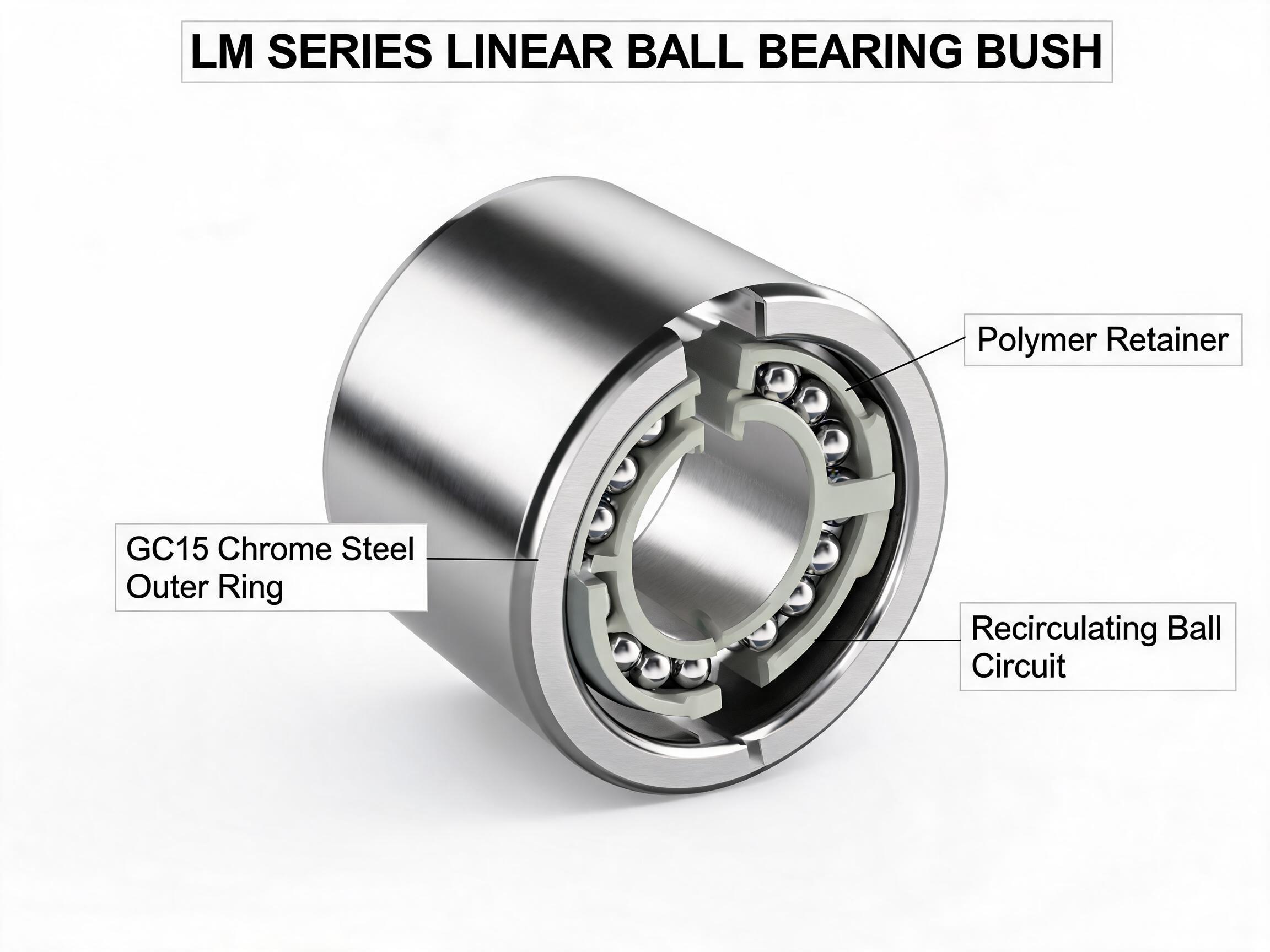
Why an off-axis or cantilever load concentrates contact
A bushing acting as a simple support is one thing. A bushing at the end of a cantilever arm is another. When the load hangs off the end of a rail, the bushing sees a moment as well as a radial force. The moment tries to rotate the housing on the shaft. Part of the ball complement loads up; the opposite side may unload or even lose preload contact.
The consequences follow directly from contact mechanics:
- Higher stress on fewer elements. The same total force divided among fewer balls means higher stress per ball and per raceway contact.
- Faster wear. Elevated contact stress accelerates the rolling-contact wear process and can shorten service life well before the nominal rating would suggest.
- Deflection you did not account for. Moment load also tilts the bushing, producing angular deflection at the load point that a pure radial rating does not describe.
- Edge loading. If the housing is short relative to the overhang, contact can concentrate toward one end of the outer ring, which is harder on the retainer and the raceway.
The practical rule: overhang distance is a first-class selection input, not an afterthought. A buyer comparing two bushings on dynamic rating alone can pick the higher-rated one and still get worse field life if the lower-rated bushing is better matched to the actual load direction.
Static rating vs dynamic rating: different failures
These two ratings appear side by side in catalogs, and buyers often treat them as a high-load and low-load version of the same thing. They are not. Each protects against a distinct failure mode.
| Rating | Protects against | When it governs |
|---|---|---|
| Dynamic (basic) load rating | Rolling-contact fatigue of raceways and balls under repeated travel | Continuously moving axes; used for life calculation in linear travel |
| Static load rating | Permanent denting (brinelling) of raceways from a stationary or shock load | Idle or slow axes, heavy shock during assembly, parking loads |
A cyclic application that never stops — a pick-and-place head running thousands of strokes per shift — is governed by rolling-contact fatigue, so the dynamic rating is the relevant one. An axis that sits still under load, or takes a shock during handling, can dent raceways without any travel at all; that is what the static rating exists to prevent.
Note that the static rating for a given LM size is a separate catalog line from the dynamic figure. If a supplier cannot provide the static value for the exact size you are evaluating, that is a gap to close before committing to a shock-loaded design, not a number to estimate.
How double-length bushings change the load direction picture
The LMK series double-length linear ball bearing uses a longer housing than a standard single-length bushing. That structural difference pays off in exactly the conditions where a standard single-circuit bushing struggles.
- Longer contact arc. A longer housing spreads the load over a greater length of shaft, so individual contact stresses drop for the same total force.
- Better moment resistance. A longer housing resists the tilting that an overhanging load produces, reducing angular deflection at the load point.
- Tolerates modest misalignment. The longer contact arrangement absorbs small angular errors that would concentrate load in a single short bushing.
What the double-length design does not do is change the fundamental assumption. It is still a radial-load component. It still wants the primary force applied through the housing perpendicular to the shaft. It buys you margin against direction error and modest misalignment; it does not turn a bushing into a rail carriage. Use it as a direction-margin tool, not as a substitute for choosing the right component class. The LMK series double-length linear ball bearing is the version to specify when that extra direction margin is the deciding factor.
When a bushing is right, and when an honest answer is a profile rail
Round-shaft linear ball bearings are the economical, compact choice when the load is primarily radial and in one direction, the stroke is moderate, and the surrounding structure provides enough support to keep alignment reasonable. Open (OP) types share the same envelope dimensions as closed (UU) types, which is useful when the shaft must be supported along its length. Dimensions follow JIS B 1185 / ISO 10285, and shaft diameters run from 6 mm to 60 mm, so most light-to-medium duty guided motion fits the family.
Step outside those conditions and the honest recommendation changes:
- Predominantly axial load. A bushing is the wrong load path; a recirculating ball screw or a profile-rail carriage with the load taken in the intended direction is the right conversation.
- Large moment from a long overhang. When the moment dominates the radial force, a profile rail carriage with a wide, preloaded raceway can carry it more predictably.
- High stiffness and high accuracy. Profile-rail systems are built to hold stiffness and repeatability that a round-shaft bushing is not rated for.
- High load in one direction at high cycle rates. If the dynamic figure is already near its limit in the ideal direction, direction error will push it past the limit in practice.
It is worth being direct with the buyer here. Recommending a profile rail where it fits is a better outcome than quoting a bushing that will wear out early and send the account looking for a different supplier.
Pre-order checklist: the inputs that decide the rating
Before you compare a rating to a load, collect these four inputs. They are what a sales engineer needs to match a bushing to the application rather than to a number.
- Load direction and magnitude. State the primary force direction relative to the shaft axis: pure radial, radial with an axial component, or with a moment. Give the working force, not just the static weight.
- Overhang distance. Measure from the load point to the center of the bushing. This drives the moment the bushing must resist.
- Shaft orientation. Horizontal, vertical, or inclined changes which direction gravity loads the bushing and where the load zone sits.
- Housing fit and support. Note the housing bore fit and whether the shaft is fully supported along its length. A compliant or short housing changes how the load distributes.
Add the duty cycle — continuous travel, intermittent indexing, or mostly stationary — because it tells you whether the dynamic rating or the static rating governs the choice. With those inputs on the table, the correct rating is usually obvious, and so is whether a round-shaft bushing belongs in the design at all.
Not sure which rating your application needs? Send the load direction, magnitude, overhang, and shaft orientation, and we will help match an LM series bushing or an LMK double-length bushing to the actual loading condition.
View the LM series linear ball bearing bush