
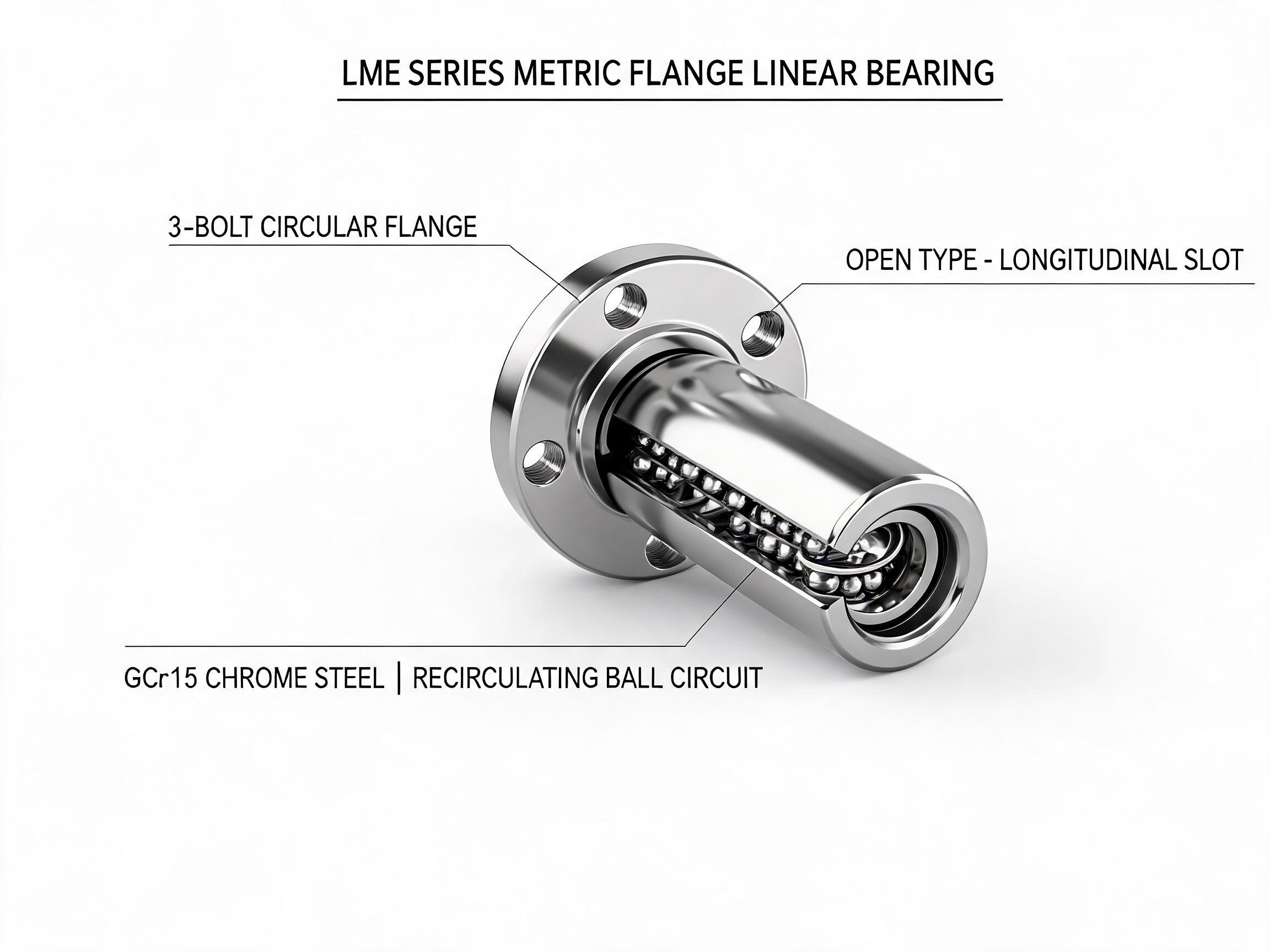
Standard LM linear bearings ship with anti-corrosion oil, not a plating. Here is what buyers facing washdown, coolant or corrosive conditions should actually specify — seals, stainless variants, housing finish — and which questions to settle with the supplier before ordering.
Buyers working in washdown, coolant or mildly corrosive environments often ask for a linear bearing with "surface treatment" or a "plated finish." Before that becomes a line on a purchase order, it is worth knowing what a standard linear bearing bush actually ships with, what options exist beyond plating, and which questions to settle with the supplier first. This article covers linear bearing surface treatment from the buyer's side of the desk: what is standard, what can realistically be specified, and where a request needs written confirmation against a datasheet.
Key takeaways
- Standard LM linear bearing bushes use a GCr15 chrome steel outer ring and balls, hardened to HRC 60-64, with dimensions to JIS B 1185 / ISO 10285.
- The anti-corrosion oil these bearings leave the factory with is storage and shipment protection. It is not a coating and should not be treated as one in the specification.
- The realistic levers for wet or corrosive environments are seal material (NBR or FKM), stainless housing variants, and housing material and finish — not an assumed plating.
- Whether any special plating is offered must be confirmed with the supplier against the datasheet, per model.
In this article
What the standard finish actually is
A standard LM series linear ball bearing bush, as listed in the LM series product page, has a GCr15 chrome steel outer ring and balls, hardened to HRC 60-64, with boundary dimensions to JIS B 1185 / ISO 10285. The UU closed type is fitted with rubber end seals.
That is the whole of the "finish" on a standard unit. There is no decorative or protective plating on the catalogue specification. What the bearing does carry is a film of anti-corrosion oil applied for shipment and storage. That oil protects the steel from moisture during transport and while the bearing sits on a shelf. It is not a coating, it does not change the surface of the steel, and it is not a substitute for choosing a bearing suited to wet or chemical exposure.
Buyers sometimes assume that a bearing described as "protected" is plated and can therefore be washed down or run wet without further thought. That assumption is where specification errors start. The oil protects until it is washed away or wiped off; after that, the base material is what sits in the environment.
One more point in the same direction: linear bearings in the LM and LME families do not normally carry a plating in their standard catalogue form. Plated and specially coated variants exist across the linear motion industry, but which of them a particular supplier offers is a commercial and technical question for that supplier, per model, and should be confirmed against the datasheet rather than assumed from a generic catalogue description.
What buyers can realistically specify
For a corrosive, washdown or coolant environment, the practical decisions are not "which coating do I want." They are three narrower choices the buyer can define with real information:
| Decision | What the buyer defines | Why it matters |
|---|---|---|
| Seal material | NBR (standard) or FKM | Seals are the first barrier between the bearing race and the environment; the seal's own temperature and chemical limits bound the application. |
| Bearing or housing material | Standard chrome steel, or stainless steel housing where offered | Material choice determines what the environment has to attack, independent of any surface film. |
| Housing finish | Anodized cast aluminium, or stainless steel 304 | Pillow block housings in washdown, food-grade or outdoor settings are exposed surfaces in their own right. |
None of these is a plating. They are the levers a buyer can state clearly on an inquiry and get a clear answer back on. A request for "surface treatment" without an environmental description and temperature range tends to come back as an optimistic one-line answer; a request that names the seal, the housing material and the exposure gets a specification that can be checked.
Seal material selection
The LMUU sealed extended series uses a double-lip NBR rubber seal combined with a labyrinth groove, within the JIS B 1185 LM envelope. The NBR seal is rated for an operating range of -30°C to +110°C.
For applications running hotter than that, an FKM (Viton) seal option is listed for use up to 200°C. Per the supplier's records, this option is available for orders of 500 pieces or more; confirm current availability and MOQ with the supplier before relying on it in a plan.
The seal choice deserves more attention than it usually gets in a corrosive or washdown conversation, for a simple reason: the seal sits at the sliding interface where washdown spray and coolant actually reach. A double-lip NBR seal with a labyrinth groove is a physical barrier at that point. A plating on the outer ring is further away from the problem. So if the environment is wet, the first question is whether the standard NBR seal is adequate for the chemicals and temperature involved, and only then whether anything else needs to change.
Note what the NBR temperature range does and does not tell you. It bounds the seal's operating temperature. It does not certify the seal for a particular chemical concentration, contact time or spray pressure. If the washdown involves a specific cleaning agent or a coolant formulation, that information needs to go to the supplier rather than staying in the buyer's own project notes.
Housing material and finish
In many washdown and coolant installations the bearing is not the only exposed surface. The KH pillow block housing unit uses a cast aluminium ADC12 housing with an anodized surface. With the NBR seal, its stated operating temperature range is -20°C to +80°C.
Per the supplier's records, a stainless steel 304 housing variant is also available for food-grade and washdown applications, with a minimum order quantity of 200 pieces. Confirm current availability with the supplier, since variant availability and MOQ can change.
This matters because the housing is a mounting surface: it bolts to the frame, sits where water drains, and is often the part an inspector looks at. An anodized aluminium housing and a stainless steel 304 housing are different answers to the same environment. For a regular washdown duty, the anodized aluminium unit may be entirely adequate. For food-grade or heavy washdown, the stainless variant is the one to specify, subject to the confirmed MOQ.
Also note the temperature gap between a KH housing unit with NBR seal (-20°C to +80°C) and the FKM-sealed LMUU bearing mentioned above (up to 200°C). A high-temperature application that also uses a pillow block housing is constrained by the housing, not only by the seal. That is a place where buyers get caught by specifying the seal upgrade and overlooking the housing range.
Questions to ask a supplier first
The questions below are the ones that decide the specification. They are grouped because the answer to one often changes the answer to the next.
- What is the environment class? Dry, humid, occasional splash, regular washdown, continuous coolant contact or chemical exposure — these are different problems. State which one applies rather than the general word "corrosive."
- What are the actual temperature extremes? Give the ambient or process temperature range, including peaks. This determines whether standard NBR seals, the FKM option, or a different housing is in scope.
- Which chemicals, at what concentration and contact time? Cleaning agents, coolant types and spray conditions. The seal's temperature rating does not automatically answer chemical compatibility.
- What bearing and housing configuration is offered for the environment? Ask specifically whether the LMUU sealed extended series with NBR, the FKM option, the standard KH housing unit or the stainless steel 304 housing variant applies, and what the confirmed MOQ is.
- Is a special plating or coating offered for this model? Ask it directly and require the answer against the datasheet. Do not accept a generic "we can do surface treatment" reply without a named treatment, a stated scope and a document.
The reasoning behind the order is straightforward. Environment, temperature and chemistry describe the problem. Materials and options describe the answer. A plating request, if it is relevant at all, is the last layer of the answer and can only be assessed once the first four points are settled. Asking "do you offer plating" as the opening question tends to get a yes or a no that tells the buyer little.
One more point about documentation: the LM series and LMUU series dimensions follow JIS B 1185 / ISO 10285, and the LME series follows DIN ISO 10285. The dimensional standard is a real anchor for checking interchangeability. It does not say anything about the surface finish or the seal. Those are specified separately, which is exactly why the environment questions above have to be asked rather than inferred from the standard.
Finally, note that anti-corrosion oil is not a defect and not a marketing claim. It is a normal shipping and storage measure on chrome steel bearings, and it belongs on a datasheet. If a supplier cannot tell you clearly whether the protection on the bearing as shipped is oil, coating or plating, that answer is itself worth knowing before the order is placed.
FAQ
Is the anti-corrosion oil on a linear bearing a surface treatment?
No. It is a protective film applied for shipment and storage. It is not a coating and does not survive as one once the bearing is washed down or wiped. Treat it as transit protection when you write the specification.
Can I get a plated linear bearing bush from this supplier?
Plating and special coating availability must be confirmed with the supplier against the datasheet for the specific model. The catalogued LM, LMUU, KH and LME specifications covered here list chrome steel, seal material and housing material or finish — not a plating type. Do not assume a plating from a generic catalogue wording.
What seal should I specify for a washdown application?
Start with the standard double-lip NBR rubber seal and labyrinth groove in the LMUU sealed extended series. It is rated -30°C to +110°C operating range. If the washdown includes specific chemicals or higher temperatures, provide those details to the supplier and ask whether the FKM (Viton) option up to 200°C applies; per the supplier's records it is available for 500+ piece orders, so confirm current availability and MOQ.
Is there a stainless option for corrosive environments?
Per the supplier's records, a stainless steel 304 housing variant is available for the KH pillow block housing unit for food-grade and wash-down applications, with an MOQ of 200 pieces. Confirm current availability with the supplier. Note the standard KH housing uses cast aluminium ADC12 with an anodized surface and a -20°C to +80°C range with the NBR seal.
Does the dimensional standard tell me anything about the finish?
No. JIS B 1185 / ISO 10285 for the LM and LMUU envelope, and DIN ISO 10285 for the LME series, set boundary dimensions and interchangeability. Surface finish, seal material and housing finish are specified separately and need their own confirmation.