
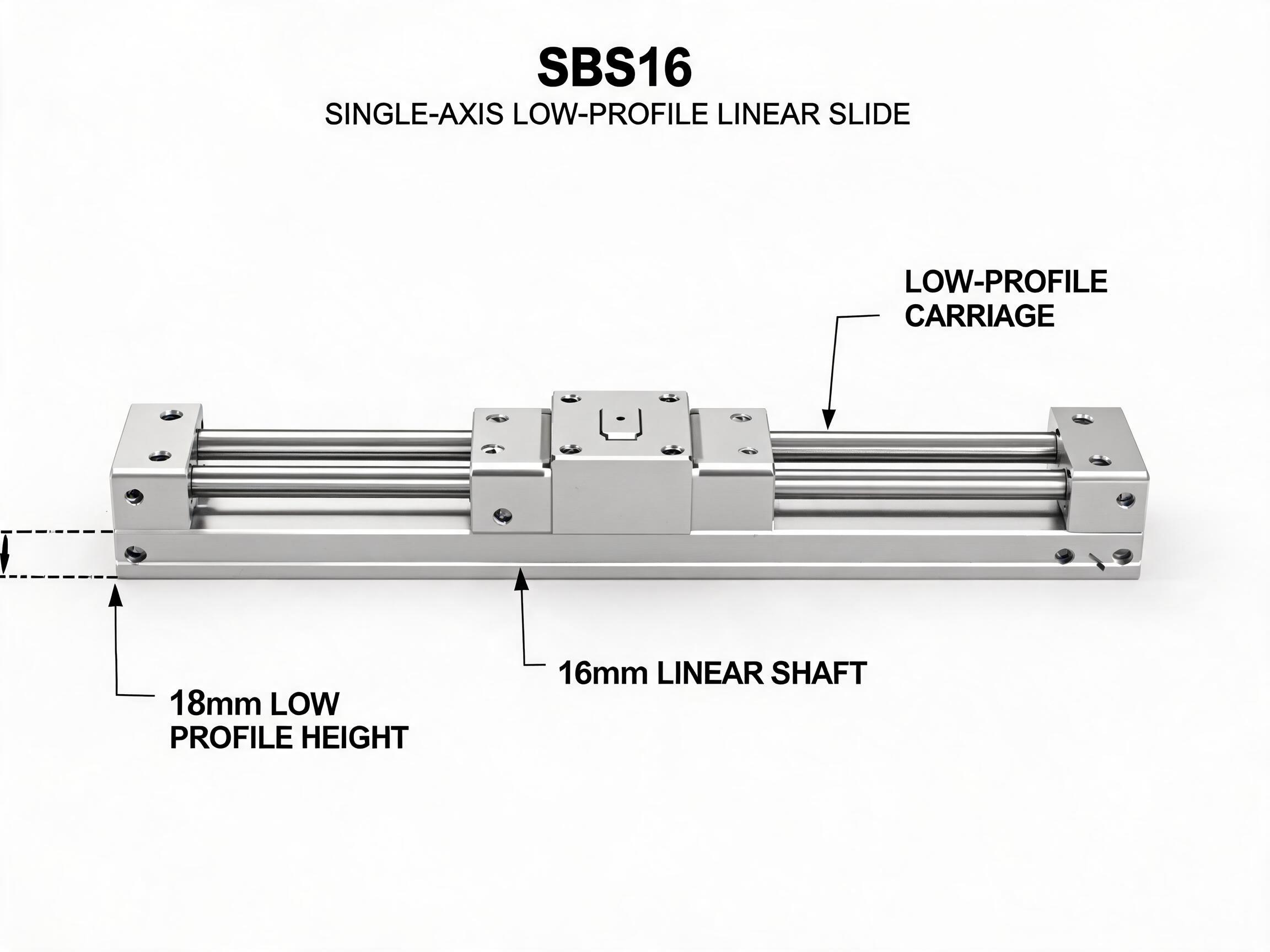
A buyer's guide to linear bearing tolerance: how bore, outside diameter and length tolerances work, how line-to-line, interference and sliding fits change running behavior, what happens when a fit is too loose or too tight, and a pre-order checklist for shaft and housing dimensions.
Technical Guide
A datasheet lists a shaft diameter, a housing diameter and then a set of tolerance figures. This article explains what those numbers describe, how shaft and housing fits change the way a linear bearing runs, and what to confirm before you place an order.
On this page
Tolerance is not the same as clearance
These two words get used interchangeably in conversation, and that causes a lot of avoidable confusion at the ordering stage.
Clearance is the internal space built into the bearing itself — the play between the rolling elements and the raceways, chosen by the bearing grade and type. That is a property of the bearing as supplied, and it is covered separately from this article.
Tolerance, in the sense used here, is the dimensional accuracy of the bearing as a manufactured part: how far the bore, the outside diameter and the length may deviate from the nominal values. Tolerance is what the manufacturer controls when the part is made. The fit is what happens when you combine a bearing of a given tolerance with a shaft and a housing of their own tolerances. The fit is therefore a relationship between three parts, not a single number printed on the catalogue page.
If you are looking for the internal preload or play of a linear bearing, read that in the separate clearance guide. This article is about the outer dimensions, and about the shaft and housing you press the bearing into.
What the three tolerances on a datasheet cover
Most linear bearing datasheets list three data points. They measure three different things, and they fail in three different ways if they are not respected.
| Dimension | What is being controlled | Why it matters in assembly |
|---|---|---|
| Bore diameter | How closely the inner bore matches the nominal shaft size | Sets the fit on the shaft; too small a bore can close up the running clearance |
| Outside diameter | How closely the outer ring matches the nominal housing bore | Sets the fit in the housing; too large an OD can distort the outer ring |
| Length / width | Overall length of the bearing and, on some types, the width of the outer ring | Affects axial location, shoulder contact and how the bearing sits next to spacers |
The exact tolerance values are stated in the datasheet for the specific series and are not repeated here, because they differ by size and type.
On a linear bearing, an understanding of what the numbers mean matters more than normal, because the bearing is a thin-walled sleeve. A small amount of interference on the outside diameter gets transferred through the wall of the sleeve and narrows the bore. The same effect works the other way around. The fit numbers on the datasheet only tell you the starting point; the assembled result depends on the shaft and housing dimensions as well.
Common fit approaches on the shaft and in the housing
Three broad approaches appear again and again in machine building. They are described here in plain terms rather than as a table of standard tolerance class codes, because the right choice depends on your motion requirements, your housing material, and how the assembly will be serviced. Most bearing manufacturers publish recommended fits in their catalogues; the descriptions below reflect typical industry practice, not a specification from any one supplier.
Line-to-line (zero clearance)
The shaft or housing is made to the same nominal size as the bearing dimension, so the parts slide or press together with essentially no designed gap. This is a middle path: it avoids the rocking of a loose fit and the distortion of a heavy press fit. It demands that your shaft and housing machining actually hold the tolerance you specified, because there is no room on either side to absorb error. It suits applications where the bearing is lightly loaded and located by other components.
Slight interference
The shaft is made a little larger than the bearing bore, or the housing a little smaller than the outside diameter, so the parts require a light press. The aim is to keep the ring from creeping or rotating under load. The trade-off is direct: interference is transferred into the bearing as deformation. On a thin-walled linear bearing this narrows the bore and reduces the internal running clearance. Choose a light interference only when the assembly process can control it, and expect the running feel to change once the part is pressed home.
Sliding fit
The shaft or housing is made slightly smaller or larger so the bearing can be moved by hand or with light force. This is used where the bearing must be replaced in the field, where the housing is a softer material such as aluminium and you want to avoid galling, or where thermal expansion will close the gap in service. A sliding fit does not locate the bearing by friction, so the design needs another feature — a shoulder, a retaining ring, a clamp — to hold it axially.
There is no universal correct choice. The same bearing series may be specified with a press fit on the shaft and a sliding fit in the housing on one machine, and the reverse on another, depending on which part carries the load and which part is easier to service.
When the fit is too loose
A loose fit is easy to assemble and hard to diagnose later. Typical symptoms include:
- The bearing creeps or rotates in the housing under load, wearing the housing bore.
- Vibration and knocking at direction changes, because the shaft can move within the bore.
- Lost positioning accuracy — the carriage does not return to the same point.
- Uneven wear on the raceways, since the load is not shared evenly.
On a linear guideway system, a loose fit between the rail and the mounting surface can also cause the rail to shift, which shows up as a change in parallelism rather than as a bearing problem. It is worth checking the mounting fit as well as the bearing fit when accuracy drifts.
When the fit is too tight
An over-tight fit is applied with the best intentions — usually to eliminate any chance of movement — and it is the more damaging of the two errors.
- Pressing the outer ring into a housing that is too small squeezes the bearing and reduces the internal running clearance. The result is increased friction, heat and a shorter service life.
- A shaft that is too large for the bore does the same from the inside, and may make the bearing difficult or impossible to install without damage.
- On ball screws, an over-tight support-bearing fit or an over-tight nut preload can raise torque and accelerate wear; the fit needs to match the preload the screw was designed for.
- In the worst case the bearing seizes, or the outer ring cracks during pressing.
Because distortion is not visible after assembly, a bearing that feels stiff or noisy right after installation is often a fit problem rather than a defective bearing. Measure the shaft and housing before blaming the part.
Pre-order checklist
The most reliable way to avoid a fit problem is to settle the dimensions before the order, not after the goods arrive. A short set of steps:
- Measure the shaft and housing you actually have. Use the measured diameter, not the nominal drawing value. If the housing is worn or already in service, measure at several points along its length and record the range.
- State both dimensions in the inquiry. Give the supplier the measured shaft diameter and the measured housing bore, with your tolerance, so the recommended bearing can be checked against your actual parts rather than against a nominal size.
- Ask which fit the supplier recommends for your application. Mention the load direction, the housing material, whether the bearing will be replaced in the field, and the expected operating temperature. These are the factors that decide between line-to-line, interference and sliding fit.
- Confirm the assembly method. If the design calls for a press fit, say so, and ask whether the recommended bearing can be pressed without closing its running clearance beyond the intended value.
- Check the datasheet against your drawing. The exact tolerance values vary by series and are listed in the datasheet; verify that the catalogue tolerance band, combined with your shaft and housing tolerance, produces the fit you intended.
- Record the fit on the drawing. Note the shaft tolerance, housing tolerance and assembly method on the part drawing so the next build uses the same combination.
FAQ
Does a tighter fit always give better accuracy?
No. Up to a point, reducing play improves repeatability, but beyond that point the interference deforms the bearing and removes the internal clearance it needs to run. Accuracy usually peaks at a light, well-controlled fit, not at the tightest fit the press can achieve.
Can I use the same fit on the shaft and in the housing?
It is possible, but it is often not the best choice. Many designs use a firmer fit on the rotating or load-bearing side and a lighter fit on the side that needs to be serviced. The deciding factor is which part must be located rigidly and which part must come apart.
Why does a bearing feel tight after installation when it turned freely beforehand?
The most common cause is an interference fit that has closed up the running clearance. Check the shaft and housing dimensions against the drawing, and confirm that the housing bore is round rather than oval or tapered. If the dimensions are correct, ask the supplier whether a different fit or a bearing with different internal clearance is more appropriate for that assembly.
What information should I send with an inquiry?
The measured shaft diameter and housing bore, the length of the bearing you need, the load direction, the housing material and the assembly method. With those, a supplier can recommend a fit and confirm the correct series instead of asking you to choose from a catalogue page.
Tolerance figures describe the bearing as a manufactured part; the fit is decided by how that part meets your shaft and housing. Measure before you order, state both dimensions, and let the supplier confirm the fit against your actual assembly. For linear guideways, linear bearings and ball screws, send the shaft and housing dimensions with your inquiry and the correct fit can be checked before production.