
A decision guide for CNC machine builders comparing round-shaft LM bushings with HGR profile guide rails on machine axes: where each type fits, what the load ratings say, and how to specify the right one for your frame.
Bearing & Rail Selection
Two bearing types answer the same question in different ways: how does a CNC axis carry its load along a defined path. Round-shaft linear ball bearings, often called bushings, run on hardened shaft; HGR profile guide rails mount a carriage on a hardened rail. This guide explains where each belongs on a CNC axis, so you can settle the choice before you draw the frame.
Key takeaways
- LM bushings make sense on light-load axes built around standard hardened shaft: hobby and desktop routers, simple gantry frames, short travel and a tight parts budget.
- HGR profile rails carry far more load per carriage, resist moment loads, and are easier to mount accurately as an axis grows longer or heavier.
- The HGR20 dynamic rating of 16.7 kN is about 17 times the LM16UU rating of 980 N — a magnitude reference only, since the two ratings are defined under different standards and mounting conditions.
- Stiffness, accuracy grade and price are not in these product records; confirm them with the datasheet or your supplier before committing a design.
Where the two bearing types differ
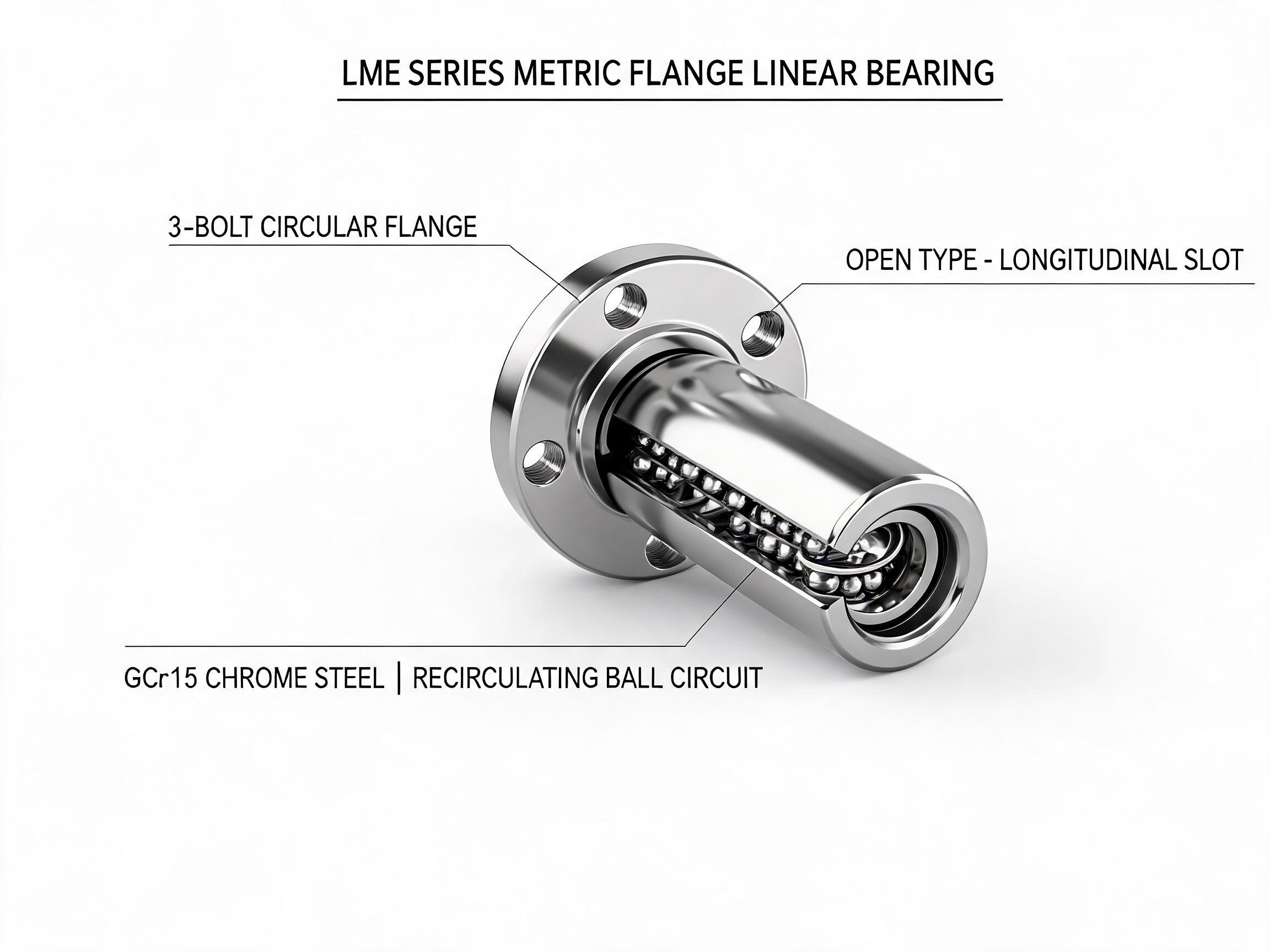
An LM-type bushing is a compact ball cage that slides over a hardened round shaft. A profile rail bearing carries four-row ball circuits between a carriage and a hardened rail with a machined groove profile. Both support linear motion, but the load is applied differently.
On a bushing, load passes through the shaft in every direction, and only the ball cage in the housing resists moment load. On a profile guideway, the four-row ball circuit wraps the rail from both sides and above and below, so the carriage can resist loads in several directions and deliver more load capacity for a similar footprint.
| Attribute | LM series linear ball bearing (bushing) | HGR series profile guideway rail |
|---|---|---|
| Load path | Ball cage on a round shaft | Four-row ball circuit on a profiled rail |
| Shaft / rail size range | Shaft diameters 6–60 mm | Sizes 15–45 |
| Material and hardening | GCr15 hardened HRC 60–64 | 55# steel rail, induction-hardened 58–62 HRC |
| Example dynamic rating | LM16UU: 980 N | HGR20: 16.7 kN dynamic, 26.7 kN static |
| Housing variants | Closed UU and open OP types share the same envelope per JIS B 1185 / ISO 10285 | Carriage mounts to a rail; rail grades ground H (P5 equivalent) and rolled N (P7), as designated in the product record |
| MOQ | 100 pieces | 50 pieces |
Ratings are as listed in the product records. Confirm exact ratings for your chosen size and mounting with the datasheet or your supplier.
When a linear bushing is the right call on a CNC axis
A light-load axis with a simple frame is the clear case for round-shaft bushings. Desktop and hobby CNC machines often place the spindle at the end of a short gantry and move a light cutting head. In that setting the bushing's compact housing, its standard shaft selection and the option to buy shaft in length fit naturally into a low parts budget.
- Short travel axes where deflection of a single shaft is contained by close support.
- Frames built from standard shaft, in which bushings slide directly over round stock without a machined rail bed.
- Loads applied close to the axis of the shafts, with limited moment acting on each bearing.
- Hobby and desktop builds where a small, standardized bearing package is the practical choice.
The open OP type shares its envelope with the closed UU type per JIS B 1185 / ISO 10285, which matters when a design has to accommodate either variant in the same hole spacing. The LM series is available in shaft diameters from 6 to 60 mm, so a single bearing family can cover a range of axis sizes.
A bushing does have an open question at the design stage: long, uncluttered shafts flex under their own load and cutting force, and that shaft deflection passes directly into cutting accuracy. The right shaft diameter, support span and support layout must be set by calculation or by the supplier's recommendation; these values are not in the catalog records and need to be confirmed before the frame is frozen.
When moving to profile guide rails pays off
The HGR series becomes the better choice as the load, the lever arm or the precision demand rises. The 16.7 kN dynamic rating of an HGR20 carriage against the 980 N of an LM16UU reflects that: 16.7 kN ÷ 980 N ≈ 17. The two ratings are defined under different standards and mounting conditions, so treat the ratio as a magnitude reference rather than a direct substitution; carriage count and rail sizing still follow from a load calculation for the axis, including load direction, moments and required life.
The four-row ball circuit resists moment loads, which is the issue on gantry and router axes where the cutting head sits off the centerline of the bearing. Allowable moment values are not in these product records, so the specific moment rating for your carriage size must be confirmed with the datasheet. A rail also provides a ready-made rigid bed once it is mounted and aligned, so accuracy depends on the rail's straightness and mounting alignment rather than on shaft deflection between supports.
HGR sizes 15 to 45 cover a range of carriage sizes, and the rail is designated in the product record as ground precision grade H (P5 equivalent) and rolled grade N (P7). The H grade is the one usually specified for an axis where positioning accuracy matters; confirm the exact tolerance values with the datasheet, since grade tolerances are not listed in these product records.
The trade-off is real in the other direction too: a profile rail needs a machined or accurately leveled mounting surface, careful alignment along the whole travel, and a carriage that is typically heavier than a bushing housing. For a light, short desktop axis, this added mount prep can outweigh the load margin.
A short selection path
- Estimate the load per bearing, including the spindle weight and the lever arm of the cutting head.
- Check the shaft or rail support span against allowable deflection or the supplier's guidance.
- If the load is low, the frame is based on standard shaft and the travel is short, start with the LM series.
- If load is significant, moments are large or precision and long-term rigidity are priorities, specify the HGR series.
- Confirm rating, accuracy grade and price for the exact size with the datasheet or your supplier before issuing drawings.
Specifying the bearing and specifying the axis
Specification is not just the bearing model. On a bushing axis, the shaft diameter, hardness and support layout are part of the design; on a rail axis, the mounting surface flatness, rail grade and alignment procedure set the outcome. State both in your request to the supplier so the parts you receive match the axis you intend to build.
For the bushing path, review the LM series linear ball bearing bush sizes and housing variants. For the rail path, review the HGR series heavy-duty linear guideway rail. The listed MOQ is 100 pieces for LM bushings and 50 pieces for HGR rails; confirm the commercial terms for your order with the supplier.
Buyer questions
Can I mix bushings and profile rails on one machine?
Yes, and some builders do, using bushings on the lightest axis and rails on the heavily loaded one. The two families do not share a mounting interface, so each axis has to be designed around its own bearing type. Confirm the mounting dimensions for each chosen part with the datasheet.
Is a bushing enough for a small desktop router?
It depends on the spindle weight and the lever arm at the cutting head, not just the machine size. Calculate the load per bearing and the shaft deflection over its support span before deciding. If those stay within the bearing's rating and your accuracy target, a bushing is a practical choice.
Why does the rail have two accuracy grades?
HGR rail is designated as ground H (P5 equivalent) and rolled N (P7). The grade you choose should match how much straightness and positioning error the axis can tolerate. Ask the supplier for the tolerance values of the specific grade and size before selecting.
What load rating should a CNC axis bearing be chosen against?
The catalog dynamic rating is a stated capacity, not a guarantee for your cutting conditions. It needs combining with the actual load, moment and expected life for the axis. Confirm the applicable factors with the datasheet or your supplier.